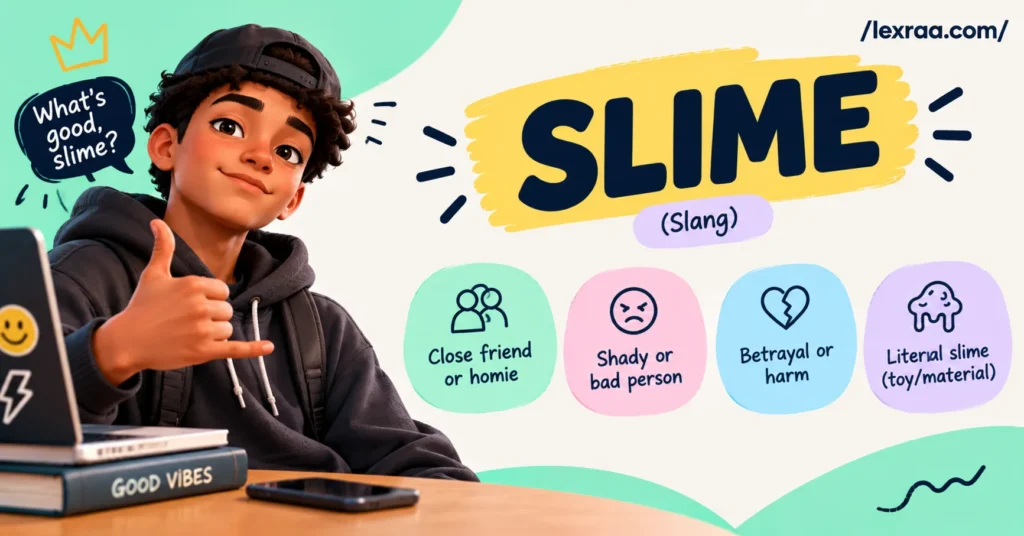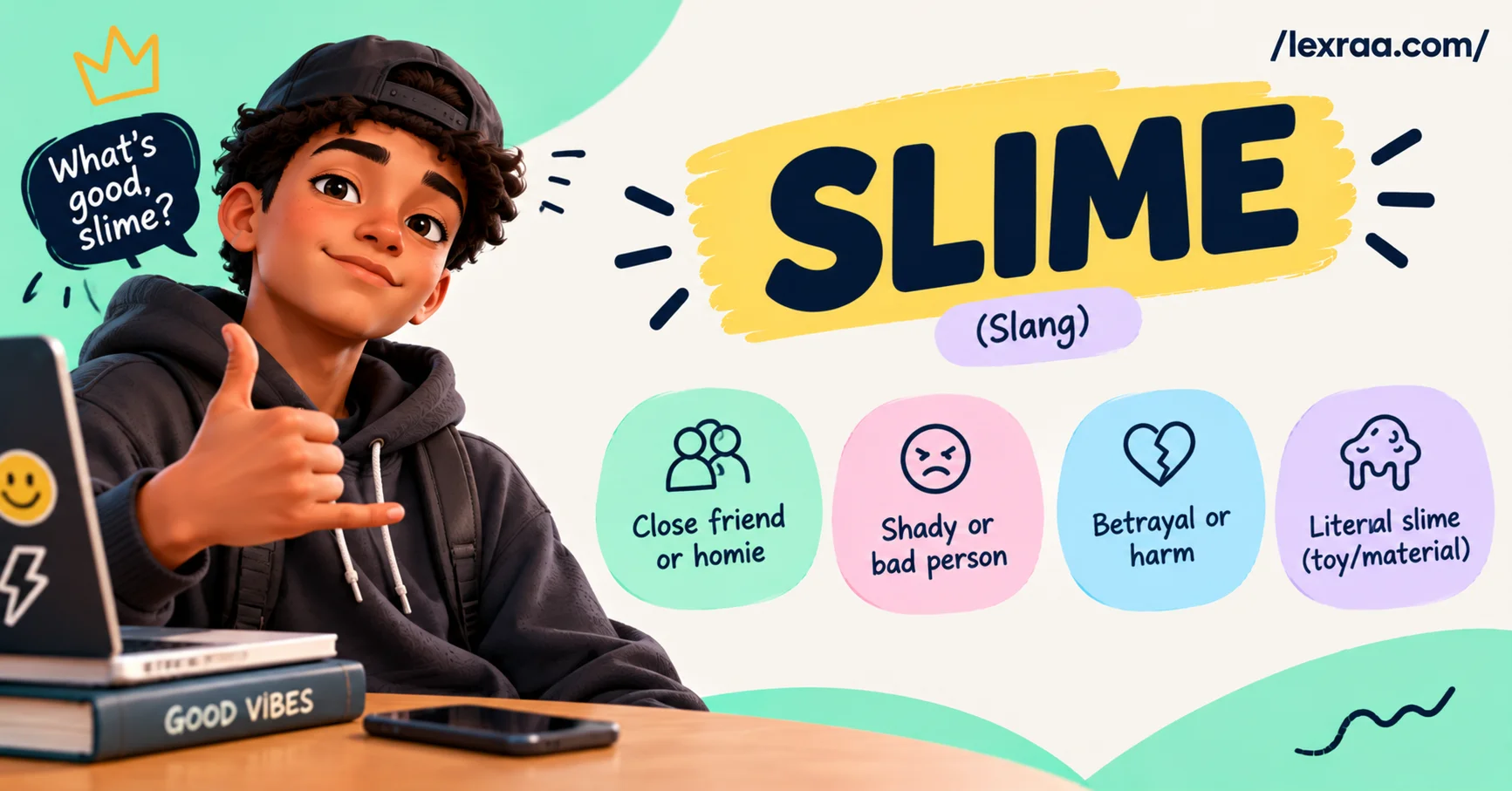
Slime is slang that can mean a close friend or trusted homie, but it can also refer to a shady person. In phrases like “slimed out,” it may mean being betrayed—or, in some contexts, killed. The surrounding words matter more than the word itself.
Your friend texts, “What’s good, slime?” They probably aren’t calling you disgusting. But if someone says, “He slimed me out,” the mood has changed dramatically.
The word slime meaning slang has several distinct uses, from friendly greetings to serious accusations. Here’s how to tell which one someone intends.
What “slime” means in slang
The word is an ordinary English noun with several informal slang meanings. It isn’t an acronym or a shortened phrase.
1. A close friend or trusted person
In some conversations, slime means a friend, homie, or someone in your inner circle. It can signal familiarity and loyalty, especially when used as a greeting or affectionate nickname.
Examples:
- “What’s up, slime?” = What’s up, bro?
- “That’s my slime.” = That’s my close friend.
- “Good looks, slime.” = Thanks, my guy.
This friendly use is documented in
dictionary.com and in user-submitted examples on
urbandictionary.com.
2. A shady or despicable person
Slime can also be an insult for someone considered dishonest, unpleasant, or contemptible. Dictionary.com records this negative sense, too.
For example:
“He took credit for my work and blamed me when it failed. What a slime.”
Here, the speaker isn’t showing affection. They’re calling someone a bad person.
3. To betray or seriously harm someone
The verb forms slime, slimed, and slimed out can carry a much harsher meaning. Depending on the context, they may describe betraying, backstabbing, or killing someone.
The distinction matters: calling a friend “slime” isn’t automatically a threat, but saying someone got “slimed out” can refer to serious violence. Know Your Meme documents this darker internet-slang use and its spread through online memes.
knowyourmeme.com.
4. Literal slime, toys, and other meanings
Outside slang, slime is the sticky, gooey substance associated with craft toys, mud, and certain biological materials. The word also appears in science and entertainment, including fictional slime creatures in games and fantasy stories.
Wikipedia’s
en.wikipedia.org lists several distinct subjects, including slime toys, biological material, and the German punk band Slime. These are genuine meanings, but they don’t explain a message like “What’s up, slime?”
How to tell which meaning someone intends
The quickest clue is the sentence around “slime.” Look at what the person is doing with the word, not just where you saw it.
| Message or phrase | Likely meaning | Tone |
|---|---|---|
| “Wassup, slime?” | Friend or homie | Friendly |
| “That’s my slime fr” | Close, trusted friend | Affectionate |
| “He’s a slime” | Shady or despicable person | Negative |
| “He slimed me out” | He betrayed or wronged me; potentially a more serious meaning | Negative |
| “They got slimed out” | Could refer to being killed in certain slang or meme contexts | Potentially threatening |
| “Look at this slime I made” | Gooey craft material | Playful |
One edge case deserves attention: “slime” and “slimed out” aren’t interchangeable. The first can be a friendly way to address someone; the second can describe something harmful that happened to someone.
A Reddit discussion about the phrase “slime out” shows exactly this confusion. People debate whether it means killing someone, while others point out that “slime” can simply mean a friend.
reddit.com.
Five realistic conversations using “slime”
These examples illustrate how the word can work in different situations.
1. iMessage — close friends
Jay: You coming to the game?
Malik: Yeah slime, pick me up at 6
Jay: Bet 🤝
Malik uses “slime” as a casual nickname for his friend.
2. Snapchat — playful greeting
Ari: Wsp slime 😂
Dev: Nothinggg, just bored
Ari: Come outside then
Meaning: It’s a familiar greeting, similar to “What’s up, bro?”
3. Group chat — showing loyalty
Nico: He stayed to help me finish the project
Sam: That’s your slime fr
Nico: Real one 💯
Meaning: The group is using the word positively to describe a close, dependable friend.
4. Private message — calling someone out
Leah: He told everyone my business
Mia: Nah that’s slime behavior
Leah: I’m not telling him anything again
Meaning: Here, the word is negative and criticizes someone’s behavior. This is an illustrative use, not a fixed definition of the phrase “slime behavior.”
5. TikTok comments — darker meme slang
User 1: Bro said he was gonna slime him out 💀
User 2: That phrase is NOT friendly 😭
User 3: Depends on the context, but yeah
Meaning: The commenters are reacting to the more threatening sense of “slime out.” The laughing emojis don’t necessarily make the underlying expression harmless.
These examples are fictional illustrations, not quotations from actual users.
Slime vs. similar slang words
A few familiar terms help clarify the meaning without assuming they are exact synonyms.
| Term | Meaning | Tone | Popularity | Confusion Risk |
|---|---|---|---|---|
| Slime | A close friend, an insult, or part of a phrase about betrayal or harm | Friendly or negative | — | High |
| Homie | A friend or someone from your circle | Friendly | — | Low |
| Bro | A casual way to address a friend or another person | Casual | — | Low |
| Snake | Someone who acts disloyally or betrays trust | Negative | — | Medium |
| Slimy | Literally slippery; figuratively dishonest or unpleasant | Usually negative when describing behavior | — | Medium |
| Slimed out | In certain slang contexts, betrayed, harmed, or killed | Negative; potentially threatening | — | High |
Popularity ratings are omitted because the sources reviewed don’t provide comparable usage statistics for these terms.
The key difference is that “homie” and “bro” are generally straightforward, while “slime” has both friendly and hostile uses. “Snake” and “slimy” more directly suggest dishonesty.
Where the slang came from—and why the meaning shifts
Modern slang uses of slime are associated with African American Vernacular English (AAVE) and hip-hop culture. The term spread more widely through music and internet culture, where its meaning can shift from a loyal friend to betrayal or violence.
The exact origin of every slang sense is difficult to establish. Know Your Meme traces the online spread of the darker “slimed out” meaning to the late 2010s and early 2020s, with greater visibility on TikTok around 2021. Later memes helped push the phrase into wider online conversations.
One important distinction: not every use of “slime” comes from the same slang tradition. A person using it as a friendly nickname may mean something entirely different from someone using it in a violent meme.
Frequently Asked Questions
What does “my slime” mean?
“My slime” usually means “my close friend” or “my homie.” It can express familiarity or loyalty, but the intended tone depends on the relationship between the people speaking.
Why do people say “slime” in rap lyrics?
In some hip-hop contexts, “slime” is used as a familiar term for a friend, associate, or someone within a trusted circle. Other lyrics use related forms in harsher contexts, so the surrounding lines matter.
What does “slime ya” mean?
The phrase can imply doing something harmful to someone, including betrayal or violence, depending on the context. If it appears in a threatening message rather than an obvious joke or meme, don’t assume it’s harmless slang.
Is “slime” a compliment or an insult?
It can be either. “What’s up, slime?” may be friendly, while “he’s a slime” can be an insult. The wording and tone usually provide the clearest clue.
Is “slime” appropriate for school or work?
The friendly nickname may be fine among friends who understand it, but it can sound unfamiliar or overly casual in formal settings. Avoid using it in professional writing, and be especially careful with phrases like “slimed out,” which may suggest violence.
What should you say if someone calls you “slime”?
If it sounds friendly, you can reply naturally with “What’s good?” or “What’s up, bro?” If you’re unsure, ask, “Wait, what do you mean by slime?” There’s no need to guess when the context isn’t clear.
Why the word sticks
“Slime” is memorable because it flips between a friendly nickname and a word associated with something unpleasant. Online jokes can make the darker meaning sound playful, even when its original implication is serious. That contrast is exactly why context matters.
Conclusion
Slime meaning slang most often points to a close friend or homie in friendly conversation, but it can also describe a despicable person. Phrases such as “slimed out” may refer to betrayal or violence, so don’t treat every use as harmless. If a friend greets you with “What’s up, slime?”, a casual response is usually enough. If the phrase appears in an argument or threat, pay attention to the actual words rather than assuming it’s just internet slang. The biggest mistake is giving the word one fixed meaning when its context can change everything.