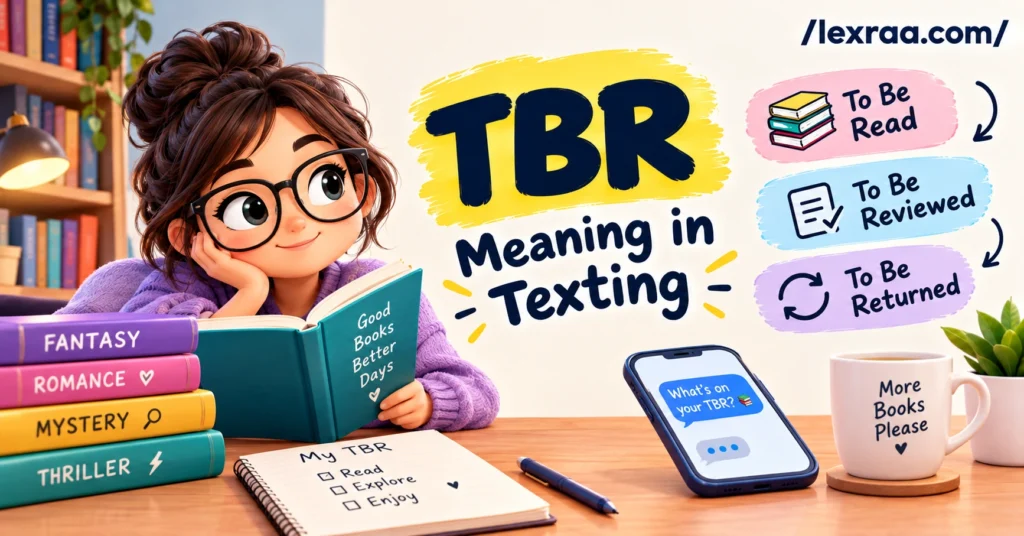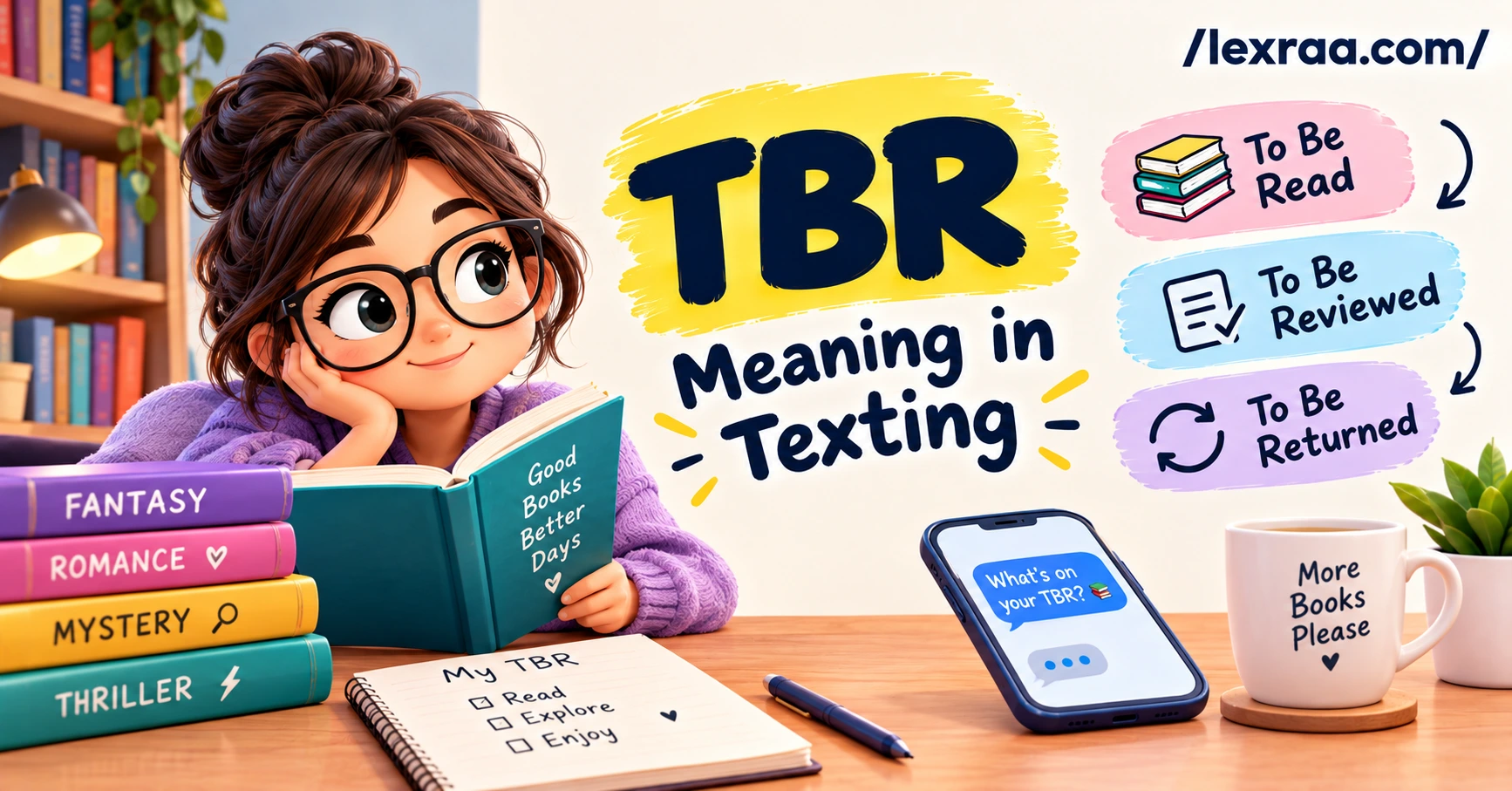
TBR means “to be read.” When someone texts it to you, they’re talking about books they plan to read, as in “my TBR is huge.” In work chats, it can occasionally mean “to be reviewed.”
Why People Search “TBR Meaning in Text”
TBR looks a lot like TBD, TBA, and TBH, so it’s easy to assume it belongs to the same “to be…” family and guess wrong. People usually search it right after getting a message like “adding that to my TBR” or “it’s TBR for Thursday” and not knowing whether it’s about books, deadlines, or something else.
The confusion exists because one abbreviation has a dominant meaning (books) and a few situational ones. This guide sorts out which meaning applies, using the context around the message.
What Does TBR Mean?
To Be Read (The Most Common Meaning)
TBR is an initialism: people say “T-B-R” letter by letter, though most call it an abbreviation or acronym in casual use. It stands for to be read. A “TBR” is the list or pile of books someone owns, or wants to own, and plans to read. Typical texts include “My TBR pile is out of control,” “That’s going straight on my TBR,” and “What’s on your TBR this month?” It almost always works as a noun: a TBR is something a person has, not something they do.
To Be Reviewed
In workplace and editing chats, TBR can mean to be reviewed: a document, draft, or request waiting for someone to check it. Example: “The slides are TBR by Friday.” This is in-the-moment shorthand rather than an established slang term, so it’s less standardized. If the conversation involves files, contracts, or approvals, this is probably the meaning.
To Be Returned
Less often, TBR means to be returned, usually about borrowed items, library books, or purchases: “The jacket is TBR on Saturday.” Like the review meaning, it’s situational shorthand. When you’re unsure, just ask. “TBR as in to be returned?” is a perfectly normal reply.
Platform Breakdown: Where TBR Appears in Texts
SMS, iMessage, and WhatsApp are where most confusion happens. TBR shows up in casual book talk between friends, family, and partners, and in quick workplace messages.
Direct messages on Instagram (especially book-focused accounts), Discord (reading and book-club servers), and Snapchat carry mostly the “to be read” meaning, often alongside recommendations or links.
TBR is also common in TikTok and Instagram captions and hashtags within book communities, but this article stays focused on text messages and DMs.
Is it typed consistently? Mostly, yes. “TBR” and lowercase “tbr” mean the same thing. The common variants are “TBR pile,” “TBR list,” “TBR shelf,” and the spelled-out “to-be-read.” Doubled letters or odd spacing aren’t standard.
Tone and Context Variations
Funny
A: How’s the reading goal going?
B: My TBR has its own TBR. It’s a problem.
A: How many books are we talking?
B: Enough that my shelf is filing a complaint.
Sarcastic
A: You said you’d read it by June.
B: It’s right at the top of my TBR. Next to the other forty.
A: So… never?
B: Any day now. Truly.
Playful
A: Finished your rec. Now I’m adding three to your TBR.
B: Rude. My TBR is full!
A: Add them anyway. I’ll check in March.
B: Fine, but you’re lending me your copies.
Serious
A: Is the contract ready to send?
B: Not yet. It’s TBR by legal on Thursday.
A: TBR as in to be reviewed?
B: Yes. Nothing goes out until they sign off.
Real Chat Examples
1. Friend to Friend
A: ok book rec emergency, what should I read next
B: what’s on your TBR
A: like thirty books, that’s the problem
B: pick the shortest one and start tonight
2. Partner to Partner
A: Can I get you a book for your birthday?
B: Anything from my TBR works. It’s pinned in our shared notes.
A: Found three of them already.
B: Don’t tell me which. I want to be surprised.
3. Coworker to Coworker
A: Where’s the Q3 deck?
B: Marked TBR. Priya is reading through it now.
A: TBR meaning to be reviewed?
B: Yep, should be cleared by 3.
4. Parent to Adult Child
A: Your sister says you have a huge TBR. Is that a medical thing?
B: Ha, no. It’s my stack of books to be read.
A: Oh good. Should I bring more books at Christmas?
B: Yes please, I’m out of shelf space.
5. Sibling to Sibling
A: you still have my copy of the fantasy one
B: I know, it’s on my TBR for this weekend
A: you said that in August
B: …it’s a very long TBR
6. Stranger in an Instagram DM
A: Hey, sorry to message out of nowhere. Your story mentioned a TBR list?
B: Yes! It’s just books I want to read. Want me to send it?
A: Please! I’m new to all this.
B: Sending it now. Welcome to the club.
7. Roommate to Roommate
A: Is the blender still at your place?
B: yeah it’s TBR this weekend, sorry
A: TBR… to be returned?
B: haha yes, dropping it Saturday
8. Book Club Group Chat
A: Next month’s pick?
B: Anything from the group TBR doc. Vote by Friday.
A: I vote for the one with the green cover.
B: That narrows it to four, so please vote properly.
9. Student to Teacher
A: Hi Ms. Carter, which readings should I prioritize?
B: Start with chapter 4, then add the others to your TBR for later.
A: Thank you, I’ll finish chapter 4 tonight.
B: Good. Email me if anything is unclear.
10. A Mix-Up Between Friends
A: are we still on for dinner?
B: TBR, I’ll know after my shift
A: you mean TBD?
B: lol yes, wrong letters, long day
11. WhatsApp Reading Check-In
A: Did you finish it?
B: DNF at page 80
A: Harsh. Was it that bad?
B: Not bad, just not for me. Back to the TBR.
How to Reply to a TBR Text
Funny reply
“Mine has a waitlist. Some books have been there since 2022.”
Serious reply
“Thanks for sharing. I’ll start with the first one on your list and tell you what I think.”
Flirty reply (only fits book-talk with someone you’re into)
“Am I on your TBR yet? Asking for a friend.”
Neutral, unbothered reply
“Nice. Let me know which one you pick up first.”
If the TBR text is about work, skip the jokes and confirm the meaning: “Do you mean to be reviewed? I’ll check it today.”
TBR vs. Similar Terms: Comparison Table
| Term | Meaning | Usage Context | Tone | Popularity | Confusion Risk |
|---|---|---|---|---|---|
| TBR | To be read (also to be reviewed or returned) | Book talk, work chats | Casual to neutral | High in reading communities | Medium |
| TBD | To be determined | Plans, schedules, details | Neutral | Very high | Low |
| TBA | To be announced | Events, releases | Neutral to formal | High | Low |
| TBC | To be confirmed | Bookings, plans (common in UK English) | Neutral to formal | Medium | Medium |
| TBH | To be honest | Opinions, confessions | Casual | Very high | Low |
| DNF | Did not finish | Books, races, projects | Casual | Medium | Medium |
DNF is the closest thing to an opposite: a book you started but dropped, rather than one you plan to read. It isn’t a strict antonym, but it’s the term readers actually use as TBR’s counterpart.
Who Uses TBR?
Age groups: Anyone in a reading community, from teens to older adults. The workplace meaning is mostly used by working adults.
Gen Z vs. Millennials: There’s no solid data on differences, so treat these as common patterns rather than measured statistics. Gen Z readers often meet the term through BookTok and tend to type a casual lowercase “tbr,” sometimes with emojis. Millennials more often picked it up from blogs, forums, and Goodreads-era reader communities, and they’re a bit more likely to write “TBR pile” or “to-read list” in full.
Regional usage: TBR is used in English-speaking book communities worldwide, including the US, UK, Canada, Australia, and India. I’m not aware of any reliable evidence that its meaning differs by region. The only notable pattern is that TBC (a different term) is especially common in UK English.
Platforms: “To be read” dominates in iMessage, WhatsApp, and book-focused DMs. “To be reviewed” and “to be returned” appear mainly in workplace and household texts.
Origin and Internet Culture
TBR did not start as SMS shorthand. It wasn’t created to save characters on early phones, and it isn’t a TikTok invention. “To be read” is ordinary English, and the abbreviation became standard in online reader communities such as book blogs, forums, and Goodreads (whose default shelf is called “Want to Read,” the same idea). It later spread through BookTube, Bookstagram, and BookTok. No single inventor or first use is reliably documented, so any exact “origin story” you see online should be treated with caution.
TBR has no AAVE or other specific cultural roots that I can verify, so there’s nothing to attribute there.
The meme culture around it is real but narrow: readers joke about never-ending TBR piles, and the Japanese word tsundoku, meaning to buy books and leave them unread, is often cited alongside the idea. Over time the term shifted from a literal list of books to a casual way of saying “things I mean to get to,” which is how it sometimes leaks into non-book chats.
Safety and Appropriateness
Is it rude or offensive? No. TBR is neutral and friendly in every common meaning.
Is it profanity? No. It contains no explicit language.
School and workplace use: Fine for both, with one caution. At work, “TBR” can be misread because it could mean “to be reviewed” or “to be read,” so spell it out the first time if there’s any doubt. With a teacher or boss, “to be reviewed” is clearer than the abbreviation.
Cultural sensitivity: None specific. The only courtesy worth keeping in mind is not mocking someone’s reading choices, since a TBR list is personal.
Real-World Observation
In everyday chats, TBR works less like a definition and more like a social signal: it tells the other person “I read, and I’m planning ahead.” What makes it durable in texting is that it’s short and fits naturally into a sentence, so people use it without explaining it.
It also invites easy follow-ups, because “what’s on your TBR?” is one of the quickest ways to start a recommendation swap. The same abbreviation can switch jobs depending on who’s texting, such as a friend talking books or a colleague tracking drafts, and that flexibility is why it keeps drawing searches.
FAQ
Is it rude to reply with just “TBR” in a text?
Not rude, but it can feel incomplete. In a book chat, a bare “TBR” doesn’t answer a question like “what are you reading?” Add the title or a short comment so the reply feels warm. In a work chat, a bare “TBR” is fine as a status label if everyone knows what it means.
What’s the difference between texting “TBR” and saying it out loud?
Out loud, people say “T-B-R,” and it sounds more like book-club talk. In text, it’s quicker and more casual, so it can pass without much thought. Spoken, listeners may not catch it, and you might need to say “to be read.” In texts, readers can simply look it up.
Does TBR mean the same thing in a group chat vs. a one-on-one text?
The meaning is the same, but the audience changes how it lands. In a book-club group chat, everyone knows it, and “group TBR” may even refer to a shared list. In a mixed group, some people may not know the term, so someone usually has to ask. One-on-one, the surrounding context (books, work, or borrowed items) makes it clear.
What should I text back if I don’t understand someone’s TBR message?
Just ask: “Sorry, what does TBR mean here?” It’s a normal question, and most people are happy to explain. You can also guess and check, such as “TBR as in to be read?” That shows you’re trying and keeps the chat moving.
What does TBR stand for in text?
TBR most commonly stands for “to be read.” It refers to the books someone plans to read next. In workplace or household chats, it can also mean “to be reviewed” or “to be returned.” The surrounding conversation tells you which one applies.
What is a TBR pile?
A TBR pile is the stack of books someone owns and hasn’t read yet. Many readers keep a physical pile, a digital list, or a Goodreads-style shelf. It often grows faster than it shrinks, which is why readers joke about it. “TBR list” and “TBR shelf” mean the same thing.
Is TBR the same as TBD?
No. TBD means “to be determined,” as in an unsettled plan, while TBR usually means “to be read.” They look alike, so people sometimes mix them up, as in the dinner example above. If someone says their plans are “TBR,” they probably meant TBD. Check with them if the message is unclear.
What does TBR mean at work?
At work, TBR usually means “to be reviewed,” a label for a document or task waiting for someone’s feedback. It can also mean “to be read” when a file is waiting to be looked at. Because it’s not a formal standard, spelling it out the first time avoids confusion.
Conclusion
TBR means “to be read” in almost every casual text: it’s the pile or list of books someone plans to get to. Less often, it means “to be reviewed” or “to be returned,” depending on whether the chat is about work or borrowed things. Context is your best clue, and when in doubt, asking is perfectly fine.
Usage Tips
- Use “TBR” with fellow readers or in book chats, where everyone knows it.
- Follow it with a title or a question to keep the conversation going.
- Spell out “to be reviewed” the first time in a work message.
- Lowercase “tbr” is fine in casual texts, and all caps looks a bit more deliberate.
Common Mistakes
- Mixing it up with TBD, TBA, or TBH.
- Assuming it always means books, even in work or household texts.
- Sending a bare “TBR” as an answer to a question that needs details.
- Using it with someone who isn’t into reading, without explaining it.
When to Use It and When to Avoid It
Use TBR in friendly texts about books, in book-club chats, and in quick workplace status notes among coworkers who know the shorthand. Avoid it in formal messages to people you don’t know well, and in any text where “to be read,” “reviewed,” and “returned” could all make sense. In those cases, write the full phrase.