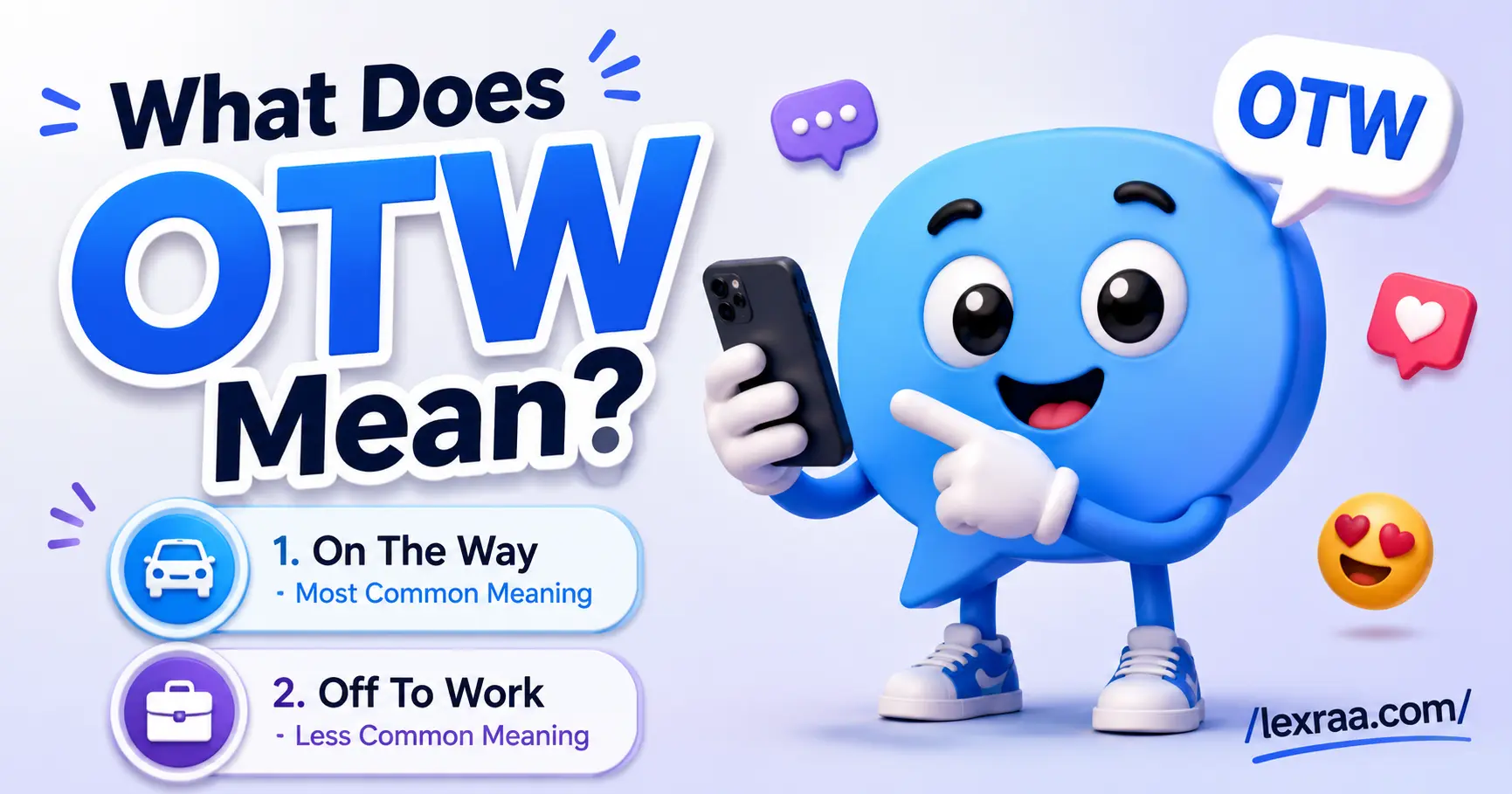
OTW means “on the way.” In texts, DMs, and casual online conversations, people use it to say they are heading somewhere or that something is currently coming or being delivered. For example, “I’m OTW” means “I’m on the way.”
What Does OTW Mean in Text?
OTW is an initialism/abbreviation for “on the way.” It is one of those digital shortcuts where the first letters of the words are enough for the reader to reconstruct the full phrase.
The most common use is to tell someone that you are already traveling toward a destination:
“I’m OTW to your house.”
That means:
“I’m on the way to your house.”
It is particularly useful when someone has asked “Where are you?”, “Are you coming?”, or “How long until you get here?” Slang.net specifically describes OTW as a response to questions about someone’s location or estimated arrival.
OTW can also describe an object rather than a person:
“Your food is OTW.”
Here, the food or delivery is “on the way.”
Likewise:
“The package is OTW.”
means the package is currently being transported or is expected to arrive soon.
This broader use is important because OTW does not necessarily mean “I am physically traveling.” The thing that is “on the way” can be a person, package, meal, document, update, or another item whose arrival is being discussed.
Is OTW Slang or an Acronym?
OTW is best described as an informal texting abbreviation or initialism, rather than a traditional slang word.
It is formed from the initial letters of:
O = On
T = The
W = Way
Unlike a word such as “ghosting,” OTW does not create a new vocabulary item. It compresses an existing three-word phrase into three letters.
You may see it written as OTW, otw, or occasionally Otw. Capitalization usually does not change the meaning.
For example:
“OTW now”
and
“otw now”
both mean:
“On the way now.”
The lowercase form is especially natural in casual messaging because people often type quickly without worrying about capitalization.
What Does “OTW” Actually Imply?
Although OTW literally means “on the way,” the practical meaning can depend on the situation.
If a friend asks:
“Where are you?”
and you answer:
“OTW.”
the normal implication is you have started heading there or are sufficiently committed to going that you describe yourself as being on the way.
It does not necessarily tell the other person exactly how far away you are.
That is why someone might reply:
“How far?”
or:
“ETA?”
OTW tells them that movement toward the destination is happening; it does not automatically give them a precise arrival time.
This distinction makes OTW different from ETA, which specifically asks or gives an estimated time of arrival.
Read More: Meaning of ASF Explained: The Slang Everyone Uses Online
OTW Can Be About More Than Travel
One useful detail that many simple definitions overlook is that “on the way” can describe progress toward arrival, not just physical transportation.
Consider:
“The new update is OTW.”
That can mean the update is coming soon.
Or:
“Your order is OTW.”
That means the order has been dispatched or is being brought toward the recipient.
In a more casual conversation:
“Help is OTW.”
means help is coming.
The shared idea is always movement or progress toward a destination or expected result.
This makes OTW a flexible abbreviation even though its basic expansion remains unchanged.
OTW vs. OMW: What’s the Difference?
OTW and OMW are closely related and are easy to confuse.
- OTW = On the way
- OMW = On my way
Both can tell someone that you are heading toward them.
For example:
“OTW to the mall.”
simply states that you are on the way to the mall.
“OMW to the mall.”
emphasizes that you personally are on your way.
In everyday texting, the distinction is usually small enough that the two expressions can overlap. Slang.net specifically describes OTW as similar to OMW and notes that OMW is more common.
A useful practical distinction is this:
OTW can describe a person or something else that is coming.
OMW more specifically emphasizes the sender’s own movement.
So:
“The pizza is OMW”
sounds less natural than:
“The pizza is OTW.”
But:
“I’m OMW”
is extremely natural when talking about yourself.
A Common Misunderstanding: Does OTW Mean You’re Already There?
No.
OTW means you are on the way, not that you have arrived.
If someone says:
“I’m OTW.”
you should understand that they are still traveling or progressing toward the destination.
Compare these:
- OTW = I am on the way.
- Almost there = I am very close.
- Here = I have arrived.
- ETA 10 mins = I expect to arrive in about 10 minutes.
This matters in practical situations. If you’re waiting for someone outside a restaurant and they text “OTW,” it would be a mistake to assume they are already at the entrance.
Another Documented Meaning: “Off to Work”
A less common interpretation of OTW is “off to work.” Slang.net lists this as a secondary meaning and warns that it can be confusing because most people understand OTW as “on the way.”
For example:
“OTW now. I’ll call you after work.”
Depending on context, someone could interpret that as “I’m on the way” or “I’m off to work.”
Because “on the way” is substantially more established in texting, “off to work” should not be assumed unless the surrounding conversation makes it obvious.
If you want to avoid confusion, simply write:
“Off to work now.”
instead of relying on OTW.
Other Meanings of OTW
OTW has numerous specialized expansions outside everyday texting. For example, reference databases list meanings connected with organizations, business, sports, and other specialized fields.
Wiktionary also records OTW as an initialism for “on the way” and gives “overtime win” as a sports-related noun usage.
These meanings are not reasons to overcomplicate an ordinary text.
If your friend writes:
“I’m OTW.”
the overwhelming contextual reading is “I’m on the way.”
If OTW appears in a sports statistic, organization name, technical document, or specialized discussion, then another expansion may be relevant.
Which Apps Use OTW?
OTW is not an Instagram-only or TikTok-only expression. It belongs to broader digital communication and is documented in texting, chat, social media, and online communication. All Acronyms categorizes “On The Way” under texting, chat, internet slang, social media, and related communication contexts.
On Instagram, OTW can naturally appear in DMs, comments, captions, or Stories when someone is traveling somewhere.
For example:
“OTW to the concert 🎶”
means:
“On the way to the concert.”
There is no evidence that Instagram gives OTW a special platform-specific meaning.
Snapchat
Snapchat’s short, casual messaging style is compatible with OTW.
A conversation might look like:
“Where you at?”
“OTW 👀”
The sender is saying they are heading there.
OTW can be used in WhatsApp chats and group conversations to coordinate meetups, deliveries, errands, or plans.
For example:
“Leaving now, OTW.”
The meaning is simply “I’m on the way.”
TikTok
OTW can also appear in TikTok comments, captions, and casual interactions, especially when someone is describing travel or heading toward a place. However, there is no reliable evidence that TikTok has a unique OTW definition.
X
OTW also appears in broader social-media communication, including Twitter/X-style posts. Dictionary.com gives examples of OTW being used in posts about traveling to work and going to a studio.
The key point across all these platforms is the same: the app does not determine the meaning. The sentence does.
Where Did OTW Come From?
The exact origin of OTW is unclear.
There are plausible explanations for why the abbreviation developed: “on the way” is a common phrase in everyday coordination, and shortening it to three letters makes it quick to type.
However, claims that OTW was definitely invented during a particular year, by a particular texting community, or specifically because of SMS character limits are not sufficiently established by the sources available.
Older online evidence shows that the abbreviation was already in use by the early 2000s. Urban Dictionary has an entry dated November 10, 2003 defining OTW as “on the way,” followed by another documented entry from 2015.
Dictionary.com later documented OTW as textspeak in 2018 and included examples from social-media posts dating to 2015 and 2017.
These records demonstrate that OTW was established in informal digital communication by the early-to-mid 2000s. They do not, however, prove who invented it or exactly where it began.
So the most accurate historical conclusion is:
OTW has been documented as internet/texting shorthand since at least the early 2000s, but its precise origin is unclear.
There is also no strong evidence that OTW originated specifically in AAVE, Gen Z culture, or one particular geographic region.
10 Natural OTW Conversations
1. Funny — Friends
Jake: Bro, where are you?
Ryan: OTW.
Jake: You said that 30 minutes ago.
Ryan: Technically, my bed is on the way to the door 😂
The joke plays on the difference between saying OTW and actually making progress.
2. Sarcastic — Best Friends
Mia: You coming to dinner?
Zoe: OTW.
Mia: You haven’t even left, have you?
Zoe: Details, details 🙄
Here, OTW is being used sarcastically because the sender is probably running late.
3. Playful — Dating
Alex: Are you actually coming tonight?
Jordan: OTW ❤️
Alex: How long?
Jordan: Ten minutes. Save me a seat 😉
The romantic tone comes from the conversation, not from OTW itself.
4. Serious — Work
Manager: Are you close to the meeting?
Employee: Yes, I’m OTW now.
Manager: Okay, we’ll wait five minutes.
Employee: Thanks, I’ll be there shortly.
Here, OTW gives a straightforward progress update.
5. Family Chat
Mom: Can you pick up some groceries?
Sam: Sure. I’m OTW to the store.
Mom: Get bread and eggs too.
Sam: Added to the list.
OTW simply communicates movement toward the store.
6. Instagram DM
Lena: Are you going to the festival?
Ava: Yep, OTW now!
Lena: Send me your location when you’re close.
Ava: Will do 🎶
This is a natural social-media use of the abbreviation.
7. Snapchat
Noah: Where are you?
Eli: OTW 👀
Noah: Actually?
Eli: Actually this time 😂
The context suggests the sender has started traveling.
8. WhatsApp Group
Sara: Who’s bringing the drinks?
Tom: I am. OTW to the shop.
Sara: Perfect.
Tom: Be there soon.
The abbreviation makes the group update quick and easy to scan.
9. Delivery Conversation
Customer: Has my order left yet?
Friend: Yep, your food is OTW.
Customer: Finally 😂
Friend: Shouldn’t be long now.
Here, OTW describes an object moving toward its destination.
10. Gaming Chat
Kai: We’re starting the match in five.
Max: OTW.
Kai: Hurry!
Max: Loading in now.
In this situation, OTW still means “on the way,” but the destination is effectively the online game or lobby rather than a physical location.
How Should You Reply to OTW?
Because OTW usually communicates a simple status update, your response can depend on what you need to know.
Funny reply
“OTW from where? The couch? 😂”
This works when a friend has a reputation for being late.
Serious reply
“Okay, thanks for letting me know. Please drive safely.”
Use this when someone is traveling and safety matters more than speed.
Flirty reply
“Good 😌 I’ll be waiting for you.”
This fits when OTW appears in an already romantic conversation.
Neutral reply
“Okay, see you soon!”
This is the safest response when someone simply tells you they are coming.
If you need timing information, ask:
“What’s your ETA?”
That gets you information OTW itself does not provide.
OTW vs. Similar Terms
| Term | Meaning | Tone | Popularity | Confusion Risk |
|---|---|---|---|---|
| OTW | On the way | Casual, practical | Common | Low |
| OMW | On my way | Casual, direct | Very common | Medium |
| ETA | Estimated time of arrival | Practical | Very common | Low |
| BRB | Be right back | Casual | Very common | Low |
| GTG | Got to go / Gotta go | Casual | Common | Medium |
| AFK | Away from keyboard | Casual, gaming/chat | Common online | Medium |
| Here | Already arrived / present | Neutral | Extremely common | Low |
The closest comparison is OMW. If someone says “OMW,” they are specifically saying they are on their way. OTW can be used more broadly:
“The package is OTW.”
That sentence works naturally, whereas “The package is OMW” does not.
ETA is also important because people sometimes treat the two as interchangeable. They aren’t. OTW tells you about status; ETA tells you about expected arrival time.
Who Uses OTW?
There is no strong evidence that OTW belongs exclusively to teenagers, Gen Z, Millennials, or another specific age group.
In fact, its documented history reaches back to early online slang records, including examples from the 2000s.
The abbreviation is better understood as general digital shorthand. Its usefulness is not tied to a particular generation because the underlying situation—telling someone you’re coming—is common to almost everyone.
There is also no reliable evidence for a major US-versus-UK difference in the meaning of OTW. English-speaking users may differ in their preferred abbreviations, but “on the way” remains the dominant interpretation in ordinary texting.
Is OTW Rude or Safe?
OTW is generally harmless, non-offensive, and not profane.
It is appropriate for casual messages between friends, family members, classmates, and coworkers when the communication itself is informal.
For example:
“Hi, I’m OTW to the office.”
is understandable in a casual workplace chat.
However, a formal email would normally be better as:
“I am on my way to the office.”
The issue is not that OTW is rude. It is simply informal shorthand.
There is also no inherently romantic meaning. Someone saying:
“I’m OTW.”
is not automatically flirting with you.
Likewise, OTW does not imply annoyance, excitement, or urgency by itself. Those emotions come from the surrounding words, punctuation, emojis, or situation.
A Useful Conversational Insight: OTW Is a Status Signal
What makes OTW especially useful is that it answers a practical question without requiring a complete sentence. When someone is waiting for you, they usually want to know one thing first: Are you coming? OTW immediately signals commitment and movement toward the destination, while leaving room for a follow-up such as “How far away?” or “What’s your ETA?” That makes it more useful than simply saying “coming,” because OTW describes an ongoing state rather than only a future intention. At the same time, the abbreviation can become humorous when people use it loosely while they are still getting ready—one reason “I’m OTW” can sometimes be treated skeptically in casual chats.
FAQ About OTW
What does OTW mean in a text message?
OTW usually means “on the way.” It tells someone that a person or sometimes an object is traveling or progressing toward a destination. For example, “I’m OTW” means “I’m on the way.”
What does OTW mean from a guy or girl?
OTW has no different meaning based on the sender’s gender. Whether a guy, girl, friend, coworker, or family member sends it, the normal interpretation is “on the way.” The surrounding conversation determines whether the message is casual, serious, or romantic.
Does OTW mean “on my way”?
It can communicate essentially the same idea, but OMW is the more direct abbreviation for “on my way.” OTW literally expands to “on the way.” In many everyday conversations, people use the two interchangeably when talking about themselves.
Does OTW mean someone has already left?
Usually, OTW suggests that the person is already traveling or considers themselves to be actively on the route. However, casual users sometimes send it loosely when they are just about to leave. If their arrival matters, ask for an ETA rather than assuming exactly where they are.
Can OTW be used for a package?
Yes. OTW can describe something other than a person, such as food, a package, a delivery, or another item that is coming toward you. “Your order is OTW” means the order is on its way.
Is OTW the same as ETA?
No. OTW means “on the way,” while ETA means “estimated time of arrival.” Someone can tell you “I’m OTW” without telling you when they expect to arrive. If you need a time, ask “What’s your ETA?”
What does OTW mean on Instagram?
On Instagram, OTW normally means “on the way.” It can appear in DMs, comments, captions, or Stories when someone is traveling somewhere. There is no reliable evidence that Instagram gives OTW a special meaning different from its normal texting use.
What does OTW mean on Snapchat or WhatsApp?
On Snapchat and WhatsApp, OTW generally has the same meaning: “on the way.” It is useful for short updates such as “OTW home” or “OTW to the party.” The app itself does not change the basic definition.
Final Takeaway
If someone sends you “OTW,” the safest interpretation is “on the way.”
They are usually telling you that they are heading toward a place, although OTW can also describe something such as a delivery or package that is coming.
Remember these distinctions:
- OTW = On the way
- OMW = On my way
- ETA = Estimated time of arrival
- Here = Already arrived
OTW is casual, safe, and widely understandable in digital communication. It is not inherently romantic, rude, or associated with one particular generation.
The exact origin of the abbreviation is unclear, although online records show “OTW = on the way” in use by at least the early 2000s. There is not enough reliable historical evidence to credit a particular person, platform, region, or cultural group with inventing it.