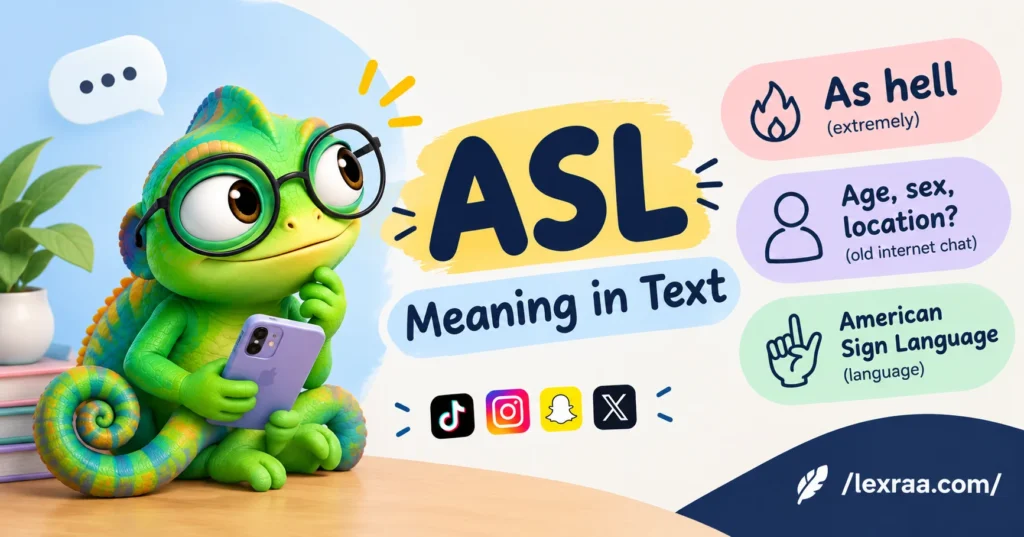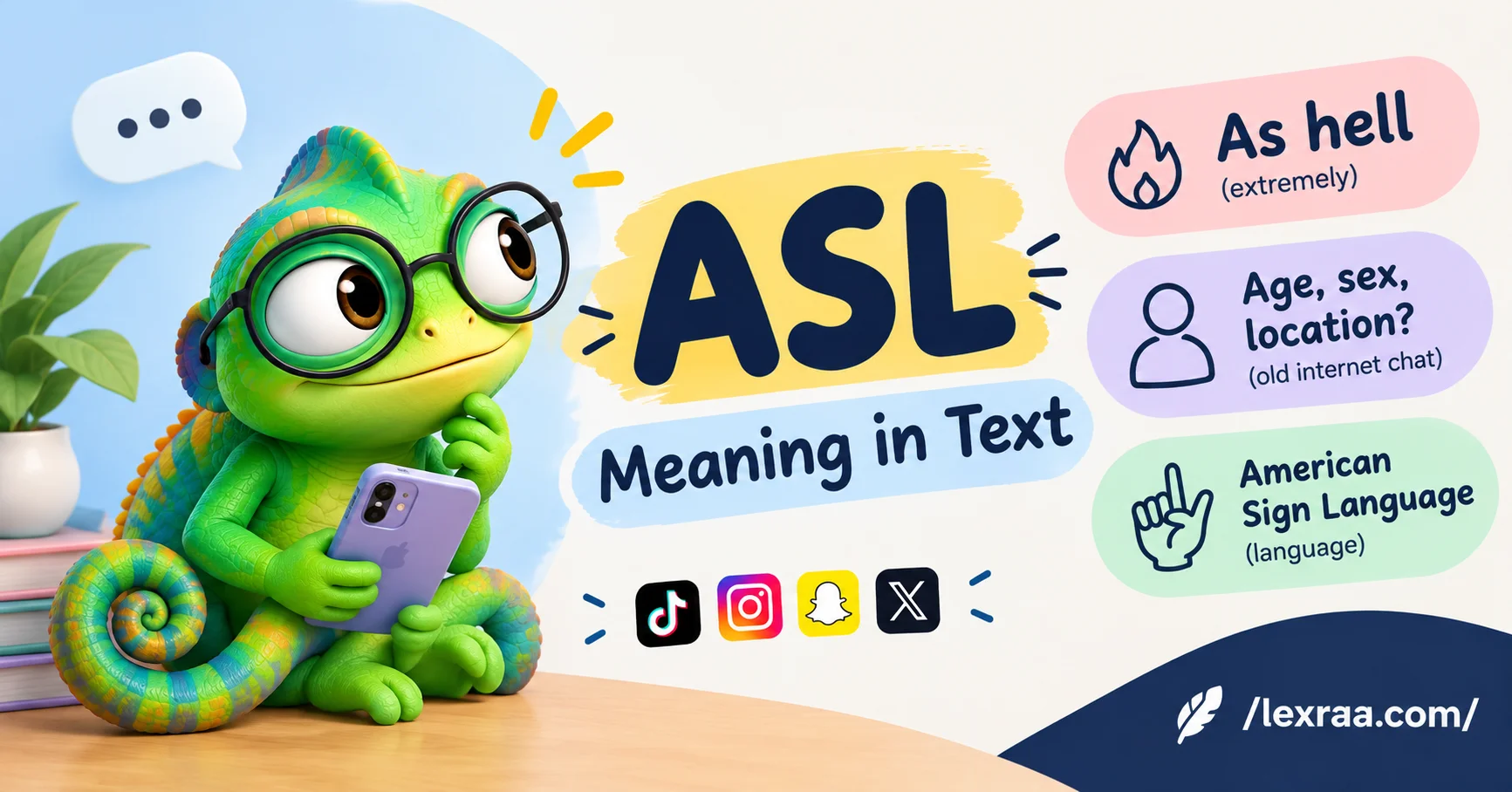
ASL in text usually means “as hell” when it appears after an adjective, such as “tired asl.” But ASL can also mean “age, sex, location?” in older internet chat or American Sign Language in language-related conversations. Context tells you which meaning applies.
What Does ASL Mean in Text?
ASL is an abbreviation/initialism with multiple meanings, not one universal piece of slang.
In modern casual texting and social-media slang, lowercase asl commonly means “as hell.” It works as an intensifier, making the word before it stronger:
“That movie was funny asl.”
means:
“That movie was extremely funny.”
But ASL has two other well-established meanings. “ASL?” was a familiar early-internet shorthand for “age, sex, location?”, while ASL is also the standard abbreviation for American Sign Language, a complete natural language. Dictionary.com lists both “age, sex, location” and American Sign Language, and also recognizes the slang “as hell” use.
That means the same three letters can represent completely different things.
ASL Meaning #1: “As Hell”
The most important meaning to recognize in modern slang texting is “as hell.”
Here, asl usually comes after a descriptive word:
- tired asl = extremely tired
- funny asl = extremely funny
- cold asl = extremely cold
- cute asl = extremely cute
- expensive asl = extremely expensive
- annoying asl = extremely annoying
It works grammatically as an intensifier. In plain English, you could often replace it with “very,” “really,” or “extremely.”
For example:
“This homework is hard asl.”
means:
“This homework is extremely hard.”
The phrase is informal because “as hell” itself is an emphatic expression, so the abbreviated form belongs naturally in casual messages, comments, captions, and online conversations.
Dictionary.com specifically identifies lowercase asl as internet slang for “as hell,” while Dictionary.com’s TikTok guide notes that the usage is not exclusive to TikTok.
Why Does “asl” Go at the End?
One of the easiest ways to recognize this meaning is sentence position.
When you see:
“That food is good asl.”
the word asl comes after the adjective “good.” It strengthens the adjective.
You would not normally interpret this as someone asking about age, sex, and location.
Compare:
“That food is good asl.”
with:
“ASL?”
The first is an intensifier. The second can be the older chat abbreviation.
This grammatical clue is more reliable than capitalization alone.
ASL Meaning #2: “Age, Sex, Location?”
The older internet-chat meaning of A/S/L is “age, sex, location?”
It was used as a quick way for people meeting online to ask for basic personal information.
A typical exchange could look like:
“Hey, asl?”
“17/f/Ohio.”
The three parts corresponded to age, sex, and location.
Research on early online teen chatrooms documents A/S/L as a conventional chat code and conversation opener. A 2004 study describes users typing “a/s/l” to find out basic identity information about people in the room and notes that a 2001 Pew report identified it as the most common question directed at new entrants in chatrooms.
This meaning is strongly associated with older internet chat culture, rather than being a new TikTok invention.
It also has an important privacy angle. A stranger asking “ASL?” is requesting personal information, so there is no obligation to provide an exact age or location. This matters especially when the person asking is unknown to you.
Is “ASL?” Still Used This Way?
It can be, but context is crucial.
If someone sends:
“ASL?”
as a standalone question at the beginning of a conversation, the older age/sex/location meaning is plausible.
If someone writes:
“I’m exhausted asl.”
they are almost certainly using as hell instead.
Research has also documented A/S/L in online-chat settings involving relationship and sexual partner selection, which is another reason a standalone “ASL?” from a stranger should not automatically be treated as harmless small talk.
ASL Meaning #3: American Sign Language
In a completely different context, ASL means American Sign Language.
This is not internet slang.
The National Institute on Deafness and Other Communication Disorders describes ASL as a complete, natural language with its own grammar, expressed through movements of the hands and face. It is distinct from English rather than simply being English translated into hand signs.
For example:
“I’m taking an ASL class.”
Here, ASL clearly means American Sign Language, not “as hell” or “age, sex, location.”
Likewise:
“Does your school offer ASL?”
is a question about learning the language.
This meaning is particularly easy to identify because the surrounding conversation usually involves language, signing, Deaf communities, education, interpreters, or accessibility.
It is also worth remembering that ASL is not a universal sign language. The NIDCD notes that different countries and regions have different sign languages; for example, British Sign Language (BSL) is distinct from ASL.
How to Tell Which ASL Meaning Someone Means
When you see ASL in a text, don’t automatically expand the letters. Look at the sentence first.
| What you see | Most likely meaning | Example |
|---|---|---|
| Adjective + asl | As hell | “That song is good asl.” |
| ASL? by itself | Age, sex, location? | “Hey, ASL?” |
| ASL with language/education context | American Sign Language | “I’m learning ASL.” |
| a/s/l in an old-style chat context | Age/sex/location | “a/s/l?” |
The Best Clue Is Grammar, Not Capitalization
Many explanations say lowercase asl means “as hell” and uppercase ASL means something else. That can be a helpful clue, but it is not a rule.
People do not always follow capitalization conventions in texts.
Someone could write:
“That was ASL funny.”
and still mean “as hell.”
Likewise, someone discussing American Sign Language may casually type:
“asl is really interesting.”
So where the abbreviation appears and what the surrounding conversation is about are stronger clues than capitalization by itself.
This is one of the most useful distinctions missing from many basic ASL meaning guides.
Where Is “ASL” Used as “As Hell”?
The modern as hell usage has been documented across social media rather than being exclusive to one platform.
Dictionary.com specifically documents the use on TikTok and says it also appears on other social-media platforms. Know Your Meme traces the modern slang usage through social-media culture, including Twitter/X and later TikTok.
So if you searched “what does ASL mean on TikTok?”, the answer is commonly “as hell.”
For example:
“That cat is cute asl.”
means:
“That cat is extremely cute.”
But the same three letters in a conversation about sign language still mean American Sign Language.
Where Did the “As Hell” Meaning Come From?
The exact origin of asl = as hell is not firmly established.
Know Your Meme documents a first-known instance in 2018 on Twitter/X in which a user connected ASL with “as hell,” followed by an Urban Dictionary entry using that meaning later in 2018. It also documents the meaning spreading more widely on TikTok in the early 2020s.
That gives us a useful timeline, but it would be too strong to say that one person definitively invented the slang.
The older A/S/L meaning has a much longer documented history in internet chat. Academic research from the early 2000s describes it as an established chatroom code, including examples from teen chatrooms.
So modern asl = as hell should be understood as a later internet slang development involving an abbreviation that already had an older meaning.
Does ASL Mean “Very” or “Extremely”?
When asl means “as hell,” it can usually be understood as “very,” “really,” or “extremely.”
For example:
“I’m hungry asl.”
means:
“I’m extremely hungry.”
But “as hell” can carry a little more informal emphasis than simply saying “very.”
Compare:
“I’m very tired.”
“I’m tired asl.”
The second is much more casual and sounds like texting or social-media language.
Is ASL the Same as AF or ASF?
They can perform a similar grammatical job when they are used as intensifiers, but they are not the same abbreviation.
ASL = as hell
AF = as fuck
ASF = as fuck
All can intensify an adjective:
“That game is hard asl.”
“That game is hard af.”
The difference is primarily in the expression being abbreviated and the level of profanity involved. ASL is the less profane option, although “as hell” is still informal.
This makes ASL useful when someone wants strong emphasis without using the more explicit AF/ASF.
Is ASL Rude or Inappropriate?
The “as hell” meaning is informal and mildly profane because it abbreviates a phrase containing “hell.”
That does not make it an offensive slur or inherently insulting. However, it is better suited to casual texts, friends, social media, and informal conversations than formal school or workplace writing.
For example:
“That presentation was impressive asl.”
might be understandable in a group chat, but in a professional email:
“That presentation was extremely impressive.”
would be more appropriate.
The age/sex/location meaning has a different concern: privacy. If an unknown person asks you for your age and location, you can decline to share personal information.
How Do You Reply to “ASL?”
If someone sends only:
“ASL?”
you need to determine which meaning they intended.
If it appears to be the old age/sex/location question, you can answer only what you are comfortable sharing:
“I’d rather not share personal details.”
Or, if you know the person:
“Why do you ask?”
If someone says:
“That movie was scary asl.”
you do not need to interpret ASL as a question. A natural reply would simply respond to the statement:
“Seriously! I couldn’t sleep afterward.”
If you’re genuinely unsure, the easiest response is:
“Do you mean ‘as hell’?”
That is clearer than guessing.
5 Conversations Showing the Different Meanings
1. Friends — Compliment
Mia: Have you heard the new song?
Zoe: Yeah, it’s catchy asl.
Mia: Right? I’ve had it stuck in my head all morning.
Zoe: Same. I already played it five times.
2. Group Chat — Calling Something Excessive
Noah: I ordered one pizza for everyone.
Evan: You ordered six?
Noah: I didn’t know how hungry everyone would be.
Evan: Bro, that is asl. 😭
3. Stranger Online — Older Chat Meaning
User1: Hey, ASL?
User2: I don’t share that with strangers.
User1: Fair enough.
User2: We can just talk about the game.
4. School — American Sign Language
Ava: What language are you taking next semester?
Maya: ASL.
Ava: American Sign Language?
Maya: Yep, I’m really looking forward to it.
5. Social Media — Modern Slang
Leo: This comment section is wild asl.
Kai: I know 😂
Leo: Every reply is somehow worse than the last.
Kai: I should’ve stayed off the app.
ASL vs. Similar Terms
| Term | Meaning | Tone | Popularity | Confusion Risk |
|---|---|---|---|---|
| ASL | As hell; age/sex/location; or American Sign Language | Depends on context | High | High |
| AF | As fuck; used for strong emphasis | Very casual/profane | High | Medium |
| ASF | As fuck; emphasis | Very casual/profane | High | Medium |
| FR | For real | Casual | High | Low |
| A/S/L | Age/sex/location | Old-school internet chat | Lower today | High |
| BSL | British Sign Language | Formal/neutral language context | Medium | Medium |
There is no true single opposite of ASL because its meanings are unrelated. For example, “American Sign Language” does not have an opposite, and “age/sex/location” is a question rather than a quality with a direct antonym.
One Important Misunderstanding About ASL
A common source of confusion is assuming that every ASL in a text means “age, sex, location.”
That was a major internet-chat meaning, but modern slang created a completely different use.
If you see:
“You look good asl.”
the writer is not asking for your age, sex, and location. They are saying:
“You look extremely good.”
The position of the abbreviation gives you the clue.
Real Insight: Why ASL Became So Confusing
ASL is unusual because two different generations of internet language overlap in the same three letters. The older A/S/L was designed as a compact information request in chatrooms, while the newer “as hell” usage turns the same letters into an intensifier placed after an adjective. Add American Sign Language, which has an entirely separate real-world meaning, and ASL becomes a perfect example of how digital language relies heavily on context rather than spelling alone. The interesting part is not simply that the meaning changed; it is that the grammatical position of the abbreviation now helps separate the newer meaning from the older one.
FAQ’s
What does “asl” mean after a word?
When asl appears after an adjective, it usually means “as hell.” For example, “busy asl” means “extremely busy.”
What does “ASL?” mean from a stranger?
A standalone “ASL?” can mean “age, sex, location?”—an older internet-chat question asking for basic personal information. Because this can involve personal details, you do not have to answer it when communicating with someone you do not know.
What does “cute asl” mean?
“Cute asl” means “extremely cute.” In this sentence, asl is an intensifier and has nothing to do with age, sex, location, or American Sign Language.
What does ASL mean on TikTok?
On TikTok, lowercase asl is commonly used to mean “as hell,” particularly when it follows an adjective. Dictionary.com specifically documents this social-media usage and notes that it is not exclusive to TikTok.
Is ASL still used to mean age, sex, location?
The expression has a documented history in early internet chatrooms and can still be understood in that context. However, seeing “asl?” today does not guarantee that meaning; you need to consider the conversation and who is using it.
Is “asl” a bad word?
The “as hell” version is informal and mildly profane, but it is not inherently a slur or offensive term. It is generally better suited to casual communication than formal school or workplace writing.
Does ASL always mean American Sign Language?
No. ASL can mean American Sign Language, but in texting it can also mean “as hell” or “age, sex, location?” The subject of the conversation and the position of the abbreviation usually make the intended meaning clear.
Conclusion
So, what does ASL mean in text? Most often in modern slang, asl means “as hell” and adds emphasis to a description: “funny asl” means “extremely funny.”
But ASL has two other important meanings. “ASL?” can refer to the older “age, sex, location?” chat abbreviation, while ASL in a language or education context means American Sign Language.
The safest way to interpret it is to look at the sentence rather than relying only on capitalization. If asl follows an adjective, think “as hell.” If it appears as a standalone question, consider the older chat meaning. If the conversation involves signing or Deaf communities, it is probably American Sign Language.
And when an unfamiliar person uses the older “age, sex, location?” meaning, remember that you never need to share personal information simply because someone asks.