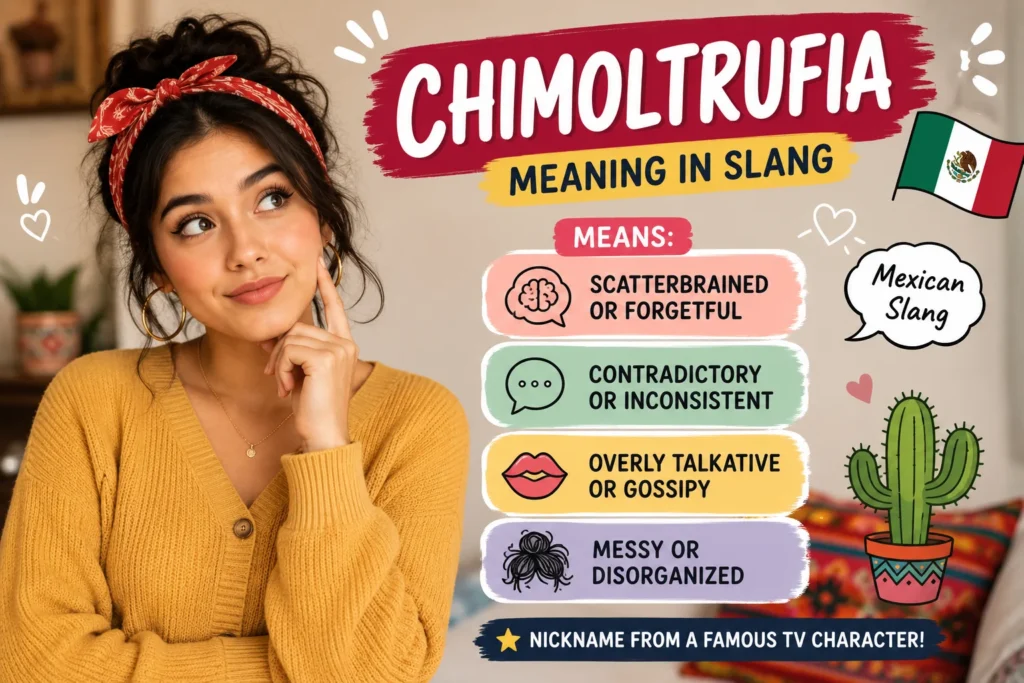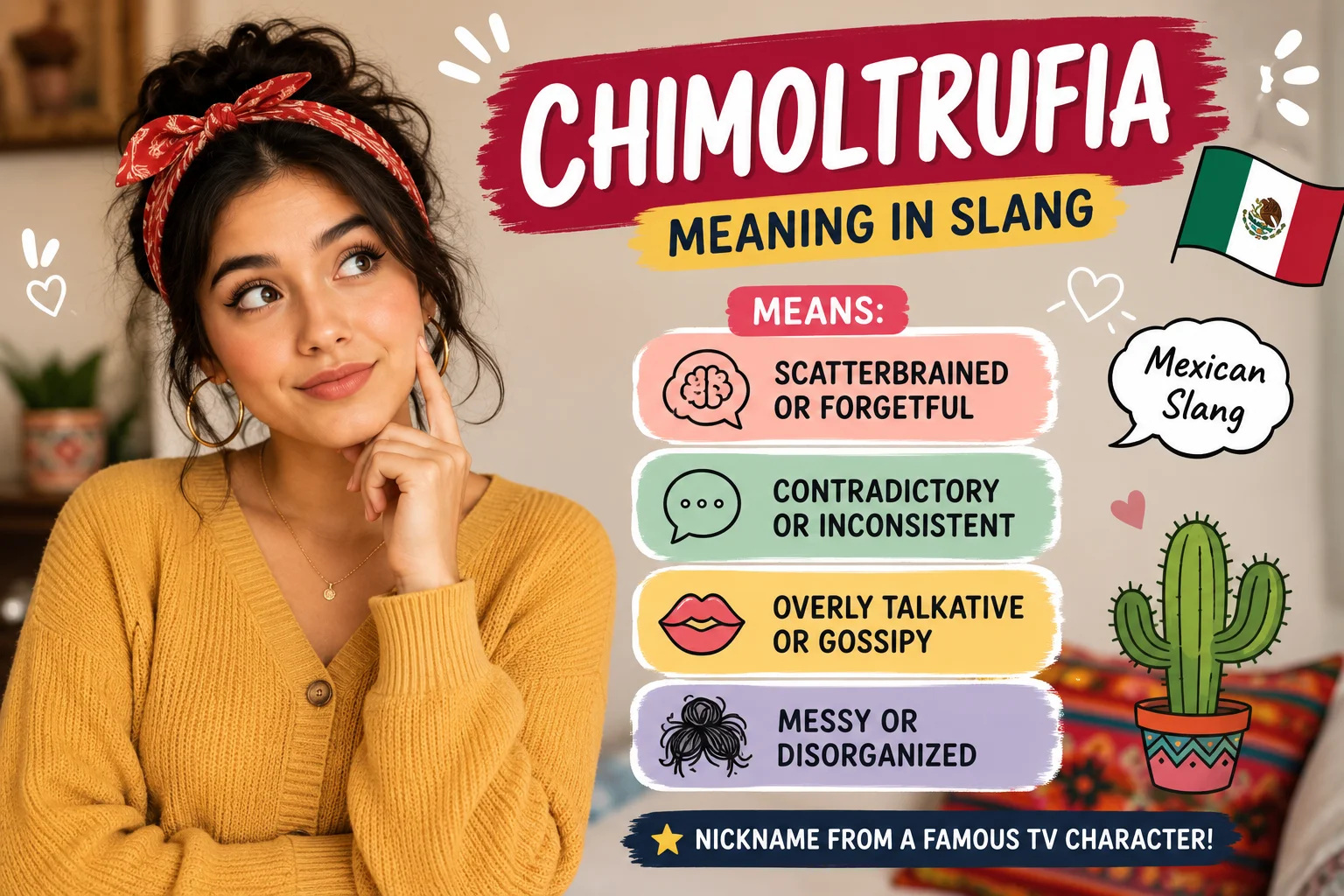
Chimoltrufia is a Mexican slang term used to describe a woman who is scatterbrained, contradictory, overly talkative, messy, or gossipy. The nickname comes from a famous character on the classic Mexican television show Chespirito and later became part of everyday slang in Mexico.
Many people search for the meaning of chimoltrufia after hearing it in Mexican conversations, TV clips, TikTok videos, or social media memes. Because it originated as a fictional character before becoming slang, understanding both its cultural background and modern usage helps avoid misunderstandings.
What Does Chimoltrufia Mean in Slang?
Today, chimoltrufia is most commonly used in Mexican Spanish as an informal nickname for a woman who may be:
- Scatterbrained
- Forgetful
- Contradictory
- Very talkative
- Disorganized
- Gossipy
- Slightly chaotic
The exact meaning depends heavily on the speaker’s tone and relationship with the person being described.
Sometimes it’s used affectionately between friends or family members.
Other times, it can be meant as an insult.
Example
A: You just said the opposite five minutes ago.
B: Did I?
A: You’re such a chimoltrufia today.
In this conversation, the nickname playfully points out someone’s contradictory behavior.
Another example:
A: Where are my keys?
B: Weren’t they in your hand a second ago?
A: Oh… they are.
B: Classic chimoltrufia moment.
Here, the word describes someone acting absent-minded in a humorous way.
Is Chimoltrufia a Slang Word or an Acronym?
Unlike abbreviations such as LOL, BRB, or IDK, chimoltrufia is not an acronym.
Instead, it is a slang noun that originated from a fictional television character and later entered everyday Mexican Spanish.
Today, many speakers use it as:
- A humorous nickname
- A playful description
- An informal insult (depending on context)
Because the meaning comes from culture rather than internet shorthand, it has a much richer history than many modern slang terms.
Where Does the Word Come From?
The word Chimoltrufia originally referred to a beloved fictional character portrayed by Florinda Meza on the classic Mexican television program Chespirito.
The character became famous for:
- Constantly contradicting herself
- Speaking in confusing ways
- Forgetting what she had just said
- Gossiping
- Wearing untidy clothing
- Creating humorous misunderstandings
One of her trademarks was saying one thing and then immediately correcting or contradicting herself, which made audiences laugh.
Over time, viewers began using her name to describe real people who behaved in similar ways.
This is why chimoltrufia eventually became everyday Mexican slang.
Why Is She Called Chimoltrufia?
The nickname is widely understood to be a playful combination of two Spanish words:
- Chimuela (someone missing teeth)
- Atrofiada (atrophied or impaired)
The resulting name was intentionally humorous and exaggerated to match the quirky personality of the television character.
Today, however, most people recognize chimoltrufia as a slang expression rather than thinking about its original word formation.
Other Meanings of Chimoltrufia
Although the primary slang meaning refers to a scatterbrained or contradictory woman, there are a few additional nuances.
A Humorous Nickname
Among close friends or family members, chimoltrufia can simply describe someone who is:
- Forgetful
- Clumsy
- Easily distracted
- Constantly changing their mind
In these situations, the word is often affectionate rather than insulting.
Example:
A: I forgot my phone at home again.
B: You’re becoming a real chimoltrufia.
A Mild Insult
In some parts of Mexico, chimoltrufia may also be used to mock a woman who appears:
- Untidy
- Poorly dressed
- Disheveled
- Unkempt
Because this usage focuses on someone’s appearance, many people consider it rude or disrespectful. It’s best to avoid using the term this way unless you clearly understand the cultural context and have a close relationship with the person.
A Pop Culture Reference
Sometimes the word isn’t being used as slang at all.
Instead, people simply mention La Chimoltrufia, the television character herself.
For example:
My grandparents still watch old Chimoltrufia episodes.
In this case, the speaker is referring to the fictional character rather than describing someone’s personality.
How Chimoltrufia Is Used on Different Platforms
Although the term has its roots in classic television, it continues to appear across modern social media.
TikTok
TikTok is one of the most common places to encounter chimoltrufia today.
Users frequently share:
- Classic Chespirito clips
- Nostalgic Mexican television moments
- Funny comparisons
- Memes about forgetful behavior
Comments often describe someone acting absent-minded or contradicting themselves as chimoltrufia.
On Instagram, the word commonly appears in:
- Meme pages
- Family humor
- Nostalgic posts
- Pop culture accounts
People may jokingly caption a messy situation with:
“Modo chimoltrufia.”
Among Mexican families and close friends, chimoltrufia still appears in everyday chats.
It’s commonly used after someone:
- Misplaces something
- Changes their story
- Forgets an important detail
- Says something contradictory
Because the speakers usually know each other well, the word is often understood as playful teasing.
Snapchat
The term is less common on Snapchat.
When it does appear, it’s usually between Spanish-speaking friends sharing jokes or everyday moments.
X (Formerly Twitter)
On X, chimoltrufia often appears in:
- Political memes
- Humorous observations
- Cultural discussions
- Television nostalgia
Writers sometimes compare public figures to the famous character when pointing out inconsistent statements or contradictory behavior.
Read More: What Does PMG Mean in Slang? 2 Common Meanings Explained
How Common Is Chimoltrufia Today?
The word remains widely recognized in Mexico, especially among people familiar with Chespirito. Younger generations may first encounter it through TikTok clips, memes, or family conversations rather than the original television series itself.
While it isn’t used as frequently outside Spanish-speaking communities, chimoltrufia remains an enduring example of how a fictional character’s personality can become part of everyday language.
Real Chat Examples of Chimoltrufia in Slang
The following conversations show how chimoltrufia is used in everyday Mexican Spanish. In most situations, the word playfully refers to someone who is forgetful, contradictory, messy, or talks more than they listen.
Example 1: Forgetting the Keys
A: Didn’t you leave with your keys?
B: I thought I did.
A: They’re still on the kitchen table.
B: I’m such a chimoltrufia today.
Example 2: Contradicting Yourself
A: You just said you didn’t want pizza.
B: Did I?
A: Now you’re ordering two slices.
B: Okay… maybe I’m being a chimoltrufia.
Example 3: Family Gathering
A: Grandma asked you to bring dessert.
B: I completely forgot.
A: We reminded you three times!
B: Don’t call me a chimoltrufia. 😂
Example 4: Gossip Between Friends
A: Did you hear what happened at work?
B: Tell me everything.
A: You’re such a chimoltrufia—you always know the latest news.
B: Guilty!
Example 5: Messy Bedroom
A: How can you find anything in this room?
B: I know where everything is.
A: It doesn’t look like it.
B: Fine… maybe I’m a little chimoltrufia.
Example 6: TikTok Comments
A: She keeps changing her story in every video.
B: Total chimoltrufia energy.
A: That’s exactly what I was thinking.
B: The comments noticed it too.
Example 7: Shopping Trip
A: Didn’t you come here for milk?
B: Yes.
A: Then why are you leaving with candles and snacks?
B: Classic chimoltrufia moment.
Example 8: Workplace Friends
A: You sent the wrong file again.
B: Seriously?
A: Double-check before you click send.
B: My inner chimoltrufia is showing today.
Example 9: Watching Old TV
A: My parents love this character.
B: That’s La Chimoltrufia.
A: Now I understand where the nickname comes from.
B: Exactly.
Example 10: WhatsApp Chat
A: I left my phone in the refrigerator.
B: 😂 How does that even happen?
A: Don’t ask.
B: You’re becoming a chimoltrufia.
Example 11: Less Playful Use
A: Did you hear what he called her?
B: He said she looked like a chimoltrufia.
A: That wasn’t very kind.
B: Yeah, it sounded insulting.
In this example, the word refers to someone’s appearance rather than their personality, showing why context and tone matter.
Chimoltrufia in Different Tones
The same word can sound humorous, affectionate, sarcastic, or critical depending on how it’s delivered.
Funny
A: I spent ten minutes looking for my glasses.
B: Where were they?
A: On my head.
B: You’re such a chimoltrufia. 😂
Playful
A: I changed my mind again.
B: Again?
A: I can’t decide.
B: That’s my favorite chimoltrufia.
Sarcastic
A: First you agreed, then disagreed, then agreed again.
B: I changed my opinion.
A: More like full chimoltrufia mode.
B: Very funny.
Serious
A: Someone called her a chimoltrufia at work.
B: Were they joking?
A: It didn’t sound like it.
B: That’s probably not appropriate in a professional setting.
Grammar and Language Role
Unlike many internet abbreviations, chimoltrufia behaves like a regular Spanish noun.
Part of Speech
Chimoltrufia is primarily a noun.
It refers to a person, usually a woman, who displays the traits associated with the famous television character.
Example:
Ella es una chimoltrufia.
(“She is a chimoltrufia.”)
In English conversations, bilingual speakers may also use it as a nickname.
Sentence Position
The word most naturally appears:
- After a linking verb
- As a nickname
- As a playful label
Examples:
She’s a chimoltrufia.
Don’t be such a chimoltrufia.
My aunt calls herself a chimoltrufia.
Can It Replace a Full Sentence?
Not usually.
Unlike abbreviations such as LOL or OMG, chimoltrufia normally forms part of a sentence rather than standing alone.
However, among close friends, someone might jokingly reply:
Chimoltrufia!
after watching someone do something forgetful.
Formal vs. Informal Register
| Situation | Appropriate? |
|---|---|
| Family conversations | ✅ Yes |
| Friendly jokes | ✅ Yes |
| WhatsApp chats | ✅ Yes |
| TikTok comments | ✅ Yes |
| Instagram memes | ✅ Yes |
| Casual storytelling | ✅ Yes |
| Workplace meetings | ❌ Usually no |
| Business emails | ❌ No |
| Academic writing | ❌ No |
Because the word is slang, it’s best reserved for informal settings.
How to Reply if Someone Calls You Chimoltrufia
Your response depends on whether the speaker is teasing you affectionately or using the word critically.
Funny Reply
- “I’ll forget this conversation in five minutes anyway!”
- “That’s just part of my charm. 😂”
- “At least I keep life interesting.”
Serious Reply
- “I know I’m forgetful sometimes.”
- “Fair enough—I wasn’t paying attention.”
- “I’ll try to do better next time.”
Flirty Reply
If the conversation is already lighthearted:
- “So you’re saying I’m unforgettable?”
- “Only because you keep distracting me.”
- “You’ll have to help this chimoltrufia remember.”
Neutral Reply
- “Maybe you’re right.”
- “Good point.”
- “I’ll be more careful.”
- “I didn’t realize I was doing that.”
Comparison Table
| Term | Meaning | Usage Context | Tone | Popularity | Confusion Risk |
|---|---|---|---|---|---|
| Chimoltrufia | Scatterbrained, contradictory or messy woman | Mexican slang | Playful or critical | High (Mexico) | Medium |
| Chismosa | Gossipy person | Everyday conversation | Negative or teasing | High | Low |
| Despistada | Absent-minded or forgetful | Casual conversation | Neutral | High | Low |
| Metiche | Nosy person | Informal slang | Negative | High | Low |
| Dramática | Overly dramatic person | Social conversations | Playful | Medium | Low |
| Organizada (opposite) | Organized person | General conversation | Positive | High | Low |
Who Uses the Term?
Teenagers (13–19)
Many teenagers first encounter chimoltrufia through family members, TikTok videos, memes, or clips from classic Mexican television. Some use it jokingly with friends, although younger speakers may not always know its original TV origin.
Young Adults (20–35)
Young adults commonly recognize the word through parents, grandparents, or internet culture. They often use it humorously to describe forgetful friends or people who constantly contradict themselves.
Adults Over 35
Older generations are generally the most familiar with the character from Chespirito. They are also the most likely to use chimoltrufia in everyday conversation because they remember the original television series.
Gen Z vs. Millennials
Gen Z
Gen Z usually discovers chimoltrufia through short-form videos, reaction memes, and nostalgic social media content. Many understand the slang without having watched the full television show.
Millennials
Millennials are more likely to recognize both the character and the slang. For many, the word carries nostalgic value because they grew up watching reruns of Chespirito.
Regional Usage
Chimoltrufia is strongly associated with Mexico, where both the television character and the slang became widely known.
The word is also understood in many Spanish-speaking communities across Latin America due to the popularity of Chespirito, although the frequency of everyday use varies by country.
Outside Spanish-speaking communities, the term is relatively uncommon and is usually encountered by people interested in Mexican culture, television history, or Spanish-language slang.
Where You’re Most Likely to See Chimoltrufia Today
Today, the term appears most often on:
- TikTok
- X (formerly Twitter)
- YouTube comments
- Family group chats in Spanish
Most modern uses either reference the iconic television character or humorously describe someone acting forgetful, contradictory, or disorganized.
Origin and Internet Culture
The slang term chimoltrufia comes directly from La Chimoltrufia, a memorable character portrayed by Florinda Meza on the classic Mexican comedy program Chespirito. The character became famous across Mexico and much of Latin America for her humorous personality, unique way of speaking, and habit of contradicting herself.
Over time, audiences stopped using Chimoltrufia only as a character’s name and began applying it to real people who displayed similar traits. This shift from a fictional nickname to an everyday slang expression is why the word has remained recognizable for decades.
How the Character Influenced the Slang
La Chimoltrufia was known for several distinctive characteristics:
- Constantly changing what she said
- Speaking in confusing or roundabout ways
- Being forgetful and absent-minded
- Gossiping about everyday situations
- Wearing mismatched or untidy clothing
- Creating humorous misunderstandings
Because these personality traits became so iconic, the character’s name eventually turned into shorthand for describing someone with similar behavior.
The Name’s Origin
The nickname Chimoltrufia is widely understood to be a playful blend of the Spanish words:
- Chimuela (someone missing teeth)
- Atrofiada (atrophied or impaired)
The unusual combination was intentionally created for comedy and reflected the quirky, exaggerated personality of the television character rather than serving as a literal description.
Chimoltrufia in Modern Internet Culture
Although Chespirito first aired decades ago, chimoltrufia continues to appear in online conversations.
Today, the word frequently shows up in:
- TikTok nostalgia videos
- Instagram memes
- Facebook posts about classic television
- X (formerly Twitter) discussions
- YouTube clips featuring scenes from Chespirito
Many younger users discover the slang through short video clips or memes before learning about the original television series.
Unlike many internet slang terms that disappear after a few years, chimoltrufia has remained culturally relevant because it is tied to a beloved television character rather than a temporary online trend.
Is Chimoltrufia Rude or Offensive?
The answer depends on how and why it is used.
Is It Profanity?
No.
Chimoltrufia does not contain profanity, vulgar language, or explicit content.
Can It Be Offensive?
Yes, sometimes.
Among close friends and family members, calling someone a chimoltrufia is often intended as lighthearted teasing about forgetfulness, disorganization, or constantly changing opinions.
However, if the term is used to criticize someone’s appearance or intelligence, it may feel insulting.
Is It Appropriate at School or Work?
Generally, it’s best to avoid using chimoltrufia in formal settings.
While the word itself isn’t offensive, it is still slang and may be misunderstood by people unfamiliar with its cultural background.
For professional communication, it’s better to describe someone’s behavior directly instead of using a nickname.
Cultural Sensitivity
Because chimoltrufia is closely connected to Mexican television history, people outside Mexico may not recognize its meaning.
If you’re speaking with someone unfamiliar with the character, explaining the reference can help avoid confusion.
It’s also worth remembering that not everyone appreciates being compared to a comedic character, even if the comment is intended as a joke.
Real-World Observation
One reason chimoltrufia has survived for so many years is that it describes a personality type people immediately recognize. Nearly everyone knows someone who forgets where they put their phone, changes their mind several times in one conversation, or tells a story that keeps taking unexpected turns. Instead of listing all those traits, many Mexican Spanish speakers simply say “chimoltrufia.” The word captures an entire personality in a single nickname, which explains why it continues to appear in everyday conversations, family jokes, and social media memes decades after the original television character debuted.
Frequently Asked Questions
What does chimoltrufia mean in Mexican slang?
In Mexican slang, chimoltrufia usually describes a woman who is scatterbrained, contradictory, overly talkative, or somewhat disorganized. The meaning comes from the famous television character of the same name. Depending on the speaker’s tone, it can be affectionate, humorous, or mildly insulting.
Where does the word chimoltrufia come from?
The word comes from La Chimoltrufia, a fictional character played by Florinda Meza on the classic Mexican television program Chespirito. The character became so popular that her name eventually entered everyday speech as slang.
Is chimoltrufia an insult?
Sometimes.
Among friends or relatives, it’s often used playfully to tease someone who is forgetful or chaotic. However, using it to criticize a stranger or mock someone’s appearance may be considered disrespectful.
Is chimoltrufia still used today?
Yes.
Although the television series is decades old, the term still appears in conversations, family jokes, memes, and nostalgic social media posts. Many younger people first encounter it through TikTok clips or internet humor.
Does chimoltrufia only refer to women?
Traditionally, the word refers to a woman because it comes from a female television character. While some people may jokingly use it more broadly, its original and most common usage is feminine.
Why do people call someone a chimoltrufia?
People use the nickname when someone behaves in a way that resembles the famous character—for example, by forgetting things, changing opinions frequently, gossiping, or acting in a humorous, disorganized manner.
Is chimoltrufia used outside Mexico?
Yes, but less frequently.
Because Chespirito was broadcast throughout Latin America, many Spanish-speaking audiences recognize the character and the slang. However, everyday usage is strongest in Mexico.
Can chimoltrufia describe someone’s appearance?
In some contexts, yes.
Historically, the term has occasionally been used to mock someone who appears messy or poorly dressed. Because this usage can be offensive, it’s generally best to avoid using the word to comment on another person’s appearance.
What does chimoltrufia literally mean?
The name itself is a humorous fictional creation associated with the television character. Today, most people understand it through its slang meaning rather than its literal word formation.
Is chimoltrufia a real Spanish word?
Yes. Although it began as a fictional name, chimoltrufia has become a recognized slang term in Mexican Spanish because of its widespread cultural use.
Who created Chimoltrufia?
The character La Chimoltrufia was portrayed by Florinda Meza as part of the classic Mexican comedy series Chespirito. Her performance made the character one of the show’s most memorable personalities.
Why is chimoltrufia popular on TikTok?
Many TikTok creators share classic clips from Mexican television or create memes comparing everyday situations to the character’s funny behavior. This has introduced the slang to younger audiences who may not have watched the original show.
Is chimoltrufia positive or negative?
It depends on context.
Among friends, it’s often affectionate and humorous. In more critical situations, it can become an insult, especially if it’s directed at someone’s appearance or intelligence.
Can I call my friend chimoltrufia?
If your friend understands the cultural reference and enjoys playful teasing, they may find it funny. However, because not everyone interprets the word the same way, it’s best to consider your relationship and the situation before using it.
Conclusion
Chimoltrufia is much more than a slang word—it’s a cultural reference that has become part of everyday Mexican Spanish. Originating from the unforgettable television character played by Florinda Meza, the term is now commonly used to describe someone who is forgetful, contradictory, talkative, or delightfully disorganized.
While the nickname is often used humorously among friends and family, context is essential. Depending on tone, it can sound affectionate, playful, or mildly insulting. Understanding its television roots makes it easier to appreciate why the word has remained popular for generations.
Usage Tips
- Use chimoltrufia only in informal conversations.
- Remember that it refers to behavior more often than appearance.
- Consider your relationship with the other person before using it.
- Understand the cultural reference to avoid misunderstandings.
Common Mistakes
- Assuming it’s simply another internet slang term.
- Using it in formal or professional communication.
- Thinking it always has a negative meaning.
- Using it to criticize someone’s appearance, which may be offensive.
When to Use Chimoltrufia
Use the term in casual conversations, family chats, humorous storytelling, or discussions about Mexican culture and classic television where the audience understands the reference.
When to Avoid Chimoltrufia
Avoid using it in business settings, academic writing, or with people who may find the nickname disrespectful or who are unfamiliar with its cultural background.