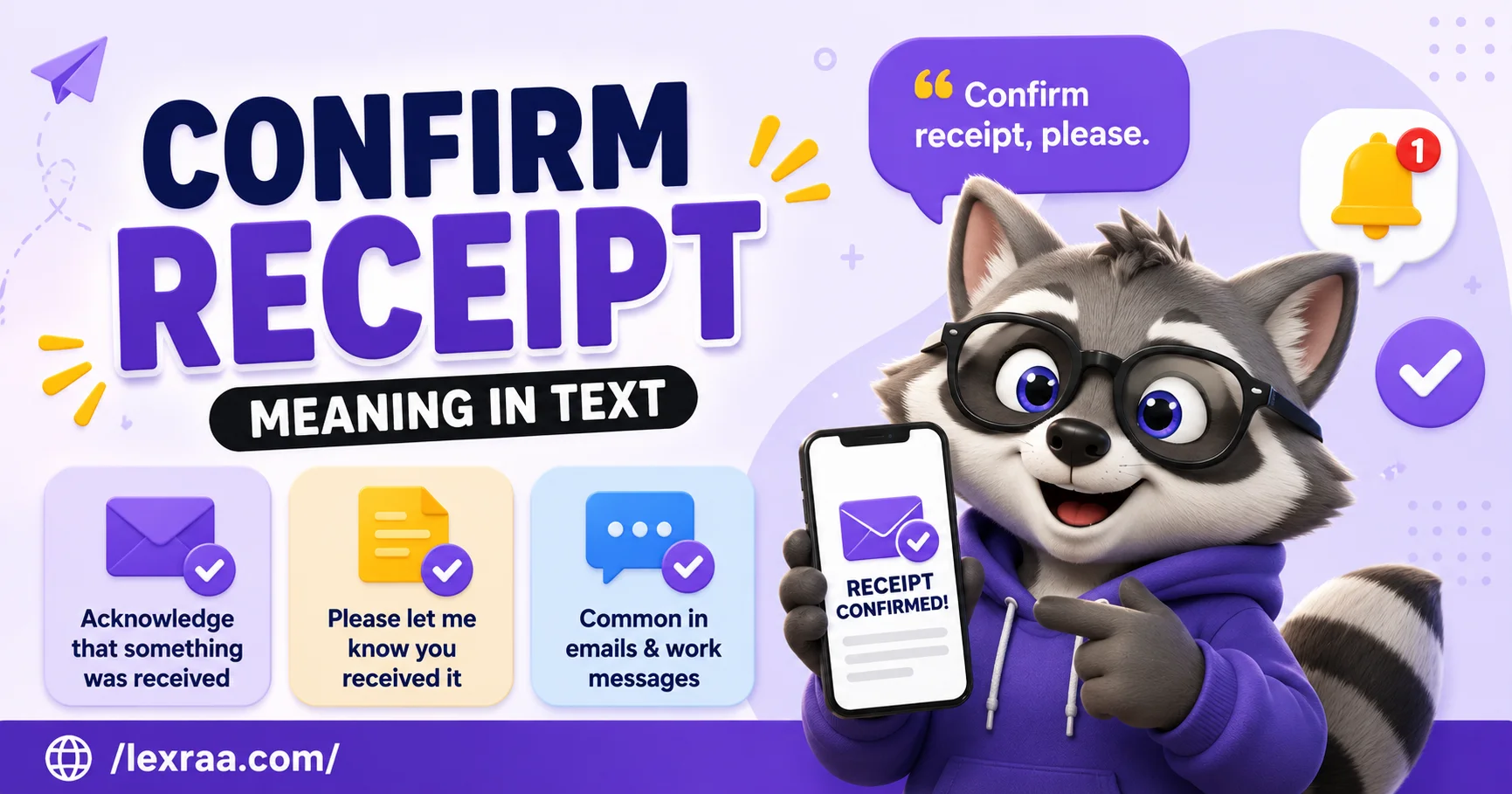
When someone says “confirm receipt” in a text, email, or message, they are asking you to let them know that you received something. It usually means “please tell me you got this,” especially when the message, document, payment, or file is important.
What Does “Confirm Receipt” Mean in Text?
“Confirm receipt” means acknowledge that something has been received. The “something” could be a text message, email, document, photo, payment, attachment, application, or other piece of information.
For example, if your manager texts, “I sent the updated schedule. Please confirm receipt,” they are not necessarily asking you to comment on the schedule. They simply want confirmation that the message or file reached you.
In plain English, you could translate it as:
- “Please let me know you got it.”
- “Can you confirm that you received this?”
- “Tell me when you receive it.”
- “Please acknowledge that it arrived.”
The phrase is particularly common in professional and official communication. Current language references describe “confirm receipt” as a standard expression for acknowledging that something has been received.
Is “Confirm Receipt” Slang or an Abbreviation?
No. “Confirm receipt” is not slang, an acronym, or a texting abbreviation. It is a formal phrase made from the verb “confirm” and the noun “receipt.”
That distinction matters because a search for “confirm receipt meaning in text” might make the phrase look like another internet shorthand term. It isn’t. Unlike abbreviations such as “LOL” or “WDYM,” the words are being used in their ordinary English meanings.
“Confirm” means to establish or state that something is true or has happened. In this phrase, “receipt” refers to the act of receiving something. Dictionaries also list “confirm receipt” as an established collocation in English.
What Does “Please Confirm Receipt” Mean?
“Please confirm receipt” is a polite but formal request for acknowledgment.
Suppose someone sends:
“I’ve attached the signed contract. Please confirm receipt.”
They want you to respond that you received the contract. A simple answer such as “Confirmed, I received it” normally satisfies the request.
The phrase can also be used with payments, applications, packages, invoices, notices, and other important items. Business-writing sources consistently identify these situations as common uses because the sender wants a clear record that the material reached the intended recipient.
Does “Confirm Receipt” Mean You Read It?
Not necessarily. This is one of the most important distinctions.
Confirming receipt normally establishes that you received something. It does not automatically establish that you carefully read, understood, agreed with, or approved its contents.
For example:
“Please confirm receipt of the policy document.”
A reply such as “Received, thank you” confirms that the document arrived. It does not necessarily mean the person has finished reading the policy.
This distinction can matter at work. Someone might confirm receipt immediately and review the document later. A receipt confirmation is therefore different from a statement such as “I have reviewed and approved the document.”
Confirm Receipt vs. Read vs. Acknowledge
These expressions overlap, but they are not identical.
| Phrase | Meaning | Tone | Popularity | Confusion Risk |
|---|---|---|---|---|
| Confirm receipt | Verify that something was received | Formal | High in professional writing | Low |
| Acknowledge receipt | Formally recognize that something was received | Very formal | High in official writing | Medium |
| Confirm you received it | Tell someone you got it | Neutral | High | Low |
| Read it | Indicate that you looked at the content | Neutral | Very high | Medium |
| Got it | Say you received/understood something | Casual | Very high | Medium |
| Ignore it | Do not respond or acknowledge it | Opposite | Common | Low |
The practical difference is simple: receipt is about getting something; reading is about looking at its contents; approval is about agreeing with it.
That three-step distinction prevents a surprisingly common misunderstanding.
“Confirm Receipt” Does Not Mean “I Agree”
Another useful distinction is between receiving information and accepting information.
Imagine a company sends an employee a revised policy and asks for confirmation of receipt. The employee might respond:
“I confirm receipt of the policy.”
That does not necessarily mean:
“I agree with the policy.”
It only confirms that the employee received it.
Likewise, confirming receipt of an invoice does not necessarily mean the recipient agrees with every amount listed on the invoice. If agreement is required, the sender normally needs to ask for approval or another specific response.
This is one reason the phrase is useful in formal communication: it separates delivery acknowledgment from later actions.
Where Is “Confirm Receipt” Used?
There is no reliable reason to treat “confirm receipt” as a TikTok-, Snapchat-, Instagram-, or Gen Z-specific expression. The phrase is primarily associated with written professional, administrative, business, academic, and official communication.
It can appear in:
- Emails
- Workplace messaging
- Text messages
- Business correspondence
- Official notices
- Document exchanges
- Payment communications
- Application-related communication
Search results also show examples involving email, documents, payments, applications, and other business materials.
That does not mean the phrase cannot appear in a casual text. Someone might text a friend “Confirm receipt 😂” as a joke. But that playful use builds on the phrase’s formal meaning rather than representing a separate slang definition.
Where Did “Confirm Receipt” Come From?
There is no clear internet-slang origin for “confirm receipt.” The phrase is ordinary English business language rather than a recently invented texting abbreviation.
Its meaning is also straightforwardly compositional: “confirm” asks for verification, while “receipt” refers to receiving something. Dictionary references recognize “confirm receipt” as a normal English collocation and provide examples from formal contexts such as letters, applications, payments, and official notifications.
Because there is no credible evidence pointing to a particular social-media community, meme, or subculture as the source of the phrase, it would be misleading to assign it a specific internet origin.
Examples of “Confirm Receipt” in Different Contexts
1. Serious — Manager and Employee
Manager: I sent the revised project schedule. Please confirm receipt.
Employee: Confirmed. I received the schedule.
Manager: Thanks. Please review the changes before tomorrow’s meeting.
Employee: Will do.
Here, the manager wants acknowledgment that the schedule arrived, not an immediate review.
2. Funny — Friends
Alex: I just sent you 47 vacation photos.
Sam: I see them.
Alex: Please confirm receipt of this extremely important evidence.
Sam: Receipt confirmed. My storage space is not okay.
The formal phrase is being used humorously because the situation is completely casual.
3. Sarcastic — Group Chat
Mia: I sent the group the restaurant address.
Leo: Got it.
Mia: Please confirm receipt in triplicate.
Leo: Confirmed, stamped, notarized, and framed.
The joke comes from deliberately making a simple acknowledgment sound bureaucratic.
4. Playful — Dating
Jamie: Sent you the playlist I promised.
Taylor: I got it 👀
Jamie: Confirm receipt?
Taylor: Receipt confirmed. Now I’m judging your music taste.
Here, the phrase is intentionally more formal than necessary, making the exchange playful.
5. Workplace Email
Supervisor: Please confirm receipt of the attached report.
Employee: Confirmed. I received the report and will review it this afternoon.
Supervisor: Perfect. Let me know if anything needs clarification.
The response confirms receipt and separately states the next action.
6. Family Text
Parent: I sent the appointment details to your email. Please confirm receipt.
Child: Got it.
Parent: You actually got the email?
Child: Yes 😂 I promise.
The formal wording can sound slightly unusual in family conversation, but the meaning remains clear.
7. Client Communication
Client: The revised invoice is attached.
Business: Thank you. Please confirm receipt.
Client: Confirmed. We received the revised invoice.
Business: Thank you for confirming.
This is a straightforward professional acknowledgment.
8. Group Project
Student A: I uploaded the final presentation to the shared folder.
Student B: I can see it.
Student A: Can everyone confirm receipt?
Student C: Confirmed. I have access.
Here, the request makes sure every participant can access the file before the project deadline.
9. Payment Context
Customer: The payment has been sent.
Business: Thank you. We will confirm receipt once the funds reach the account.
Customer: Okay, thanks.
This is slightly different from asking the customer to confirm receipt. The business itself is promising to acknowledge the incoming payment.
10. Casual Text Used Seriously
Friend: I sent the address because the location changed.
Friend: Please confirm receipt so you don’t end up at the old place.
Other friend: Got it. New address received.
Friend: Perfect.
The wording is more formal than “Did you get it?” but can still be perfectly understandable in a text.
Read More: BW Meaning Explained: Texting, Snapchat & Social Media
How Should You Reply to “Confirm Receipt”?
Your response should match the situation and what you actually received.
Neutral Reply
“Received, thank you.”
This is short and works well when the sender only wants acknowledgment.
Serious or Professional Reply
“I confirm receipt of the document. Thank you.”
This is appropriate when the original message is formal or when a clear written record is useful.
Friendly Reply
“Got it, thanks!”
There is no need to imitate formal wording when the conversation is casual.
Funny Reply
“Receipt confirmed. Loud and clear 😂”
This works when the sender is a friend or coworker who is clearly being playful.
If You Received It but Haven’t Read It
Be precise:
“Received. I haven’t had a chance to review it yet, but I’ll look at it shortly.”
That response is better than implying you have reviewed something when you have only received it.
If You Didn’t Receive It
Say so directly:
“I haven’t received it yet. Could you resend it?”
A confirmation should be truthful. If the attachment is missing or the message never arrived, there is nothing to confirm.
Who Uses “Confirm Receipt”?
Because this is formal English rather than slang, it is not especially useful to divide its users into Gen Z versus Millennials.
It is more strongly associated with professional and official communication than with a particular age group. Managers, employees, customers, students, organizations, and individuals handling important documents can all use it when acknowledgment matters.
The phrase also appears across both American and British English. Dictionary examples from Collins include formal uses involving applications, letters, payments, and official requests.
There is no strong evidence that “confirm receipt” belongs specifically to one generation, gender, or online community.
Is “Confirm Receipt” Rude or Safe?
It is generally safe, professional, and non-offensive. There is no profanity or inherently insulting language in the phrase.
The main issue is tone, not offensiveness.
“Please confirm receipt” can sound stiff if sent to a close friend about something trivial. For example, texting a friend “Please confirm receipt of my meme” may sound intentionally formal or humorous.
In a workplace, however, the same phrase can be entirely appropriate when dealing with documents, deadlines, invoices, or important instructions.
If you want a warmer professional tone, alternatives such as “Please let me know once you’ve received this” or “Could you confirm that you received this?” can sound more conversational.
Why Does “Confirm Receipt” Work So Well?
The phrase survives because it solves a very specific communication problem: silence does not tell the sender whether something arrived. An email can be overlooked, an attachment can fail to download, or a message can go to the wrong person. A short confirmation closes that uncertainty.
It is also efficient because it separates two questions that people often mix together: Did you get it? and What do you think about it? “Confirm receipt” asks only the first question. That narrow purpose makes it useful whenever delivery needs to be documented before the conversation moves on.
Frequently Asked Questions
Is “confirm receipt” formal?
Yes. “Confirm receipt” is generally formal or professional rather than casual slang. It is especially common in business, administrative, official, and document-related communication. In an everyday text, “Got it” or “I received it” may sound more natural.
What does “please confirm receipt of this email” mean?
It means the sender wants you to reply and verify that you received the email. It does not necessarily mean that you have fully read or reviewed everything inside it. A simple “Received, thank you” is usually enough unless the sender asks for additional action.
Does confirming receipt mean I agree?
No. Confirming receipt normally means only that you received the material. Agreement, approval, acceptance, or consent are separate actions and should not automatically be inferred from a receipt confirmation.
Is “confirm receipt” the same as “acknowledge receipt”?
They are very similar and are often interchangeable. “Acknowledge receipt” can sound somewhat more formal or official, while “confirm receipt” is straightforward and widely understood. Both generally communicate that something was received.
Can I say “confirm received”?
In standard English, “confirm receipt” or “confirm that you received it” is the safer construction. “Receipt” is a noun, while “received” is normally used as part of a verb phrase. For example, “Please confirm receipt of the document” is natural and grammatical.
What is the difference between “confirm receipt” and “read receipt”?
“Confirm receipt” usually requires a person to respond and acknowledge receiving something. A read receipt is generally a system-generated indication associated with a messaging or email service that a message was opened or viewed. Neither should automatically be treated as proof that the recipient understood or agreed with the content.
What should I say if someone asks me to confirm receipt?
If you received the item, a simple response such as “Received, thank you” works. For a more formal exchange, you can say “I confirm receipt of the document.” If you received it but have not reviewed it, say that clearly rather than implying that the review is complete.
Can “confirm receipt” be used in a casual text?
Yes, but it can sound formal depending on the relationship and situation. Friends sometimes use formal expressions jokingly, such as “Please confirm receipt of this meme.” In ordinary casual conversation, “Got it” or “Did you get this?” is usually more natural.
Conclusion
“Confirm receipt” simply means to acknowledge that you received something. It is a formal English phrase, not a slang term or texting abbreviation.
The most important thing to remember is that receiving is not the same as reading, agreeing, or approving. If someone asks you to confirm receipt of an email, file, document, payment, or message, they normally just want a clear acknowledgment that it reached you.
For professional situations, “Received, thank you” is usually enough. For casual conversations, “Got it!” sounds more natural. And if you have received something but have not reviewed it, make that distinction clear.
The phrase is best used when the sender genuinely needs certainty that something arrived. When that certainty does not matter, simpler wording usually makes the conversation feel more natural.