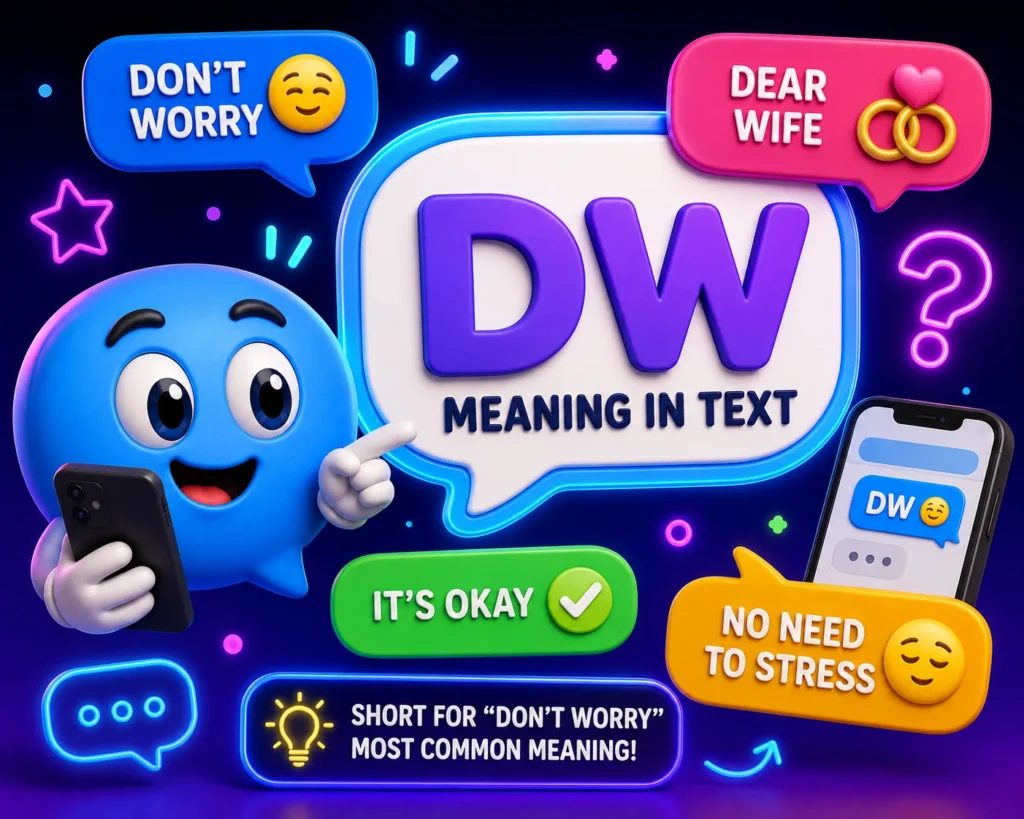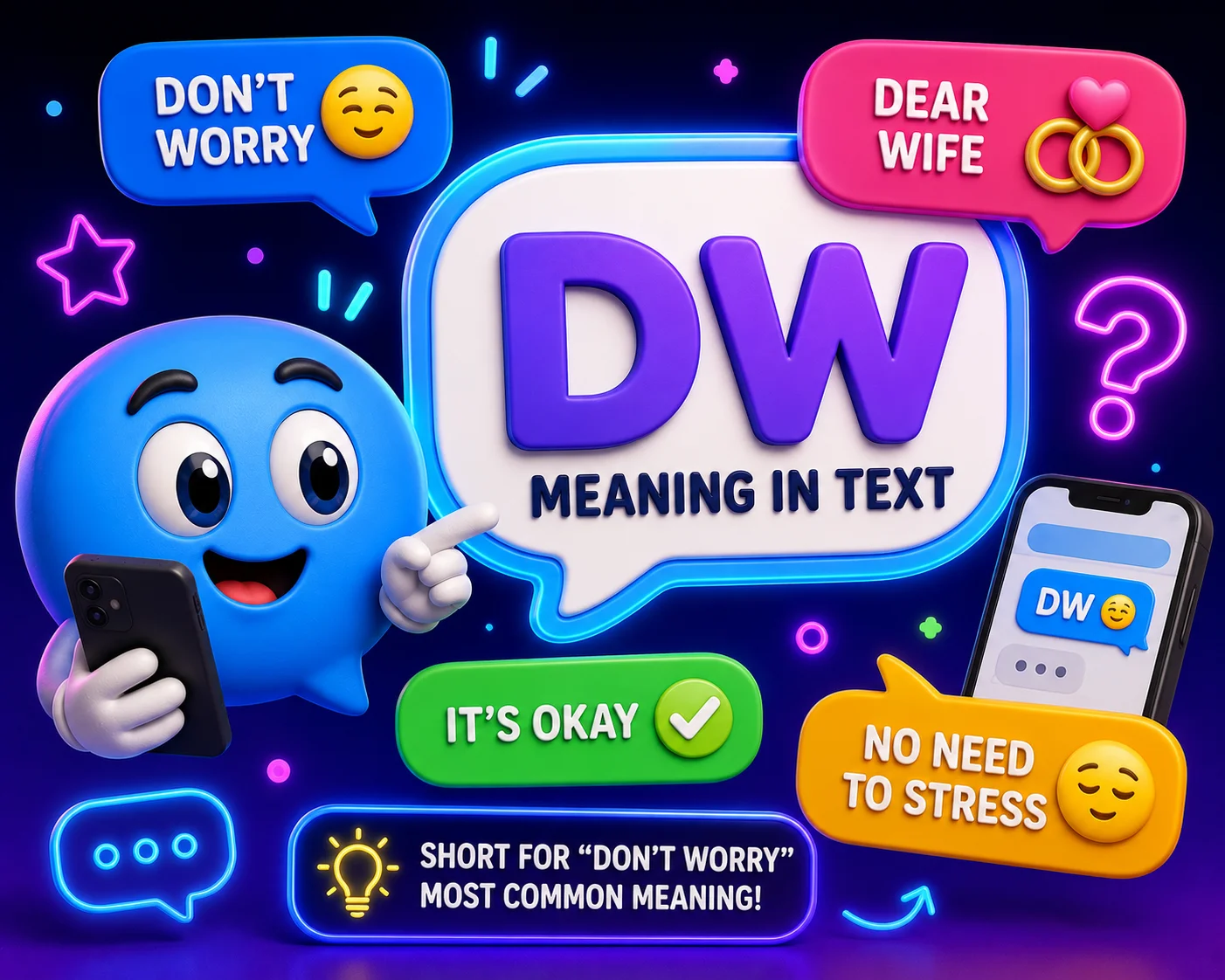
DW in text usually means “don’t worry.” It is an informal abbreviation used to reassure someone, tell them not to stress, or let them know that a situation is okay. Depending on context, DW can also mean “dear wife,” but “don’t worry” is the usual meaning in casual messaging.
What Does DW Mean in Text?
When someone sends “dw” in a text, they are normally shortening “don’t worry.” It can mean “it’s okay,” “no need to stress,” “everything is fine,” or “you don’t have to be concerned.”
For example:
“Sorry I’m running late.”
“DW, take your time.”
Here, DW is simply a quick reassurance.
The abbreviation can appear at the beginning or end of a message:
- “DW, I already handled it.”
- “I’ll be there soon dw.”
- “dw about it.”
- “You’re fine, dw 😊”
It is better described as an initialism or informal abbreviation than as a traditional slang word. The letters represent the first letters of “don’t worry,” and people generally understand them individually rather than pronouncing “DW” as a normal word.
The Most Common Meaning: “Don’t Worry”
The main meaning of DW in texting is “don’t worry.” It is normally used when someone wants to reduce another person’s concern.
You might see it after an apology:
“Sorry I forgot to call.”
“DW, it happens.”
It can also appear when somebody is nervous:
“I’m scared I’m going to mess this up.”
“DW, you’ve got this.”
Another common use is to dismiss a small problem:
“I spilled some water on the table.”
“DW, I’ll clean it.”
In each example, the underlying message is similar: the situation is not serious enough to worry about.
The abbreviation is especially useful in fast conversations because “dw” communicates the same basic idea as “don’t worry” while requiring only two letters.
Does DW Mean “Don’t Worry About It”?
Sometimes, yes—but technically DW stands for “don’t worry,” not specifically “don’t worry about it.”
Context can make the shorter expression carry the longer meaning.
For example:
“Sorry I broke your charger.”
“DW.”
The sender probably means something closer to “Don’t worry about it” or “It’s okay.”
By contrast:
“DW, I’ll call you when I get home.”
Here, it simply means “Don’t worry.”
So it is better not to treat “DW” as a completely separate abbreviation for every variation of the phrase. The basic expression is “don’t worry,” while the exact interpretation comes from the surrounding message.
Read More: HM Meaning in Text: Why That Tiny Reply Says So Much
A Common Misunderstanding: DW Is Not Automatically Rude
A short “dw” can sometimes look cold, dismissive, or uninterested, but that does not mean the abbreviation itself is rude.
Tone depends heavily on context.
Compare:
“dw ❤️”
with:
“dw.”
The first may feel warm and reassuring because of the emoji and conversational setting. The second could feel more abrupt, particularly if someone is discussing something emotionally serious.
That difference is a feature of digital communication, where readers cannot hear voice tone or see facial expressions.
In fact, real users sometimes report different reactions to the abbreviation. Some people use “dw” frequently in texting, while others rarely encounter it. That means familiarity itself can affect how the message feels.
Other Real Meanings of DW
Although “don’t worry” is the dominant meaning in casual text conversations, DW has other established meanings.
DW = Dear Wife or Darling Wife
In some online communities, particularly discussions involving marriage or family life, DW can mean “dear wife” or “darling wife.”
Oxford lists both “darling wife” and “dear wife” as informal meanings used especially in text messages and social media.
For example:
“DW and I are going on vacation next month.”
In a conversation about someone’s marriage, DW may refer to the writer’s wife rather than mean “don’t worry.”
This meaning is much easier to identify from context. If the sentence is talking about a person’s spouse, “dear wife” makes sense. If someone is responding to an apology, “don’t worry” is much more likely.
DW in Other Fields
Outside casual messaging, DW can represent completely different terms. Abbreviations.com, for example, lists meanings including data warehouse, distilled water, Deutsche Welle, dry weight, doing well, and “don’t worry.”
These meanings should not automatically be interpreted as internet slang.
For a message such as:
“DW, I got home safely.”
“Don’t worry” is obvious.
But in a technical document discussing databases, DW may mean data warehouse. Context determines the meaning.
Where Is DW Used?
There is no single social-media platform that owns the abbreviation. DW is a general internet and messaging abbreviation, so it can appear in different types of online communication.
DW on Snapchat
DW is commonly documented on Snapchat, where it is generally used to mean “don’t worry.” It can appear in private messages, replies, or casual interactions.
Example:
“Sorry I disappeared yesterday.”
“DW 😂”
The response means the person is not upset about the delay.
DW on Instagram
On Instagram, DW can appear in DMs, comments, and replies. The same “don’t worry” interpretation usually applies when the surrounding conversation is casual. Sources discussing the abbreviation specifically include Instagram among the platforms where it appears.
DW on WhatsApp
WhatsApp conversations often involve friends, family members, classmates, and coworkers, making DW useful when someone wants to reassure another person quickly.
“I might be five minutes late.”
“DW, we’re still here.”
Again, the abbreviation is not a special WhatsApp code. It is simply internet shorthand being used inside WhatsApp.
DW on TikTok
DW can also appear in TikTok comments and replies, particularly when users are responding casually to another person’s concern or mistake. However, usage can vary considerably from one online community to another, so it should not be assumed that every TikTok occurrence has the same meaning.
DW on X
On X, formerly Twitter, DW can occur in replies and casual posts. Because X combines ordinary conversation, fandoms, news discussions, and specialized communities, context becomes particularly important.
The important point is that DW is not platform-specific slang. It is a general abbreviation that travels between messaging services and social networks.
Where Did DW Come From?
There is no reliably documented single person, message, or date that can be identified as the inventor of DW meaning “don’t worry.”
The abbreviation fits the broader development of internet shorthand, where users shortened frequently typed phrases to make online conversations faster.
Some sources place its emergence in the 1990s, during the growth of internet chatrooms, bulletin boards, IRC, and instant messaging. However, that should be treated as a historical estimate rather than a proven invention date.
A particularly useful piece of evidence is the early internet usage documented in Urban Dictionary. An entry dated July 27, 2003 records “dw” as “don’t worry,” while another 2005 entry specifically describes it as being used in MSN and AIM.
That does not prove that 2003 was the first-ever use. It simply gives us an early searchable record of the abbreviation in internet slang.
So the safest conclusion is:
The exact origin is unclear, but DW belongs to the older tradition of online shorthand that developed alongside early internet chat and instant messaging.
DW in Different Tones
The meaning stays basically the same, but the emotional effect can change.
Friendly
“Sorry I forgot to send that file.”
“DW, send it whenever you can.”
“Thanks for understanding!”
Here, DW sounds relaxed and forgiving.
Funny
“I accidentally ate the last slice.”
“DW.”
“I’m only saying this because I’m ordering pizza now 😂”
The abbreviation can soften a joke.
Sarcastic
“I only deleted the entire presentation.”
“DW.”
“I’m sure your computer will magically recreate it.”
Here, DW can be part of a sarcastic response rather than genuine reassurance.
Serious
“I’m worried about tomorrow’s appointment.”
“DW. I’m coming with you.”
“You don’t have to deal with it alone.”
In a serious conversation, spelling out “don’t worry” may sometimes feel more caring than using the abbreviation.
More Real-World Examples
1. Friends
Mia: “I forgot to bring your book.”
Alex: “DW, I don’t need it until Friday.”
Mia: “Thank goodness 😭”
2. Family
Mom: “I might be late picking you up.”
Sam: “DW, I can wait with Dad.”
Mom: “Okay, I’ll be there soon.”
3. Coworkers
Jordan: “Sorry, I sent the report five minutes late.”
Taylor: “DW, I was still reviewing the numbers.”
Jordan: “Perfect, thanks.”
4. Dating
Ava: “Sorry, I fell asleep before replying.”
Noah: “DW 😂 I figured you were tired.”
Ava: “I definitely was.”
5. Group Chat
Chris: “Guys, I may have taken the wrong train.”
Lena: “DW, we’ll figure it out.”
Chris: “Okay, checking Maps now.”
6. Gaming
Player 1: “My internet died during the match.”
Player 2: “DW, we can play another round.”
Player 1: “You’re a legend.”
7. Snapchat
Friend: “Sorry I left you on opened.”
You: “DW 😂”
Friend: “I was at work all day.”
8. Casual Support
Sam: “I’m nervous about my presentation tomorrow.”
Riley: “DW, you practiced more than anyone.”
Sam: “I hope that’s enough.”
These examples show why the relationship matters. The same two letters can sound playful between friends, practical between coworkers, or supportive between people who are emotionally close.
How Should You Reply to DW?
Your response depends on what the sender is trying to communicate.
Funny Reply
If someone says:
“DW.”
You could respond:
“Too late, I already worried professionally. 😂”
Serious Reply
If someone is genuinely reassuring you:
“Thanks. I really appreciate that.”
Flirty Reply
If the conversation is already romantic:
“Hard not to worry when I care about you 😉”
This works only when the existing conversation is clearly flirtatious. DW itself is not inherently romantic.
Neutral Reply
A simple:
“Okay, thanks!”
works in almost any ordinary conversation.
DW vs Similar Texting Abbreviations
| Term | Meaning | Tone | Popularity | Confusion Risk |
|---|---|---|---|---|
| DW | Don’t worry | Reassuring, casual | High in informal texting | Low |
| NP | No problem | Casual, helpful | High | Low |
| NBD | No big deal | Relaxed, dismissive or reassuring | Moderate | Medium |
| NVM | Never mind | Casual, sometimes abrupt | High | Medium |
| DWBH | Don’t worry, be happy | Playful/reassuring | Lower | Medium |
| DW = Dear Wife | Dear/darling wife | Affectionate, contextual | Niche | High outside marriage contexts |
One important distinction is between DW and NP. “DW” generally tells someone not to worry, while “NP” usually responds to a request, apology, or thank-you by saying “no problem.”
Similarly, NVM is not a synonym for DW. “Never mind” usually means the speaker is withdrawing a question, request, or thought.
There is no universally recognized opposite abbreviation for DW meaning “don’t worry.” If someone wants to express concern, they normally use ordinary language rather than a fixed opposite initialism.
Who Uses DW?
There is not enough reliable evidence to say that DW belongs exclusively to Gen Z, Millennials, teenagers, or any other specific age group.
What can be said more confidently is that DW belongs to informal digital communication and has roots in older internet messaging culture. It was documented in online slang records during the early 2000s, including references to MSN and AIM.
Modern users may encounter it through texting, Snapchat, Instagram, WhatsApp, TikTok, X, and other online spaces. Individual familiarity varies, however. Some younger users report seeing it frequently, while other English speakers say they rarely use or encounter it.
There is also no strong evidence that DW is inherently American, British, Canadian, or tied to one particular regional dialect. It is better understood as internet shorthand that can cross regional boundaries.
Is DW Rude or Safe?
DW is not profanity and is generally safe in casual conversation. It does not inherently contain an insult or offensive meaning.
It is normally fine when texting:
- Friends
- Family
- Classmates
- Gaming friends
- Casual online contacts
- People you know personally
The main caution is formality.
Writing:
“DW, I’ll handle it.”
to a close friend is perfectly natural.
Writing:
“DW about the delay.”
to a professor, client, hiring manager, or senior executive may sound overly casual.
For school or workplace communication, “Please don’t worry”, “No need to worry”, or “It’s completely fine” is usually safer when you need a professional tone.
Another issue is emotional seriousness. If someone is dealing with grief, anxiety, a major conflict, or another sensitive situation, replying only “dw” can accidentally sound like you are minimizing their feelings. A fuller response can show more care.
Why Does DW Work So Well in Conversation?
DW survives because it compresses a complete social action into two letters: reassurance. The sender does not have to explain a situation or write a long comforting message; “dw” immediately signals that the problem is not worth stressing over. That efficiency fits the nature of text messaging, where people frequently shorten familiar phrases while relying on context to supply the missing words. Its usefulness also explains why it moved from older chat and instant-messaging environments into newer social platforms. The abbreviation is short enough to type almost instantly but still recognizable to people familiar with digital shorthand.
Common Questions
What does DW mean in a text message?
In most casual text messages, DW means “don’t worry.” It is used to reassure someone, calm a concern, or tell them that a problem is not serious. Context can occasionally give DW another meaning, such as “dear wife.”
What does DW mean on Snapchat?
On Snapchat, DW generally means “don’t worry.” It can be used in a private message, reply, or casual interaction when someone wants to reassure another person. It is not a Snapchat-exclusive abbreviation.
Does DW mean “don’t worry about it”?
It can communicate that idea, especially when someone apologizes or feels guilty about something. Strictly speaking, however, the abbreviation stands for “don’t worry.” The longer interpretation comes from context.
Is DW slang or an acronym?
DW is best described as an informal abbreviation or initialism. It represents the first letters of “don’t worry,” and sources classify the expression as internet slang or text-message shorthand.
Can DW mean “dear wife”?
Yes. DW can mean “dear wife” or “darling wife” in some online and social contexts. This meaning is most likely when someone is discussing their spouse, marriage, family, or household. Oxford specifically lists this usage as an informal abbreviation.
Is DW rude?
Not by itself. DW normally has a reassuring meaning, but a very short response can sometimes feel dismissive depending on the situation and the relationship between the speakers. Adding words, punctuation, or an emoji can make the intended tone clearer.
Can I use DW at work?
You can use it in a very casual workplace chat if your team routinely uses texting abbreviations. For formal emails, applications, official documents, or communication with someone you do not know well, it is better to write “don’t worry” or “no need to worry.”
Is DW still used today?
Yes. DW continues to appear in contemporary texting and social-media conversations. Current dictionary and slang references still document “don’t worry” as a meaning, while recent online discussions show people using and interpreting it that way in everyday digital communication.
Final Takeaway
When you see DW in a text, the safest first interpretation is “don’t worry.” It is an informal initialism used to reassure someone, dismiss a minor concern, respond to an apology, or say that everything is okay.
The main alternative worth remembering is “dear wife” or “darling wife,” but that meaning usually becomes obvious from a marriage or family-related context. Other meanings exist in technical, media, and professional contexts, but they should not be forced into an ordinary text conversation.
Use DW naturally with friends and other people who are comfortable with casual messaging shorthand. Avoid relying on it in formal communication, and remember that a two-letter response may feel too brief when someone is discussing something genuinely serious.
In short:
DW = Don’t worry.
If the conversation is casual and reassuring, that is almost certainly what the sender means.