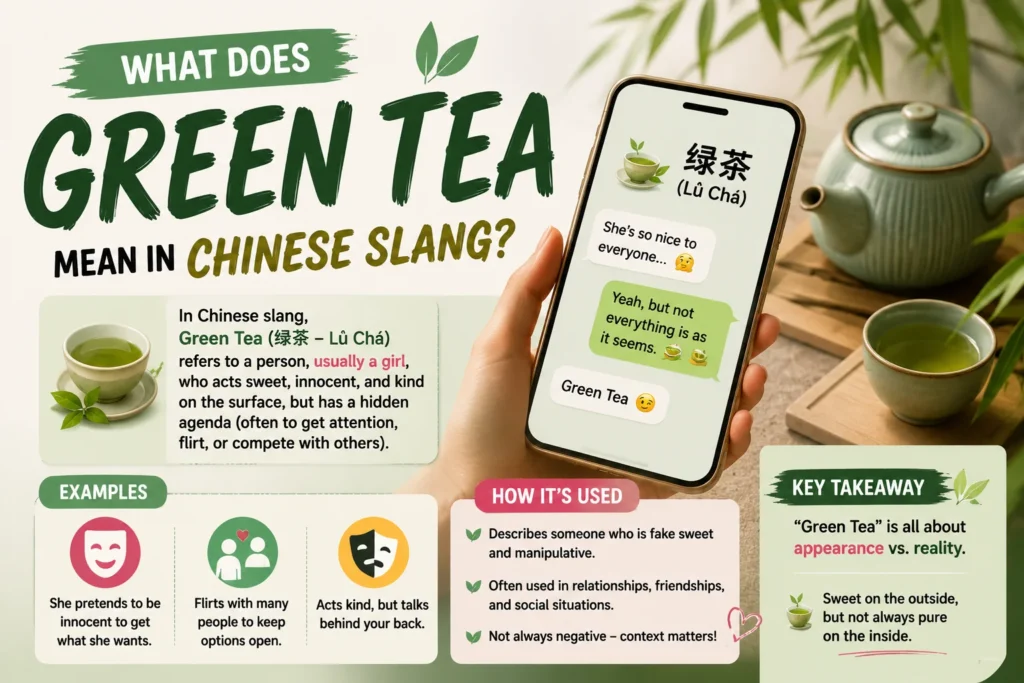
In Chinese slang, “green tea” usually refers to a person — often a girl — who appears innocent, sweet, and gentle on the surface but is believed to be manipulative or attention-seeking underneath. The phrase comes from the slang term “green tea bitch” (绿茶婊 / lǜchá biǎo), which became popular on Chinese social media.
Example:
“She acts super innocent around everyone, but my friends say she’s giving green tea energy.”
People search for this phrase because they see it on TikTok, memes, dramas, or online conversations and want to understand whether it’s an insult, a joke, or part of internet culture.
What Does “Green Tea” Mean in Chinese Slang?
The slang meaning of “green tea” has very little to do with the actual drink.
In online culture, especially Chinese internet slang, “green tea” describes someone who carefully presents themselves as pure, kind, soft-spoken, and harmless while secretly trying to gain attention, manipulate emotions, or create drama.
The phrase often targets social behavior rather than appearance.
People may use it when someone:
- Pretends to be overly innocent
- Acts sweet only around certain people
- Plays the victim for attention
- Uses subtle flirting to gain sympathy
- Appears fake or performative online
A typical example might be:
“She says she hates drama, but somehow she’s always in the middle of it. Total green tea behavior.”
Another example:
“He thinks she’s shy and sweet, but the group chat says she’s green tea.”
The term became widely discussed because it reflects modern social dynamics, especially around dating, social media image-building, and online personas.
Origin & Background of the Slang
The expression comes from the Chinese phrase:
绿茶婊 (lǜchá biǎo)
Directly translated, it roughly means “green tea girl” or “green tea manipulator.”
The term exploded online in China during the early 2010s through forums, gossip blogs, celebrity culture, and relationship discussions.
Why “green tea”? Because green tea culturally symbolizes something:
- Pure
- Natural
- Elegant
- Delicate
- Calm
Internet users started using the drink symbolically for people who looked innocent but allegedly behaved differently behind the scenes.
Over time, the phrase moved from Chinese social media into:
- TikTok discussions
- K-drama fandoms
- Meme culture
- Dating conversations
- Instagram captions
- Reddit slang discussions
Today, many people use “green tea” casually without even knowing the original Chinese slang background.
Why the Phrase Became Popular Online
Modern social media rewards image.
People carefully curate photos, captions, reactions, and personality traits online. Because of that, internet slang often develops around authenticity versus performance.
“Green tea” became popular because it gives people a quick way to describe someone they feel is:
- Fake-nice
- Strategically innocent
- Emotionally manipulative
- Attention-seeking in subtle ways
TikTok especially helped spread the term globally.
Users began posting videos like:
- “Signs your friend is green tea”
- “Green tea girl starter pack”
- “Green tea behavior explained”
- “POV: the green tea girl enters the group chat”
Many of these videos use humor, exaggeration, or stereotypes, which is why the term can sometimes become controversial.
Real-Life Chat Examples
WhatsApp Conversation
Friend: Why was Emma acting so shy around Jake yesterday?
You: I don’t know, but the second he walked away she changed completely.
Friend: That’s such green tea behavior.
Instagram DM
Person A: She commented “I’m ugly” under her own selfie again.
Person B: Girl… she knows exactly what she’s doing.
Person A: Green tea energy for real.
TikTok Comments
User 1: “I’m just a quiet girl 🥺”
User 2: This feels so green tea coded.
User 3: Nah she’s just introverted.
Text Message
Friend: He bought her flowers after she cried for five minutes.
You: She definitely knows how to play innocent.
Friend: Green tea masterclass honestly.
Emotional & Psychological Meaning
One reason this slang became so popular is because it reflects modern trust issues in online communication.
People today constantly analyze:
- Intentions
- Social behavior
- Attention-seeking habits
- Emotional manipulation
- Online authenticity
Calling someone “green tea” usually expresses suspicion.
It often means:
- “I don’t think this person is being genuine.”
- “Their kindness feels strategic.”
- “They act differently depending on who’s watching.”
At the same time, the phrase can sometimes be unfair.
Quiet, soft-spoken, or feminine people occasionally get labeled “green tea” simply because others misread their personality.
That’s why context matters.
I’ve personally seen this happen in friend groups online. Someone posts cute photos, acts shy in public, and suddenly people start joking that they’re “green tea,” even when there’s no actual manipulation involved. Internet slang often exaggerates personality traits for entertainment.
Green Tea Meaning on TikTok
TikTok helped turn this phrase into a global trend.
On TikTok, “green tea” often appears in:
- Storytime videos
- Dating advice clips
- Relationship drama content
- Friendship memes
- POV skits
People use it jokingly to describe:
- Fake innocence
- Subtle flirting
- Strategic crying
- “Pick me” behavior
- Manipulative sweetness
Example TikTok caption:
“When she says ‘I don’t usually get along with girls’ 🚩 #greentea”
However, TikTok culture also turned the term into an aesthetic.
Some creators now ironically embrace “green tea energy” by acting extra sweet, soft, calm, and emotionally mysterious.
Green Tea Meaning in Relationships
In dating culture, the phrase usually describes someone who:
- Acts innocent to attract attention
- Pretends to dislike drama while creating it
- Uses emotional tactics subtly
- Seeks validation from multiple people
For example:
“He thinks she’s sweet, but everyone else sees the manipulation.”
Or:
“She always acts helpless around guys but confident around everyone else.”
Still, not every flirtatious or shy person is “green tea.”
Sometimes the term gets overused in jealous or competitive situations.
Is “Green Tea” an Insult?
Usually, yes.
In most situations, calling someone “green tea” is negative.
It implies:
- Fake behavior
- Manipulation
- Attention-seeking
- Emotional performance
Because of that, you should be careful using it directly toward someone.
Online, friends may joke about “green tea energy,” but saying it seriously can hurt feelings.
It’s especially sensitive because the original Chinese phrase includes a harsher insult.
Green Tea Meaning From a Girl vs a Guy
From a Girl
Girls may use the term:
- To warn friends about someone
- To joke about dating culture
- To describe fake innocence
- To criticize manipulative social behavior
Tone can range from playful to harsh.
From a Guy
Guys often use it in dating conversations.
Sometimes they use it to describe:
- Someone who acts sweet strategically
- Mixed signals
- Emotional manipulation
- Attention-seeking behavior
However, men sometimes misuse the term to criticize confident or socially skilled women unfairly.
That’s why context matters a lot.
How to Respond When Someone Says “Green Tea”
Casual Replies
- “Honestly, I kind of see it.”
- “Maybe a little bit.”
- “That explains so much.”
Funny Replies
- “Certified green tea behavior.”
- “Not the green tea allegations again 😭”
- “Extra sweet with hidden ingredients.”
Respectful Replies
- “I think we might be judging too quickly.”
- “Maybe that’s just their personality.”
- “Let’s not assume bad intentions.”
Mature Replies
- “Social media never shows the full story.”
- “People are more complicated than labels.”
- “Sometimes confidence gets misunderstood.”
Where You’ll See This Slang Most
TikTok
The biggest platform for “green tea” slang.
Often appears in meme captions or relationship posts.
Snapchat
Used casually in gossip or private chats.
Common in dating discussions and pop culture threads.
Drama & Reality TV Communities
Fans often label certain personalities as “green tea.”
Similar Slang Comparison Table
| Slang | Meaning | Tone | Similarity |
|---|---|---|---|
| Green Tea | Fake innocent behavior | Negative | Main term |
| Pick Me | Seeks validation by acting “different” | Negative | Very similar |
| Fake Nice | Pretends to be kind | Negative | Related |
| Two-Faced | Acts differently behind people’s backs | Harsh | Similar |
| Manipulative | Controls emotions strategically | Serious | Related |
| Genuine | Honest and authentic behavior | Positive | Opposite meaning |
👉 Key Insight
Most slang terms like “green tea” are really about trust and authenticity. People use them when they feel someone’s online personality doesn’t fully match their real behavior.
Variations & Related Terms
1. Green Tea Energy
Someone giving off fake-sweet vibes.
2. Green Tea Girl
A person seen as strategically innocent.
3. Green Tea Behavior
Actions considered manipulative but subtle.
4. Green Tea Vibes
A softer, more joking version.
5. Pick Me Girl
Someone seeking approval through attention-seeking behavior.
6. Fake Innocent
Pretending to be harmless.
7. Soft Girl Manipulation
Internet phrase mixing aesthetics with emotional strategy.
8. Attention Farming
Trying to gain sympathy or reactions online.
9. Main Character Syndrome
Acting like everything revolves around you.
10. Performative Sweetness
Kindness that feels exaggerated or fake.
Common Mistakes & Misunderstandings
Assuming Every Quiet Person Is “Green Tea”
Being shy or feminine does not automatically mean someone is manipulative.
Using It Too Seriously
Online slang often exaggerates behavior for entertainment.
Cultural Misunderstanding
Some people use the term casually without understanding its harsher origins in Chinese internet culture.
Labeling Without Context
One interaction rarely tells the full story about a person.
Regional & Cultural Usage
Western Internet Culture
Often used humorously or ironically on TikTok.
Chinese Culture
The original meaning is sharper and more insulting.
Korean & Asian Pop Culture Communities
The phrase appears in fandom discussions and dating conversations.
Middle Eastern & Global Online Communities
Mostly used through TikTok trends rather than traditional slang.
Gen Z vs Millennials
Gen Z uses “green tea” more frequently in memes and social media commentary.
Millennials are more likely to say:
- “Fake nice”
- “Manipulative”
- “Two-faced”
instead.
Is It Safe for Kids?
Generally, yes — but with context.
The phrase itself is not a swear word, but it can become insulting depending on how it’s used.
Parents and teachers should know that teens may use it in:
- Gossip
- Relationship drama
- Social media jokes
- Online arguments
It’s best understood as internet slang rather than dangerous language.
FAQs
What does “green tea” mean in Chinese slang?
It describes someone who appears sweet and innocent but is believed to be manipulative or fake underneath.
Is “green tea” an insult?
Usually yes. It’s commonly used negatively online.
What does “green tea girl” mean?
It refers to a girl perceived as strategically innocent or attention-seeking.
Is green tea slang popular on TikTok?
Yes. TikTok helped make the phrase globally popular.
Does “green tea” always mean fake?
Not always. Sometimes people use it jokingly or exaggerate the label.
Is “green tea” sexist?
Some people believe the term unfairly targets women, especially feminine personalities.
Can guys be called green tea too?
Yes. Although less common, the term can describe manipulative behavior from anyone.
Conclusion
The slang term “green tea” is a fascinating example of how internet culture turns everyday words into social commentary.
What started as Chinese online slang evolved into a global TikTok-era phrase about authenticity, relationships, and social behavior.
Most people use it humorously, but it can also become judgmental if overused.
The best way to understand “green tea” is to focus on context. Sometimes it’s playful internet slang. Other times, it reflects real frustrations about fake behavior online.
Used carefully, understanding this phrase can help you better navigate modern digital conversations without getting confused by trending slang.