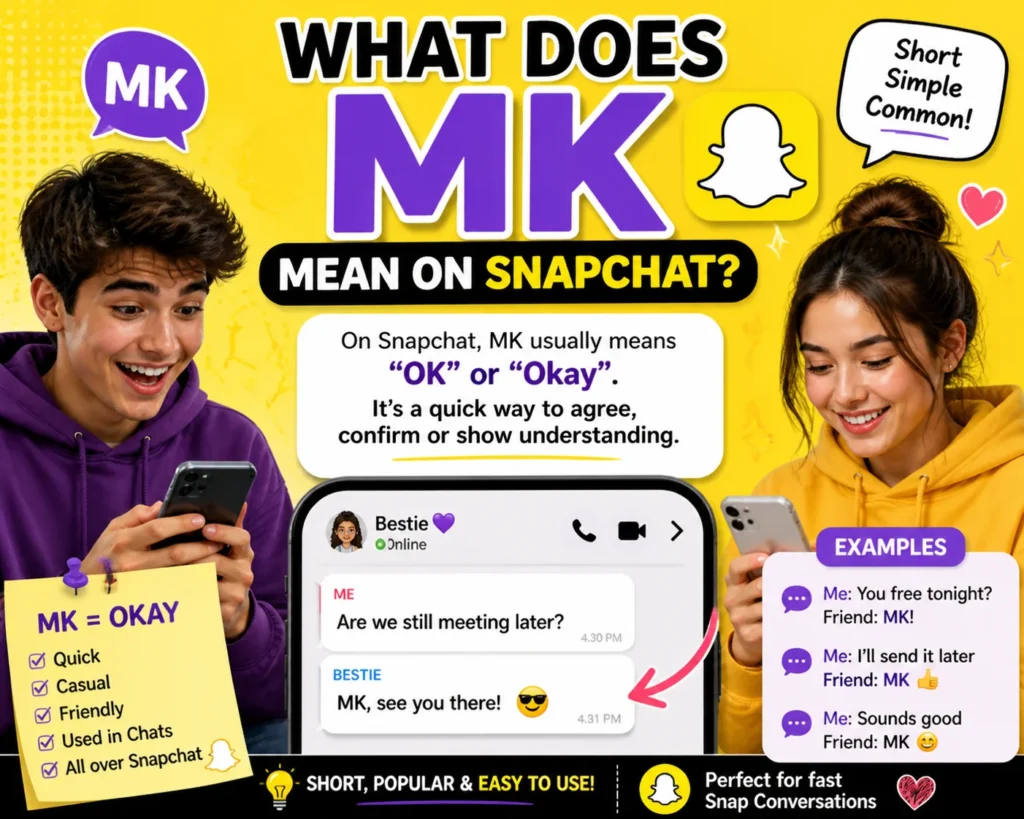
MK on Snapchat is a popular texting abbreviation that generally stands for “Mmm, okay” or simply “Okay”. It’s used to acknowledge something in a nonchalant, casual way, or to signal that you’re listening but may not have much to add.
The MK meaning on Snapchat is typically “Mmm, okay.” It’s a short and casual way to acknowledge or respond to something, often when you’re not fully invested but still want to engage. People search for it to understand how to interpret short, seemingly indifferent replies, especially when they’re chatting with friends, dating, or participating in group conversations. This article dives into the origins, cultural context, and how to respond to it.
MK Meaning in Snapchat – Quick Meaning
In simple terms, MK is used to indicate a casual acknowledgment or agreement. It’s often used when someone has just said something and the response is an easy way to show they’ve heard or understood, but without going into detail or showing strong emotion.
Key Points:
- MK = “Mmm, okay” or “Okay”
- It can also be interpreted as “I hear you” or “Got it” in casual conversations.
- It’s often a laid-back response used in Snapchat, texting, DMs, or group chats.
Quick Examples:
- Person A: “I’m not coming to the party tonight.”
Person B: “MK, see you tomorrow then.” - Person A: “I’ll be late to the game.”
Person B: “MK, I’ll hold off.” - Person A: “Do you want to hang out later?”
Person B: “MK, I’m down.”
The beauty of MK lies in its simplicity. It expresses understanding without a lot of emotional weight or effort.
Origin & Background
The origin of MK likely lies in the evolution of texting and internet slang. It was created as a way to streamline conversation in an era where every character counts. People began shortening phrases for convenience, and MK was born out of the common response “Mmm, okay.” It evolved in texting and social media spaces, especially in platforms like Snapchat, where brevity reigns supreme.
As for cultural influence, MK has become especially prevalent among younger generations, particularly Gen Z. The rise of casual communication, where more complex sentences are often shortened for convenience and tone, helped make abbreviations like MK part of everyday texting.
With social media platforms like Snapchat and Instagram pushing out rapid and informal communication, terms like MK allowed users to communicate more effectively while maintaining a casual, relaxed tone. It became one of the staple slang words in online chat rooms, and even seeped into memes, where people use it to emphasize a lack of enthusiasm or energy in their response.
Social Media Impact
On Snapchat, MK fits the quick messaging culture. It’s quick to type, leaving just enough room for users to acknowledge a statement without spending too much time typing out a lengthy reply.
Also, in memes and trending videos, MK has been adopted as shorthand for showing boredom, indifference, or simply the desire to not engage deeply. Its use has grown over time, especially with the expansion of Gen Z culture, where users often prioritize speed and ease in their interactions.
Real-Life Conversations
Let’s break down how MK is used in typical everyday conversations, especially on Snapchat.
WhatsApp Conversation
Person A: “I don’t think I’ll be able to make it today.”
Person B: “MK, hope everything is okay.”
Here, MK is acknowledging the situation, but Person B doesn’t push the matter further. It’s a response that shows understanding but not much emotional depth.
Instagram DM
Person A: “Sorry, I can’t talk right now, I’m super busy.”
Person B: “MK, we’ll talk later then.”
In this case, MK shows that Person B is okay with the delay, signaling a casual understanding of the situation without taking offense.
TikTok Comment Section
Person A: “This challenge is impossible.”
Person B: “MK, I’ll try it anyway.”
MK is often seen in comments when users don’t have a lot to say but still want to acknowledge what’s being shared.
Text Message
Person A: “I’ll be 10 minutes late.”
Person B: “MK, no worries!”
Again, MK works as a simple acknowledgment, suggesting that Person B is not upset about the late arrival.
Emotional & Psychological Meaning
Emotionally, MK reflects a level of detachment or indifference. It shows that the person has acknowledged the information but does not feel the need to express deep enthusiasm or concern. In some cases, it can also reveal boredom or lack of interest in continuing the conversation.
Why People Use It:
- To acknowledge information without much emotional involvement.
- To signal disinterest in further elaborating on a topic.
- To keep the conversation going without appearing rude.
- To maintain a casual, laid-back tone while communicating quickly.
Personal Example:
Imagine texting a friend about your plans for the weekend. You might send:
You: “I’m not sure if I want to go out anymore this weekend.”
Friend: “MK, I get that.”
In this situation, your friend used MK to show they understand you might not feel up to the plans, but they didn’t go overboard with trying to fix things. It shows emotional understanding without pushing any further.
Usage in Different Contexts
Social Media
On platforms like Snapchat, Instagram, and TikTok, MK is widely used in conversations, especially in group chats, casual replies, and comments. It’s used in situations where the user doesn’t need to provide a long-winded answer but still wants to show that they’re listening or acknowledging the point being made.
Friends & Relationships
With close friends, MK is often used to show that you’re okay with whatever is being said, even if you don’t have much to add to the conversation. It’s a relaxed way to acknowledge information without making a big deal out of it.
Example:
Person A: “I don’t think I’ll be able to make it.”
Person B: “MK, hope you feel better soon.”
Here, it shows understanding, but without forcing the issue.
Work / Professional Settings
In professional settings, MK would generally be avoided. It’s too casual and could seem dismissive if used in emails, Slack messages, or professional chats. Instead, you’d use phrases like:
- “Understood.”
- “Got it, thanks.”
- “I acknowledge your message.”
Casual vs Serious Tone
While MK is typically used in casual conversations, it’s important to be cautious about how you use it in serious discussions. If someone is sharing something emotional or important, using MK might come off as dismissive, especially if they’re expecting a more thoughtful response.
When NOT to Use It
- Serious discussions: When someone shares important or personal feelings, MK may sound dismissive.
- Professional contexts: Avoid using MK at work or in official communications unless you know the culture supports this casual style.
- Sensitive situations: If a person shares something vulnerable or serious, MK can come off as emotionally distant.
- With older generations: People from older generations may not understand the casualness of MK, so it’s best to avoid it in conversations with them unless you are sure they’re familiar with online slang.
Common Misunderstandings
One common misunderstanding is tone confusion. While MK is often neutral, it can easily be misinterpreted. For instance, a person might think you’re disinterested or dismissive when you simply meant to acknowledge what they said.
Literal vs Figurative Meaning
MK can sometimes confuse people if they take it literally. They might expect a more detailed response, but the abbreviation is designed to keep things short and straightforward.
Example:
Person A: “I got tickets to the concert!”
Person B: “MK, that’s cool.”
Here, MK means that Person B has understood and acknowledged the statement, but it’s not an enthusiastic “wow, that’s amazing.”
Comparison Table
| Slang | Meaning | Usage Context | Tone | Popularity |
|---|---|---|---|---|
| MK | “Mmm, okay” | Casual conversations, texting, DMs | Neutral, laid-back | Popular among Gen Z |
| OK | “Okay” | General communication | Neutral, formal | Universal |
| K | “Okay” | Quick acknowledgment | Neutral, sometimes curt | Common in texting |
| Bet | “Okay, deal” | Confirming plans | Confident, affirming | Gen Z slang |
| No cap | “No lie” | Truth, emphasis | Honest, bold | Popular in Gen Z |
| Fr | “For real” | Agreement or affirmation | Serious, confirming | Gen Z, casual |
Key Insight:
MK is widely used in casual settings, especially among younger audiences. While MK shows acknowledgment, it’s often less emotionally invested than other affirmative words like “okay” or “bet”.
Variations / Types
- MK: Standard “Mmm, okay”.
- Mmm, OK: A longer version for more emphasis.
- MK?: Used as a question – “Are you sure?” or “Really?”
- Mkay: A playful, drawn-out version.
- M-K: A stylized version, often used in more personal conversations.
- MK, cool: Adds confirmation or approval after acknowledging.
- Mk: A super short, minimalist response.
- Okay, MK: Used for double emphasis in agreement.
- F-MK: Used sarcastically, typically indicating “I’m not impressed.”
- MK, sure: Adds confirmation to a nonchalant response.
How to Respond When Someone Uses It
Casual Replies
- “Got it.”
- “Alright then.”
- “Cool, see you.”
- “No problem.”
Funny Replies
- “Same.”
- “MK, but are you coming?”
- “MK, for sure.”
- “Noted.”
Mature Replies
- “Understood.”
- “Thanks for letting me know.”
- “I’ll take care of it.”
- “That makes sense.”
Respectful Replies
- “Thanks for sharing.”
- “I appreciate it.”
- “That’s helpful to know.”
- “I hear you.”
Regional & Cultural Usage
Western Culture
In the US and UK, MK is commonly used by younger generations, particularly Gen Z. It’s widely understood on platforms like Snapchat, Instagram, and TikTok.
Asian Culture
MK is also popular in countries like India, the Philippines, and Singapore, especially among younger internet users who are exposed to global slang through social media platforms.
Middle Eastern Culture
In Arabic-speaking regions, MK might be less common. However, it is still used in more informal, English-speaking spaces within the region.
Global Internet Usage
Globally, MK has been adopted as shorthand for “Mmm, okay,” especially in digital conversations where brevity is valued. It is often used in comment sections and group chats.
Generational Differences
While MK is widely used among Gen Z, Millennials might prefer more formal alternatives like “Okay” or “Alright”.
Is It Safe for Kids?
Yes, MK is safe for kids as long as it’s used in a casual, non-argumentative way. It’s important to guide younger users to use slang appropriately and avoid using it in more serious contexts or with older generations.
FAQs
What does MK mean on Snapchat?
MK means “Mmm, okay”. It’s used to acknowledge something casually without much emotion.
Is MK rude?
No, MK is not inherently rude, but it can sound indifferent if used in the wrong context.
Can you use MK in professional settings?
No, MK is too casual for professional or formal settings. Use more neutral responses like “Got it” or “Understood”.
Why do people use MK instead of okay?
People use MK for convenience and to convey a more relaxed, nonchalant tone in quick chats.
Is MK used only by Gen Z?
While it’s most popular among Gen Z, it’s used by a wider audience on social media platforms.
Can MK be used sarcastically?
Yes, when used with the right tone, MK can be sarcastic, especially if the person is not truly agreeing.
Does MK mean something else in other cultures?
In some cultures, MK may stand for other phrases, but in casual English texting, it almost always means “Mmm, okay.”
Is MK safe to use in texts with friends?
Yes, MK is safe for casual chats with friends but should be avoided in sensitive or emotional conversations.
Can MK mean “Mmm, not okay”?
It could be interpreted as such, especially if used with sarcastic tone or in response to a disappointing statement.
Conclusion
MK is a quick, laid-back way to acknowledge something or show casual agreement in digital conversations. Its rise in popularity reflects a shift toward quicker, more informal communication styles, especially among younger generations. While it’s generally harmless and convenient, understanding its tone and context will help ensure it doesn’t come across as rude or indifferent. So the next time you see MK, remember that it’s all about simplicity in communication – just a quick, easy way to say “Okay”.