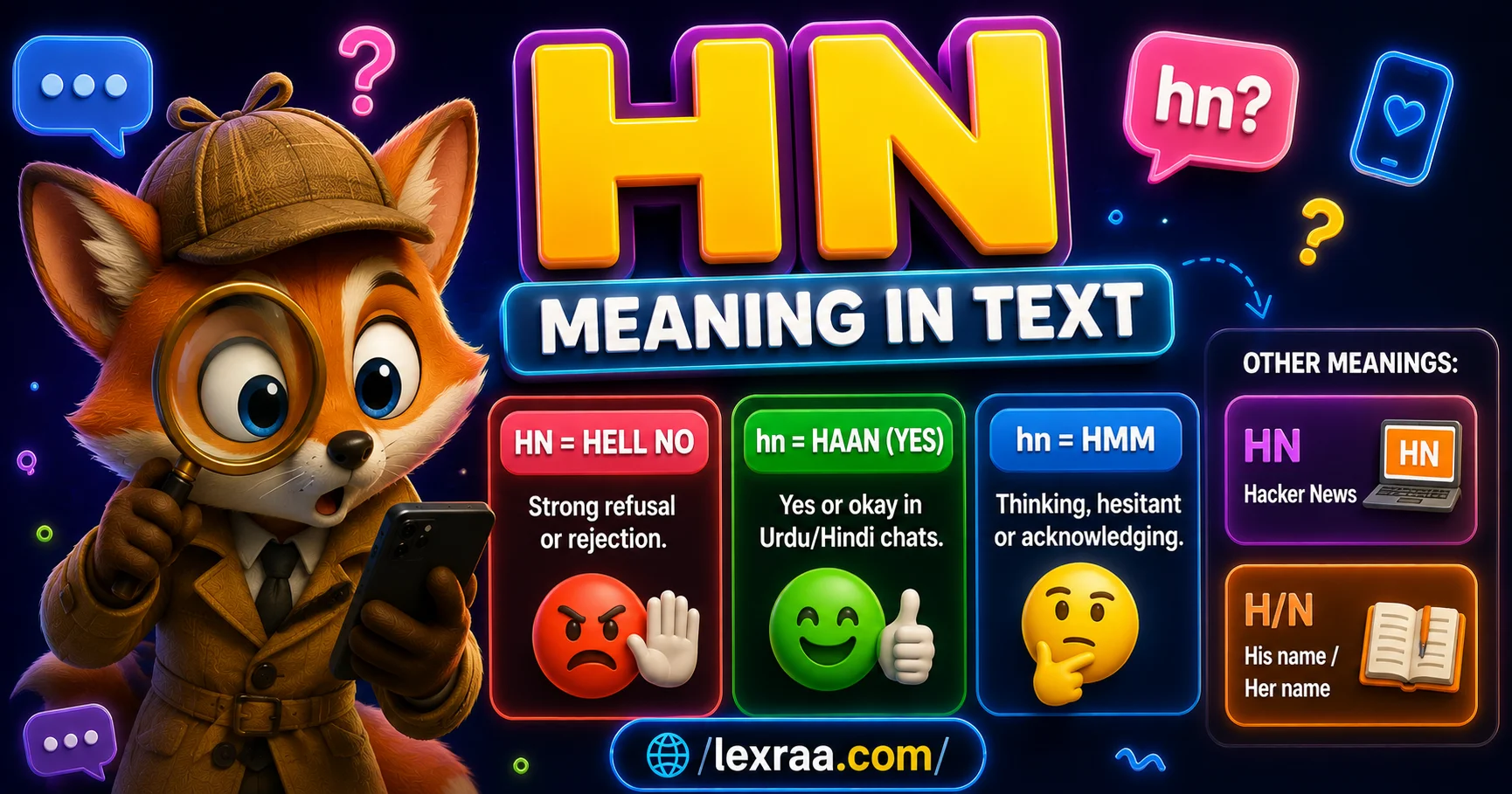
If someone sends you HN or hn, the meaning depends heavily on context. In English-language casual texting, HN often means “hell no”—a strong refusal. In many South Asian chats, lowercase hn can also be shorthand for haan/haan, meaning “yes.”
The short answer: what does HN mean in text?
HN/hn does not have one universal meaning. The three most useful meanings to know are:
- Hell no — a strong refusal, especially in English-language casual chat.
- Haan (ہاں) — “yes” or “yeah” in many Urdu/Hindi and South Asian text conversations.
- Hmm / a brief acknowledgment — in some chats, lowercase hn functions more like a short thinking sound or minimal response.
Outside ordinary texting, HN can also refer to Hacker News, while H/N with a slash may appear in reader-insert fiction as a name placeholder. Hacker News itself officially uses HN as its common abbreviation.
The important detail is that “HN” and “hn” can point in completely opposite directions. One person may mean absolutely not, while another simply means yes.
HN can mean “Hell No”
In English-language casual texting, HN = hell no is a compact initialism used for a strong rejection.
Example:
“Want to wake up at 5 a.m. and go running?”
“HN 😭”
That does not mean a polite “no, thank you.” It usually means something closer to “absolutely not,” “no way,” or “not a chance.”
The surrounding message usually makes this meaning easy to spot. If someone has just been asked a question, offered an idea, or presented an outrageous suggestion, HN may be an emphatic refusal.
How strong is “HN = hell no”?
The tone can range from playful to genuinely firm.
- “hn 😂” — probably joking or dramatic.
- “HN.” — can sound blunt or final.
- “HN, I’m not doing that.” — clear refusal.
- “hnnnn” — may be more expressive, depending on the writer’s style.
Capitalization and punctuation can therefore add tone, but they do not create a fixed rule.
Hn can mean “haan” — yes
This is where many explanations of hn meaning in text become incomplete.
In Urdu, ہاں (haan) is a word used to express agreement or “yes”; bilingual dictionary material translates it that way. In Roman Urdu and similar informal typing styles, people may shorten haan to hn in quick conversations.
Example:
“Kal aa rahe ho?”
“hn”
Here, hn can simply mean:
“Yes.”
“Yeah.”
“Okay.”
This use is particularly important in informal South Asian conversations. So if a message contains Roman Urdu, Hindi, Hinglish, or another familiar South Asian texting style, reading hn as “hell no” could produce exactly the wrong interpretation. Multiple current discussions of the abbreviation identify this context-dependent use, although there is no single standardized dictionary definition for the two-letter texting form itself.
Read More: YH Meaning in Text: Why “Yeah” Isn’t Always Just Yeah
Hn can sometimes act like “hmm”
A lowercase hn may also be used as a minimal acknowledgment or a typed thinking sound. This interpretation is less standardized than haan or hell no, so context matters even more.
For example:
“I don’t know if taking that job is the right move.”
“hn… I get what you mean.”
In that situation, the sender may be expressing:
- “Hmm.”
- “I’m listening.”
- “I’m thinking about that.”
- “I understand.”
Do not automatically translate every lowercase hn into “hmm,” though. It is better to look at the language of the rest of the conversation first.
A common misunderstanding: uppercase HN and lowercase hn are not always the same thing
There is no official rule saying that capitalization changes the definition. Still, the way people encounter the term often creates a useful pattern:
| Form | Possible interpretation | Context to check |
|---|---|---|
| HN | Hell no | Strong reaction or refusal |
| hn | Haan / yes | Roman Urdu or Hindi-style chat |
| hn… | Hmm / thinking | Hesitation or reflection |
| HN | Hacker News | Technology or startup discussion |
| H/N | His name / her name | Reader-insert fiction |
This is a context clue, not a grammar rule. Someone can type lowercase hn and mean “hell no,” or uppercase HN and simply be using a personal texting style.
What about HN as “Hacker News”?
If you see HN in a discussion about programming, startups, technology, or links, it may have nothing to do with texting slang.
Example:
“This story was on HN this morning.”
Here, HN means Hacker News, the technology-focused discussion community associated with Y Combinator. Y Combinator itself refers to the site as “Hacker News (HN).”
This is one reason blindly expanding HN to “hell no” is risky.
What does H/N mean in stories?
A slash can completely change the meaning.
In some reader-insert or fanfiction content, H/N may be used as a placeholder for his name or her name, allowing readers to imagine a particular character or person in the story.
That is different from a casual message containing plain hn. Reader discussions around fanfiction show this interpretation appearing specifically in that kind of context.
So:
- “HN 😂” in a chat → possibly hell no
- “hn, theek hai” → possibly haan / yes
- “H/N walked into the room” → likely a story placeholder
- “I saw it on HN” → probably Hacker News
The letters alone are not enough.
Which apps is HN used on?
There is not strong evidence that HN belongs exclusively to one specific app. It is better understood as a piece of informal digital shorthand that can travel wherever people send short messages.
WhatsApp and private messaging
hn = haan/yes is especially easy to encounter in conversations using Roman Urdu, Hindi, or related informal writing styles. A quick reply such as “hn” may simply confirm something.
Instagram and Snapchat
Short, context-dependent replies can also appear in DMs and casual conversations. However, you should not assume a special Instagram-only or Snapchat-only definition. The same conversation clues still matter.
TikTok and fanfiction-style content
If you encounter H/N with a slash in POV, reader-insert, or fictional content, the placeholder interpretation becomes more plausible. The surrounding storytelling format is more important than the platform itself.
X and other public platforms
HN may also appear in technology discussions as shorthand for Hacker News rather than as texting slang.
The safest conclusion is simple: HN is context-dependent across platforms rather than platform-specific.
Where did HN come from?
There is no reliable record identifying the exact first person or first message that turned “hell no” into HN. Claims that it can be traced precisely to a particular year, subculture, or chatroom should therefore be treated cautiously.
The likely explanation is more ordinary: digital communication encourages shortening familiar expressions. “Hell no” already existed as a spoken English expression, and reducing two words to their initials follows the same broad pattern as abbreviations such as IDK, TBH, BRB, and SMH.
The hn = haan use has a different path. Here, the abbreviation comes from informal Romanized typing, where speakers represent Urdu or Hindi words using the Latin alphabet and often shorten them for speed. The underlying word ہاں / haan means “yes.”
So there is no single origin story for every use of HN. The identical letters developed or are used in different contexts for different reasons.
HN in real conversation styles
1. Funny: “hell no”
Friend: Want to try that ghost pepper challenge?
You: HN 😭
Friend: You said you wanted to be adventurous.
You: I meant emotionally adventurous.
2. Sarcastic: “hell no”
Coworker: They scheduled another 7 a.m. meeting.
You: HN, my brain doesn’t open until 9.
Coworker: So you’re attending?
You: Physically? Maybe. Spiritually? Never.
3. Playful: “hell no”
Friend: Should I text my ex?
You: HN. Put the phone down.
Friend: But what if they’ve changed?
You: Then they can change without receiving your text.
4. Serious: “hell no”
Sibling: Are you okay with them blaming you for everything?
You: HN. I’m done accepting that.
Sibling: Good. You should say something.
You: I plan to.
5. Family chat: “haan / yes”
Mom: Ghar aa gaye?
You: hn
Mom: Khana kha lena.
You: okay 👍
Here, hn functions as a quick “yes.”
6. Friends making plans
Friend: Kal movie?
You: hn, after 7
Friend: Done.
You: Perfect.
Again, the language around it makes haan/yes the natural reading.
7. Thinking or acknowledgment
Friend: I might actually move to another city.
You: hn… that’s a big decision.
Friend: Yeah, I’ve been thinking about it for months.
You: Then tell me what’s making you consider it.
Here, hn works more like a brief “hmm.”
8. Dating chat
Person A: You disappeared for three days.
Person B: hn 😭 I know, I’m sorry.
Person A: That’s your defense?
Person B: No, my defense arrives after coffee.
In this context, hn may simply act as an acknowledgment before the actual reply.
9. Group chat
Friend 1: Who wants to volunteer for the presentation?
Friend 2: HN 💀
Friend 3: That was fast.
Friend 2: I believe in supporting from the audience.
The reaction makes hell no clear.
10. Tech discussion
Person A: Where did you find that startup?
Person B: HN.
Person A: Hacker News?
Person B: Yep, it was trending there.
Here, the topic completely changes the meaning.
How should you reply to HN?
Your reply should follow their intended meaning, not the letters alone.
Funny reply to “HN = hell no”
“That sounds like a very firm no 😂”
Serious reply
“Fair enough. I won’t push you.”
Playful or flirty reply
If the conversation is already flirtatious:
“HN? I haven’t even made my best argument yet 😏”
Only use this when the relationship and tone clearly support it.
Neutral reply to “hn = haan”
“Okay, got it.”
If you genuinely do not know what they mean
The easiest response is:
“Wait, hn as in yes or hell no? 😅”
That is often better than confidently misunderstanding the message.
HN vs similar texting terms
| Term | Meaning | Tone | Popularity | Confusion Risk |
|---|---|---|---|---|
| HN / hn | Hell no, haan/yes, or context-based acknowledgment | Highly context-dependent | Variable | Very high |
| Nope | No | Casual | High | Low |
| Ngl | Not gonna lie | Casual | High | Low |
| Hmm | Thinking, hesitation, uncertainty | Neutral to thoughtful | High | Medium |
| Yh / Yeah | Yes | Casual | High | Low |
| IDK | I don’t know | Casual | Very high | Low |
| Yes / yeah | Agreement; opposite of “hell no” | Neutral to casual | Very high | Low |
The unusual thing about hn is that it can sometimes represent an affirmative response and, in another conversation, an emphatic negative one.
Who uses HN?
There is not reliable evidence for a clean age-based rule such as “only Gen Z uses HN” or “Millennials do not use it.”
Different meanings are more closely tied to language, community, and context than to a strict generation.
- Haan/hn is associated with informal Roman Urdu and Hindi-style digital communication.
- HN = hell no can appear in casual English-language texting.
- HN = Hacker News belongs to a technology and startup context rather than a particular age group.
This is a good example of why slang should not always be treated as one global language with one fixed definition.
Is HN rude or safe?
It depends on the meaning.
If HN means “hell no”
It contains no profanity by itself, but it abbreviates an expression that can sound blunt, dismissive, or aggressive. Among close friends, HN 😂 may be harmless and funny. In an argument, HN. can sound much harsher.
Avoid using it in formal emails, professional messages, or situations where a clear and respectful response is better.
If hn means “haan”
This version is generally neutral and informal. It is fine in casual conversation but may be too abbreviated for formal communication.
If HN means something else
In technology, fiction, medicine, or workplace-specific communication, always use the surrounding context before deciding whether it is appropriate.
Why does such a tiny abbreviation work?
HN works because it compresses more than one kind of conversational information into very little space. Depending on context, it can signal refusal, agreement, hesitation, acknowledgment, or membership in a particular community. That efficiency is useful—but it also creates ambiguity. The same feature that makes hn fast to type is what makes it worth checking before reacting.
FAQ
What does HN mean in a text from a friend?
If the conversation is in English and your friend is rejecting an idea, HN often means “hell no.” If the chat uses Roman Urdu or Hindi, lowercase hn may mean haan, or “yes.” Read the messages immediately before and after it.
Does HN always mean hell no?
No. HN does not have one universal texting definition. It can also refer to haan/yes, a thinking-style acknowledgment, Hacker News, or other context-specific meanings.
What does hn mean in Urdu texting?
In informal Roman Urdu, hn is often a shortened way of typing “haan” (ہاں), meaning “yes.” It is mainly a casual texting shortcut rather than formal spelling.
What is the difference between hn and hmm?
Hmm more clearly signals thought, hesitation, or uncertainty. Hn may be used similarly by some people, but it can also mean haan/yes or hell no, making it much more dependent on context.
What does H/N mean in fanfiction?
H/N, with a slash, may be used as a placeholder for his name or her name in reader-insert writing. That is separate from ordinary chat slang.
What does HN mean in technology?
In technology and startup conversations, HN commonly means Hacker News. Y Combinator itself uses the abbreviation when referring to the community.
Is HN okay to use at work?
Usually, no—at least not when you mean “hell no” or “haan.” The abbreviation is ambiguous and can look unprofessional. Write out your response unless HN is an established abbreviation within your specific workplace or industry.
Is hn a Gen Z word?
There is not enough evidence to label it exclusively as Gen Z slang. Its usage depends more on texting habits, language background, and online community than on one generation.
Final takeaway
The safest answer to “what does hn mean in text?” is not simply “hell no.”
In English-language casual chat, HN can mean “hell no.” In many South Asian conversations, hn can mean “haan,” or yes. It may also function like a brief “hmm” in some chats, while HN can mean Hacker News in tech discussions and H/N may have a different meaning in reader-insert fiction.
Before replying, check three things: the language of the conversation, what was said immediately before it, and whether the letters are written as HN, hn, or H/N. With this abbreviation, context is not just helpful—it is the meaning.