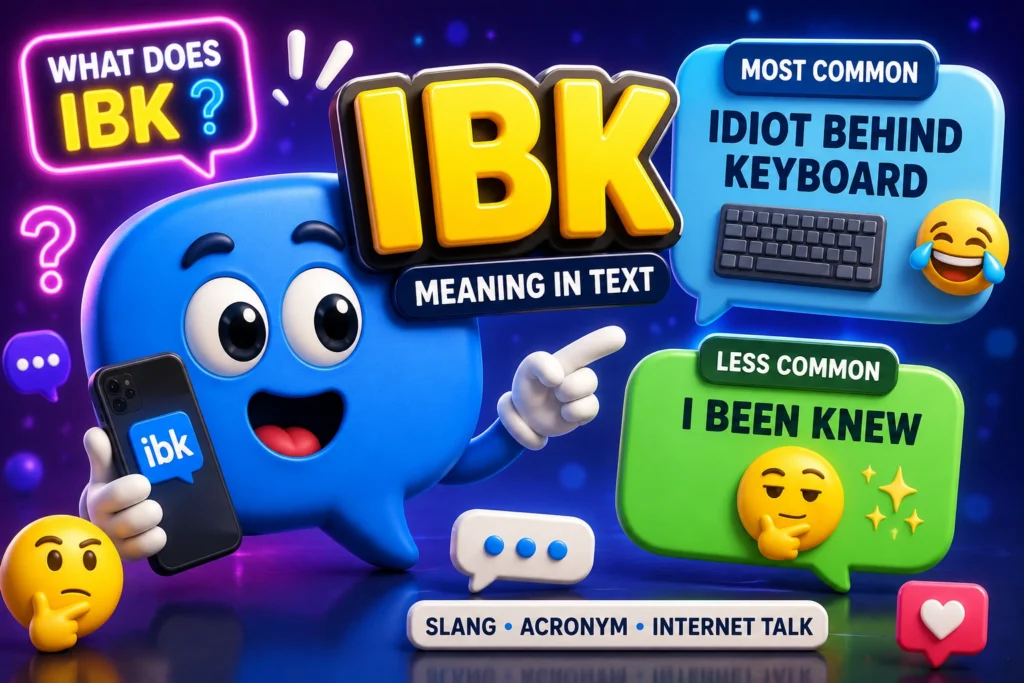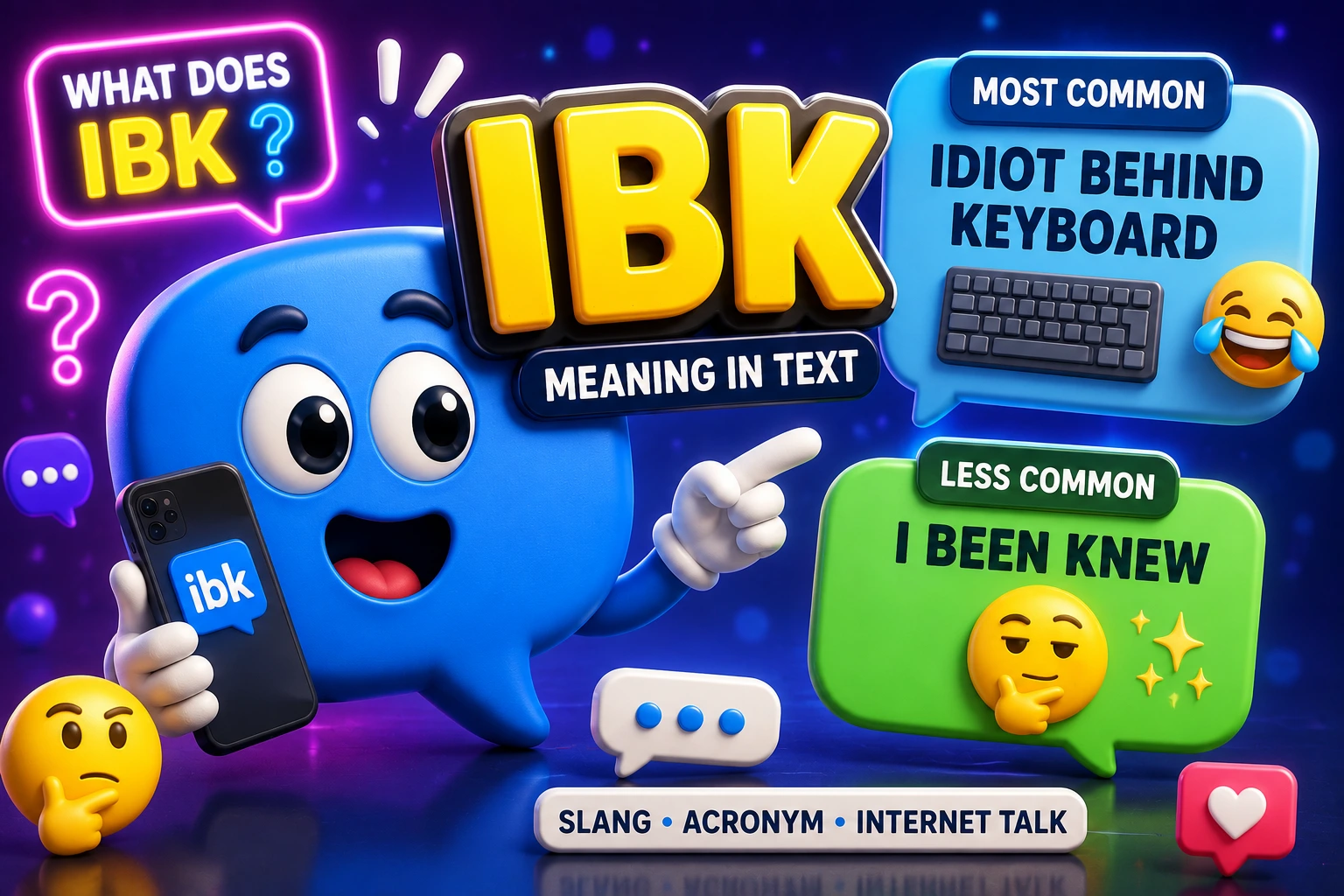
IBK most commonly means “Idiot Behind Keyboard” when texted to you — a joking or self-deprecating way of blaming a mistake on the person typing rather than the device. A second, less common meaning is “I Been Knew,” used to say you already knew something before it was said. Which one applies depends entirely on the sentence around it.
If someone just sent you “ibk” and you’re staring at your phone confused, you’re not overthinking it — this is a genuinely ambiguous acronym with two real, unrelated meanings that happen to share the same three letters. That’s exactly why “ibk meaning in text” gets searched: the word gives almost no context clues on its own, and guessing wrong can make you misread the whole message.
What Does IBK Mean?
IBK is an acronym — each letter stands for a specific word, not just a sound-alike abbreviation. But it has two distinct expansions in active use, and only context tells you which one you’re dealing with.
The Most Common Meaning: Idiot Behind Keyboard
This is the meaning listed across nearly every slang and acronym dictionary, and it’s the one you’ll see most often in general texting and tech-adjacent conversations. It’s a self-aware, often funny way of admitting a mistake was human error, not a glitch — similar in spirit to older IT jargon like “PEBKAC” (problem exists between keyboard and chair).
Full expansion: Idiot Behind Keyboard
Example: “App crashed again.” / “Nah that one’s on me, IBK, I fat-fingered the settings.”
The Second Meaning: “I Been Knew”
Less common but genuinely in use, especially in DMs and reply threads, “ibk” is sometimes shorthand for “I been knew” — meaning “I already knew that, this isn’t news to me.” It works the same way as “wbk” (we been knew), just in first person. This usage leans confident, sometimes a little smug, and shows up more in social and flirty contexts than technical ones.
Example: “You’re actually really smart, you know that?” / “ibk 😌”
Is IBK an Acronym or Abbreviation?
It’s a true acronym in both cases — each letter represents a full word in a phrase (Idiot Behind Keyboard / I Been Knew), rather than being a shortened single word. It is not a contraction and it is not sound-based like “gr8” or “l8r.”
Platform Breakdown
SMS/iMessage and WhatsApp: This is where “Idiot Behind Keyboard” shows up most — usually after someone messes up a task, sends the wrong file, or double-books a plan.
DMs (Instagram, Snapchat, Discord): Both meanings appear here, but “I been knew” is more common in these more social, back-and-forth spaces — replying to a compliment, a joke, or an “I told you so” moment.
TikTok/X: IBK does occasionally show up in comment replies on TikTok and X, almost always in the “I been knew” sense, riffing off the same energy as “wbk.” It’s not common enough to be a primary platform for the term, but it’s genuine, not fabricated.
Typing Consistency
IBK is typed almost exclusively in lowercase (“ibk”) in casual texting and DMs — this is standard for most short reaction acronyms and doesn’t usually signal a tone shift the way all-caps does for longer sentences. You’ll occasionally see it capitalized (IBK) in dictionary sites, tech-support forums, or when someone is typing more formally, but that’s rare in actual text conversations. There’s no widely used doubled-letter or spaced-out variant.
Tone & Context Variations
The same three letters can land completely differently depending on delivery. Here’s how IBK shifts across four common tones.
Funny
A: why is the wifi named “FBI Surveillance Van 4” B: oh that’s mine lol A: you’re so weird B: IBK, I own it 😂
Sarcastic
A: you told me the meeting was at 3, it was at 2 B: did I? my bad A: yeah you def did B: ibk, clearly not a competent adult today
Playful
A: wait you knew the ending the whole time?? B: yesss A: and you didn’t say anything?! B: ibk, I just wanted to watch your reaction lol
Serious
A: I need you to double check the numbers before you send that report B: I already did, twice A: okay good, last time there was a mix-up B: yeah that one was IBK on my end, won’t happen again
Read More: GTS Meaning in Text: You’re Probably Reading It Wrong
Real Chat Examples
1. Friend to friend
A: bro why does my playlist say “banger” 47 times
B: IBK, I renamed every song when I had your phone lol
A: I HATE YOU
B: you’re welcome
2. Partner texting
A: did you seriously forget our reservation
B: ibk, I got caught up at work, I’m so sorry
A: it’s fine just don’t let it happen again
B: promise, rebooking it right now
3. Coworker in Slack-style text
A: the deck you sent has last quarter’s numbers
B: oh no, ibk, let me fix that now
A: no worries, just resend before the call
B: on it
4. Parent to child
A: why is there a dent in the car
B: ibk mom, I backed into the mailbox, I’m sorry
A: we’ll talk about this when I get home
B: okay 😬
5. Sibling texting
A: you used my charger and now it’s broken
B: ibk that one’s fully on me, I’ll get you a new one
A: thank you, finally an apology
B: don’t get used to it
6. Stranger / new match on a dating app
A: you seem way more interesting than your bio makes you sound
B: ibk 😌 the bio was written at 2am
A: that explains a lot
B: honestly? fair
7. Group chat
A: who left the group chat name as “Losers Anonymous”
B: IBK, I did it at 1am and forgot
C: iconic honestly
B: don’t encourage me
8. Friend admitting fault
A: the plan completely fell apart because of the timing
B: yeah, ibk, I should’ve checked everyone’s schedule first
A: it’s okay, we’ll replan
B: appreciate you not being mad
9. Flirty back-and-forth
A: okay I’ll admit, you were right about that movie
B: ibk 😏 I’m always right
A: don’t push it
B: no promises
10. Coworker owning a mistake in a group chat
A: the client emailed asking why the invoice was wrong
B: that one’s on me, IBK, fixing it now
C: appreciate you catching it fast
B: on it, sending the corrected one in 5
11. Sibling calling out a spoiler
A: wait you already knew who won?
B: ibk, I saw it on twitter this morning
A: why didn’t you warn me
B: thought it’d be funnier this way
Grammar & Language Role
Part of speech:
IBK functions as an interjection or a standalone declarative phrase — it doesn’t behave like a noun or verb you’d build a sentence around.
Sentence position:
It typically appears either as a full standalone reply or tacked onto the start or end of a sentence — “IBK, my bad” or “that’s on me, ibk.”
Can it replace a full sentence?
Yes. On its own, “ibk” can function as a complete reply — either admitting fault (Idiot Behind Keyboard) or asserting prior knowledge (I been knew), with no additional words needed.
Capitalization conventions:
Lowercase “ibk” is the casual, default texting form and doesn’t shift meaning. All-caps “IBK” doesn’t add emphasis or change the definition — it just tends to show up more in formal or reference contexts than in real texts.
Embedded mid-sentence:
Common, especially in the “fault-admitting” sense — “that mistake was fully IBK” reads naturally.
Formal vs. informal register:
Strictly informal. It doesn’t appear in professional emails or formal writing, only casual texting, DMs, and internal work chats with a relaxed tone.
How to Reply to IBK
Funny reply:
“IBK certified 🏆” or “at least you admit it lol”
Serious reply:
“Okay, just make sure it doesn’t happen again” or “Appreciate you owning it”
Flirty reply:
“ibk huh? prove it” or “confident, I like that”
Neutral/unbothered reply:
“all good” or “no worries, happens”
Comparison Table
| Term | Meaning | Usage Context | Tone | Popularity | Confusion Risk |
|---|---|---|---|---|---|
| IBK | Idiot Behind Keyboard / I Been Knew | Texting, DMs | Self-deprecating or confident | Moderate | High (two unrelated meanings) |
| WBK | We Been Knew | DMs, social replies | Confident, sometimes snarky | High | Low |
| IKR | I Know Right | Agreement in chat | Casual, agreeable | Very high | Low |
| SMH | Shaking My Head | Disapproval/disbelief | Frustrated or amused | Very high | Low |
| PEBKAC | Problem Exists Between Keyboard And Chair | Tech/IT humor | Joking, technical | Low-moderate | Low |
| IDK | I Don’t Know | Uncertainty | Neutral | Very high | None — near-opposite of “I been knew” |
Who Uses This Term
Gen Z vs. Millennials:
Gen Z texters use IBK more frequently and more fluidly across both meanings, often relying on tone and prior context rather than clarifying which one they mean. Millennials are more likely to use it strictly in the “Idiot Behind Keyboard” sense, largely because that’s the meaning that’s been documented in slang dictionaries and tech-support culture the longest, while the “I been knew” usage is a newer, social-media-driven layer.
Regional usage:
IBK doesn’t show strong regional variation the way some slang does — both meanings appear across US, UK, and other English-speaking online spaces, though the “I been knew” sense is more visible in US-based social platforms.
Platforms:
The “Idiot Behind Keyboard” meaning dominates in SMS, iMessage, WhatsApp, and workplace-style texting. The “I been knew” meaning shows up more in Instagram/Snapchat DMs, Discord, and occasional TikTok/X comment replies.
Origin & Internet Culture
“Idiot Behind Keyboard” has roots in tech-support and gaming culture rather than TikTok trend culture — it’s part of the same lineage as older jargon like “ID10T error” and “PEBKAC,” phrases IT workers used long before social media to good-naturedly blame user error instead of the machine. As texting shorthand became mainstream, the phrase compressed into the acronym IBK and moved from niche tech forums into everyday texting.
“I been knew” comes from a grammatical construction rooted in African American Vernacular English (AAVE), where “been” is used to indicate something has been true for a long time already — distinct from standard English’s simple past tense. This construction gained wider mainstream visibility through Black Twitter and social media, eventually giving rise to “wbk” (we been knew) as a popular internet phrase, with “ibk” following as its first-person counterpart. It’s worth using and crediting accurately rather than treating it as generic internet slang with no cultural origin.
Safety & Appropriateness
IBK is not profanity and contains no explicit language in either meaning. It’s generally safe to use casually with friends, partners, and siblings.
Workplace/school appropriateness:
In the “Idiot Behind Keyboard” sense, it can be fine in casual internal team chats with coworkers you’re friendly with, but it’s still self-deprecating slang — avoid it with a boss, a teacher, or in any message that needs to read as fully professional. The “I been knew” sense is purely social and doesn’t belong in workplace or school communication at all.
Cultural sensitivity:
Because “I been knew” draws from AAVE, it’s worth using it as intended rather than stripping it of its origin or overusing it performatively, especially outside the communities where the construction comes from.
Real-World Observation
What makes IBK durable in texting specifically is that it does two very different emotional jobs with the same three letters, and somehow that ambiguity rarely causes real confusion in practice — because the sentence around it almost always disambiguates it instantly. Nobody reads “ibk, my bad” and thinks it means “I already knew that,” and nobody reads “ibk 😌” after a compliment and thinks it’s an apology. It’s a rare case of internet shorthand where economy of typing wins out over precision, because the surrounding conversation does the disambiguating work for free — which is exactly what good texting slang is supposed to do.
FAQ
What does IBK mean when a girl or guy texts it?
The meaning doesn’t change based on who sends it — it’s still either “Idiot Behind Keyboard” (admitting a mistake) or “I Been Knew” (asserting they already knew something). What can shift is tone: in flirty or dating contexts, “ibk” leans more toward the confident “I been knew” sense than the self-deprecating one.
Is it rude to reply with just “ibk” in a text?
No, on its own it’s not rude in either sense. As a standalone reply to a compliment (“ibk 😌”) it can come across as a little cocky, but that’s usually the intended, playful effect rather than genuine rudeness.
What’s the difference between texting it and saying it out loud?
“IBK” is almost never spoken aloud as an acronym — people say the full phrases (“idiot behind keyboard” or “I been knew”) in conversation instead. As a written acronym, it belongs specifically to texting and typed chat, not spoken language.
Does it mean the same thing in a group chat vs. a 1-on-1 text?
Yes, the meaning itself doesn’t change based on chat size, though group chats slightly favor the “Idiot Behind Keyboard” sense since it often follows someone publicly owning a shared mistake in front of others.
How do I know which meaning someone intends?
Look at what came right before it. If it follows an admitted mistake or mix-up, it’s “Idiot Behind Keyboard.” If it follows a compliment, a reveal, or an “I told you so” moment, it’s “I Been Knew.”
Is IBK a new slang term or has it been around a while?
“Idiot Behind Keyboard” predates TikTok and modern meme culture, growing out of earlier tech-support jargon. The “I Been Knew” sense is newer and tied more directly to recent social media and DM culture, following the popularity of “wbk.”
Can IBK be used sarcastically?
Yes, especially in the “Idiot Behind Keyboard” sense, where it’s often delivered with a self-aware, joking tone rather than genuine embarrassment.
Is IBK appropriate to text a boss or teacher?
No — it’s casual slang in both meanings and doesn’t fit a professional or academic register, even when it’s being used to politely own a mistake.
Conclusion
IBK carries two genuinely different meanings — “Idiot Behind Keyboard” for owning a mistake, and “I Been Knew” for asserting you already knew something — and the sentence around it is almost always enough to tell you which one you’re looking at.
Usage tips:
- Let context, not the acronym alone, tell you which meaning applies
- Keep it lowercase for standard casual texting
- Use it to defuse a mistake lightly, or to reply with quiet confidence — not both at once
- Save it for friends, partners, and casual chats, not professional messages
Common mistakes:
- Assuming IBK only has one meaning
- Using it in a work email or message to a teacher/boss
- Overusing the “I been knew” sense without understanding where it comes from
- Reading it as harsh or rude when it’s usually lighthearted
When to use it:
Casual texts, DMs, and group chats where you’re either owning a small mistake or replying to something you already anticipated.
When to avoid it:
Formal or professional messages, first impressions with someone you don’t know well, or any context where ambiguity between the two meanings could cause a genuine misunderstanding.