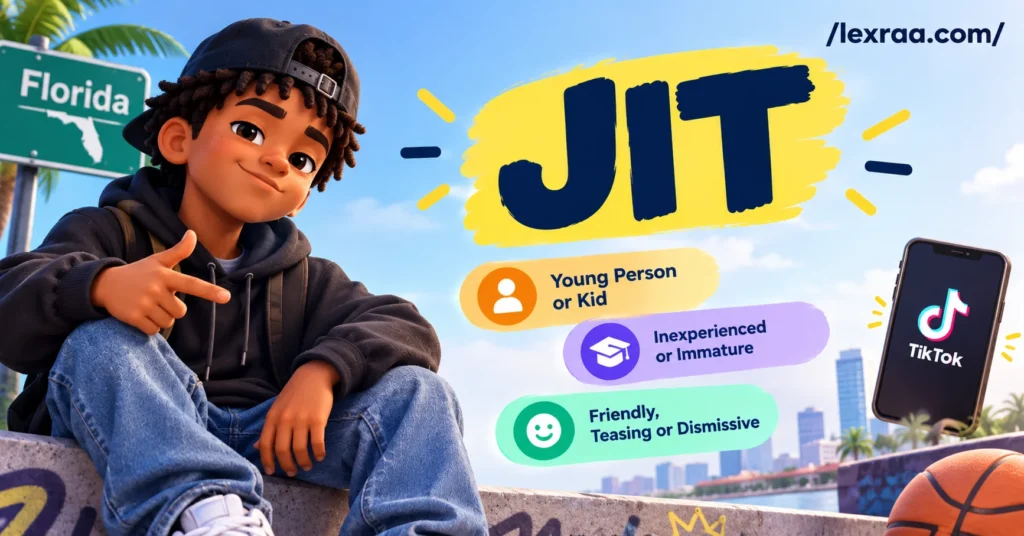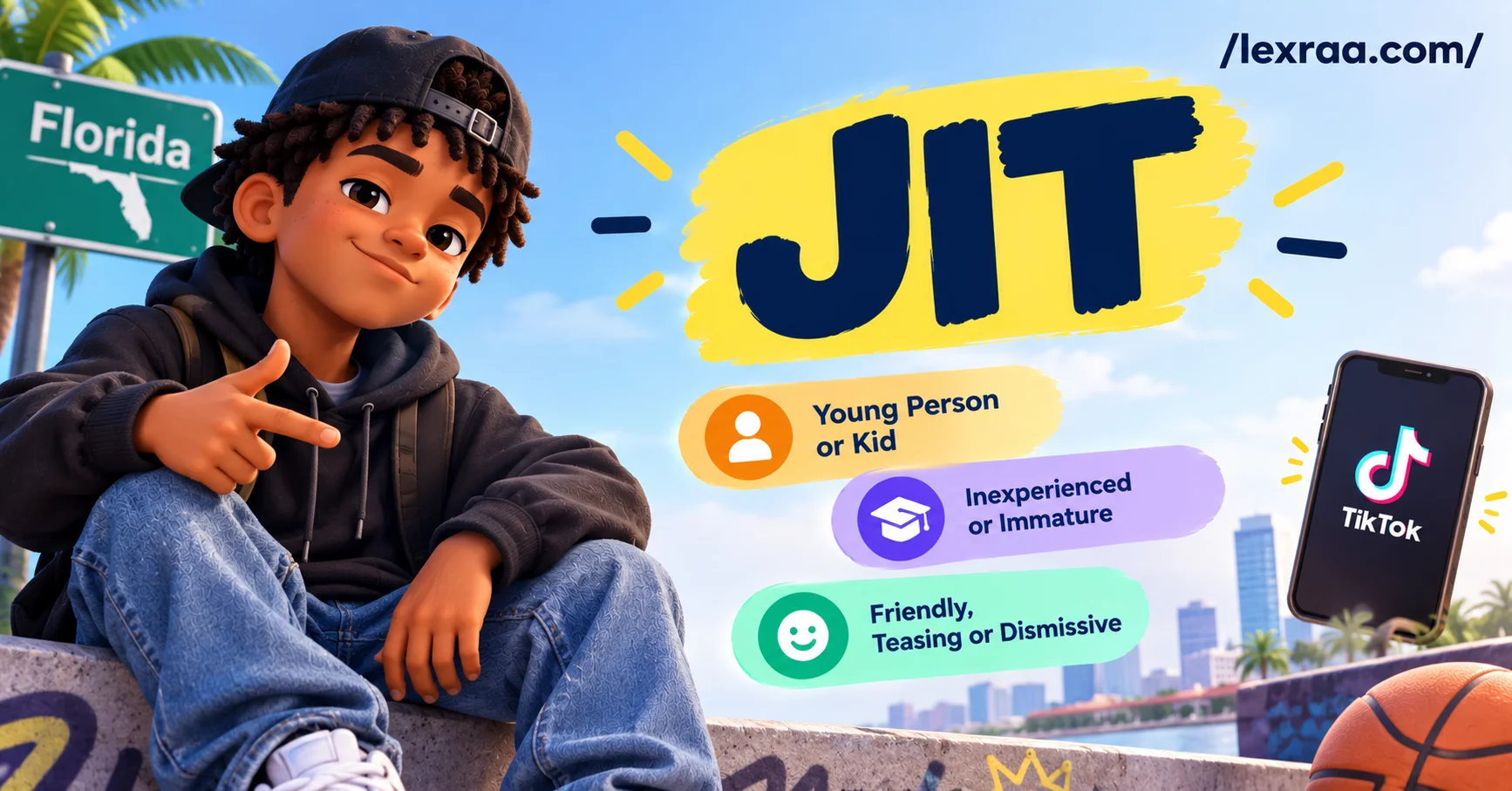
Jit is slang for a young person, kid, or someone younger or less experienced than the speaker. It traces back to African American English in Florida, where it likely grew out of “jitterbug,” a word used decades ago for a lively or restless young person. The clipped form “jit” shows up in Florida newspapers as early as the 1990s, long before social media picked it up — and today it swings between friendly, teasing, and dismissive depending entirely on who’s saying it and why.
That last point is the one most definitions miss: “jit” isn’t a fixed label like “kid.” It’s a lens the speaker applies, and the lens changes the meaning. This guide breaks down exactly how.
What Does Jit Mean in Slang?
The simplest translation is “kid” or “young person.”
Someone might say:
“That jit is fast.”
That usually means:
“That kid is fast.”
But “jit” does not always describe someone’s exact age. In casual speech, it can also point to someone who seems young, inexperienced, immature, or simply younger than the person speaking.
That flexibility explains why you might see an adult called a “jit” online. The speaker may be emphasizing that the person is inexperienced or acting childish rather than literally saying they are a child.
“Jit” is best classified as a slang noun, not an acronym, in its primary slang use.
The Florida Connection and the “Jitterbug” Origin
“Jit” has a long-standing association with Florida slang, specifically within African American English. According to Merriam-Webster’s slang dictionary, online use of the word dates back to the early 2000s, but the term itself is much older — documented in Florida newspapers from the 1990s, including a 1994 South Florida Sun-Sentinel piece that explicitly defines a character’s nickname “Jit” as short for “Jitterbug.” Merriam-Webster
That’s the most credible origin trail: jit as a clipped form of jitterbug, a term that itself described a lively, high-energy, sometimes reckless young person going back to the swing-era 1930s-40s and carried forward in Black vernacular speech.
You’ll also see a competing claim online that JIT is an acronym for “Juvenile In Training.” That expansion shows up in user-submitted slang references and has circulated as an explanation, but it reads as a later backronym rather than a documented origin — there’s no historical record tying the phrase “Juvenile In Training” to the word’s actual use in the 1990s. Treat it as folk etymology, not fact.
So the safe historical takeaway is: jit predates TikTok by at least three decades, most likely as a shortening of “jitterbug,” and social media only accelerated a word that already existed.
How “Jit” Changes With Context
The word itself stays short, but the tone can move around quite a bit.
| Situation | Likely meaning | Tone |
|---|---|---|
| “What’s up, jit?” | Young person/friend | Friendly |
| “That jit is talented.” | Kid/young person | Neutral or positive |
| “This jit really thought he won.” | Young/inexperienced person being teased | Humorous |
| “Move, jit.” | Kid/person being dismissed | Dismissive |
| “That jit doesn’t know anything.” | Inexperienced or immature person | Critical |
A useful clue is what the speaker is focusing on. If the sentence mentions age, siblings, school, sports, or being young, “jit” probably means a younger person. If the sentence is reacting to someone’s behavior, it may carry the extra idea of “immature” or “inexperienced.” Merriam-Webster notes this edge directly: the word “often has a neutral connotation, but in some contexts it can have a slightly negative edge, implying that the young person in question is unwise, impertinent, or otherwise acting in a way that they shouldn’t.” Merriam-Webster
That distinction is more useful than memorizing a single one-word definition.
Jit on TikTok and Texts
On TikTok and other social platforms, “jit” generally keeps its basic meaning but is often used more loosely.
You might see comments such as:
“This jit is wild 😭”
or:
“Jit really thought he was him.”
In these examples, “jit” can mean this kid, this guy, or this person, with the joke coming from what the person is doing. Dexerto’s slang explainer confirms the same pattern, describing “jit” as a term that spread from Florida onto TikTok and noting it commonly shows up in phrases like “jit trippin'” or “sit down jit.” Dexerto
TikTok didn’t invent the slang — it helped carry a regional term to people who’d never have encountered it otherwise.
Read More: Bay Area Slang: Words and Phrases You’ll Actually Hear
“Lil Jit” and “Jit Trippin'” Meanings
Two combinations show how easily “jit” changes depending on the words around it. (These get a fuller breakdown in their own guides, linked below — here’s the short version.)
“Lil jit”
Lil jit is essentially “little jit” — a young kid, younger person, or someone being treated as the younger one.
“That lil jit can really play.”
The phrase is not automatically affectionate or insulting; the surrounding sentence decides that.
“Jit trippin'”
Jit trippin’ usually means the person is acting strangely, overreacting, making a bad take, or otherwise behaving foolishly.
“Nah, jit trippin’ fr.”
The common thread across the many user-submitted definitions for the phrase is that someone is being called out for their behavior.
Five Realistic Examples of “Jit”
1. iMessage — Older sibling teasing
Alex: You coming to the game? Sam: yeah give me 10 Alex: Hurry up jit 😭 Sam: bro I’m literally outside
Why it works: “Jit” is being used as a playful nickname rather than a serious insult.
2. TikTok comments — Funny reaction
User 1: This jit really tried that trick 💀 User 2: And somehow it worked User 3: bro got lucky fr
Here, “jit” means roughly this kid/person, with the humor coming from what they attempted.
3. Snapchat — Talking about a younger sibling
Mia: My lil jit just got his first bike Kay: Awww 😭 Mia: Now he thinks he owns the whole street Kay: LMAO
The context makes the younger-person meaning obvious.
4. Gaming chat — Calling out an inexperienced player
Jay: Who pushed that early?? Chris: That jit on our team 😭 Jay: He just started playing Chris: explains everything lol
Here, “jit” carries both young/new player and inexperienced ideas.
5. Group chat — Dismissive use
Leo: Trust me, I know how this works Nate: Bro you joined yesterday Leo: I know enough Nate: Sit down jit 😂
This is teasing, but the word has a slightly dismissive edge because Nate is emphasizing Leo’s lack of experience.
Jit vs. Similar Words
| Term | Meaning | Tone | Popularity | Confusion Risk |
|---|---|---|---|---|
| Jit | Young, younger, or inexperienced person | Casual/teasing | High online | Medium |
| Kid | Child or young person | Neutral | High | Low |
| Youngin | Young person, often someone younger | Casual | Medium | Low |
| Rookie | Someone new or inexperienced | Casual | High | Medium |
| Noob | Beginner, especially in online/gaming contexts | Teasing | High | Medium |
| Lil bro | Younger person or younger friend | Friendly/teasing | High online | Medium |
The key difference is that jit combines youth with slang and regional flavor. “Rookie” is mainly about experience, while “kid” is much more neutral.
That is also why replacing “jit” with “noob” is not always accurate. A person can be a jit because they are young without being new at anything.
Is Jit Rude or a Bad Word?
Jit is not automatically rude or a swear word. Its tone depends heavily on the relationship and the sentence.
Among friends, “What’s up, jit?” can be harmless banter. Calling a stranger “that stupid jit,” however, clearly makes the word dismissive. Some slang dictionaries do flag the word as potentially derogatory depending on delivery, which lines up with the Merriam-Webster note above about its occasional “negative edge.”
It is safest in casual communication where slang is already normal. For school assignments, professional emails, job interviews, or formal writing, use kid, young person, younger person, beginner, or rookie, depending on what you actually mean.
A common mistake
Do not assume every JIT you see means the slang word.
In technology and business, JIT commonly means “just-in-time.” In computing, JIT can refer to just-in-time compilation; in manufacturing, it can refer to just-in-time production.
Context settles this quickly:
“That jit is wild.” → slang
“The company uses JIT inventory.” → just-in-time manufacturing
“The JVM uses JIT compilation.” → computing
Other Real Meanings of JIT and Jit
The lowercase slang word is only one entry in a much larger set of meanings. Wikipedia’s JIT disambiguation page lists several established uses, including:
- Just-in-time compilation — computing.
- Just-in-time manufacturing — business and supply-chain management.
- Joint investigation team — an investigative team, especially in cross-border cases.
- Jit — a style of Zimbabwean dance music.
- Jit — a 1990 Zimbabwean film.
- Jit, Qalqilya — a Palestinian town in the West Bank.
- JIT — Jhulelal Institute of Technology in India.
So if someone types “JIT” in a technical document, do not automatically read it as slang. The capitalization and surrounding subject matter are strong clues.
Why “Jit” Sticks
“Jit” is useful because one short word can carry several ideas at once: young, inexperienced, smaller, or acting immature. That makes it more flexible than simply saying “kid,” especially in casual teasing. Social media then gave a decades-old regional word a much larger audience without completely removing its original flavor.
FAQ
What does jit mean in text messages?
In casual texting, jit usually means a young person, kid, or someone younger or less experienced. It can also be used simply as a playful way to address someone.
What does jit mean on TikTok?
On TikTok, jit generally means a kid, young person, or person being humorously treated as young or inexperienced. Comments such as “this jit is wild” often focus as much on the person’s behavior as their age.
Does jit stand for “Juvenile in Training”?
No reliable record supports this as the word’s actual origin. “Juvenile in Training” is a backronym that circulates in user-generated slang references, but the historical evidence — including 1990s Florida newspaper usage — points to “jit” as a shortening of “jitterbug,” not an acronym.
What does “lil jit” mean?
“Lil jit” usually means a little kid, young person, or younger person. It can be affectionate, playful, or teasing depending on the situation.
What does “jit trippin'” mean?
“Jit trippin'” generally means that someone is acting strangely, overreacting, or making a questionable move or statement. It is often used as a humorous callout.
Can an adult be called a jit?
Yes. In newer online usage, “jit” can be applied to an adult who is younger than the speaker or who is acting inexperienced or immature. The word does not function as a strict age category.
Conclusion
Jit is slang for a young person, kid, or someone who seems younger or less experienced, with real historical roots as a Florida shortening of “jitterbug” rather than a modern acronym. It became much more widely recognizable through music, social media, TikTok, and memes — but it didn’t start there.
Use it casually when the surrounding conversation already supports that kind of slang. Avoid it in formal or professional writing, and remember that calling someone a jit can sound dismissive if the context is unfriendly.
The biggest mistake is assuming JIT always means the slang word. In technology, manufacturing, and other formal contexts, it may mean just-in-time or another established abbreviation.