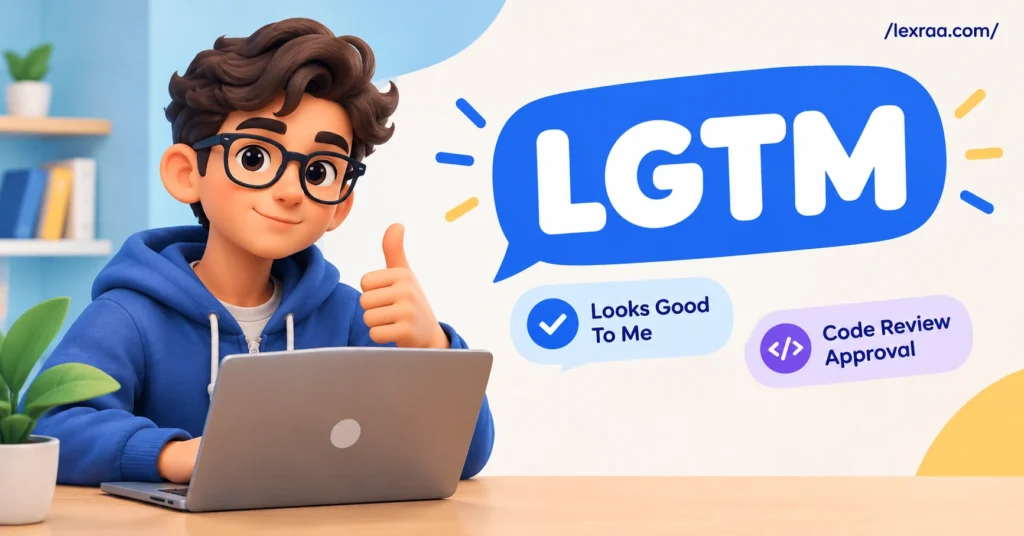
LGTM in chat means “Looks Good To Me.” It is a quick way to say that you approve of, agree with, or are satisfied with something someone has shown you. It is an initialism and abbreviation, rather than slang in the traditional sense, although it is widely treated as internet/chat slang.
You might see LGTM meaning in chat searches because the expression has two closely related uses: ordinary online approval and a more specific meaning in software development. In a casual conversation, it can mean “That looks fine” or “I approve.” In a code review, it can carry a much more specific signal: the reviewer is saying the proposed change has been reviewed and is acceptable.
What Does LGTM Mean in Chat?
The full form of LGTM is:
L = Looks
G = Good
T = To
M = Me
So if someone sends:
“LGTM 👍”
they are essentially saying:
“Looks good to me.”
In everyday chat, LGTM can be used after someone shares a photo, plan, design, message, document, invitation, caption, or other idea. Slang dictionaries and internet-language references specifically record LGTM as an abbreviation used in texting, online chat, instant messaging, email, and social media.
For example:
Friend: “Should I post this picture?”
You: “LGTM.”
Here, there is no technical meaning. You are simply giving the person a quick thumbs-up.
Is LGTM an acronym or abbreviation?
Technically, LGTM is an initialism because the letters are normally pronounced individually: “L-G-T-M.” An acronym is more strictly a shortened expression pronounced as a word, such as “NASA.” Some dictionaries and slang sites nevertheless use acronym as a broader category for LGTM.
So the most precise description is an initialism/abbreviation that has become common internet shorthand.
LGTM Has a Special Meaning in Code Reviews
The term has a particularly strong connection to software development.
When a programmer reviews a proposed code change and writes LGTM, they are normally saying that the change looks acceptable from their perspective. Google’s engineering documentation explicitly defines LGTM as “Looks Good to Me” and describes it as what a code reviewer says when approving a changelist.
The expression is also documented in Google’s historical development workflow. A 2010 Go contribution guide instructed reviewers to approve a change by replying with LGTM, after which the change could be submitted.
Modern code-review systems still use the term. For example, Chromium’s documentation describes an LGTM as a positive code-review signal, while Kubernetes documents /lgtm as a command that can add an LGTM label to a pull request. Kubernetes also makes an important distinction: an ordinary “LGTM” comment can be non-binding, while /lgtm can trigger automation.
That distinction is easy to miss if you only know LGTM as a chat abbreviation.
A useful distinction: approval does not always mean “merge immediately”
In casual chat, LGTM usually means “I like it” or “I don’t see a problem.”
In a technical review, however, the meaning can depend on the project’s rules. An LGTM may represent formal approval, an informal positive review, or an automation-triggering command such as /lgtm. The exact effect therefore comes from the team’s review system rather than from the four letters alone.
That is one reason simply translating LGTM as “yes” can be misleading in a workplace or programming context.
Where Did LGTM Come From?
The exact person who coined LGTM is not firmly established, but the documented history points to software code-review culture in the mid-2000s.
A historical account traces an early documented explanation to a November 2006 discussion of Google’s Mondrian code-review system. It described developers using “looks good to me,” shortened to lgtm, when communicating approval by email.
Google’s later engineering material confirms that LGTM became part of its code-review terminology. A 2010 Go development guide also shows reviewers using LGTM as an approval signal.
The origin story is therefore clearer than many internet slang terms, but it is better to say LGTM emerged from developer/code-review communication than to claim that one particular person definitively invented it.
How LGTM Works in Everyday Conversation
Outside programming, LGTM is essentially a compressed approval sentence.
It can respond to a question such as:
- “Does this outfit look okay?”
- “Should we go with this design?”
- “Is this message ready to send?”
- “What do you think of this photo?”
- “Does this plan work for everyone?”
The important part is that something has normally been presented for evaluation. LGTM is not usually a random expression of excitement.
Compare:
“I finished the presentation. Can you check it?”
“LGTM.”
That makes sense because the recipient has something to review.
But:
“What are you doing tonight?”
“LGTM.”
doesn’t make sense unless there is some unusual context. The abbreviation depends on an object, idea, or proposal that can “look good” to the speaker.
LGTM Examples in Chat
1. Friends — casual
Maya: “Thinking of using this as my profile picture.”
Zara: “LGTM.”
Maya: “No edits?”
Zara: “Nope. Leave it.”
Here LGTM simply means the photo looks fine.
2. Coworkers — workplace chat
Sam: “I updated the client email and fixed the confusing paragraph.”
Nina: “LGTM.”
Sam: “Good, I’ll send it.”
Nina: “Yep, you’re clear to go.”
This is a practical workplace use, although a more formal team may prefer “Approved” or a complete sentence when the decision needs to be unambiguous.
3. Dating — playful
Alex: “Black shirt or blue shirt for dinner?”
Jordan: “Blue. LGTM 😌”
Alex: “That’s the final vote?”
Jordan: “Final vote.”
Here LGTM is deliberately casual and works like a quick approval.
4. Family group chat — funny
Dad: “I found a restaurant for Sunday. Everyone okay with this one?”
Leah: “LGTM.”
Dad: “You haven’t even opened the menu.”
Leah: “I trust the process.”
The abbreviation can sound humorously official when used for an ordinary family decision.
5. Developer group — technical
Ravi: “I pushed the fix for the login bug.”
Mina: “Reviewed the changes. LGTM.”
Ravi: “Thanks!”
Mina: “Tests look good too.”
Here LGTM has its established code-review meaning: the reviewer is signaling approval after examining the change.
6. Group chat — quick decision
Noah: “Final poster attached. Can we use this version?”
Ella: “LGTM.”
Chris: “Same here.”
Noah: “Perfect, sending it now.”
This shows why the abbreviation remains useful: four letters can replace a sentence without changing the basic message.
Read More: Thank You for the Update Meaning: What It Really Means
LGTM vs. Similar Terms
| Term | Meaning | Tone | Popularity | Confusion Risk |
|---|---|---|---|---|
| LGTM | Looks Good To Me; approval after looking something over | Casual to professional | Common online | Low |
| OK | Acceptable, fine, or agreed | Neutral | Very common | Low |
| Approved | Official or explicit approval | More formal | Very common | Low |
| +1 | Agreement or support | Casual/workplace | Common in technical communities | Medium |
| Ship It | Proceed with releasing or merging something | Casual, enthusiastic | Common in developer culture | Medium |
| ACK | Acknowledged; sometimes implies agreement depending on context | Technical/concise | Common in technical contexts | Medium |
The biggest difference is that LGTM is built around visual or review-based judgment: something has been looked at and appears acceptable. “OK” can simply acknowledge a statement, while “Approved” can sound more formal. In software communities, “Ship It” focuses more directly on proceeding with a release or merge.
When LGTM Can Be Misleading
One subtle issue with LGTM is that it can sound stronger than the sender intended.
If someone says:
“LGTM.”
the recipient may interpret that as “I reviewed this carefully and found no issue.” In casual conversation, however, the person may only mean “I looked at it briefly and it seems fine.”
This matters particularly in code review. Research on software development has even examined the problem of low-attention “LGTM” approvals, where reviewers approve changes without sufficiently reviewing them.
For that reason, LGTM should not automatically be interpreted as a guarantee that something is perfect. In technical work, the project’s review rules determine what an LGTM actually authorizes.
How to Reply to LGTM
Your response depends on what you were asking the person to review.
Neutral:
“Thanks!”
Professional:
“Great, I’ll move forward with it.”
Playful:
“That’s the approval I was waiting for 😂”
If the person says LGTM to a technical change, you can also acknowledge the review directly:
“Thanks for reviewing — I’ll merge it.”
There is usually no need to respond with another abbreviation unless the conversation is already highly informal.
Is LGTM Rude or Offensive?
No. LGTM is not inherently rude, profane, or offensive. It is normally a neutral-to-positive shorthand for approval.
The main issue is context, not offensiveness. In a formal email to a client, “Looks good to me” or “Approved” may be clearer than LGTM, especially if the recipient is unfamiliar with internet abbreviations. In a developer-to-developer conversation, however, LGTM is well established and can be perfectly natural.
Why LGTM Stuck Around
LGTM works because it compresses an entire conversational function into four letters: I looked at what you sent, and I don’t see a problem with it. That makes it useful wherever people repeatedly review code, documents, designs, plans, or other shared work. Its roots in developer communication gave it a precise professional use, while texting and online chat made the same approval pattern understandable outside programming.
Its continued use also illustrates a broader feature of internet language: technical communities often turn repeated workplace phrases into compact initialisms, and those abbreviations can later travel into general online communication. LGTM is a good example because its original review-oriented meaning remains recognizable even when someone uses it jokingly in an ordinary group chat.
Frequently Asked Questions
What does LGTM mean in a text message?
LGTM means “Looks Good To Me.” It usually tells someone that you have looked at something they shared and think it is acceptable or good enough.
What does LGTM mean on GitHub?
On GitHub and other code-review systems, LGTM generally signals that a reviewer approves of the proposed change. The exact effect of an LGTM can vary by repository and workflow; some systems attach formal permissions or automation to the approval process.
Is LGTM still used?
Yes. Current technical documentation from Google, Chromium, and Kubernetes continues to use LGTM in code-review contexts. It is also listed by internet-language dictionaries as an abbreviation for online chat and texting.
Is LGTM professional?
It can be professional in a technical or workplace environment where the abbreviation is understood. For clients, formal correspondence, or people unfamiliar with the term, spelling out “Looks good to me” or using “Approved” is often clearer.
What does LGTM mean from a girl or guy?
There is no reliable gender-specific meaning of LGTM. Whether someone sends it to a friend, coworker, date, or family member, the basic meaning remains “Looks Good To Me”; the surrounding conversation determines whether it sounds casual, professional, or playful.
Does LGTM mean approved?
Often, yes, but the strength of that approval depends on context. In ordinary chat it can simply mean “I think this is fine,” while in a formal code-review workflow it may represent a defined approval signal.
What should I say instead of LGTM?
Use “Looks good,” “Looks good to me,” “Approved,” or “That works for me” when you want to be clearer. In a technical conversation, LGTM is useful when everyone already understands the abbreviation and its role in the team’s review process.
Final Takeaway
LGTM = “Looks Good To Me.” In ordinary chat, it is a short way to approve something someone has shown you. In programming, it has a more established code-review meaning and can represent a meaningful approval signal rather than just casual agreement.
Use LGTM when the context is clear and the other person is likely to understand it. Avoid relying on it as a vague substitute for detailed feedback when the decision matters, especially in professional or technical review. And remember: LGTM means something looks acceptable to the person saying it—it does not automatically mean something is perfect or guaranteed to be correct.