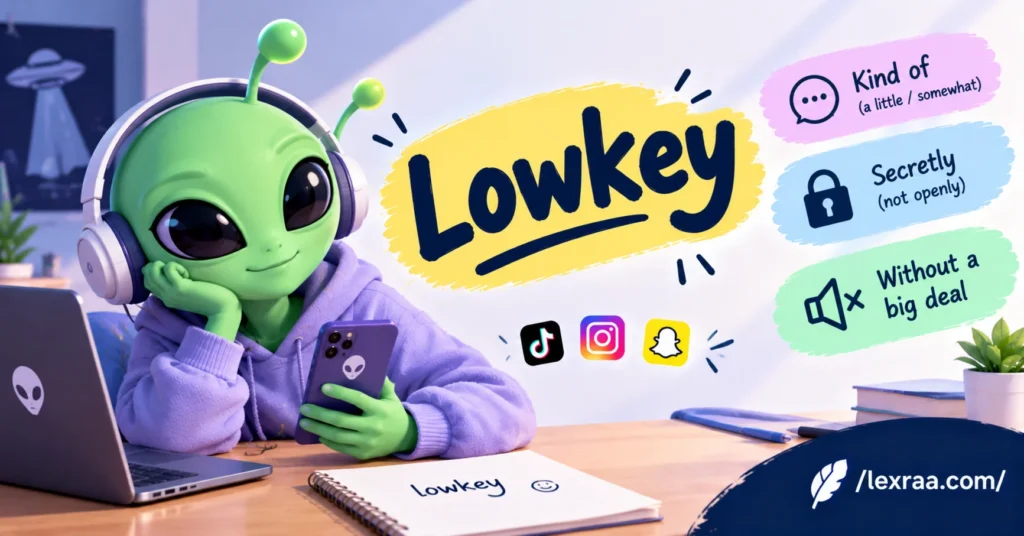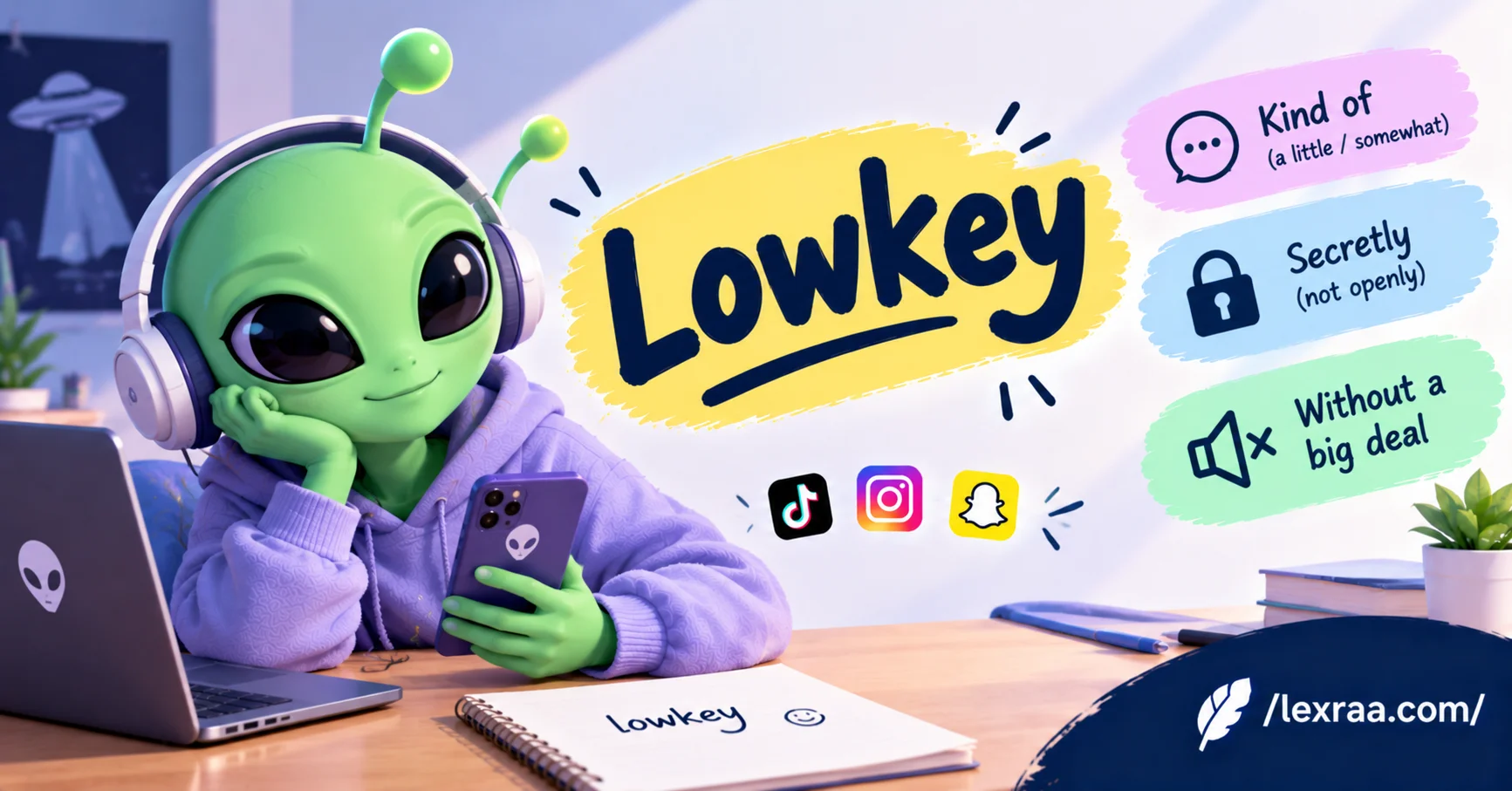
In slang, lowkey usually means “kind of,” “somewhat,” “quietly,” or “without making a big deal about it.” It softens whatever comes next, especially an opinion, feeling, or confession. “I lowkey love this” can mean “I really do, but I’m saying it casually.”
What Does “Lowkey” Mean in Slang?
If someone texts “I lowkey want pizza,” they probably aren’t announcing a life-changing pizza emergency.
They mean something closer to “I kind of want pizza” or “I secretly want pizza, but I’m not making a big deal about it.”
That’s the core of modern slang lowkey: it turns down the intensity of a statement.
Cambridge Dictionary specifically records low-key/lowkey as a slang adverb used when someone expresses an opinion without emphasizing it too much. Dictionary.com similarly describes the slang form as something done or felt with reduced intensity or discreetly.
The important word here is soften.
Compare:
“I love this song.”
with:
“I lowkey love this song.”
The second sentence sounds more casual, understated, or slightly less committed—even if the speaker genuinely loves the song.
The Three Main Slang Uses of Lowkey
Modern lowkey has several closely related uses rather than one rigid translation.
1. “Kind of” or “somewhat”
This is probably the easiest meaning to recognize in texting.
“I’m lowkey tired.”
That can mean “I’m a little tired” or “I’m somewhat tired.”
Likewise:
“That movie was lowkey good.”
means the movie was actually pretty good, but the speaker is presenting the opinion without making a huge declaration about it.
Reddit discussions from English learners repeatedly describe this use as “somewhat,” “slightly,” or a softer way of expressing a feeling.
2. “Secretly” or “without saying it too loudly”
Sometimes lowkey carries a stronger sense of privacy.
“I lowkey have a crush on her.”
This can mean:
“I have a crush on her, but I don’t really want everyone knowing.”
The secrecy does not have to be literal. Often, the speaker simply doesn’t want to make the feeling sound dramatic or embarrassingly serious.
That is why translating every use of lowkey as “secretly” can go wrong.
3. “Without making a big deal”
Lowkey can also describe an understated action, opinion, or situation.
“We’re keeping the birthday lowkey.”
Here, lowkey means simple, relaxed, and not attention-grabbing.
This is closer to the older adjective low-key, which dictionaries define as quiet, restrained, or not attracting much attention. Oxford gives the example of a wedding being “very low-key,” while Cambridge describes the adjective as quiet and not attracting much attention or excitement.
“Lowkey” vs. “Low-Key”: Same Word, Different Job
This is one of the easiest details to miss.
Low-key as an adjective is an established English expression:
“It was a low-key party.”
The party was quiet, simple, or understated.
Lowkey as slang often behaves like an adverb:
“I lowkey loved the party.”
Now it modifies the speaker’s opinion and makes that opinion sound less emphatic.
The spellings overlap in real-world usage. Cambridge lists low-key, lowkey, and low key, while modern texting commonly favors the one-word form.
So don’t assume the spelling alone tells you the meaning. Grammar and context are better clues.
The Best Context Clue: Look at What Comes Next
If you’re trying to decode lowkey meaning in text, don’t translate the word by itself. Look at what it modifies.
| Example | Most likely meaning |
|---|---|
| “I lowkey miss him.” | I kind of/quietly miss him. |
| “I’m lowkey nervous.” | I’m somewhat nervous. |
| “She lowkey annoyed me.” | She annoyed me, but I’m downplaying it. |
| “Keep it lowkey.” | Don’t make it obvious or public. |
| “It was a lowkey party.” | The party was relaxed and understated. |
| “That restaurant is lowkey amazing.” | The restaurant is surprisingly or genuinely very good, stated casually. |
This matters because “lowkey” does not always mean the speaker’s feeling is weak.
Someone can say:
“I lowkey love you.”
and still mean a very real feeling.
The word may be softening the delivery, not necessarily reducing the truth of the feeling.
That’s one of the biggest differences between dictionary definitions and how people actually use the slang.
Lowkey on TikTok, Instagram, and in Texting
Lowkey is well established in online and casual communication, including social-media posts, comments, and texting. Dictionary.com documents examples involving social media, while current slang usage guides and Reddit discussions show the word functioning as a general-purpose conversational softener.
You may see:
“lowkey obsessed 😭”
“this is lowkey fire”
“lowkey wanna go home”
“lowkey the best one”
The interesting part is that lowkey can sometimes become almost a discourse marker.
A person might write:
“Lowkey, why did he even say that?”
In that sentence, it isn’t doing much literal work. It gives the statement a casual, slightly less confrontational opening.
Recent Reddit discussions even debate whether younger speakers sometimes use lowkey as a filler, where removing it barely changes the literal meaning. That doesn’t make the word meaningless; it shows how repeated slang can gradually become part of conversational rhythm.
Five Realistic Examples of “Lowkey”
1. iMessage — Quiet confession
Maya: did you like the movie?
Nina: lowkey loved it 😭
Maya: “lowkey”?? you were crying
Nina: THAT’S NOT THE POINT
Note: Here, lowkey deliberately understates a feeling that is obviously stronger than the wording suggests.
2. Snapchat — Crush confession
A: why do you keep checking his story lol
B: idk 😭
A: you like him
B: lowkey maybe
Here, lowkey makes the admission less direct and gives the speaker some emotional cover.
3. TikTok comments — Unexpected compliment
User 1: this outfit is lowkey so good
User 2: LOWKEY?? it’s literally perfect
User 1: okay highkey then 😂
The first commenter is not necessarily saying the outfit is only slightly good. They are using lowkey to make the compliment sound casual.
4. Group chat — Mild complaint
Sam: anyone else tired
Alex: lowkey exhausted
Jamie: same
Sam: and somehow we still have 3 hours left 😭
Here, lowkey works almost like “honestly, kind of.”
5. Instagram DM — Keeping plans simple
A: birthday plans?
B: nothing crazy
B: just dinner w a few people
A: oh nice
B: yeah keeping it lowkey
This is the older adjective-style use: simple, relaxed, and not a big public event.
Lowkey vs. Similar Slang
| Term | Meaning | Tone | Popularity | Confusion Risk |
|---|---|---|---|---|
| Lowkey | Somewhat, quietly, subtly, or without emphasis | Casual | High | — |
| Highkey | Openly, strongly, or without hiding the intensity | Casual | Medium | High |
| Kinda | Somewhat or to a degree | Casual | High | Medium |
| Secretly | Without others knowing | Neutral | High | Medium |
| NGL | “Not gonna lie”; signals honesty | Casual | High | Medium |
| No cap | Seriously; not lying or exaggerating | Casual | High | Medium |
The most important comparison is lowkey vs. highkey.
“I lowkey love this.”
suggests understatement.
“I highkey love this.”
makes the enthusiasm much more obvious.
They are opposites in tone, but not necessarily strict opposites in every sentence. Someone can even combine them jokingly:
“I’m lowkey highkey obsessed.”
That intentionally creates a contradiction for emphasis.
Is Lowkey Actually “Secretly”?
Sometimes. But not always.
This is where many quick slang definitions become misleading.
If someone says:
“I lowkey want fries.”
they probably aren’t hiding a classified French-fry operation.
They may simply mean “I kind of want fries” or “I’m admitting that I want fries, but I’m keeping the statement casual.”
A better mental translation is:
“I mean this, but I’m turning the volume down.”
That can involve secrecy, moderation, embarrassment, understatement, or simply casual speech.
Where Did Lowkey Come From?
The phrase low-key is much older than today’s internet slang. Dictionary.com traces the older expression to descriptions involving a low musical tone, with written examples going back to the 19th century. (Dictionary.com)
The modern slang usage has a documented connection with African American English/AAVE and later spread widely through music and internet culture. Dictionary.com notes that the term became part of mainstream informal usage, while Later’s social-media glossary specifically identifies AAVE as an important source for the modern slang sense. (Later)
The exact path from older low-key to every modern use of lowkey is not something to reduce to one neat invention date. What is clear is that the adverbial slang sense developed beyond the older adjective meaning and became widely established in online language.
When Lowkey Sounds Natural—and When It Doesn’t
Lowkey fits naturally in:
- Texts with friends
- Casual group chats
- TikTok and Instagram comments
- Informal captions
- Memes and casual online conversation
It is less useful in formal writing.
For example, instead of writing:
“I lowkey think the deadline is unrealistic.”
in a formal work email, simply write:
“I think the deadline may be unrealistic.”
The second version is clearer and leaves less room for someone to wonder whether you are being serious.
Also, don’t force lowkey into every sentence just because you’ve seen it online. When it becomes a filler word, it can stop adding useful nuance.
Why Lowkey Sticks
Lowkey solves a surprisingly specific communication problem: how do you say something true without making it sound like a dramatic declaration?
It gives speakers a tiny amount of emotional distance.
That makes “I lowkey miss you” feel very different from the blunt “I miss you”—even when both sentences point to the same underlying feeling.
FAQ
Does lowkey mean “a little”?
Often, yes. In sentences such as “I’m lowkey tired,” it can naturally be understood as somewhat, kind of, or a little.
But “a little” is not a perfect replacement every time. “Keep it lowkey,” for example, is closer to “keep it quiet, simple, or discreet.”
Is lowkey one word or two words?
You can encounter lowkey, low key, and low-key. The one-word form is especially common in informal online writing, while low-key remains an established dictionary spelling for the adjective.
What does “lowkey obsessed” mean?
It usually means “I’m really obsessed, but I’m saying it casually or without making a huge deal about it.” The phrase can be intentionally exaggerated because the speaker may obviously be very enthusiastic.
Can lowkey be positive or negative?
Yes. You can say “lowkey amazing,” “lowkey annoying,” “lowkey nervous,” or “lowkey excited.” The word itself doesn’t determine whether the feeling is positive or negative; it mainly changes how strongly or openly the statement is presented.
Is lowkey the opposite of highkey?
In slang, they are commonly treated as opposites. Lowkey downplays or softens a statement, while highkey makes the feeling or opinion more open or emphatic.
Does “lowkey” always mean you want to keep something secret?
No. That is one of the most common oversimplifications. Sometimes it signals privacy, but in many current uses it simply means “kind of,” “somewhat,” or “I’m saying this without making it dramatic.”
Conclusion
Lowkey is slang for expressing something in a restrained, casual, subtle, or somewhat secretive way. In texting, it often works like “kind of,” “a little,” or “I mean this, but I’m not making a big deal about it.” Use it naturally in casual chats and social media, but skip it in formal writing when a clearer phrase would do the job. The biggest mistake is translating every lowkey as “secretly”—sometimes it is really just a conversational volume knob.