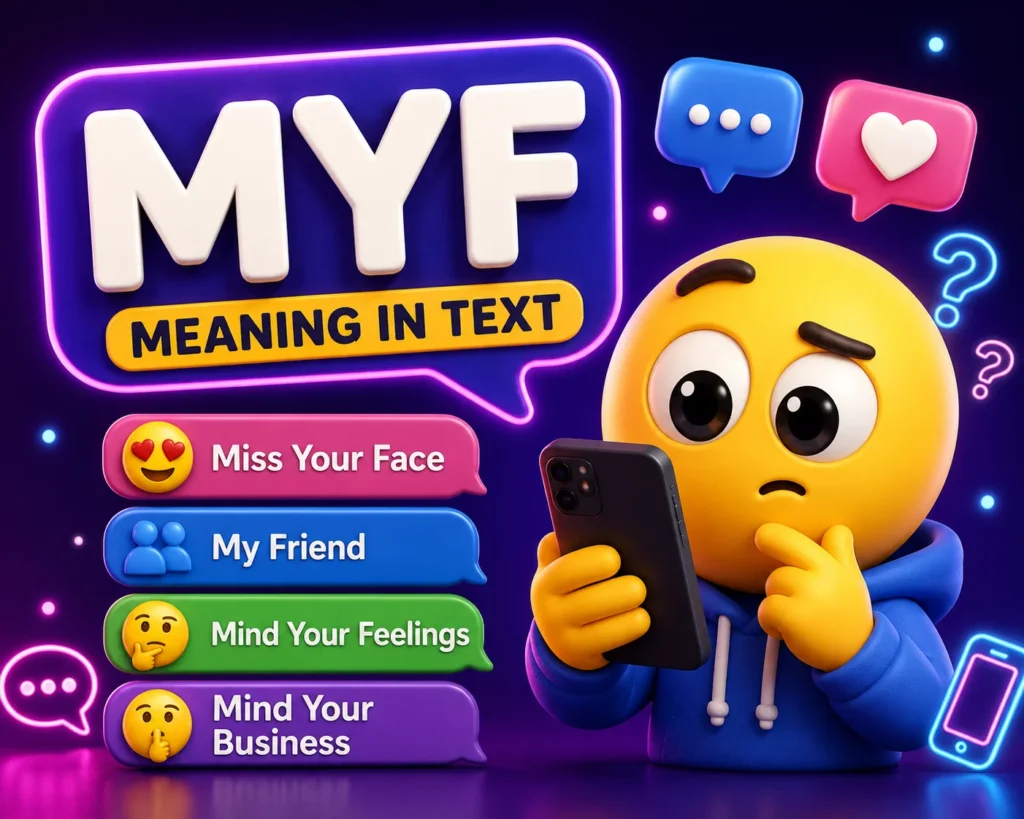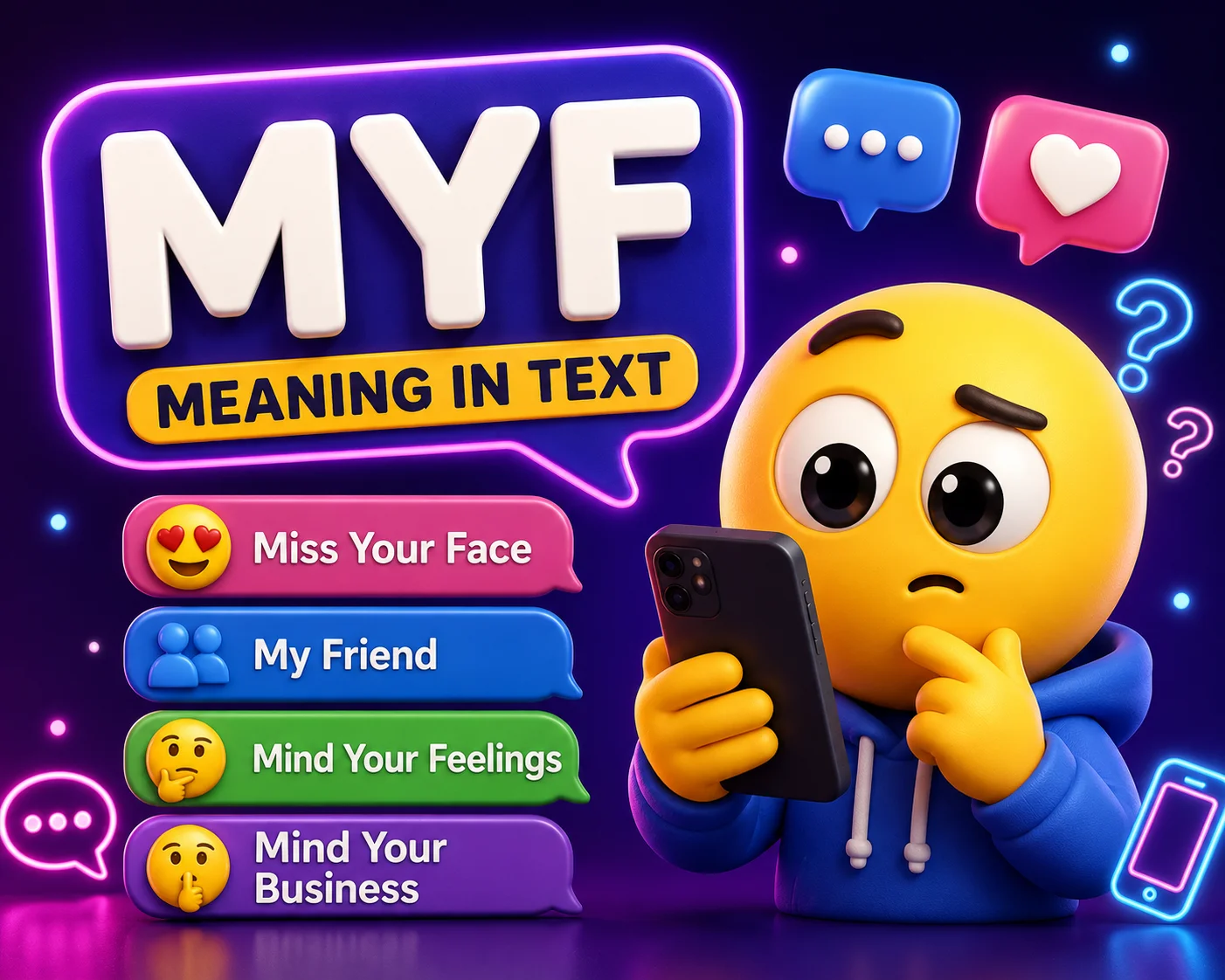
If someone texts MYF, there isn’t one universally accepted meaning. The interpretation depends on the conversation because MYF is not an established texting abbreviation like LOL, BRB, or TBH. The most commonly claimed meaning is “Miss Your Face,” but other interpretations also appear online, making context essential.
Unlike popular internet abbreviations that have one widely recognized definition, MYF is an example of an acronym with conflicting online explanations. That’s exactly why many people search for it after receiving a text—they want to know whether the sender meant something affectionate, friendly, or entirely different.
If someone texts you:
“MYF ❤️”
the sender is most likely saying:
“Miss Your Face.”
It’s a casual, affectionate way of saying they miss seeing you. Instead of writing “I miss you,” they specifically say they miss your face, making the message sound slightly warmer and more playful.
However, this interpretation is not universally standardized. Unlike abbreviations such as IMO, IDK, or SMH, there isn’t reliable evidence that MYF has one agreed-upon meaning across the internet.
Is MYF an Acronym, an Abbreviation, or Slang?
MYF is best described as an acronym or initialism used informally in digital conversations.
The letters may represent different phrases depending on the community or individual using them.
The meanings most commonly claimed online include:
- Miss Your Face (most common in recent slang articles)
- My Friend
- Mind Your Feelings
- A few other niche interpretations with very limited evidence
Because these meanings conflict, MYF should not be treated as a standardized slang term.
The Meaning Most People Are Looking For
Among recent online references, “Miss Your Face” appears most often.
Example:
A: It’s been months since we last met.
B: MYF ❤️
Meaning:
I miss seeing you.
This expression is warmer than simply saying “I miss you.” It emphasizes missing someone’s presence rather than only missing communication.
Why There Isn’t a Single Correct Definition
One thing becomes clear when comparing the top search results:
Different websites confidently define MYF in completely different ways.
For example:
- One article says it means Miss Your Face.
- Another says My Friend.
- Another claims Mind Your Feelings.
- Others list additional meanings without showing real-world examples or evidence of widespread use.
Unlike abbreviations such as LOL, which have decades of documented usage, MYF lacks consistent documentation. No major internet slang reference clearly identifies one official meaning or traces its origin to a specific online community.
That doesn’t necessarily mean people never use it—it means the abbreviation hasn’t reached a level where one definition is universally recognized.
What Does MYF Mean When Someone Texts It to You?
The safest interpretation depends on the conversation.
If you’re talking with someone close to you
Example:
MYF ❤️
This probably means:
“Miss Your Face.”
If it’s a longtime friend
Example:
Hey MYF!
The sender may simply be shortening:
“My Friend.”
If the surrounding conversation doesn’t fit either meaning
Don’t assume.
Because MYF has no universally accepted definition, asking for clarification is often the smartest response.
For example:
“Haha, what do you mean by MYF?”
That avoids misunderstandings and keeps the conversation natural.
Is MYF Common on Messaging Apps?
Current evidence suggests that MYF is relatively uncommon compared with well-established abbreviations.
SMS and iMessage
Occasionally used between friends or romantic partners, especially when intended to mean “Miss Your Face.”
May appear in personal conversations, but there is no evidence that it’s a widely recognized abbreviation on the platform.
Instagram DMs
Some people use MYF affectionately in private messages, particularly after not seeing someone for a while.
Snapchat
Possible, but uncommon. Users are generally more likely to type the full phrase “miss you” or use emojis instead.
X (formerly Twitter)
There is little evidence that MYF functions as a recognizable abbreviation in public posts or replies. When it does appear, it often refers to something unrelated to texting slang.
A Common Misunderstanding
One mistake many readers make is assuming that every acronym found on a slang website is universally understood.
MYF is a good example of why that’s not always true.
Because multiple websites disagree about its meaning, there’s no guarantee the person who texted it intended the same definition you found online.
The surrounding conversation matters much more than the letters themselves.
How People Type It
You’ll usually see:
- MYF
- myf
- Myf
Capitalization doesn’t appear to change the meaning. As with many casual abbreviations, lowercase is common in quick text conversations, while uppercase may simply stand out more visually.
Where Did MYF Come From?
Unlike classic internet abbreviations such as LOL, BRB, or IDK, there is no verified origin for MYF.
No reliable source traces it to:
- early SMS culture,
- IRC or MSN Messenger,
- AOL Instant Messenger,
- internet forums,
- AAVE,
- or a specific social media platform.
Instead, it seems to have emerged gradually through individual online usage, with different communities assigning different meanings. Because those meanings never became standardized, MYF remains an uncommon and context-dependent abbreviation rather than a universally recognized piece of internet slang.
Tone Variations: How MYF Can Sound in Different Conversations
Assuming MYF means “Miss Your Face,” the tone depends almost entirely on the relationship between the people texting. Since the abbreviation isn’t universally recognized, these examples reflect the most common affectionate interpretation rather than a guaranteed meaning.
Playful
A: It’s been forever since our coffee run.
B: I know! MYF 😂
A: This weekend?
B: Definitely.
Romantic
A: My flight got delayed another day.
B: MYF ❤️
A: I’ll see you soon.
B: Can’t wait.
Funny
A: I finally got a haircut.
B: About time. MYF 😆
A: Rude.
B: Just kidding.
Genuine
A: Work has been so busy lately.
B: Yeah… MYF.
A: Let’s catch up soon.
B: I’d love that.
Real Text Message Examples
These examples demonstrate how MYF might naturally appear if the sender means “Miss Your Face.” Because the abbreviation isn’t standardized, many people still choose to write the full phrase instead.
1. Best Friends
A: Haven’t seen you since graduation.
B: MYF!
A: Same here.
B: Let’s fix that soon.
2. Dating
A: Only two more days until I’m home.
B: MYF ❤️
A: I miss you too.
B: Counting down.
3. Siblings
Brother: When are you visiting?
You: Hopefully next month.
Brother: MYF.
You: Miss you too.
4. Parent and Child
Mom: The house feels empty.
Daughter: Aww.
Mom: MYF.
Daughter: I’ll visit this weekend.
5. College Friends
A: Everyone met without me?
B: We did… MYF though.
A: I’ll be there next time.
B: Promise.
6. Coworkers
A: Working remotely again today.
B: The office is quiet. MYF.
A: I’ll be back tomorrow.
B: Good.
7. Group Chat
A: Sorry I missed movie night.
B: MYF!
C: We saved your seat anyway.
A: Next time for sure.
8. Long-Distance Friends
A: It’s already been six months.
B: Seriously… MYF.
A: Video call tonight?
B: Sounds perfect.
9. Instagram DM
A: I saw your vacation photos!
B: Wish you were here.
A: MYF ❤️
B: Next trip together.
10. Former Coworkers
A: The office isn’t the same anymore.
B: Haha.
A: MYF.
B: I miss everyone too.
How to Reply to MYF
If you’re confident the sender means “Miss Your Face,” here are natural replies.
Funny Reply
“My face misses you too 😂”
Serious Reply
“I’ve missed seeing you as well.”
Flirty Reply
“Come see it in person 😉”
Neutral Reply
“We should catch up soon.”
MYF Compared With Similar Texting Terms
| Term | Meaning | Tone | Popularity | Confusion Risk |
|---|---|---|---|---|
| MYF | Usually “Miss Your Face” (not standardized) | Affectionate | Low | Very High |
| ILY | I Love You | Loving | Very High | Low |
| IMY | I Miss You | Affectionate | High | Low |
| HMU | Hit Me Up | Casual | Very High | Low |
| WYD | What Are You Doing? | Casual | Very High | Low |
| IDC (opposite tone) | I Don’t Care | Indifferent | Very High | Low |
One useful distinction is that IMY (“I Miss You”) is widely recognized and immediately understood, while MYF may require additional context because many people have never encountered it before.
Who Uses MYF?
Current evidence suggests that MYF is relatively niche rather than mainstream internet slang.
Gen Z
Some Gen Z users may recognize or use MYF in private conversations, but it is far less common than abbreviations such as IMY, ILY, TBH, or FR.
Millennials
Most Millennials are more likely to type “miss you” or IMY instead of MYF. Recognition varies widely.
Older Adults
Older adults are unlikely to recognize MYF unless someone specifically explains it.
Regional Usage
There is no verified evidence that MYF has distinct meanings in the United States, the United Kingdom, Canada, Australia, or other English-speaking regions.
Instead, its meaning appears to depend on individual social circles rather than geography.
Why Context Matters More Than the Acronym
One interesting thing about MYF is that its interpretation depends almost entirely on context.
Compare these two examples:
Example 1
“MYF ❤️”
Most readers would interpret this as “Miss Your Face.”
Example 2
“Hey MYF!”
Some people would instead understand it as “My Friend.”
Unlike abbreviations such as LOL or BRB, where almost everyone shares the same understanding, MYF relies heavily on the relationship between the sender and recipient. That’s one reason it has never become a universally recognized part of internet slang.
Is MYF Actually Worth Using?
If your goal is to communicate clearly, abbreviations such as IMY, ILY, or even writing “I miss you” are much less likely to confuse someone.
However, if you and the other person already understand MYF to mean “Miss Your Face,” it can feel personal and playful because it functions like an inside expression rather than a standard piece of internet slang.
That balance—being meaningful within some conversations but unfamiliar in many others—is what makes MYF different from most well-known texting abbreviations.
Is MYF Rude or Safe to Use?
In most cases, MYF is not rude, offensive, or inappropriate. If it’s being used to mean “Miss Your Face,” it’s generally a friendly or affectionate expression.
Is it profanity?
No. MYF does not contain profanity or explicit language.
Is it safe for school or work?
It depends more on the audience than the abbreviation itself.
- Friends, family, or a partner: ✔️ Appropriate.
- Teachers or professors: Better to write “I miss seeing everyone” instead.
- Coworkers: Acceptable only if you already have a casual relationship.
- Bosses or clients: Avoid it. Use complete sentences for professionalism.
Cultural Notes
There is no verified evidence linking MYF to a specific culture, community, or dialect such as AAVE. It’s best understood as an informal internet abbreviation used by some individuals rather than a culturally rooted slang term.
A Real-World Observation
One reason MYF has never become as widespread as abbreviations like IMY or ILY is that it doesn’t solve a communication problem those terms already handle. “I miss you” is instantly recognizable, while “Miss Your Face” is more playful but less obvious. That means MYF often works best between people who already share the expression as an inside joke or habit. In everyday texting, many people would need context—or a follow-up explanation—to understand it.
Frequently Asked Questions
What does MYF mean in a text message?
Most commonly, MYF is interpreted as “Miss Your Face.” Someone texting it is usually saying they miss seeing you rather than simply missing your messages. However, because MYF isn’t a standardized abbreviation, always consider the surrounding conversation before assuming the meaning.
Is MYF a common texting abbreviation?
No. MYF is relatively uncommon compared with abbreviations such as IMY, ILY, LOL, or WYD. Many people have never encountered it, which is why it can cause confusion.
Does MYF always mean “Miss Your Face”?
Not necessarily. While “Miss Your Face” is the interpretation most often associated with casual texting, some people may use MYF differently within their own friend group. If the context doesn’t fit, it’s perfectly reasonable to ask what they meant.
Is it rude to reply with just “MYF”?
Usually not. If both people already understand the abbreviation, replying with just “MYF” can feel warm and affectionate. If the other person may not know it, a full reply such as “I miss you too!” is clearer.
What’s the difference between texting MYF and saying it out loud?
In text messages, abbreviations are common because they save time. In spoken conversation, people almost always say the full phrase “I miss your face” instead of pronouncing the letters M-Y-F.
Does MYF mean the same thing in a group chat and a one-on-one chat?
Not always. In a one-on-one conversation, MYF is usually directed at one person. In a group chat, it could refer to missing everyone or missing someone who isn’t present, so context becomes even more important.
Why do people search “MYF meaning in text”?
Many people receive an unfamiliar abbreviation in a message and want to decode it quickly. Because MYF isn’t as well known as many other internet acronyms, it’s one of those abbreviations that often sends people to search engines for clarification.
Common Mistakes to Avoid
- Assuming MYF is universally recognized.
- Using it in professional emails or workplace messages.
- Ignoring the surrounding conversation before deciding what it means.
- Confusing it with more common abbreviations like IMY or ILY.
Quick Usage Tips
- ✔️ Use it with friends, family, or someone who already understands it.
- ✔️ Add context if you’re using it for the first time.
- ✔️ Choose IMY if you want a clearer, widely recognized abbreviation.
- ✔️ Write the full phrase when clarity matters.
Conclusion
MYF most commonly means “Miss Your Face” in text messages, expressing that someone misses seeing another person. Unlike abbreviations such as LOL, WYD, or IMY, it isn’t universally recognized, so context is essential.
If someone texts you MYF, the safest interpretation is usually that they’re expressing affection or saying they miss you. When you’re unsure, simply ask what they mean—it’s better than guessing. And if you’re the one sending the message, remember that a clearer abbreviation like IMY or the full phrase “I miss you” will be understood by almost everyone.