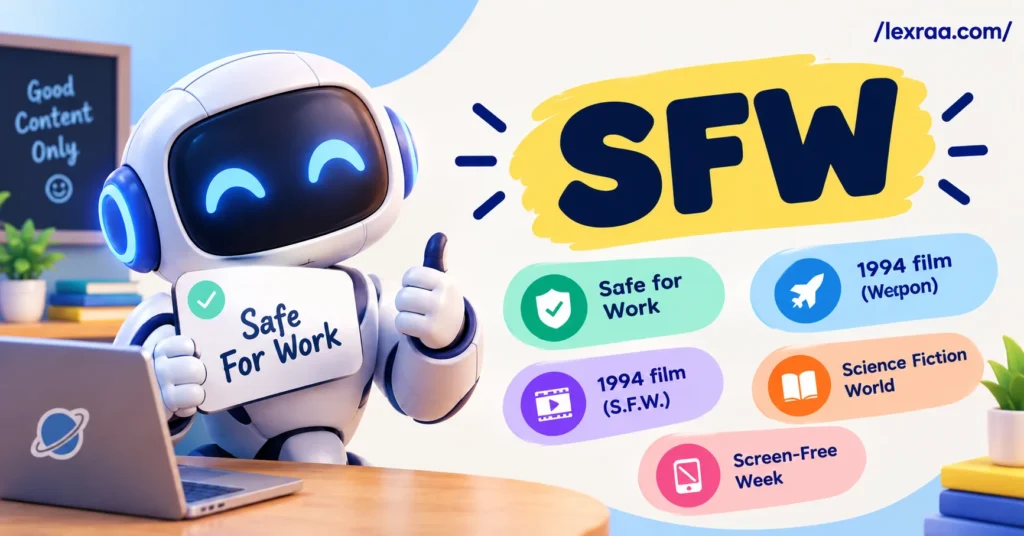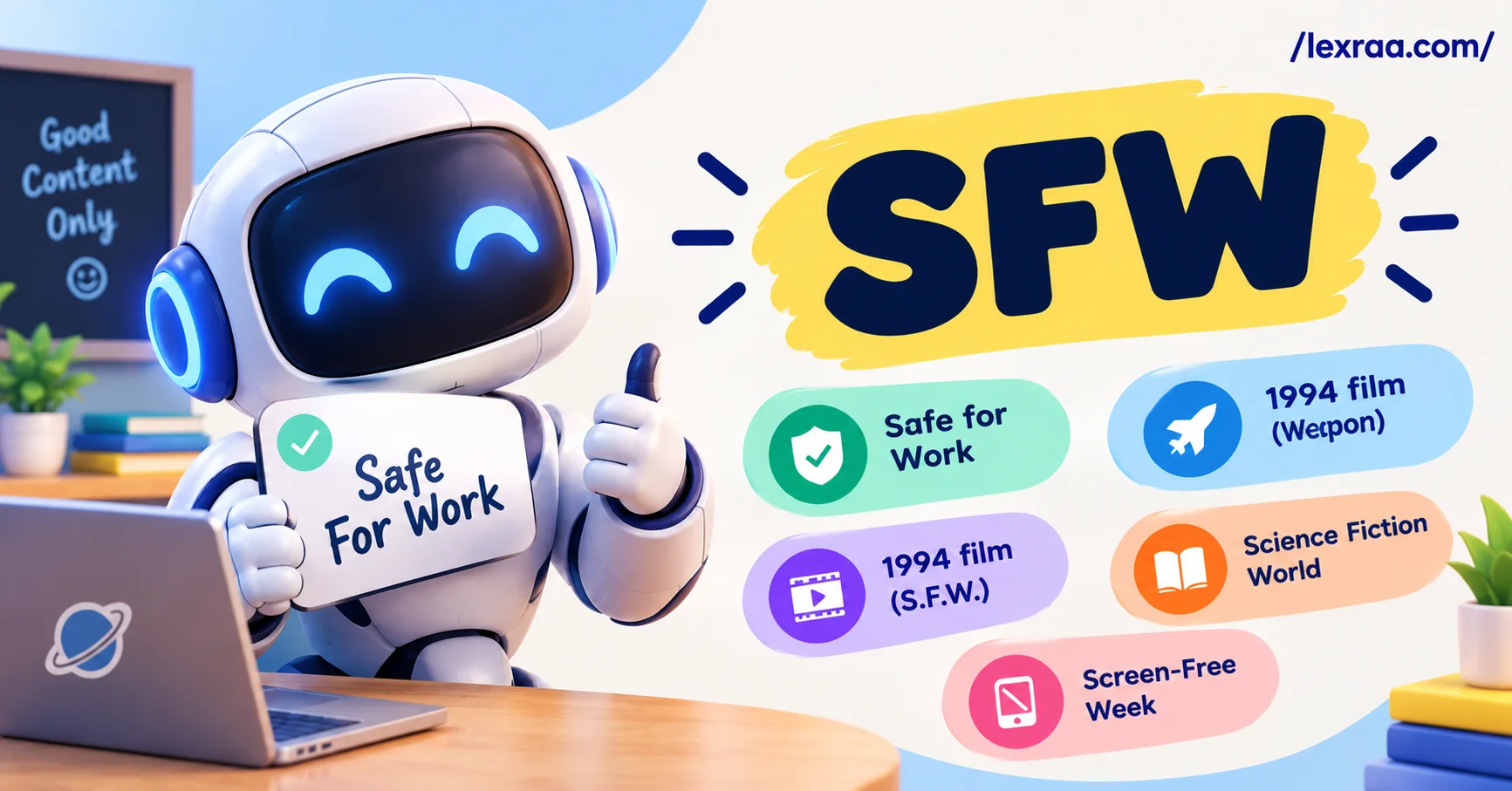
SFW usually means “Safe For Work,” an internet label telling you that a photo, video, link, post, or other content is generally appropriate to view in public or at work. It is the counterpart to NSFW, although “SFW” does not guarantee that every person or community will judge content the same way.
SFW meaning: the version you’ll see online
SFW is an initialism for “Safe For Work.” People use it as a quick label before sharing something that should not contain sexually explicit material, graphic imagery, or other content likely to cause problems in a workplace or public setting.
For example:
“Here’s the video — SFW btw.”
That means, essentially, “You can open this without worrying about something inappropriate suddenly appearing.”
The term is commonly paired with NSFW, meaning “Not Safe For Work.” Dictionary.com gives “safe for work” as the primary abbreviation meaning and defines it as content without graphic violence, sexually explicit imagery, or other potentially offensive material. Dictionary.com
You may see SFW, sfw, or [SFW]. The capitalization does not normally change the meaning.
What SFW can actually mean
1. Safe For Work — the dominant internet meaning
This is the meaning you should assume when SFW appears beside a link, image, meme, video, story, post, or social-media upload.
It is particularly useful when the sender knows the recipient might be viewing the content around coworkers, classmates, family, or strangers. Reddit discussions show people asking specifically what SFW means because the label is often used without being spelled out.
SFW does not mean “about work.” A hilarious cat video can be SFW even though it has absolutely nothing to do with spreadsheets, meetings, or whatever your boss thinks you’re doing.
2. S.F.W. — So Fucking What, the 1994 film
S.F.W. is also the title of a 1994 American black comedy starring Stephen Dorff and Reese Witherspoon. The film’s title expands to “So Fucking What.”
That meaning is a proper title rather than the normal interpretation of lowercase “sfw” in a chat. If someone mentions the 1994 movie, the surrounding context makes the distinction obvious.
3. Sensor Fuzed Weapon
In military and aerospace contexts, SFW can mean Sensor Fuzed Weapon. The U.S. Air Force describes the CBU-105 Sensor Fuzed Weapon as a weapon designed to attack groups of armored or ground vehicles using sensor-equipped submunitions.
This is obviously not what your friend means when they write “this meme is SFW.” Context does all the heavy lifting.
4. Science Fiction World
SFW is also used for Science Fiction World, a Chinese science-fiction magazine founded in 1979 and based in Chengdu. Wikipedia lists SFW as the magazine’s abbreviation, and the publication continues to maintain an official website.
This is a genuine abbreviation, but it belongs to publishing rather than internet content labeling.
5. Screen-Free Week
SFW can also refer to Screen-Free Week, an annual event encouraging people, families, schools, and communities to take a break from entertainment screens. The event dates back to 1994 and is officially associated with the first week of May.
So a sentence about an annual school event could use SFW without having anything to do with internet content warnings.
Other documented uses
Wikipedia’s SFW disambiguation also lists Safi Airways’ ICAO designator, Shoppers Food Warehouse, and Stellenbosch Farmers’ Winery. The latter was a South African wine producer that later became part of Distell; Safi Airways’ three-letter ICAO identifier was SFW.
There are technical uses too. .SFW is a file extension associated with older Seattle FilmWorks image files, while Sound Forge Pro currently uses .sfw for workspace files.
In other words, SFW is not one universal acronym outside internet slang. But in ordinary texts and online posts, “Safe For Work” is overwhelmingly the interpretation to consider first.
Read More: OMS Meaning in Chat: What Does OMS Mean?
SFW vs. NSFW: the useful distinction
| Term | Meaning | Tone | Popularity | Confusion Risk |
|---|---|---|---|---|
| SFW | Safe For Work; content suitable for a public or professional setting | Neutral | High | Low |
| NSFW | Not Safe For Work; content that may be inappropriate for public or professional viewing | Warning | High | Low |
| NSFL | Not Safe For Life; usually an especially disturbing or graphic warning | Strong warning | — | Medium |
| CW | Content Warning; alerts readers to potentially sensitive subject matter | Neutral | — | Medium |
| TW | Trigger Warning; a warning about material that may be distressing to some people | Cautionary | — | Medium |
| PG | A formal-style content classification indicating parental guidance may be appropriate | Neutral | — | Medium |
The key difference is that SFW/NSFW describe suitability for a viewing environment, while CW and TW can warn about a topic even when the material is not explicit.
For example, a detailed discussion of grief could be SFW while still carrying a content warning. Conversely, something can be visually harmless but unsuitable for a particular workplace because of its subject matter.
“SFW” does not mean the same thing to everyone
This is one of the details that gets flattened in generic slang articles.
There is no universal SFW checklist that every website, workplace, moderator, or person follows. A Reddit community may allow something another community considers inappropriate, and individual workplaces can have stricter standards than the internet generally does. A Reddit community discussing its own SFW rules explicitly notes that what counts as SFW can vary by community.
That makes “SFW” a practical warning label, not a guarantee.
If you’re about to open something on a work computer, treat the label as useful information rather than an absolute certification. The sender may simply mean “not explicit,” while your workplace might have a much broader definition of inappropriate content.
How people actually use SFW
iMessage — sending a meme at work
Nina: “I found the dumbest cat video 😂”
Omar: “send it”
Nina: “SFW lol, promise”
Omar: “bless. opening it during this meeting 😭”
Here SFW reassures the recipient that opening the link should not produce an awkward surprise.
Reddit — checking a post before opening it
User 1: “Is this SFW?”
User 2: “Yeah, just cosplay photos.”
User 1: “Okay, I’m on the train.”
User 2: “You’re safe 😂”
The label is about where the content can comfortably be viewed, not whether the content is boring or work-related.
Discord group chat — setting a channel rule
Mod: “Please keep #general SFW.”
Alex: “Does that include gore?”
Mod: “Yep, no explicit stuff or graphic images here.”
Alex: “Got it.”
Here SFW functions as a community rule rather than a warning attached to one particular link.
TikTok comments — clarifying a post
Maya: “wait is this SFW?”
Leo: “yeah 😂 just a weird cooking video”
Maya: “thank god”
Leo: “the thumbnail makes it look WAY worse”
This shows why people sometimes ask before clicking even when the content itself isn’t necessarily adult.
Work chat — sharing an article
Sam: “Found a useful article about presentation design.”
Priya: “SFW?”
Sam: “Yep, completely clean.”
Priya: “Perfect, sending it to the team.”
In professional communication, the abbreviation can work as a quick practical check rather than internet slang for its own sake.
Where did SFW come from?
The safest historical explanation is that SFW developed as the positive counterpart to NSFW, rather than having a completely independent origin story.
NSFW was already circulating in online communities in the early 2000s, and Urban Dictionary has an SFW entry dating to September 2003. Wikipedia’s history of NSFW also documents early-2000s usage and notes that SFW is used for links without the material that would make them NSFW.
The exact first person or website to coin SFW is not firmly established, so claims assigning it to one specific forum or individual should be treated cautiously.
Why SFW sticks
SFW works because it answers a very practical question before you click: “Can I open this here?” Three letters turn that entire question into a tiny label, which is why the term survived even as many other internet abbreviations faded.
FAQ’s
Does SFW mean family-friendly?
Not necessarily. SFW generally concerns whether content is appropriate to view in a work or public environment, while “family-friendly” can imply a stricter standard suitable for children.
Can SFW describe a person?
Usually no. SFW normally labels content, links, posts, images, videos, or spaces rather than describing someone’s personality or behavior.
What does SFW mean on Reddit?
On Reddit, SFW generally means Safe For Work and contrasts with NSFW content. Reddit discussions show that newcomers sometimes ask about the abbreviation because communities often use SFW/NSFW labels without spelling them out.
Is SFW a slang word or an acronym?
It is best classified as an initialism because the letters represent “Safe For Work” and are normally pronounced individually: S-F-W.
Can SFW mean something different from “Safe For Work”?
Yes. Depending on context, it can refer to things such as Science Fiction World, Screen-Free Week, Sensor Fuzed Weapon, the film S.F.W., or other organizations and technical terms.
Is lowercase “sfw” different from uppercase “SFW”?
No. In ordinary internet use, sfw and SFW mean the same thing. Lowercase simply fits the casual style of texting and online conversation.
Conclusion
When you see SFW beside a link, photo, meme, or video, it almost certainly means “Safe For Work.” Use it when you want to reassure someone that content is generally suitable for viewing in a public or professional setting. Avoid treating SFW as an absolute guarantee, because communities and workplaces can draw the line differently. The biggest mistake is assuming the letters can only mean Safe For Work when the context could actually point to a film, technical term, organization, or other documented use.