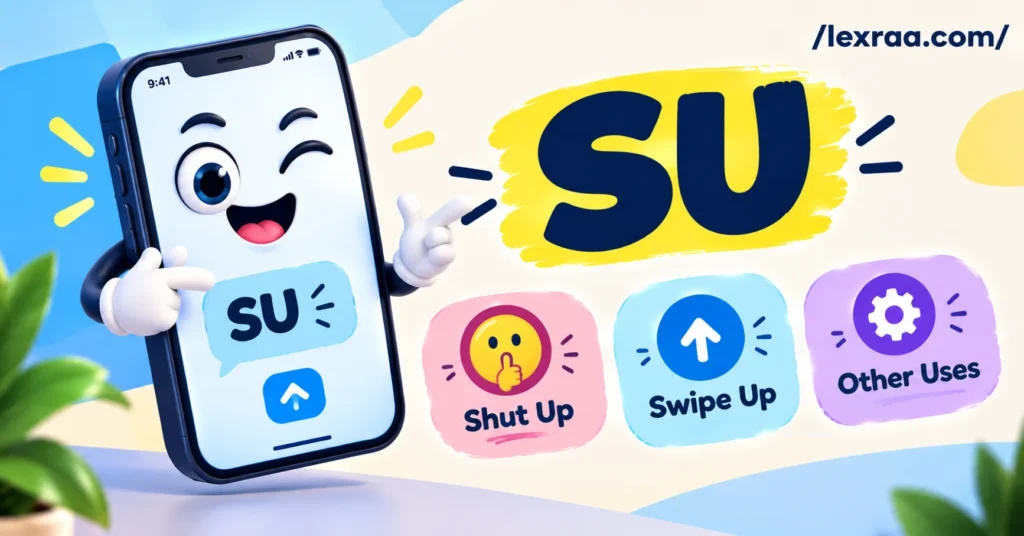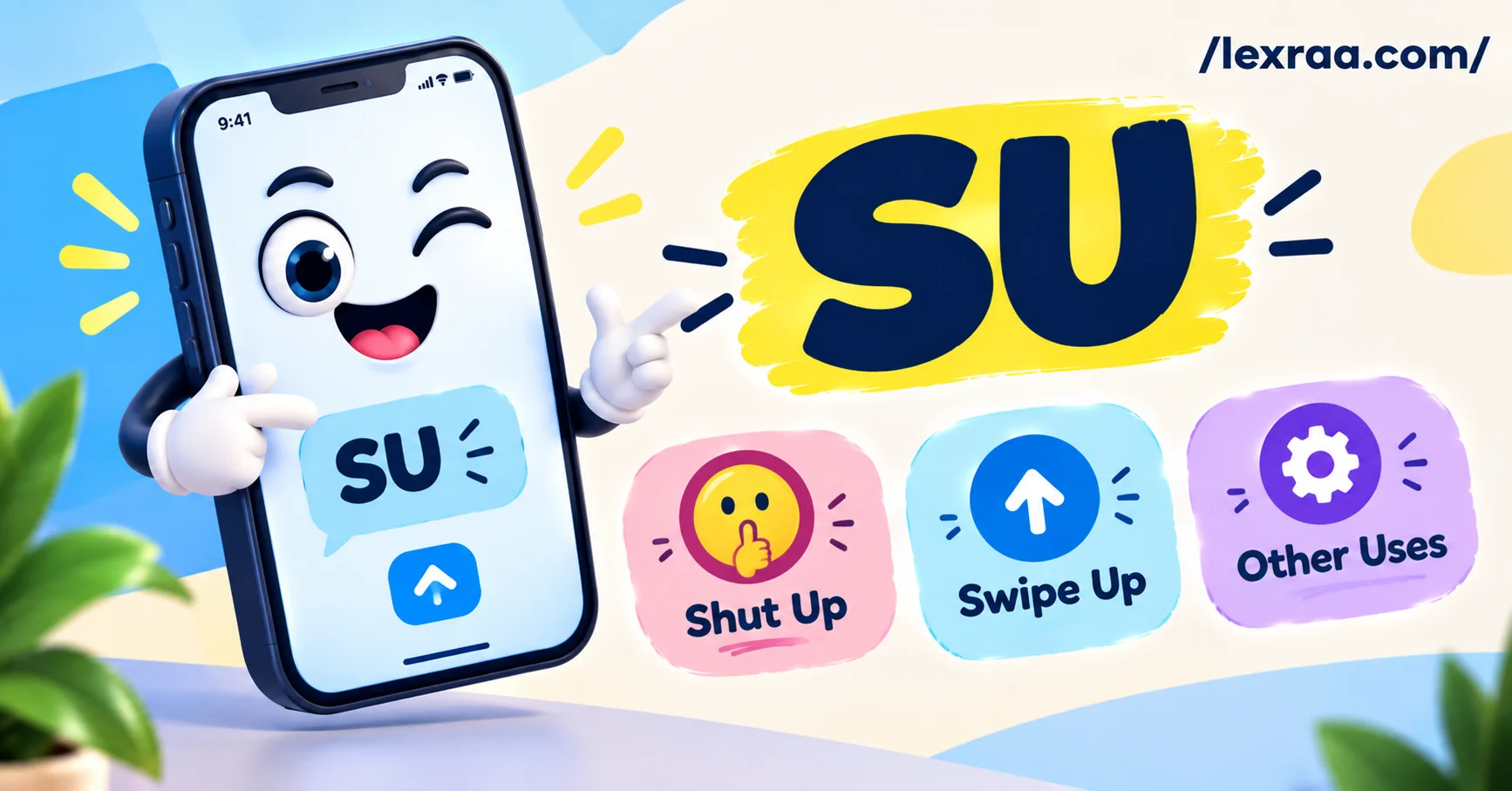
SU can mean “shut up” in casual texting, often as a reaction to surprising news rather than a literal command. It can also mean “swipe up” in social-media contexts. The sentence, conversation, and setting help you tell which meaning fits.
The main meanings of SU
SU is an abbreviation whose meaning changes with context. Two uses are especially relevant to everyday messaging, while other expansions appear in specific situations.
1. SU = “Shut up”
In a casual conversation, someone may type SU after hearing something surprising, exciting, or hard to believe. In that case, it can mean “No way!” or “You’re kidding!” rather than an angry order to stop talking.
“SU, you actually met the singer?! 😭”
Here, the sender sounds surprised. But the same abbreviation can be dismissive if someone uses it during an argument or directs it at a person they barely know.
2. SU = “Swipe up”
In a social-media story or promotional caption, SU can stand for “swipe up”—a prompt to follow a link or open more content. This use is associated with older story-link interfaces, particularly on Instagram and Snapchat.
“SU for the full recipe 👆”
The important clue is the surrounding content: a link, product, video, or other call to action. The swipe-up feature has changed on some platforms, so the phrase may be less useful than a direct instruction to tap a link.
3. Other meanings you may encounter
Some sources and users give SU additional expansions, but they are less consistently established as general texting slang.
- See you: An occasional proposed sign-off, though “CU,” “CYA,” or simply “see you” are clearer.
- Straight up: A real expression in ordinary English, but SU is not reliably understood as its abbreviation without context.
- Specialized abbreviations: In technical, educational, organizational, or scientific writing, SU can stand for terms specific to that field.
How context changes the meaning
The tricky part about SU is that two letters alone may not give you enough information. Look at what came before, what the sender is responding to, and whether the message includes a link or a clear emotional reaction.
| Message or setting | Likely meaning | Clue |
|---|---|---|
| “SU, you won?!” | Shut up | Surprising news |
| “SU for the details” | Swipe up | Link or promotion |
| “Can you SU?” | Unclear | More context is needed |
| “SU later” | Possibly “see you” | Sign-off, but not a dependable standard |
| “SU” in a technical document | Field-specific meaning | Subject matter matters |
One useful distinction: SUP and SU are not interchangeable by default. SUP is widely used as a casual form of “what’s up?” SU may be read as “shut up” or “swipe up,” depending on context.
That missing P can change the whole message.
Is SU playful, rude, or confusing?
When SU means “shut up,” its tone depends on the relationship and situation—not just capitalization or punctuation.
- Between close friends: It can express disbelief or excitement after unexpected news.
- During a disagreement: It can sound dismissive or tell someone to stop speaking.
- With someone you barely know: The intended joke may not be obvious, so the message can come across as rude.
- In a story or promotional post: “Swipe up” is an instruction, not a reaction.
A laughing emoji can help signal a joke, but it is not proof that the sender means no harm. If the message feels unclear, it is better to ask than to guess.
“If you want to keep learning trending expressions, here is what does ate mean and how it is used to praise someone.”
SU in real text conversations
These examples show how the meaning shifts across situations.
1. iMessage — friends reacting to news
Ava: I got tickets for the final!
Mia: SU 😭 no way
Ava: I swear!! Row five
Meaning: Mia uses SU to express excited disbelief.
2. Snapchat — sharing a link
Noah: Posted the full photo set
Jay: Where?
Noah: SU on the story 👆
Meaning: Noah is using SU to direct Jay toward the story link. The phrase is more recognizable in contexts where swipe-up links are available or familiar.
3. Group chat — a joke goes too far
Leo: I finished the whole assignment in ten minutes
Sam: SU 💀
Leo: Okay, it took an hour lol
Meaning: Sam is playfully calling out an unbelievable claim. The joking tone comes from the exchange, not from SU alone.
4. Instagram DM — an unclear message
Riya: SU?
Amir: Do you mean shut up or swipe up? 😭
Riya: Shut up 😂 I just saw your result!
Meaning: The extra question clears up an ambiguous abbreviation before it causes confusion.
5. Text message — a tense exchange
Ben: You keep interrupting me
Alex: SU
Ben: I’m trying to explain what happened
Meaning: Here, SU reads as a blunt command, not playful surprise. Without a friendly context, the literal meaning becomes much more likely.
SU compared with similar abbreviations
| Term | Meaning | Tone | Popularity | Confusion Risk |
|---|---|---|---|---|
| SU | Often “shut up”; can mean “swipe up” | Playful, dismissive, or instructional | Established in slang and social-media contexts | High |
| SUP | “What’s up?” | Casual, friendly | Widely used informal greeting | High when mistyped or shortened |
| STFU | “Shut the fuck up” | Strong, often aggressive | Established internet abbreviation | Medium |
| SMH | “Shaking my head” | Disappointed or disapproving | Widely recognized online | Low |
| CU | “See you” | Casual sign-off | Recognized shorthand | Medium |
| WYD | “What are you doing?” | Casual question | Widely used in texting | Low |
The closest source of confusion is SUP. If someone opens a conversation with “sup?”, they are probably greeting you. If they send “SU” after hearing surprising news, “shut up” is a more plausible reading.
Why SU sticks
SU is short enough to send as an instant reaction, but its meanings depend heavily on context. That makes it useful among people who already understand each other—and easy to misread when the message lacks clues.
Frequently asked questions
What does SU mean from someone who texts me first?
It depends on the rest of the message. If they send only “SU?”, the intent is ambiguous; they may be using shorthand differently from what you expect. Ask what they mean instead of assuming it is a greeting.
Does SU mean the same thing as “sup”?
No. “Sup” is a casual greeting derived from “what’s up?” SU is commonly used for “shut up” or “swipe up.” Because the two look similar, spelling out the intended phrase is clearer when there is room for confusion.
Can SU be used as a reaction to a compliment?
It can be used that way if the sender means “shut up” playfully, expressing surprise or embarrassment. However, it is not a reliable sign of any particular feeling; read the surrounding exchange rather than drawing a big conclusion from two letters.
Is SU an acronym or an abbreviation?
In slang, SU is best described as an abbreviation or initialism formed from the first letters of a phrase, such as “shut up” or “swipe up.” Outside texting, the same letters can stand for unrelated formal terms.
Where did SU slang originate?
The exact origin of the texting use is not firmly established by the sources checked. Although some online explainers connect it to early chat and SMS shorthand, a definitive first use or origin date could not be confirmed.
What should I say if I don’t understand SU?
A simple “What do you mean by SU?” is enough. If it seems like a playful reaction, you can also ask, “Wait, seriously—which meaning?” That keeps the conversation natural without pretending you understood.
Conclusion
SU can mean “shut up” as a reaction to surprising news or “swipe up” as a link prompt. The setting and surrounding words usually offer the strongest clues, while a bare “SU” can remain ambiguous. Use it only when the other person is likely to understand your meaning, and avoid it in formal messages where it could sound rude. The most common mistake is treating SU and SUP as if they were the same abbreviation.