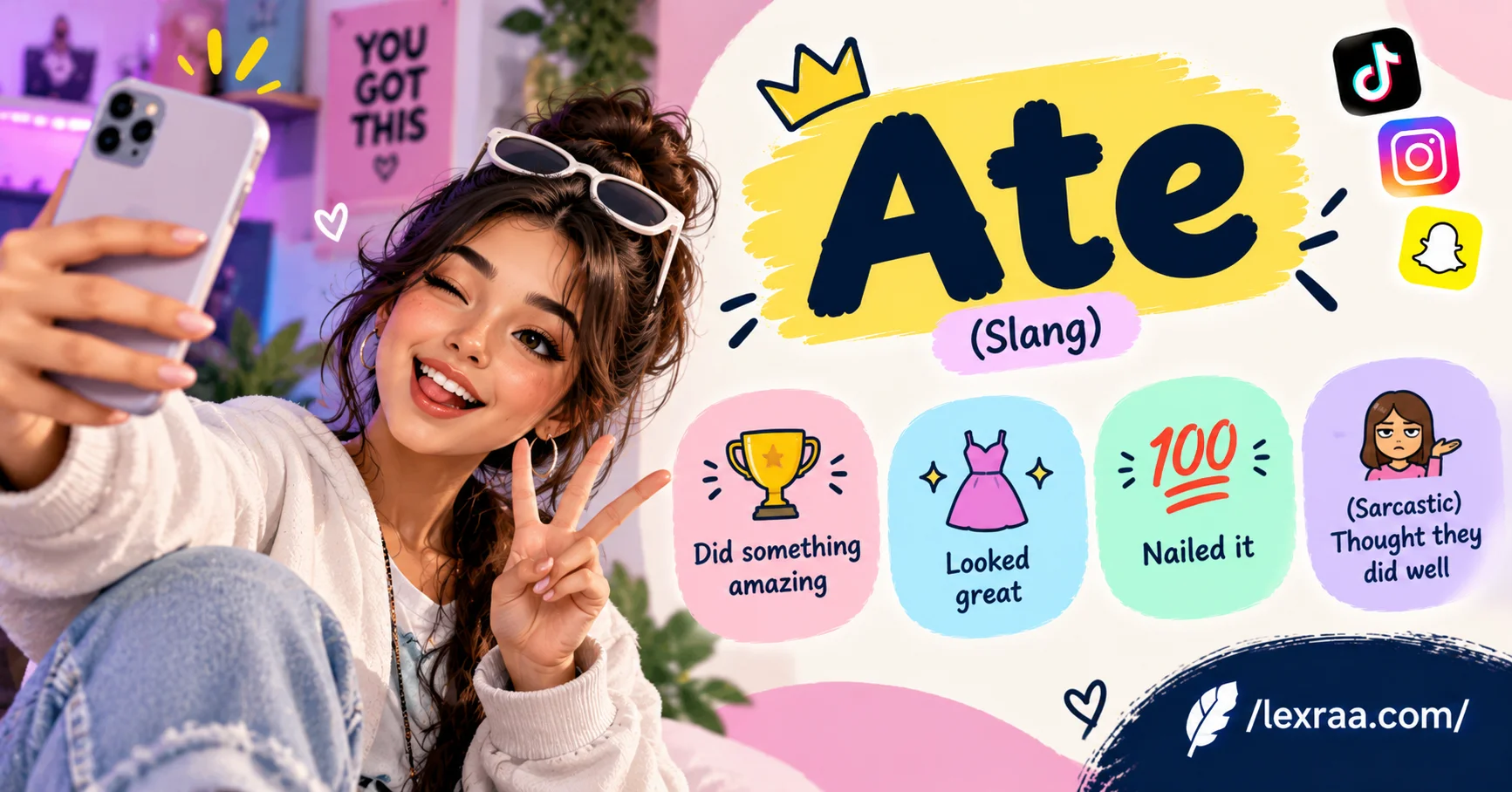
In slang, “ate” means someone did something exceptionally well, looked amazing, or completely nailed a moment.
“You ate” is a compliment, not a comment about food. But “you thought you ate” flips the meaning into sarcasm, suggesting someone thought they did well when they actually didn’t.
Someone posts a flawless outfit, delivers a killer comeback, or absolutely owns a dance routine. The comments arrive: “ATE.” “SHE ATE.” “LEFT NO CRUMBS.”
If you’re searching for the ate slang meaning, here’s the key: it’s praise for impressive execution, style, or performance. The trickier part is knowing when the word is sincere—and when someone is using it to roast another person.
What “ate” means in slang
“Ate” is the past tense of the ordinary verb eat, repurposed as an informal slang compliment. Saying someone “ate” means they performed so well that they stood out, impressed people, or made the moment look effortless.
Common examples include:
- “You ate!” — You did an amazing job.
- “She ate that outfit.” — She looked fantastic.
- “He ate that comeback.” — His response was sharp and effective.
- “I ate that presentation.” — I delivered it really well.
The expression can praise talent, appearance, confidence, humor, or a successful result.
scrabble.m-w.com defines “ate” and “ate and left no crumbs” as performing or doing something perfectly or impressively.
“Ate and left no crumbs” means extra praise
This longer expression turns the compliment up a notch. The image is of someone eating everything and leaving nothing behind—figuratively, they did such a good job that there’s nothing left to criticize.
“That singer ate and left no crumbs.”
Translation: the performance was outstanding. No weak moments, no obvious flaws.
You might see the phrase shortened to “ate,” stretched into an emphatic “ATE,” or used with emojis. The core meaning stays the same.
When “ate” means the opposite of praise
Here’s where a quick search for “ate slang” can get confusing: “you thought you ate” is often sarcastic.
The phrase suggests someone believed they had made an impressive point, delivered a great joke, or looked amazing—but the speaker disagrees.
| Phrase | Likely meaning | Tone |
|---|---|---|
| “You ate.” | You nailed it. | Positive |
| “You ate that up.” | You handled it brilliantly. | Positive |
| “Ate and left no crumbs.” | You did it exceptionally well. | Very positive |
| “You thought you ate.” | You thought you did well, but you didn’t. | Sarcastic |
| “She thought she ate.” | She thinks she impressed people, but the speaker is mocking the attempt. | Teasing or critical |
The distinction is documented by
knowyourmeme.com, which describes the latter as a way to call out a failed attempt at being entertaining, successful, or funny.
One small punctuation-free message can therefore change the whole mood. “You ate” is praise; “you thought you ate” may be shade.
Where “ate” came from
The slang expression is associated with African American Vernacular English (AAVE) and New York City’s Black and Latino LGBTQ+ ballroom culture. It spread through drag and online culture before reaching a much wider audience on social media.
Merriam-Webster traces “ate and left no crumbs” to the New York ballroom scene, with the expression appearing on social media by the mid-2010s. Know Your Meme records an early definition of “ate that” on Urban Dictionary in 2008 and documents the rise of “thought you ate” memes around 2021.
The phrase didn’t suddenly appear because of one viral video. Online platforms helped spread an expression that already had cultural roots.
Five realistic conversations using “ate”
1. Instagram comments — outfit appreciation
Maya: fit check before the concert 💅
Tori: GIRL ATEEEE
Maya: stoppp 😭❤️
Meaning: Tori loves Maya’s outfit and is hyping her up.
2. iMessage — celebrating a school win
Eli: got the highest score on the test
Noah: yooo you ate that 🔥
Eli: finally all that studying paid off lol
Meaning: Eli’s friend is praising his result, not his appearance.
3. TikTok comments — dance performance
User 1: the footwork at the end???
User 2: SHE ATE AND LEFT NO CRUMBS
User 3: that replay button is working overtime 😭
Meaning: The dancers performed impressively enough that viewers want to watch again.
4. Group chat — sarcastic reaction
Zara: he really thought that joke was hilarious 💀
Nina: bro thought he ate
Zara: nobody even laughed 😭
Meaning: The friends are mocking a joke that didn’t land. Here, “thought he ate” is not a compliment.
5. Snapchat — supportive best friends
Ava: just finished my audition!!
Rae: YOU ATE I KNOW IT 🫶
Ava: i was shaking the whole time lmao
Meaning: Rae is reassuring her friend and celebrating her effort, even without knowing the final result.
These are illustrative conversations, not verbatim quotes from real users.
Ate vs. slay, cooked, and served
These expressions can all appear in online praise, but they aren’t perfectly interchangeable.
| Term | Meaning | Tone | Popularity | Confusion Risk |
|---|---|---|---|---|
| Ate | Performed brilliantly or looked excellent | Strong praise | — | Medium |
| Slay | Do something impressively or look fantastic | Confident praise | — | Low |
| Served | Presented an impressive look, performance, or attitude | Expressive praise | — | Medium |
| Cooked | In positive slang, can mean doing something very well; in other contexts, being “cooked” means being in trouble or doomed | Context-dependent | — | High |
| Nailed it | Successfully did something, often a task or performance | Positive, straightforward | — | Low |
| Thought you ate | Suggests someone failed to impress despite thinking they did | Sarcastic | — | High |
Popularity is left unranked because the sources reviewed don’t provide comparable usage statistics.
A useful distinction: “ate” praises the result, while “slay” can praise someone’s overall look or performance. “Nailed it” is easier to use in ordinary conversation, and “cooked” needs context because its meanings can point in opposite directions.
Other meanings of “ate” worth knowing
Not every search for “ate” is about slang. The same spelling has several established meanings in other contexts.
- Ordinary English: “Ate” is the past tense of eat, as in “I ate breakfast.”
- Filipino usage: Ate (commonly pronounced AH-teh) means an older sister and can be a respectful way to address an older woman. See oxfordlearnersdictionaries.com.
- Greek mythology: Atē, also written Ate, is a goddess associated with ruin, recklessness, and delusion.
- Technology: ATE can stand for automatic test equipment, used to automate testing.
- Music: ATE is also the title of a 2024 EP by Stray Kids.
These meanings are not interchangeable. If someone comments “ATE 🔥” under a dance video, the slang compliment is the likely reading; in a technical document, uppercase ATE may mean something entirely different.
Why “ate” sticks
“Ate” compresses a big reaction into one short word. Its food metaphor makes the idea of total success easy to picture, while “left no crumbs” gives people a punchier way to intensify the praise. The phrase also works as a quick reaction when a full sentence would feel unnecessary.
Frequently asked questions
What does “I ate” mean in slang?
“I ate” means “I did really well” or “I nailed it.” Someone might say it after giving a great presentation, posting an outfit they love, or succeeding at a difficult task.
What does “she ate” mean on social media?
It usually means she impressed people with her appearance, performance, skill, or response. The exact thing being praised depends on the post and its comments.
Can “ate” be used as a compliment to anyone?
Yes. The slang compliment isn’t limited to one gender; it can praise anyone’s performance, style, or achievement. What matters is whether the speaker and audience understand the expression.
Is “ate” appropriate in school or at work?
It’s generally fine in casual messages between friends or classmates who understand the slang. In formal essays, business emails, or professional reports, “performed excellently” or “did a great job” is clearer.
How should you reply when someone says “you ate”?
You can say “thank you,” “you’re too nice 😭,” or “I tried my best!” If you’re joking with a friend, a playful “I knowww” may fit. Match your reply to the relationship rather than treating the phrase like a formal compliment.
Does “ate” always mean something positive?
No. “You ate” is usually positive, but “you thought you ate” often mocks someone for thinking they did well when the speaker believes they didn’t. The extra words completely change the meaning.
Conclusion
The slang word ate means someone did something exceptionally well, looked great, or owned a moment. Use it to hype up a friend’s outfit, celebrate a performance, or praise a sharp comeback in casual conversation. Avoid relying on it in formal writing, where a direct compliment is clearer. Remember that “ate and left no crumbs” intensifies the praise, while “thought you ate” can be sarcastic. The biggest mistake is reading every version as a compliment without checking the full phrase.