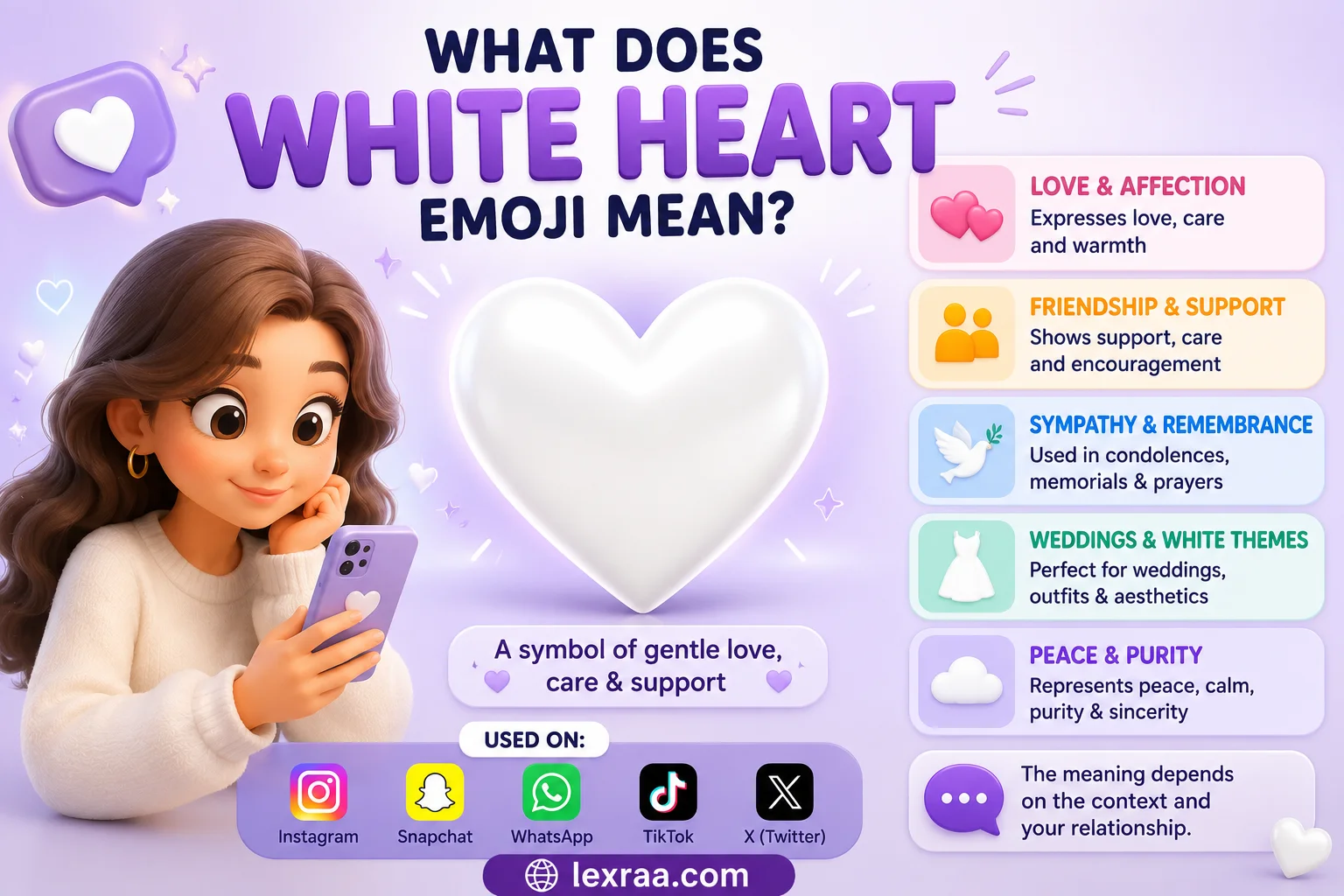
The white heart emoji 🤍 usually expresses love, affection, care, support, or gentle emotional warmth. Depending on the context, it can also represent sympathy, remembrance, peace, or something associated with the color white.
What Does the White Heart Emoji 🤍 Mean in Text?
There is no single hidden translation for 🤍. Like other heart emojis, its meaning depends heavily on the surrounding message, the relationship between the people, and the situation.
The most reliable interpretation is gentle affection or sincere care. Someone might use 🤍 to show that they appreciate you, support you, love you, or simply want to soften the emotional tone of a message. Emojipedia describes it as a heart used for love and affection, while also documenting its use around mourning, angelic or heavenly themes, and associations with white-colored things.
For example:
“Thank you for always being there 🤍”
Here, the emoji is probably reinforcing gratitude and affection rather than declaring romantic love.
By contrast:
“I miss you 🤍”
could be romantic, familial, or completely platonic. The relationship supplies information that the emoji itself does not.
That is why reading 🤍 as an automatic “I love you romantically” can lead to misunderstandings.
The Main Meanings of 🤍
1. Gentle Love and Affection
The most straightforward use of 🤍 is affection. It can communicate warmth without necessarily carrying the intensity associated with a classic red heart.
Someone might write:
“Love you guys 🤍”
A friend could use it in a group chat, a family member could add it to a message, or a romantic partner could use it with you. The heart indicates affection, but it doesn’t tell you exactly what kind of relationship the sender has in mind.
Emojipedia specifically notes that the white heart can represent romantic, platonic, familial, or other forms of love.
2. Friendship and Emotional Support
🤍 is also useful when someone wants to show that they care about another person without making the message romantic.
For example:
“You’ve got this. I’m always here for you 🤍”
In this setting, the emoji works almost like a small emotional hug. It adds warmth to words of encouragement.
This is especially useful after someone shares difficult news, talks about a stressful experience, or simply needs reassurance.
3. Sympathy and Condolences
One of the more important meanings of 🤍 is connected to grief, remembrance, and sympathy.
It can appear alongside memorial posts, tributes, condolences, or messages about someone who has died. Emojipedia notes that the white heart is commonly used when discussing someone passing away and can have heavenly or angelic associations.
For example:
“Thinking of your family during this difficult time 🤍”
Here, 🤍 does not mean flirting or romantic affection. It reinforces compassion and remembrance.
This context matters because the same symbol can feel completely different when it appears under a memorial post versus a selfie.
4. Peace, Calm, or Sincerity
White is often visually associated with simplicity, cleanliness, peace, and calmness, so 🤍 can fit messages that have a peaceful or reassuring tone.
For example:
“Everything will be okay 🤍”
The heart adds emotional softness without making the message overly dramatic.
This isn’t a secret coded definition assigned to the emoji. Rather, it is a common contextual interpretation of a white-colored heart combined with the general symbolism of hearts.
5. Weddings and White-Themed Content
The white heart can also be used simply because something is white or visually associated with white.
Emojipedia specifically notes wedding dresses as one example of this use.
You might therefore see:
“The most beautiful dress 🤍”
or
“Our wedding day 🤍💍”
In these cases, the emoji may be partly emotional and partly visual.
6. Appreciation for Something White
The emoji does not have to refer to a person.
It can accompany pictures or posts involving white clothing, snow, white flowers, white pets, minimalist designs, or other white-themed subjects. Dictionary.com also documents this color-association use, including white clothing and white-furred animals.
For example:
“Look at this little puppy 🤍”
The sender may simply be emphasizing how adorable the white puppy looks.
A Common Misunderstanding: 🤍 Does Not Automatically Mean “Just Friends”
One common mistake is assuming that 🤍 has a fixed relationship meaning such as “friendship only.”
It doesn’t.
The white heart can be romantic, platonic, familial, supportive, commemorative, or aesthetic. Emojipedia’s own explanation emphasizes that there is no rigid secret code in which every heart color has exactly one emotional definition.
So if someone you’re dating sends:
“Goodnight 🤍”
you cannot determine their romantic feelings from the emoji alone.
The rest of the conversation matters more. “Goodnight 🤍” after an affectionate conversation may feel romantic, while “Thanks for helping me today 🤍” from a coworker is much more likely to be appreciation.
🤍 vs ❤️: Why the Difference Matters
People often compare the white heart with the red heart because both can express affection.
The difference is primarily tone and context, not a universal dictionary rule.
| Emoji | Common impression | Typical tone | Confusion risk |
|---|---|---|---|
| 🤍 White Heart | Gentle affection, care, support, remembrance | Soft, calm | Medium |
| ❤️ Red Heart | Love, affection, strong emotional warmth | More direct/intense | Low–Medium |
| 🩷 Pink Heart | Affection, sweetness, fondness | Cute, warm | Medium |
| 💙 Blue Heart | Affection, support, appreciation | Calm, friendly | Medium |
| 🖤 Black Heart | Affection, darker humor, style, or grief depending on context | Edgy or emotional | High |
| 💔 Broken Heart | Emotional hurt or heartbreak | Sad, dramatic | Low |
These aren’t strict rules. Emojipedia’s research on heart emojis shows considerable overlap between the ways different colored hearts are used.
The useful distinction is that 🤍 often feels understated. Someone choosing it may want to express warmth without using the visually stronger ❤️.
What Does 🤍 Mean From a Friend?
From a friend, 🤍 usually indicates affection, appreciation, encouragement, or emotional support.
For example:
“Proud of you 🤍”
This would normally be understood as supportive rather than romantic.
Likewise:
“Thanks for listening to me 🤍”
is naturally read as gratitude.
However, if the friendship has romantic tension, the emoji cannot settle the question by itself. Look at the person’s overall communication rather than trying to decode one symbol.
What Does 🤍 Mean From Someone You’re Dating?
In dating conversations, 🤍 can express affection, tenderness, or romantic warmth.
It may appear in messages such as:
“Wish you were here 🤍”
or:
“Sleep well, beautiful 🤍”
But it can also be deliberately softer than ❤️.
If someone consistently uses 🤍 alongside affectionate language, personal compliments, or romantic conversation, it can contribute to an overall romantic tone. The emoji itself is evidence of warmth, not proof of romantic intent.
What Does 🤍 Mean From Family?
Family members can use 🤍 to communicate love, reassurance, appreciation, or support.
Examples include:
“Drive safely 🤍”
“So proud of you 🤍”
“Love you always 🤍”
In family conversations, there is usually no reason to interpret the heart romantically. The surrounding relationship makes the meaning clear.
What Does 🤍 Mean in a Condolence Message?
This is one of the contexts where the white heart deserves particular attention.
If someone posts:
“We lost Grandpa today.”
and another person replies:
“Sending love to your family 🤍”
the emoji is expressing sympathy or remembrance.
Emojipedia specifically identifies mourning, condolences, memorials, and references to someone who has passed away as established uses of 🤍.
In this situation, replying with a playful or romantic interpretation would obviously miss the context.
Which Apps Use the White Heart Emoji?
The character itself is a Unicode emoji, so its meaning isn’t controlled by one specific messaging platform. It can appear in ordinary text messages and on major social platforms.
🤍 is commonly used in personal chats, family conversations, supportive messages, and status-related communication. Search results consistently document its use in WhatsApp conversations, although there is no official WhatsApp rule assigning it a special meaning.
On Instagram, 🤍 appears in captions, comments, story replies, and direct messages. Its visual appearance makes it particularly suitable for posts involving weddings, white clothing, minimalist imagery, emotional tributes, and affectionate captions.
TikTok
On TikTok, it can appear in comments, captions, and responses to emotional or visually themed content. It may communicate appreciation or support, or simply complement the visual style of a post.
Snapchat
People can type 🤍 in Snapchat messages and captions. It should not be confused with Snapchat’s own friendship-status emoji system; a typed white heart is simply the Unicode emoji being used in the conversation.
X
The white heart is also usable on X because it is a standard Unicode emoji rather than a platform-specific symbol. Its interpretation still depends on the post and surrounding text.
The important point is that there is no reliable platform-specific dictionary saying 🤍 always means something different on each app. Claims that assign one rigid meaning to WhatsApp, another to Instagram, and another to Snapchat should be treated cautiously.
Where Did the White Heart Emoji Come From?
The modern 🤍 emoji has a clear technical history.
The character is U+1F90D WHITE HEART. It was added to Unicode 12.0 in 2019 and included in Emoji 12.0 the same year.
Unicode had already encoded several colored heart symbols, but the white heart was part of the 2019 additions. The Unicode Consortium announced it as one of the draft candidates for the 2019 emoji release in May 2018.
There is no reliable evidence that the modern emoji originated as a secret slang term or from a particular internet subculture. Its current meanings developed through ordinary emoji use and the associations people make with hearts, affection, white imagery, peace, weddings, and remembrance.
That distinction is important: the emoji’s Unicode history is documented, while claims about a single cultural group “inventing” its modern texting meaning would go beyond the available evidence.
8 Realistic Conversations Using 🤍
1. Friendly Support
Maya: “I finally finished my exam.”
Lena: “I knew you could do it!”
Maya: “Honestly, I was ready to give up.”
Lena: “Proud of you 🤍”
Here, the white heart expresses friendship and encouragement.
2. Romantic
Alex: “Wish you were here tonight.”
Sam: “Same. It would’ve been so much better.”
Alex: “Next weekend?”
Sam: “Definitely 🤍”
The surrounding conversation makes the romantic interpretation much clearer than the emoji alone.
3. Family
Mom: “Text me when you get there.”
Ryan: “I will.”
Mom: “And don’t forget your jacket.”
Ryan: “Yes, Mom 😂🤍”
Here, 🤍 adds family affection.
4. Serious
Nora: “I’m really sorry about your grandfather.”
Ella: “Thank you. It’s been difficult.”
Nora: “Take all the time you need.”
Ella: “Thank you for understanding 🤍”
The heart communicates sympathy and emotional support.
5. Funny
Jay: “I ate the last slice of pizza.”
Chris: “You did WHAT?”
Jay: “It was calling my name.”
Chris: “We’re no longer friends 🤍”
Here, the heart is intentionally playful and contrasts with the fake seriousness of the message.
6. Coworker Appreciation
Dana: “Thanks for covering my shift yesterday.”
Mia: “Of course!”
Dana: “You saved me.”
Mia: “Anytime 🤍”
The emoji softens the friendly workplace exchange.
7. Group Chat
Chris: “Everyone made it home?”
Ava: “Yep!”
Noah: “Home.”
Chris: “Good. Loved tonight 🤍”
The heart expresses group affection or appreciation.
8. Instagram Comment
Tara: “This wedding setup is gorgeous.”
Mia: “Right??”
Tara: “Everything looks so elegant 🤍”
Mia: “The white flowers were my favorite.”
Here, the emoji reinforces both appreciation and the visual theme.
How Should You Reply to 🤍?
Your response should match the relationship rather than automatically copying the emoji.
Neutral reply
“Thank you 🤍”
Simple and appropriate when you’re unsure of the sender’s intention.
Friendly reply
“Aww, appreciate you 🤍”
This works naturally between friends.
Romantic reply
If you already know the conversation is romantic:
“Wish I could be there with you 🤍”
The surrounding words make the intention clearer.
Funny reply
“Okay, emotional damage avoided 🤍😂”
This works when the conversation is already playful.
If You’re Unsure What They Mean
You usually don’t need to ask, “What does the white heart mean?” Asking directly about an emoji can make a casual interaction unnecessarily serious.
Instead, look at what they said before and after the emoji. A heart attached to “good luck,” “thank you,” “I miss you,” or a condolence message will naturally take on different meanings.
Who Uses the White Heart Emoji?
There isn’t good evidence supporting a strict rule such as “Gen Z uses 🤍 for X while Millennials use it for Y.”
The emoji is broadly available across modern devices and platforms, and its documented uses span friendship, family affection, romantic relationships, condolences, weddings, and visual references to white.
Age and personal communication style can influence which heart someone prefers, but it would be misleading to treat one generation’s interpretation as universal.
There also isn’t a reliable basis for saying that men use it one way and women use it another. Emoji meaning is much more dependent on the specific conversation than the sender’s gender.
Is the White Heart Emoji Rude or Safe?
🤍 is generally positive and non-profane.
It isn’t inherently offensive, sexual, insulting, or vulgar. It can normally be used with friends, relatives, partners, and online communities without concern.
Professional use requires more judgment. In a casual workplace chat, “Thanks for helping 🤍” may feel perfectly friendly. In a formal email to a client, however, leaving the emoji out may be more appropriate.
The main cultural caution is context. Because 🤍 is established in condolence and memorial contexts, using it casually under a memorial post could be interpreted differently from how you intended it.
Why Does 🤍 Work So Well in Conversation?
The white heart succeeds because it occupies a useful middle ground: it expresses emotion without forcing the sender to define exactly what kind of emotion they mean.
A red heart can feel more intense, while no emoji at all can make a short supportive message feel abrupt. 🤍 fills that space with a quieter signal of warmth. Its white appearance also makes it visually compatible with wedding imagery, minimalist designs, memorials, and soft-toned social content. Emojipedia’s documented usage reflects this unusually broad range.
That flexibility is precisely why trying to assign one fixed translation to it doesn’t work.
White Heart Emoji Meaning: Quick Comparison
| Situation | Likely meaning of 🤍 | Confidence |
|---|---|---|
| “Thank you 🤍” | Appreciation | High |
| “I’m here for you 🤍” | Support and care | High |
| “Miss you 🤍” from a partner | Romantic affection | Medium–High |
| “Miss you 🤍” from a friend | Friendship/affection | Medium–High |
| Memorial post + 🤍 | Sympathy/remembrance | High |
| Wedding photo + 🤍 | Love, celebration, white-themed aesthetic | High |
| White puppy + 🤍 | Affection plus color association | High |
| Random 🤍 from a crush | Affection, but intent unclear | Low–Medium |
The confidence column is about how strongly the surrounding context supports the interpretation, not about a hidden official definition.
FAQ About the White Heart Emoji
Does 🤍 mean love?
Yes, love and affection are among its established uses. However, that love can be romantic, familial, or platonic. The emoji alone cannot identify the relationship.
Is 🤍 a romantic emoji?
It can be romantic, but it isn’t exclusively romantic. A partner may use it affectionately, while friends and family may use the same emoji to show care or support.
Does 🤍 mean friendship?
It can express friendship, especially in supportive or appreciative messages. But “friendship only” is not an official definition of the emoji.
What does 🤍 mean from a girl?
There is no universal “girl-specific” meaning. It could indicate friendship, affection, support, romance, appreciation, or simply fit the visual style of the conversation. The surrounding message is more useful than the sender’s gender.
What does 🤍 mean from a guy?
The same principle applies. A guy might use 🤍 romantically, platonically, familiarly, or aesthetically. You need the conversation and relationship to interpret it accurately.
Does 🤍 mean sympathy?
It can. In particular, the white heart has a documented association with mourning, condolences, remembrance, and someone who has passed away.
Is 🤍 better than ❤️ for a friend?
If you want a softer expression of affection, 🤍 can be a natural choice. But there is no universal rule that says ❤️ is romantic and 🤍 is platonic. People use both hearts in overlapping ways.
When should I avoid using 🤍?
There is no broad rule requiring you to avoid it. The main consideration is context: use a tone appropriate to the relationship and situation, especially around serious or professional conversations.
Conclusion: What Does a White Heart Emoji Mean?
The white heart emoji 🤍 usually means love, affection, care, support, or gentle emotional warmth. It can also appear in condolences and memorials, wedding-related posts, white-themed content, and peaceful or supportive messages.
The biggest mistake is treating 🤍 as a secret code with one fixed translation. It doesn’t automatically mean “friend,” “romantic partner,” or “no romance.” The same emoji can communicate very different things depending on the words around it.
If you receive 🤍 from someone, read the whole message first, then consider your relationship with that person. That’s a much more reliable way to understand emoji meaning than trying to decode the heart color in isolation.