If you’ve spent time in online chats, text messages, or social media, you’ve probably come across the acronym “ASL.” But what does “ASL” really mean, and why is it so commonly used in texts? In this article, we’ll break down what ASL stands for, where it came from, and how it’s used in modern digital communication. Whether you’re new to texting lingo or just curious about the term, we’ve got you covered.
“ASL” stands for “Age, Sex, Location,” and it’s one of the most widely recognized acronyms in online chats. It’s typically used as an introductory question, especially in casual or early online conversations, to learn basic personal details about someone. While its origins date back to the early days of chat rooms and instant messaging, ASL continues to be used by people of all ages and backgrounds.
People search for “ASL” because it’s an easy way to ask for quick, surface-level information in informal conversations. However, there’s often confusion about how to use it appropriately, as it can sometimes seem impersonal or intrusive. Let’s explore its deeper meanings and the contexts in which it’s most commonly used.
ASL – Quick Meaning
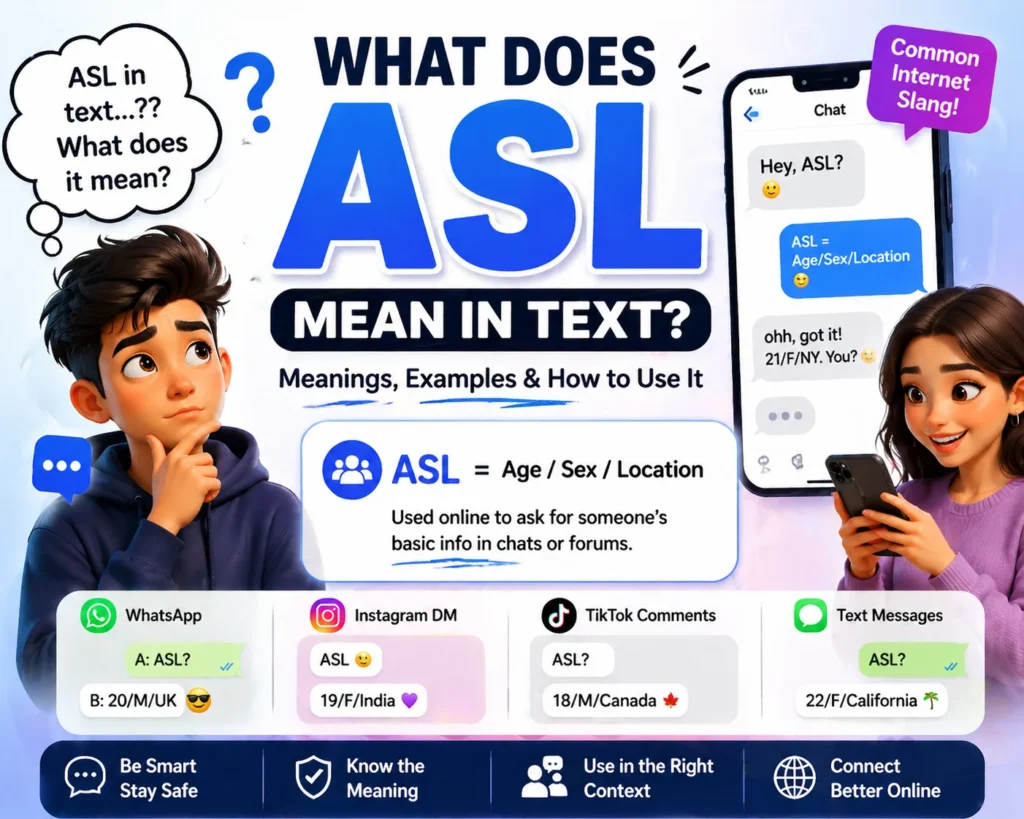
Definition: ASL stands for “Age, Sex, Location.” It’s an abbreviation commonly used to ask someone for their basic personal details, such as how old they are, their gender, and where they are located.
Key Points:
- Age: Asking how old someone is.
- Sex: Asking for their gender.
- Location: Asking where they are from, usually referring to their city or country.
Example Usage:
- “Hey, ASL?”
- “I’m 22, Female, from New York. ASL?”
Short Examples:
- “ASL?”
- “I’m 30, Male, London. You?”
Origin & Background
The phrase “ASL” originated in the early days of the internet, specifically in chat rooms and instant messaging platforms like AOL Instant Messenger (AIM) and IRC (Internet Relay Chat). These early digital spaces allowed people to connect without the usual social cues, and ASL became an easy way for users to learn basic details about someone they were chatting with.
Over time, ASL spread beyond just text-based chats and became a staple of social media and online dating platforms. It allowed for quick exchanges of basic information, especially when two people were just getting to know each other.
Culturally, ASL represents a time when internet communication was more anonymous, and people were curious about others without much context. Today, although its use has diminished in some circles, it remains a nostalgic relic of internet culture for many.
Real-Life Conversations
Here are some realistic scenarios that show how ASL is used in everyday text conversations:
WhatsApp Chat
- Person A: “Hey! I’ve seen you in a few groups. What’s your ASL?”
- Person B: “I’m 25, Female, and live in California. What about you?”
Instagram DM
- Person A: “Hey, new follower! ASL?”
- Person B: “I’m 19, Male, from Miami. You?”
TikTok Comment
- Person A: “ASL?”
- Person B: “I’m 23, Female, from Texas. Let’s connect!”
Text Message
- Person A: “ASL?”
- Person B: “29, Male, from London. What’s yours?”
These conversations show how ASL is used as a simple and informal way to introduce oneself.
Emotional & Psychological Meaning
At its core, ASL is a shorthand for curiosity and a desire to connect. It expresses a casual interest in someone’s background, often with the intent of gauging whether you have anything in common. While the phrase itself is neutral, the tone in which it’s used can change the emotional weight of the interaction.
People use ASL when they want to break the ice quickly or keep a conversation light. It’s often used with strangers or in situations where a quick, surface-level connection is desired.
For example, imagine you’re meeting someone online for the first time. Asking “ASL?” might help you understand if there’s a generational, cultural, or regional connection that could make the conversation more engaging. However, it’s important to note that, depending on the relationship, it could also feel impersonal or too direct.
Personal Scenario:
When I first joined a new online forum, someone greeted me with “ASL?” It was a bit awkward, but I didn’t mind because it was a common phrase used to quickly get to know someone. However, if the same question came from a stranger in a more intimate setting, it might feel a little off-putting.
Usage in Different Contexts
Social Media
On platforms like Twitter, Instagram, and TikTok, “ASL” is sometimes used to engage new followers or start a conversation. It’s casual and used primarily by younger generations.
Friends & Relationships
Among friends or people you know, using ASL might feel less formal and more like a fun, nostalgic reference. However, it can still be a bit awkward if not used in the right context.
Work / Professional Settings
ASL is rarely, if ever, used in professional settings. Asking for someone’s age, gender, and location is generally considered inappropriate in most work environments, especially in formal communication.
Casual vs. Serious Tone
“ASL” is almost always used in casual, friendly exchanges. In serious or formal discussions, it would likely feel out of place and could even be considered disrespectful.
When NOT to Use It
- In Professional Contexts: Asking for someone’s age, gender, and location is typically seen as unprofessional and could be considered inappropriate.
- With Strangers You Don’t Know Well: It can come across as overly blunt and impersonal when talking to someone you haven’t built a rapport with.
- Culturally Sensitive Situations: In some cultures, discussing someone’s age or gender so directly can be considered rude or intrusive.
Common Misunderstandings
Many people misunderstand the use of “ASL” as a question that must always be answered in detail, but it can be used in more casual, low-stakes conversations. Some people also confuse “ASL” with other slang terms or might think it’s an acronym for something entirely different.
For example, some might take “ASL” too literally and might answer with personal information they’re not comfortable sharing. Others might mistake the abbreviation as offensive or inappropriate due to its blunt nature.
Comparison Table
| Expression | Meaning | Usage |
|---|---|---|
| ASL | Age, Sex, Location | Informal, quick introductory question |
| DM | Direct Message | Refers to private messages on social media |
| BRB | Be Right Back | Quick way to say you’ll return shortly |
| FOMO | Fear of Missing Out | Regret about missing opportunities |
| YOLO | You Only Live Once | Encouragement to take risks |
Key Insight: ASL is a direct, quick question used to break the ice. In comparison, phrases like YOLO and FOMO delve into deeper emotional aspects, whereas ASL remains focused on surface-level connections.
Variations / Types
- ASL? – A simple, casual way to ask for someone’s basic details.
- Age/Sex/Location – Full version, sometimes used in formal discussions or explanations.
- A/S/L? – Sometimes written with slashes instead of spaces, but still means the same.
- ASL pls – A more polite request for someone’s details.
- S/O to ASL – Shortened and used with a shoutout or mention to someone asking for their info.
- A/S/L? (in context) – Used in online gaming or forums as a quick intro.
- Age/Sex/Location (informal) – A friendly, informal version used online or in chats.
- What’s your ASL? – Slightly more conversational phrasing.
- Where’s your ASL from? – Focuses on the location aspect of ASL.
- A/S/L Intro – Used when introducing someone in an online group.
How to Respond When Someone Uses It
- Casual replies: “I’m 25, Male, Chicago. You?”
- Funny replies: “25, Female, Earth! What about you?”
- Mature replies: “30, Male, New York. What’s yours?”
- Respectful replies: “29, Female, California. It’s nice to meet you.”
Regional & Cultural Usage
Western Culture
“ASL” is widely used in the United States, Canada, and Europe, especially among younger generations and in casual settings.
Asian Culture
In some Asian cultures, discussing age, sex, or location directly can be seen as rude or intrusive, so “ASL” is less commonly used.
Middle Eastern Culture
Asking for someone’s age or sex may not always be culturally appropriate in many Middle Eastern cultures, so “ASL” might be avoided.
Global Internet Usage
Globally, “ASL” is most popular in digital spaces like gaming, chat forums, and casual online environments, but its usage varies based on generational and cultural differences.
Generational Differences
While “ASL” was common among Millennials and early internet users, younger generations like Gen Z might not use it as frequently, opting for more modern phrases instead.
Is It Safe for Kids?
Since “ASL” involves asking for personal information, it’s not suitable for younger children, especially in anonymous or unmoderated spaces like online chat rooms or gaming platforms. Parents should educate their children about privacy and online safety.
FAQs
- What does ASL mean in texting?
It stands for “Age, Sex, Location,” and is used as a casual way to learn someone’s basic details. - Is it inappropriate to ask for someone’s ASL?
It can be seen as impersonal or intrusive, depending on the context. - Why did ASL become so popular?
It allowed quick, easy introductions in the early days of online chat rooms and instant messaging. - Can ASL be used in professional settings?
No, ASL is too casual and personal for professional environments. - What’s the difference between ASL and other acronyms like FOMO or YOLO?
ASL is focused on surface-level questions about personal details, while FOMO and YOLO are more emotionally charged expressions. - Do people still use ASL?
Yes, especially in casual online chats and dating apps, though it’s less common now than in the past. - Can ASL be seen as rude?
It can be if used with strangers or in formal situations. - How do you reply to ASL?
You can answer simply with your age, gender, and location. - Is it safe to share your ASL?
In private, casual conversations, it’s generally safe, but avoid sharing personal info with strangers or in public forums.
Conclusion
ASL remains a staple of internet culture, offering a simple way to break the ice and get to know someone online. However, it’s important to use it in the right context and be aware of the audience you’re addressing. Whether you’re new to texting or just revisiting old lingo, understanding how and when to use ASL can help you navigate online interactions with ease and respect.