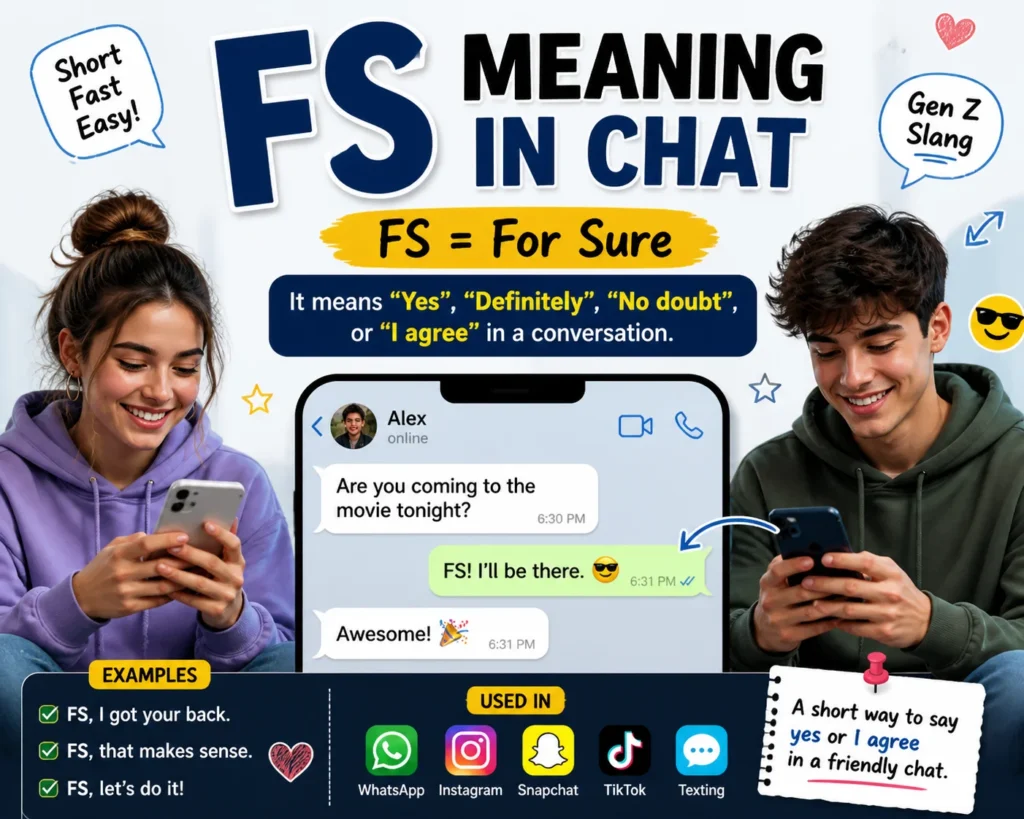
FS meaning in chat is usually “for sure.” It is a casual way to say yes, definitely, absolutely, or I agree in texts, DMs, comments, and everyday online conversations.
In most chats, FS means “for sure.” People use it to confirm plans, agree with someone, show confidence, or support a statement. In some contexts, FS can also mean “full send,” “for sale,” or other niche meanings, so the message around it matters. The phrase “for sure” itself means “without doubt” or “certainly,” which explains why FS often carries a confident tone.
People search for fs meaning in chat because the abbreviation looks too short to guess. It can feel confusing when someone replies with only “fs,” especially if you are not used to Gen Z vocabulary, texting abbreviation culture, or fast digital communication.
The good news is simple: in normal texting, FS is usually friendly, positive, and easy to understand once you know the context.
FS Meaning in Chat – Quick Meaning
The most common meaning of FS in chat is:
FS = For Sure
It means the person is agreeing, confirming something, or saying they are certain.
You can understand FS as a shorter version of:
- Definitely
- Absolutely
- Yes
- I agree
- No doubt
- That is true
- I’m sure
A few quick examples:
“Are you coming tonight?”
“FS, I’ll be there.”
“That song is good.”
“FS, it’s been stuck in my head all day.”
“You think she was upset?”
“FS. You could tell from her face.”
In everyday chat, FS does not usually sound rude. It feels casual, quick, and confident.
However, tone still matters. A simple “fs” can sound warm, lazy, supportive, or dismissive depending on the situation.
Origin & Background
FS comes from the phrase “for sure.” The full phrase has existed in English for a long time and means certainty or confidence. Dictionary sources define “for sure” as something close to certainly, without doubt, or definitely.
The abbreviation FS became common because texting rewards speed. When people moved from longer messages to SMS, WhatsApp, Instagram DMs, Snapchat, TikTok comments, and Discord chats, short forms became part of everyday language.
Instead of typing:
“Yes, for sure, I agree with you.”
People started typing:
“fs.”
That is how many internet slang terms grow. They begin as time-saving shortcuts, then become part of a shared online style.
Social media also changed the tone of FS. On TikTok and Instagram, people may use FS as a comment reaction. In friend groups, it can sound supportive. In marketplace chats, FS may mean “for sale.” In hype culture, especially around TikTok and creator slang, FS can sometimes connect with “full send,” meaning to go all in with energy or confidence.
So the meaning evolved from a simple texting abbreviation into a flexible casual chat phrase.
Real-Life Conversations
WhatsApp Conversation
Person A: Are you still coming to the birthday dinner tonight?
Person B: FS. I already got ready.
Person A: Good, because everyone keeps cancelling.
Person B: Not me. I need cake and gossip.
Here, FS means “yes, definitely.” It sounds friendly and reassuring.
Instagram DM Conversation
Person A: Your outfit in that reel was actually so good.
Person B: Thank you! I wasn’t sure about posting it.
Person A: No, fs post more like that.
Person B: That made me feel better, honestly.
Here, FS adds support. It makes the compliment feel more confident.
TikTok Comment Conversation
Person A: This is the best explanation I’ve seen all week.
Person B: FS, finally someone said it clearly.
Person A: Right? Everyone else made it confusing.
Person B: Short videos need more people like this.
Here, FS means “I agree completely.”
Text Message Conversation
Person A: Do you think I should apologize first?
Person B: FS. Not because you’re wrong, but because peace matters.
Person A: That’s actually mature.
Person B: I have my moments.
Here, FS gives emotional certainty. It shows advice, not just agreement.
Emotional & Psychological Meaning
FS may look like two small letters, but emotionally it often means more than “yes.”
People use FS when they want to sound certain without writing a long response. It gives the message a relaxed confidence.
When someone says “fs”, they may be expressing:
- Agreement
- Support
- Reassurance
- Certainty
- Loyalty
- Validation
- Quick approval
Modern communication is fast, but people still want emotional signals. FS works because it gives a small dose of certainty.
For example, imagine someone sends a nervous message:
“Do you think I looked awkward in that video?”
A reply like:
“No, fs you looked good.”
feels stronger than just:
“No.”
The FS adds confidence. It tells the person, “I’m not just saying this casually. I actually mean it.”
That is why FS has become useful in daily texting. It saves time, but it still carries emotional weight.
Usage in Different Contexts
Social Media
On social media, FS is often used as a reaction.
People may write it in:
- TikTok comments
- Instagram DMs
- Snapchat replies
- YouTube Shorts comments
- X posts
- Discord chats
Example:
“This trend is getting old fs.”
Here, FS means the person strongly believes the trend is overused.
On social media, FS often adds emphasis. It makes a sentence sound more confident and direct.
Friends & Relationships
Among friends, FS feels natural and casual.
Example:
“You’re coming with us tomorrow, fs.”
In relationships, it can show reassurance.
Example:
“I care about you fs. I just needed time to think.”
In this case, FS softens the message by adding certainty. It can make the person feel more secure.
Work and Professional Settings
FS is not ideal for formal work communication.
You should avoid it in:
- Emails
- Job applications
- Client messages
- Reports
- Academic writing
- Official workplace chats
Instead of writing:
“FS, I’ll send it today.”
Write:
“Yes, I’ll send it today.”
or
“Absolutely, I’ll send it today.”
However, in a very casual team chat with close coworkers, FS may be acceptable if your workplace culture is relaxed.
Casual vs Serious Tone
FS works best in casual conversations.
Casual:
“That movie was worth watching fs.”
Serious:
“I understand your concern, and I’ll address it today.”
In serious conversations, writing full words usually feels more respectful.
When NOT to Use It
FS is simple, but it is not right for every situation.
Avoid using FS when the message needs maturity, clarity, or professionalism.
Do not use it:
- In formal emails
- With clients or employers
- In school assignments
- In legal or medical communication
- When someone is emotionally hurt
- When the other person may not understand slang
- In cross-cultural conversations where slang may confuse people
Also avoid FS when your message could sound dismissive.
Example:
Person A: I’m really upset about what happened.
Person B: fs.
That reply feels cold. A better response would be:
“I understand. That sounds really painful.”
Slang works when the emotional stakes are low. When feelings are serious, full language is better.
Common Misunderstandings
One common misunderstanding is thinking FS has only one meaning everywhere.
In casual chat, it usually means for sure. But in other spaces, FS can mean something else.
For example:
- In marketplace posts, FS may mean for sale
- In online shopping, FS can mean free shipping
- In hype slang, it may mean full send
- In technical settings, FS can mean file system
- In business, it may mean financial statements
Another misunderstanding is tone.
A person may write:
“fs.”
That can mean:
- “Yes.”
- “I agree.”
- “Definitely.”
- “Okay.”
- “I hear you.”
- “I’m not very emotionally invested, but yes.”
The same abbreviation can feel warm or dry depending on punctuation, timing, and relationship.
Compare:
“FS!! I’m so proud of you.”
and
“fs.”
The first feels excited. The second may feel flat.
Comparison Table
| Term | Meaning | Usage Context | Tone | Similar or Opposite |
|---|---|---|---|---|
| FS | For sure | Texts, DMs, comments, casual chats | Confident, agreeing, supportive | Main keyword |
| FR | For real | Agreement, honesty, emotional emphasis | Serious, validating, casual | Similar |
| Bet | Okay, agreed, deal | Plans, confirmation, casual replies | Confident, relaxed | Similar |
| Ong | On God, I swear it’s true | Strong agreement or truth claim | Intense, emotional, Gen Z | Similar |
| No cap | No lie, seriously | Truth-telling, emphasis | Honest, casual, expressive | Similar |
| Fax | Facts, true statement | Agreement in comments or group chats | Supportive, bold | Similar |
| IDK | I don’t know | Uncertainty or lack of answer | Neutral, unsure | Opposite |
Key Insight:
FS is mostly about certainty. Terms like FR, ong, and no cap also show truth or agreement, but FS is softer and more flexible. It can confirm plans, support opinions, or reassure someone without sounding too intense.
Variations / Types
FS = For Sure
This is the main meaning. It shows agreement, certainty, or confirmation.
fs
Lowercase “fs” feels casual and relaxed. It is common in quick texts and DMs.
FS!
With an exclamation mark, it sounds more excited or energetic.
FS??
When written as a question, it can mean “for sure?” or “are you serious?”
FS FS
Repeating it adds stronger agreement. It means “definitely, definitely.”
Fasho
This is a slang pronunciation of “for sure.” It sounds more playful and informal.
Fa sho
Another casual spelling of “for sure.” It is often used for style or humor.
Full Send
In some social media contexts, FS may mean “full send,” which means going all in with confidence or energy.
For Sale
In marketplace chats, FS usually means “for sale.” Example: “iPhone 13 FS.”
Free Shipping
In online shopping or seller posts, FS may mean “free shipping.”
How to Respond When Someone Uses It
Casual Replies
Use these when FS means simple agreement.
- “Okay, cool.”
- “Sounds good.”
- “Perfect.”
- “Nice, see you then.”
- “Good to know.”
Example:
Them: I’ll be there fs.
You: Perfect, I’ll save you a seat.
Funny Replies
Use these with friends.
- “That’s the confidence I needed.”
- “FS energy only.”
- “Okay, serious person.”
- “You said that like a contract.”
- “I’m trusting you now.”
Example:
Them: I’m winning this game fs.
You: Bold words from someone who lost last time.
Mature Replies
Use these when the conversation is emotional.
- “I appreciate you saying that.”
- “That makes me feel better.”
- “Thanks for being clear.”
- “I needed that reassurance.”
- “I’m glad we’re on the same page.”
Example:
Them: I care about you fs.
You: Thank you. I needed to hear that clearly.
Respectful Replies
Use these when you want to keep the tone polite.
- “Understood.”
- “Thank you for confirming.”
- “I appreciate it.”
- “That works for me.”
- “Great, thanks.”
Example:
Them: I can send the file today fs.
You: Great, thank you for confirming.
Regional & Cultural Usage
Western Culture
In Western digital communication, especially in the US, UK, Canada, and Australia, FS is widely understood among younger users as for sure.
It sounds casual, friendly, and modern.
You may see it in friend chats, TikTok comments, Instagram captions, Discord servers, and gaming communities.
Asian Culture
In Asian countries where English is used as a second language, FS may be understood by people who spend time on English-speaking social media.
However, some users may not know it immediately. In mixed-language chats, writing “for sure” may be clearer.
For example, a Pakistani, Indian, Filipino, Malaysian, or Indonesian English speaker may understand FS if they follow global internet slang, but not everyone will.
Middle Eastern Culture
In Middle Eastern digital spaces, English slang is common among younger bilingual users, especially on Instagram, TikTok, Snapchat, and gaming platforms.
Still, FS may not be universal. In more formal or family-based chats, full words are safer.
If the person is not used to Western slang, “yes, definitely” will feel clearer and more respectful.
Global Internet Usage
Globally, FS spreads through short-form content.
TikTok, memes, gaming chats, and comment sections make abbreviations move quickly across regions.
Someone may use FS even if English is not their first language because they see it repeatedly in online spaces.
Gen Z vs Millennials
Gen Z users are more likely to use FS naturally in everyday digital communication.
Millennials may understand it, but many still prefer words like:
- Sure
- Definitely
- Absolutely
- For sure
Gen Z tends to treat FS as normal chat language. Millennials may see it as casual internet shorthand.
Is It Safe for Kids?
FS is generally safe for kids when it means for sure.
It is not a swear word, sexual term, or harmful phrase by itself.
However, parents and teachers should still look at context. If FS appears in a marketplace post, gaming chat, or risky challenge conversation, it may mean something else.
For younger children, it is better to teach the full meaning first:
FS = for sure = yes or definitely
That helps them understand the abbreviation without copying slang blindly.
FAQs
What does FS mean in chat?
FS usually means “for sure.” It is used to show agreement, certainty, confirmation, or support in casual online conversations.
What does FS mean in text from a girl?
It usually means for sure, just like it does from anyone else. The emotional meaning depends on the conversation, not the gender.
What does FS mean in text from a guy?
It usually means for sure. He may be confirming plans, agreeing with you, or showing confidence in what he says.
Is FS rude in chat?
No, FS is not usually rude. It is casual. However, a short reply like “fs” can feel dry if the conversation is emotional.
Does FS mean full send?
Sometimes. On TikTok, sports, hype culture, or challenge-related content, FS may mean full send, which means going all in.
What does FS mean on Instagram?
On Instagram, FS usually means for sure in DMs and comments. In selling posts, it may mean for sale.
What does FS mean on Snapchat?
On Snapchat, FS usually means for sure. It is often used as a quick reply to confirm something or agree with a friend.
Is FS the same as FR?
Not exactly. FS means for sure, while FR means for real. Both can show agreement, but FR often emphasizes honesty or truth more strongly.
Can I use FS in work messages?
Use it only in very casual workplace chats. For professional messages, write “yes,” “certainly,” “absolutely,” or “confirmed.”
What is the best reply to FS?
A simple reply works best: “Great,” “cool,” “sounds good,” “thanks,” or “perfect.” Match the tone of the conversation.
Conclusion
The meaning of FS in chat is simple once you understand the context. Most of the time, FS means “for sure.” It is a quick way to agree, confirm, reassure, or show confidence.
What makes FS interesting is not just the abbreviation. It is the feeling behind it. A tiny two-letter reply can sound supportive, relaxed, excited, or dry depending on how it is used.
Use FS when the conversation is casual, friendly, and clear. Avoid it when the setting is formal, emotional, or culturally sensitive.
Good communication is not about using every new slang term. It is about knowing when a short phrase helps and when full words show more respect.
When used naturally, FS is easy, modern, and useful. For sure.