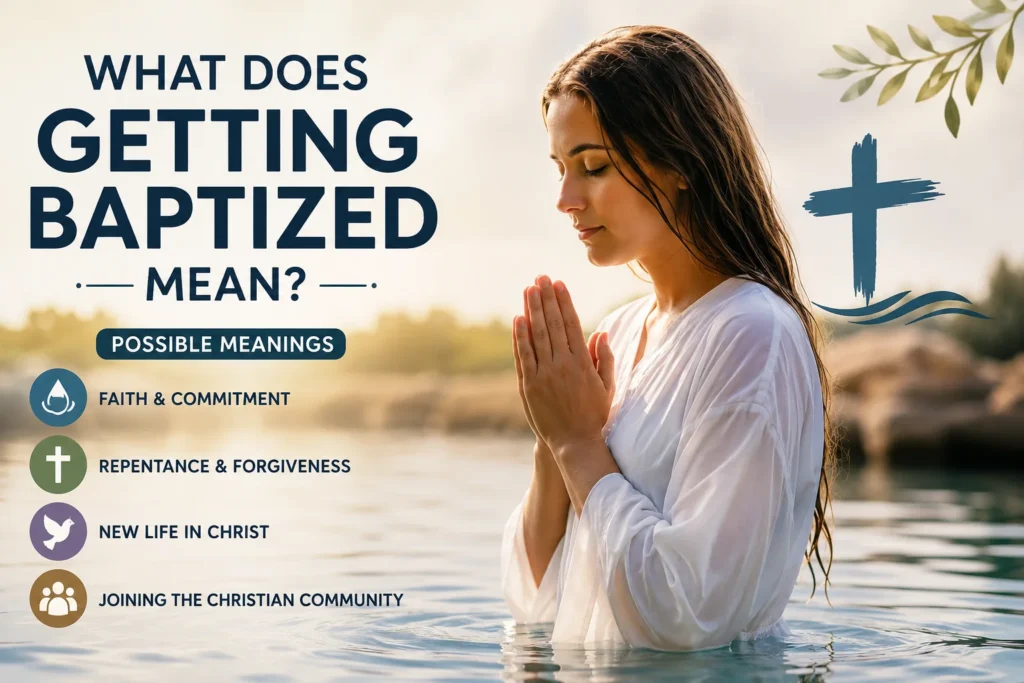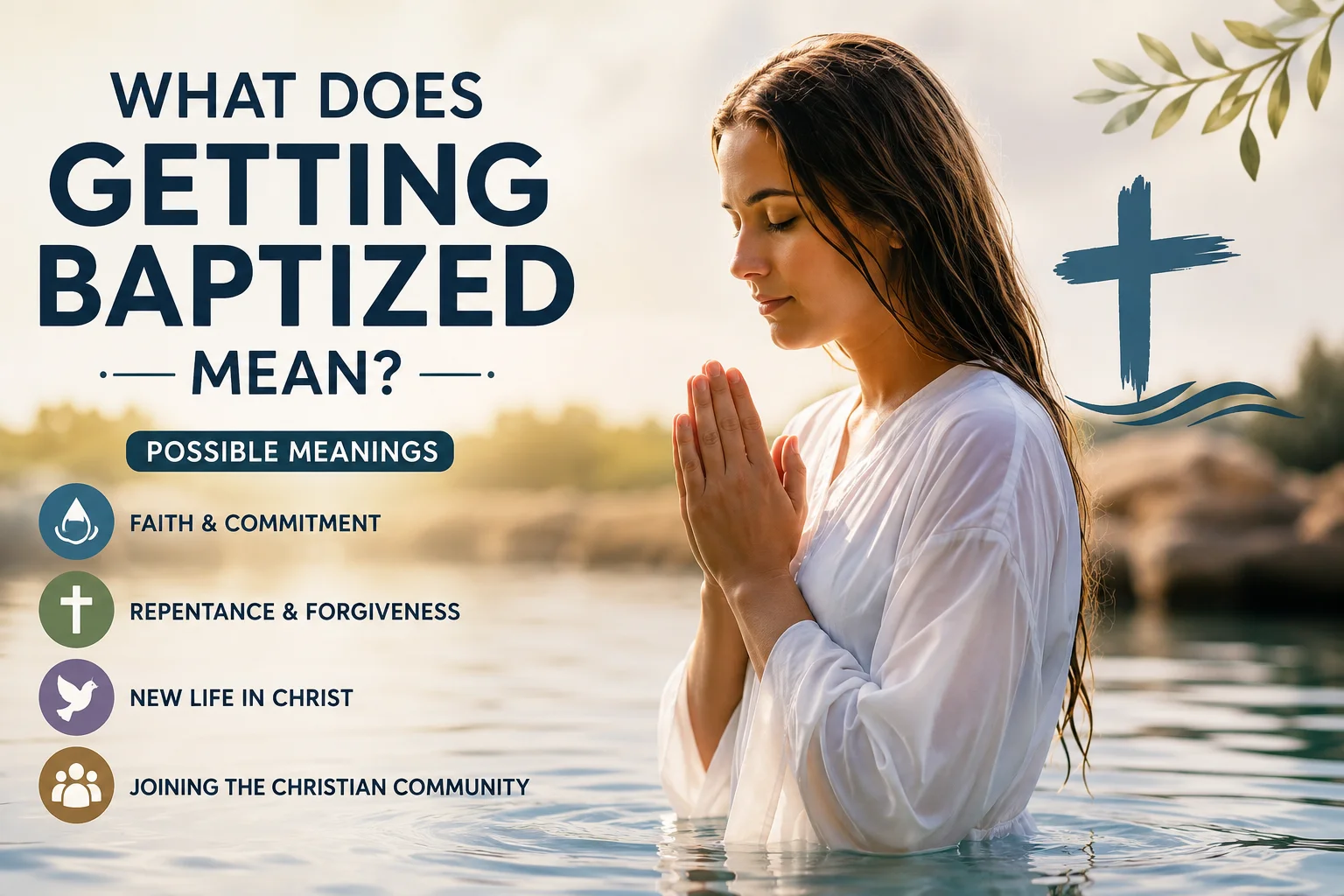
Getting baptized means publicly identifying with the Christian faith through a sacred ceremony that symbolizes repentance, forgiveness, new life in Christ, and commitment to following Jesus. While the practice is shared across Christianity, different denominations understand its purpose and timing in different ways.
People often search “what does getting baptized mean” because they’re considering baptism themselves, attending a baptism ceremony, or trying to understand what the Bible teaches. The word can sound simple, but its meaning varies slightly among Christian traditions, making it easy to feel confused.
What Does Getting Baptized Mean?
At its core, getting baptized is a public declaration of faith in Jesus Christ. Christians view baptism as an outward expression of an inward spiritual transformation.
Although baptism involves water, Christians generally believe the water itself isn’t what changes a person. Instead, the ceremony represents what God has already done—or is doing—in a believer’s life, depending on the denomination.
Across Christianity, baptism commonly symbolizes:
- Turning away from sin (repentance)
- Receiving God’s forgiveness
- Beginning a new life with Christ
- Joining the Christian community
- Following Jesus’ example
Many churches also see baptism as an act of obedience because Jesus Himself was baptized and instructed His followers to baptize others.
What Is Baptism in Christianity?
Baptism is one of Christianity’s oldest and most meaningful practices. It has been performed since the earliest days of the Church and remains an important step of faith for millions of Christians worldwide.
The English word baptize comes from the Greek word baptizō, meaning “to immerse,” “dip,” or “wash.”
In the New Testament, baptism became closely associated with faith in Jesus after His resurrection. Jesus instructed His disciples:
“Go therefore and make disciples of all nations, baptizing them in the name of the Father and of the Son and of the Holy Spirit.” (Matthew 28:19)
Because of this command—often called the Great Commission—baptism continues to be practiced by nearly every Christian denomination today.
What Does Baptism Symbolize?
Although churches differ on some theological details, several meanings are widely shared.
New Life
One of baptism’s strongest symbols is beginning a new life.
Christians believe that trusting in Christ brings spiritual renewal. Going into the water represents leaving an old life behind, while coming out of the water represents living a new life dedicated to God.
Romans 6:4 describes this imagery by comparing baptism to being buried and raised with Christ.
Identification With Jesus
Baptism symbolizes sharing in Jesus’ death, burial, and resurrection.
For many Christians, it publicly announces:
“I belong to Jesus, and I want to follow Him.”
Cleansing From Sin
Water often represents cleansing throughout Scripture.
Most Christians understand baptism as symbolizing God’s forgiveness rather than the physical water washing away sins.
Some traditions, however, believe baptism is a means through which God grants grace and forgiveness in a unique sacramental way.
Becoming Part of the Christian Community
Baptism also marks entrance into the visible Christian community.
Whether someone is baptized as an infant or as an adult believer, the ceremony usually takes place before family, friends, and fellow church members, emphasizing belonging to God’s people.
Why Do Christians Get Baptized?
People choose baptism for different personal reasons, but several motivations are common.
To Follow Jesus’ Example
Jesus was baptized by John the Baptist before beginning His public ministry.
Although Christians believe Jesus was without sin, His baptism demonstrated humility and obedience.
Many believers choose baptism because they want to follow His example.
To Publicly Declare Their Faith
Faith is personal, but baptism is public.
Many churches describe baptism as a person’s public testimony that they have chosen to trust Christ.
To Obey Christ’s Command
Many Christians view baptism as an act of obedience rather than simply a tradition.
Because Jesus instructed His followers to baptize disciples, believers often see baptism as one of their first steps after placing faith in Him.
To Join the Church
In many denominations, baptism also serves as the formal entrance into the church community.
It often marks the beginning of deeper participation in church life, worship, and discipleship.
Read More: What Does FLA Mean in Slang? Real Meaning Explained
Is Baptism Required for Salvation?
This is one of Christianity’s most discussed questions, and the answer depends on the denomination.
Many Protestant Churches
Many evangelical and Baptist churches teach that salvation comes through faith in Jesus Christ alone.
In this view:
- Baptism is important.
- Baptism is an act of obedience.
- Baptism does not earn salvation.
Catholic Church
The Catholic Church teaches that baptism is one of the sacraments instituted by Christ and ordinarily necessary for salvation because it brings a person into God’s covenant and washes away original sin. At the same time, Catholic teaching also recognizes extraordinary circumstances, such as “baptism of desire” and “baptism of blood.”
Eastern Orthodox Churches
Orthodox Christians regard baptism as a holy mystery (sacrament) through which believers receive God’s grace and become united with Christ and His Church.
Lutheran, Anglican, and Some Reformed Churches
These traditions generally teach that baptism is a means by which God works through His promises, though individual theological explanations vary.
The important point is that Christians agree baptism is significant, even when they disagree about exactly how it relates to salvation.
Infant Baptism vs. Believer’s Baptism
One of the biggest differences among Christian denominations concerns who should be baptized.
Infant Baptism
The Catholic Church, Eastern Orthodox Church, Anglican churches, Lutheran churches, Methodist churches, and some Reformed churches baptize infants.
These churches believe children should be welcomed into God’s covenant community from an early age. Parents and godparents promise to raise the child in the Christian faith until they can personally affirm that faith later in life.
Supporters often point to:
- Household baptisms mentioned in the New Testament
- The continuity between Old Testament covenant signs and New Testament baptism
- The importance of God’s grace being offered before a person can fully understand it
Believer’s Baptism
Baptist, Pentecostal, many non-denominational churches, and several evangelical traditions practice believer’s baptism.
In these churches, baptism follows a personal profession of faith. A person chooses to be baptized only after consciously deciding to follow Jesus.
Supporters argue that:
- Every New Testament baptism follows personal belief and repentance.
- Baptism is meant to be a public declaration of an individual’s faith.
- Faith should come before baptism.
Both approaches are rooted in sincere interpretations of Scripture, which is why the practice differs across Christian traditions.
How Does a Baptism Ceremony Usually Work?
While ceremonies vary by denomination, most follow a similar pattern.
Before the Baptism
The person being baptized (or the parents, in the case of an infant) often meets with a pastor or priest beforehand. This may include learning about the meaning of baptism, answering questions, and preparing spiritually.
During the Ceremony
A typical baptism includes:
- Scripture readings
- Prayer
- A declaration of faith or baptismal promises
- Water being applied
- The baptism being performed in the name of the Father, Son, and Holy Spirit
Depending on the church, the water may be applied in different ways:
- Full immersion
- Pouring water over the head (affusion)
- Sprinkling water (aspersion)
All three methods are practiced within Christianity.
After the Baptism
Many churches welcome the newly baptized person into the congregation with prayer, applause, or a blessing. Some also present a baptism certificate or Bible as a keepsake.
What Does the Bible Say About Baptism?
The Bible frequently mentions baptism, particularly in the New Testament.
Some of the best-known passages include:
Matthew 28:19
Jesus commands His disciples:
“Go therefore and make disciples of all nations, baptizing them in the name of the Father and of the Son and of the Holy Spirit.”
This passage forms the foundation for Christian baptism.
Mark 1:9–11
Jesus is baptized by John the Baptist in the Jordan River. During the event, the Holy Spirit descends like a dove, and the Father’s voice declares His pleasure in the Son.
Acts 2:38
After Peter’s sermon on the Day of Pentecost, many people ask how they should respond.
Peter replies:
“Repent and be baptized…”
This verse is frequently discussed in conversations about repentance, forgiveness, and baptism.
Romans 6:3–4
Paul explains baptism using the imagery of death and resurrection, showing how believers identify with Christ and begin a new life.
1 Peter 3:21
Peter teaches that baptism points believers toward God through the resurrection of Jesus Christ, emphasizing that its significance goes beyond simply washing the body with water.
Who Can Get Baptized?
The answer depends on the denomination.
In churches practicing believer’s baptism, anyone who has personally placed faith in Jesus Christ may be baptized.
In churches practicing infant baptism, children of Christian families are commonly baptized soon after birth or during early childhood.
Many churches also welcome adults who become Christians later in life. Adult baptisms are especially common among new believers who were never baptized as children.
Can Someone Be Baptized More Than Once?
Most historic Christian traditions believe baptism should happen only once because it represents God’s enduring covenant and does not need to be repeated.
However, some people choose to be baptized again after:
- Becoming a Christian later in life
- Moving from infant baptism to a church that practices believer’s baptism
- Feeling their earlier baptism did not reflect their personal faith
Whether rebaptism is encouraged depends entirely on the beliefs of the church involved.
Common Misconceptions About Baptism
“Baptism automatically makes someone a Christian.”
Most churches reject this idea. Baptism is deeply meaningful, but Christians generally teach that genuine faith and a relationship with Christ are essential.
“You have to be perfect before getting baptized.”
No. Baptism isn’t a reward for becoming perfect. Instead, it marks the beginning—or public acknowledgment—of a life of following Jesus.
“Only adults can be baptized.”
This depends on the denomination. Many churches baptize infants, while others baptize only those old enough to profess personal faith.
“All churches baptize the same way.”
Not at all. Churches differ in who is baptized, how the ceremony is performed, and what theological significance they attach to it. These differences have existed throughout Christian history while the practice itself remains widely shared.
Real-World Observation
For many Christians, baptism becomes one of the most memorable moments of their spiritual journey. It’s often celebrated with family, photographs, and prayers, making it both a deeply personal act and a communal event. Even among denominations that disagree on certain theological details, baptism consistently represents commitment, belonging, and hope. That enduring symbolism helps explain why it remains one of Christianity’s most recognized and meaningful practices more than two thousand years after the New Testament church began.
Frequently Asked Questions
1. What does getting baptized mean spiritually?
Spiritually, getting baptized represents a person’s relationship with God and their commitment to follow Jesus Christ. It symbolizes leaving behind an old way of life and embracing a new life centered on faith. Many Christians also see it as a public witness that they belong to Christ and want to live according to His teachings.
2. Do you have to get baptized to be a Christian?
Christians answer this question differently depending on their denomination. Many Protestant churches teach that salvation comes through faith in Jesus Christ, with baptism serving as an important act of obedience rather than the cause of salvation. Catholic, Orthodox, and some other traditions teach that baptism is a sacrament through which God gives grace, while also recognizing that God is not limited by the sacraments in extraordinary circumstances.
3. What happens during a baptism?
A baptism ceremony usually includes prayer, Scripture readings, a profession of faith or baptismal promises, and the application of water. Depending on the church, the person may be fully immersed in water, have water poured over their head, or be sprinkled with water. The minister baptizes them in the name of the Father, the Son, and the Holy Spirit.
4. Can adults get baptized?
Yes. Many people are baptized as adults after deciding to follow Jesus Christ. Adult baptisms are common in Baptist, Pentecostal, evangelical, and non-denominational churches, and they also occur in other Christian traditions when someone joins the faith later in life.
5. What’s the difference between baptism and christening?
The two terms are often used interchangeably, but they aren’t always identical. In many churches, a christening refers specifically to an infant baptism that includes giving the child a Christian name and welcoming them into the church. In other traditions, especially those that practice believer’s baptism, the word baptism is used regardless of the person’s age.
6. What should someone wear to a baptism?
Clothing depends on the church and the method of baptism. For full-immersion baptisms, many churches provide white robes or recommend modest clothing that can get wet. Guests generally wear respectful attire similar to what they would wear to a church service.
7. Can someone choose to be baptized again?
Some churches recognize only one valid baptism and do not encourage rebaptism. Others allow a second baptism if a person believes their first baptism did not reflect a personal profession of faith or if they were baptized as an infant and later choose believer’s baptism. It’s best to discuss this with the leadership of the church you attend.
8. What does the Bible say is the purpose of baptism?
The New Testament presents baptism as an act of obedience, a public expression of faith, and a symbol of identification with Jesus’ death, burial, and resurrection. Christians differ on some theological details, but nearly all agree that baptism is a meaningful practice established by Christ and continued by the early Church.
Conclusion
Getting baptized means much more than participating in a religious ceremony. For Christians, it is a visible expression of faith, symbolizing repentance, new life, and commitment to Jesus Christ. While different denominations explain its spiritual significance in different ways, they all recognize baptism as one of Christianity’s foundational practices.
If you’re considering baptism or simply trying to understand its meaning, it’s helpful to learn how your own church or denomination teaches about it. Reading the relevant Bible passages and speaking with a trusted pastor or church leader can also provide valuable guidance.
Usage Tips
- Understand your church’s teaching before deciding to be baptized, as beliefs vary among denominations.
- Read key Bible passages such as Matthew 28, Romans 6, and Acts 2 to understand the biblical foundation of baptism.
- Remember that baptism is both personal and public, expressing faith before God and the Christian community.
- Ask questions if you’re unsure about the ceremony, its purpose, or the expectations that follow.
Common Mistakes to Avoid
- Assuming every Christian denomination teaches exactly the same thing about baptism.
- Thinking baptism is merely a tradition with no spiritual significance.
- Confusing baptism with church membership alone, since its meaning is broader and deeply theological.
- Believing there is only one acceptable method of applying water, when immersion, pouring, and sprinkling are all practiced by different Christian traditions.
When to Use the Phrase “Getting Baptized”
Use the phrase when referring to:
- Someone preparing for a Christian baptism ceremony.
- Discussing Christian beliefs, worship, or church traditions.
- Explaining the symbolism of faith, repentance, and new life in Christ.
Avoid using it:
- As a substitute for all religious initiation ceremonies, since baptism is specific to Christianity.
- To describe non-Christian rituals unless making a clear comparison.
- Without recognizing that different Christian denominations hold sincere but differing theological views.