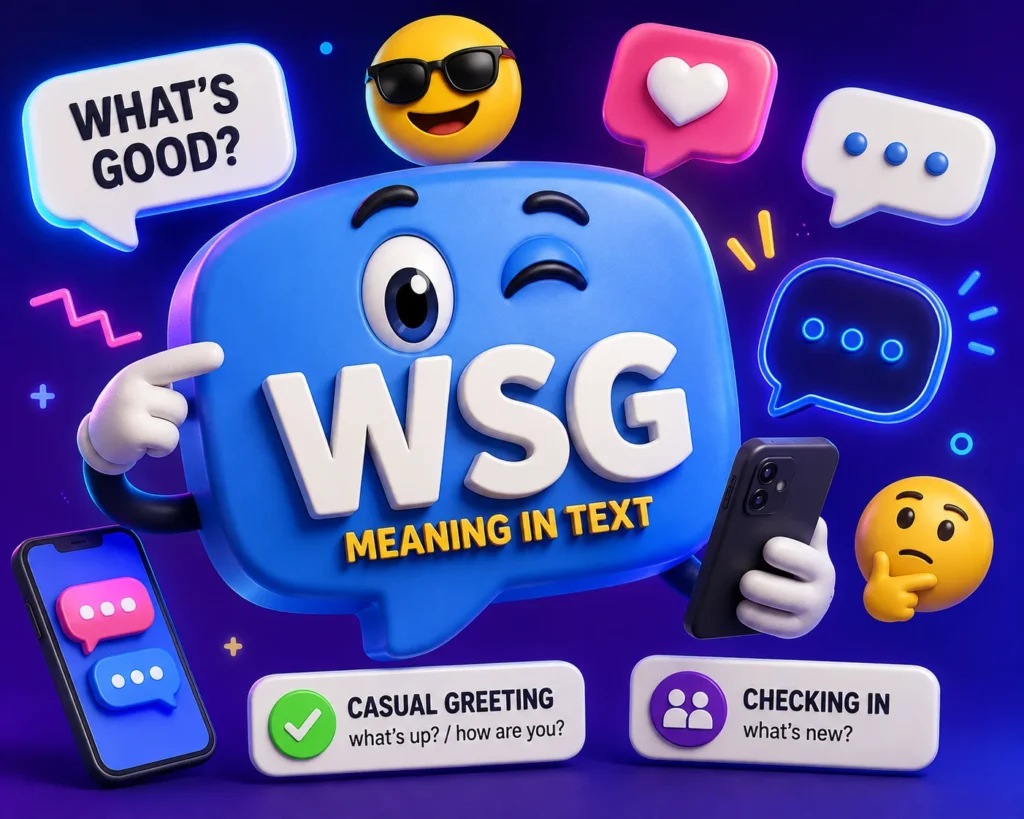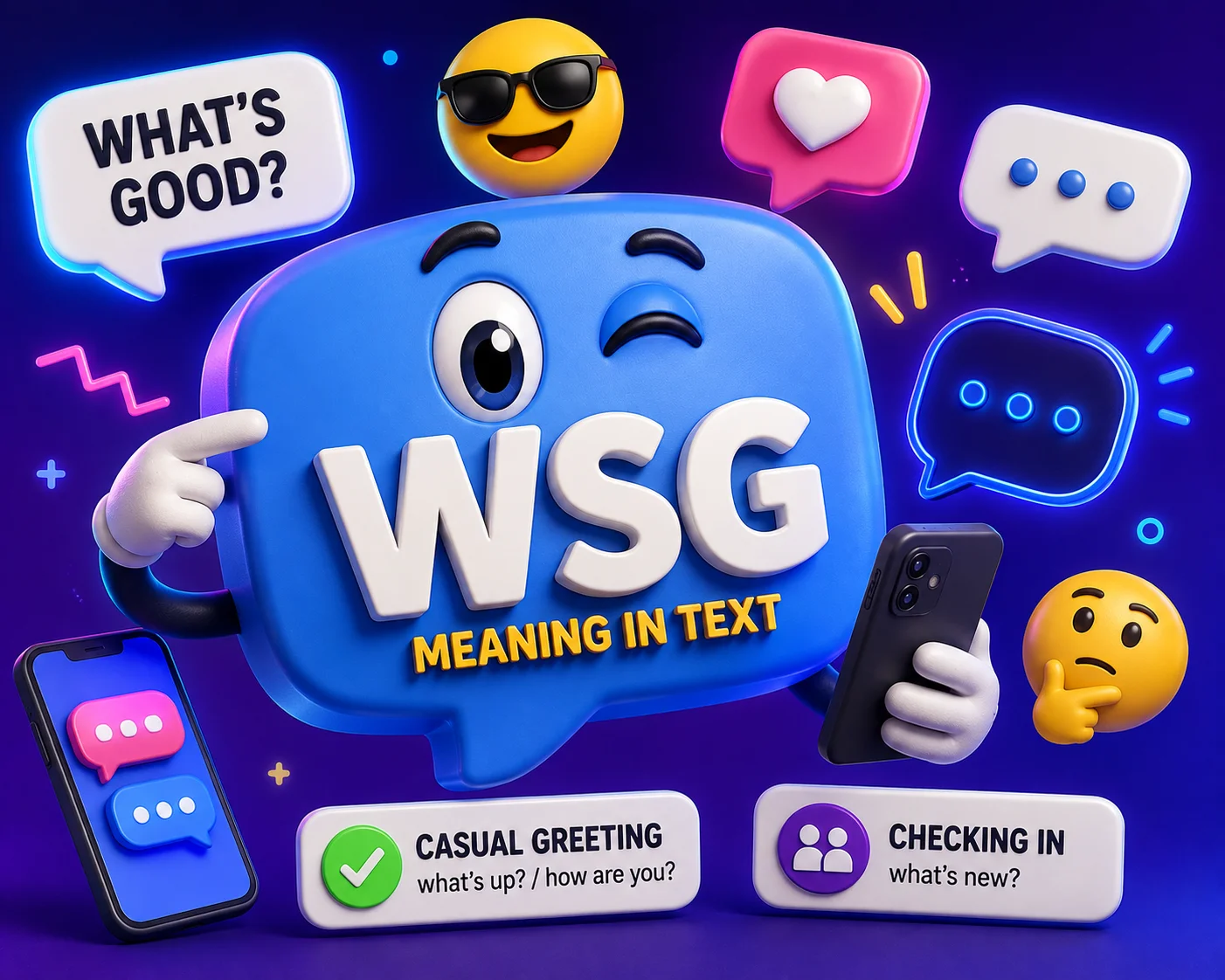
WSG usually means “what’s good?” in text. It is a casual abbreviation used as a greeting, similar to “what’s up?”, “what’s going on?”, or “how are you?” The meaning is usually friendly and conversational rather than literal.
What Does WSG Mean in Text?
In texting, WSG = “what’s good?”
When someone sends you “wsg?” they are normally opening a conversation or checking in. They may be asking what you are doing, how things are going, or whether anything interesting is happening.
For example:
Alex: wsg?
Jordan: Not much, just watching a movie. You?
Here, Alex is not asking Jordan to name something that is objectively “good.” The expression functions as an informal greeting.
This is similar to asking:
- “What’s up?”
- “What’s going on?”
- “How are you?”
- “What are you up to?”
- “What’s new?”
The exact response can depend on the relationship and the conversation. A simple “nm, you?” (“not much, you?”) is perfectly natural.
Is WSG an Acronym or an Abbreviation?
WSG is best described as an abbreviation or initialism for “what’s good?” It is not necessary to pronounce each letter when speaking because the original phrase is normally spoken as “what’s good.”
This distinction matters because internet language often gets casually labeled “acronyms” even when the shortened form does not technically work like a pronounceable acronym. For everyday texting, however, calling WSG a text abbreviation is the clearest description.
The written form is usually lowercase — wsg — especially in casual messages. Uppercase WSG can also appear, particularly when someone wants the abbreviation to stand out.
The Main Meaning: “What’s Good?”
The most established texting meaning is “what’s good?” as a casual greeting. Slang dictionaries and reference sources consistently document this interpretation. Wiktionary also records wsg as a text-messaging abbreviation of “what’s good.”
The phrase itself is older than the texting abbreviation. Evidence for “what’s good?” as an informal greeting goes back well before current social-media slang. Urban Dictionary entries from the early 2000s, for example, describe it as another way to say “what’s up?” or “what’s going on.”
That distinction is useful: the phrase has a longer history than the three-letter texting form.
WSG Can Also Ask for a Recommendation
There is another legitimate use of the full phrase “what’s good?” that is more literal.
Someone might ask:
“What’s good at this restaurant?”
Here, they are genuinely asking which food or menu item is worth choosing.
The same idea can appear in text:
“I’m ordering from that new place. Wsg on the menu?”
In that situation, WSG is closer to “what’s good?” = “what do you recommend?” rather than a greeting.
This meaning is documented for the phrase itself, although the greeting interpretation is much more relevant when someone simply sends “wsg?” as the first message.
A Common Misunderstanding About WSG
A common mistake is to read “wsg” literally and assume the sender is asking you to identify something that is good.
Usually, that is not what is happening.
If someone texts:
“wsg bro”
they are generally saying something closer to:
“What’s up, bro?”
They are starting or continuing a casual conversation.
Context determines whether “what’s good?” is functioning as a greeting or as an actual request for recommendations. A standalone “wsg?” from a friend is overwhelmingly more likely to be a greeting than a question about food, products, or quality.
How WSG Differs From “What’s Up”
WSG and “what’s up?” perform almost the same conversational job, but they do not always feel identical.
“What’s up?” is widely understood and has become a fairly ordinary informal greeting in English. “WSG” is more strongly associated with abbreviated online communication and casual texting.
For example:
“What’s up?”
“Not much. You?”
and:
“wsg?”
“Just chilling, hbu?”
Both exchanges accomplish essentially the same thing.
The difference is mainly one of register and medium. WSG looks more compressed and digital, while “what’s up?” works naturally in both speech and writing.
WSG vs. WYD
Another abbreviation that can be confused with WSG is WYD, meaning “what are you doing?”
The two questions can overlap, but WSG is broader.
If someone says:
wsg?
they may simply be checking in.
If someone says:
wyd?
they are more specifically asking what you are doing at that moment.
Compare:
wsg?
“All good, just got home.”
with:
wyd?
“Making dinner.”
The first is a general greeting. The second focuses more directly on the person’s current activity.
WSG vs. WSP
WSP is another abbreviation that can cause confusion because it can be used for “what’s up?” in texting.
That makes WSG and WSP functionally similar in many conversations.
The difference is simply the phrase being shortened:
- WSG = what’s good?
- WSP = what’s up?
Neither one automatically signals a different emotional state. The surrounding conversation and relationship matter more than the letters themselves.
Where Is WSG Used?
WSG is documented in text messaging and social-media communication. Reference sources specifically associate it with platforms such as TikTok and Snapchat, while broader texting use is also documented.
Text Messages
A person may use WSG in an ordinary SMS or messaging conversation:
“wsg?”
“nm, just got home”
This is particularly natural between people who already have an informal relationship.
Snapchat
WSG is associated with casual Snapchat communication, where short greetings and abbreviations fit the platform’s quick conversational style.
TikTok
WSG also appears in social-media interactions connected with TikTok. However, it is safer to understand it as general online slang rather than claiming that TikTok created the expression. The phrase “what’s good?” predates TikTok by many years.
Instagram and Other DMs
The same abbreviation can naturally appear in direct messages and other informal online conversations. Current web usage examples and slang references show that WSG is part of broader social-media texting language rather than being restricted to one specific platform.
Where Did WSG Come From?
The safest answer is that the exact origin of the abbreviation WSG is unclear.
There is good evidence that the underlying phrase “what’s good?” has been used as a casual greeting for many years. Reference material records the phrase as an informal equivalent of “what’s up?” and “how are you doing?”
There is also documented online evidence of the phrase being used as a greeting in the early 2000s. Urban Dictionary entries from 2003–2006 describe “what’s good?” as a greeting or a way of asking what is happening.
What cannot be established confidently from the available evidence is a specific person, platform, date, or community that invented WSG as the three-letter abbreviation.
Some sources make broad claims about the expression emerging around 2019 or 2020, but those claims conflict with older evidence for the underlying phrase and do not establish that the abbreviation itself was invented at that time.
So it would be misleading to say that TikTok, Snapchat, or Gen Z definitively invented WSG.
Is WSG Connected to AAVE?
The broader phrase “what’s good?” has been associated with informal urban and hip-hop-influenced English, and some reference sources connect its greeting use with African American Vernacular English and related varieties.
However, it would be too simplistic to claim that WSG itself was definitively invented by AAVE speakers without stronger historical evidence. The phrase has circulated widely across different English-speaking communities, and its exact linguistic path into texting is not fully documented.
That distinction is important when discussing slang with cultural roots: influence and widespread adoption do not necessarily prove a single point of invention.
Real Examples of WSG in Conversation
1. Funny
Maya: wsg 😂
Lena: My bank account is fighting for its life.
Maya: So… nothing good?
Lena: Absolutely nothing.
2. Sarcastic
Ryan: wsg?
Chris: Peace, happiness, and financial stability.
Ryan: So you got none of those?
Chris: Correct.
3. Playful
Ava: wsg 👀
Noah: Not much, you?
Ava: Depends. You free tonight?
Noah: Suddenly I’m very free.
4. Serious
Sam: wsg? You good?
Jordan: Honestly, not really.
Sam: Want to talk about it?
Jordan: Yeah, give me a minute.
5. Between Friends
Leo: wsg bro
Marcus: Just gaming.
Leo: You getting on tonight?
Marcus: Probably. Send the invite.
6. Family
Sister: wsg 😂
Brother: Trying to finish this assignment.
Sister: You said that two hours ago.
Brother: And I meant it two hours ago.
7. Coworkers
Nina: wsg?
Derek: Just catching up on emails.
Nina: Same. You joining the call at 3?
Derek: Yep.
Because WSG is strongly informal, this coworker example works best when the coworkers already communicate casually. It would not be an ideal replacement for a professional greeting to a manager or client.
8. Dating
Ella: wsg?
Jay: Just got back from the gym.
Ella: Productive.
Jay: Trying to impress you 😌
The abbreviation itself is not inherently flirty. A romantic interpretation comes from the surrounding conversation, not from WSG alone.
9. Group Chat
Ben: wsg everyone
Tara: Movie night?
Chris: I’m down.
Ben: Perfect, 8 pm?
10. Asking About Food
Alex: wsg at that café?
Mia: The chicken sandwich is actually really good.
Alex: Fries?
Mia: Definitely get the fries.
Here the context changes the meaning from a general greeting to a recommendation request.
How Should You Reply to WSG?
The easiest approach is to answer naturally and return the question.
Neutral Reply
“Not much, you?”
This works in most casual conversations.
Friendly Reply
“All good! Just chilling. Wsg with you?”
This keeps the same informal tone.
Funny Reply
“My sleep schedule is not good 😂”
This works when you already have a joking relationship.
Flirty Reply
“Better now that you texted 😏”
Use this only when the conversation already has a romantic or playful tone. WSG itself does not automatically mean the sender is flirting.
Very Short Reply
“Nm, hbu?”
Here nm means “not much,” while hbu means “how about you?” This is a natural texting-style response.
Comparison: WSG and Similar Texting Terms
| Term | Meaning | Tone | Popularity | Confusion Risk |
|---|---|---|---|---|
| WSG | What’s good? | Casual | Common in informal texting | Low |
| WSP | What’s up? | Casual | Common | Medium |
| WYD | What are you doing? | Casual | Very common | Low |
| SUP | What’s up? | Casual | Established slang | Medium |
| HRU | How are you? | Casual | Less common today | Medium |
| BRB | Be right back | Informal | Very recognizable | Low |
There is no perfect opposite of WSG because it is primarily a greeting rather than a statement with a direct antonym.
Who Uses WSG?
WSG is associated with informal digital communication and is documented among both younger users and adults. Slang references specifically describe it as being used among millennials and Zoomers, although that does not mean every person in either generation uses it.
The abbreviation is especially natural in casual online conversations where short forms are already expected. People who rarely use texting slang may not recognize it immediately, as demonstrated by real online discussions where users ask what WSG means or how they should respond.
There is not enough reliable evidence to claim that WSG belongs exclusively to one age group, U.S. region, or gender.
Is WSG Rude or Safe?
WSG is generally not offensive, profane, or inherently rude. It is simply an informal greeting.
The main issue is formality, not offensiveness. Sending “wsg?” to a close friend is normal, while sending it to a professor, formal business contact, or someone you do not know well could come across as overly casual.
Context can also change the tone. “Wsg?” between friends is usually friendly, but “what’s good?” said aggressively in person can sometimes function as a challenge or confrontation. The phrase itself does not guarantee one emotional tone.
Why Does WSG Work So Well in Conversation?
WSG works because it compresses a familiar social ritual into three letters without losing much of the original meaning. People already understand the conversational function of “what’s good?” just as they understand “what’s up?”, so the abbreviation does not require much decoding once it becomes familiar. It also leaves the recipient plenty of room to decide how much information to share, which makes it useful as both a greeting and a conversation opener.
Frequently Asked Questions
What does WSG mean in texting?
WSG usually means “what’s good?” It is a casual greeting similar to “what’s up?” or “what’s going on?” In most conversations, it is not asking you to identify something literally good.
What should I reply to WSG?
A simple response such as “not much, you?” works well. You can also say what you are currently doing or mention something interesting happening in your day. The safest approach is to match the sender’s casual tone.
Does WSG mean “what’s good” or “what’s so good”?
In established texting usage, WSG means “what’s good?” Reliable slang references consistently document this interpretation. “What’s so good?” is not the standard expansion of WSG in this context.
Is WSG flirting?
Not by itself. WSG is normally just a casual greeting, although someone may use it to start a conversation with a person they like. Whether the exchange is flirty depends on the surrounding messages and relationship.
Is WSG the same as WYD?
No, although they can overlap. WSG is a broad check-in meaning “what’s good?”, while WYD specifically asks “what are you doing?” A person can answer both with information about what they are currently doing.
Is WSG used on Snapchat?
Yes. Slang references specifically document WSG as a social-media abbreviation used on Snapchat, along with other online platforms.
Does WSG mean something different on TikTok?
The common slang meaning remains “what’s good?” Platform context does not normally change the expansion. Other technical or organization-specific meanings of WSG may exist outside casual texting, so context still matters.
Is WSG appropriate for school or work?
It is generally safe in the sense that it is not profanity or an offensive expression, but it is informal. Use a more conventional greeting such as “Hi” or “How are you?” when communicating with teachers, clients, supervisors, or other people in a formal setting.
Conclusion
WSG means “what’s good?” in text, usually as a relaxed way to say “what’s up?” or check in with someone. It is an abbreviation used in informal digital communication, including texting and social-media conversations.
The phrase “what’s good?” has a much longer history than the modern abbreviation, with documented informal-greeting use dating back at least to the early 2000s. The exact origin of the three-letter form WSG, however, is not firmly established, so claims that a particular platform or generation invented it should be treated cautiously.
If someone sends you “wsg?”, you usually do not need to overthink it. Reply with something like “not much, you?”, tell them what you are doing, or return the greeting. Save WSG for casual conversations and use more conventional wording when the situation calls for formal communication.