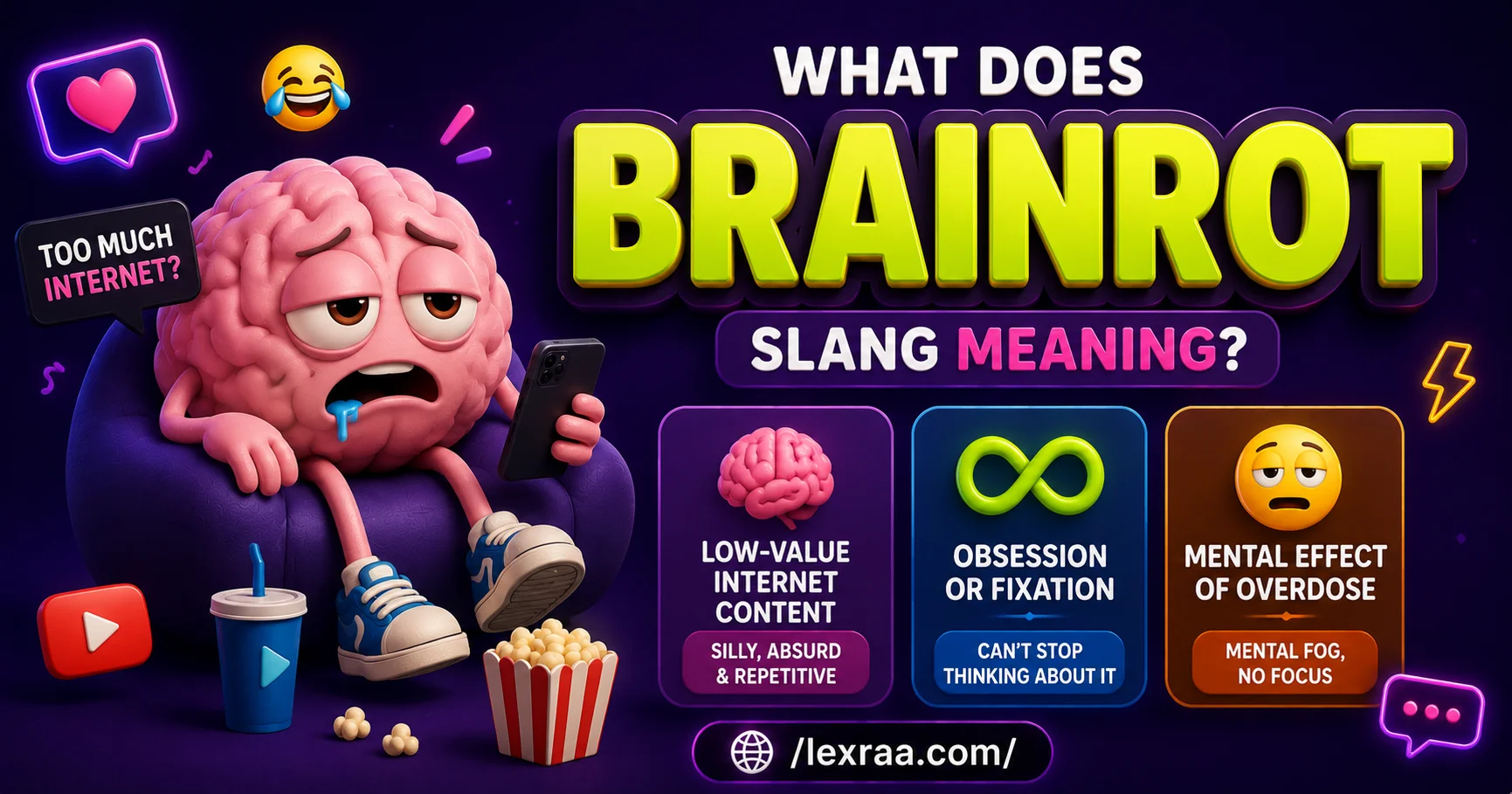
Brainrot slang refers to mindless, repetitive, absurd, or low-value internet content—and sometimes the obsessive fixation on that content. People may also say they “have brainrot” when a meme, fandom, catchphrase, or online trend has taken over their thoughts.
The term can describe the content, the obsession with it, or the supposed mental effect of consuming too much of it. That flexibility is one reason “brainrot” has become such a recognizable part of internet language.
What Does Brainrot Mean in Slang?
In internet slang, brainrot usually describes content that feels intentionally silly, repetitive, nonsensical, addictive, or intellectually empty.
For example:
“I’ve watched 50 videos about this stupid meme. I have brainrot.”
Here, the speaker is not claiming that their brain has literally deteriorated. They are joking that they have consumed so much of the same type of content that they cannot stop thinking about it.
Merriam-Webster defines brain rot as mindless digital content, the fixation on it, and the supposed harmful mental effects associated with it. It also notes that the expression can be written as brain rot, brainrot, or brain-rot.
Cambridge similarly describes brain rot as both a supposed loss of clear and critical thinking from seeing too much low-quality social-media content and a type of silly, repetitive online content itself.
Brainrot is slang, not an acronym
Unlike terms such as FML or LOL, brainrot does not stand for a series of words. It is a slang expression formed from the ordinary words brain and rot.
It can function grammatically as a noun:
“This is brainrot.”
It can also modify another noun:
“That video is pure brainrot content.”
And online speakers sometimes use it more creatively:
“I am completely brainrotted by this show.”
The exact grammatical form varies, but the central idea remains excessive fixation on trivial or repetitive content.
The Three Main Slang Uses of Brainrot
Although the meanings overlap, separating them makes the term much easier to understand.
1. Brainrot as low-value internet content
Someone can call a video, meme, game, sound, phrase, or collection of posts brainrot.
The label usually suggests that the material is:
- absurd
- repetitive
- chaotic
- intentionally stupid
- highly addictive
- difficult to explain to outsiders
- low in conventional educational or artistic value
Oxford’s definition specifically includes material perceived as likely to cause the supposed deterioration associated with brain rot.
This does not mean every funny or simple meme is automatically brainrot. The label usually carries an additional idea of excessive repetition, absurdity, fixation, or mindless consumption.
2. Brainrot as an obsession
Someone can also say:
“I have Harry Potter brainrot.”
That does not necessarily mean Harry Potter is low-quality content.
Instead, the speaker may mean they are so obsessed with the series that they constantly think about it, quote it, talk about it, or consume related content.
Merriam-Webster gives a similar modern example involving “Bridgerton brain rot,” where the speaker is consuming and thinking about the show constantly.
This is an important distinction because brainrot is not always an insult directed at the content itself. Sometimes it is affectionate self-description.
3. Brainrot as the supposed mental effect
A person might say:
“I’ve been scrolling TikTok for three hours. My brain is cooked.”
Or:
“Too much brainrot today.”
Here, brainrot refers to the perceived mental fog, overstimulation, or inability to concentrate that the speaker associates with excessive online consumption.
However, brainrot is not an official medical diagnosis. Merriam-Webster explicitly distinguishes the slang expression from a formal medical condition.
That distinction matters when people use the term in serious discussions about attention, mental health, or digital-media habits.
Brainrot vs. “Cringe”: They Are Not the Same
One useful way to understand brainrot is to compare it with cringe.
Something can be cringe because it is embarrassing, awkward, or socially uncomfortable. Something can be brainrot because it is absurd, repetitive, mindless, or so addictive that people keep consuming or repeating it.
A video can therefore be:
- cringe but not brainrot
- brainrot but not particularly cringe
- both
- neither
For example, an awkward public proposal might be called cringe. A nonsensical sound that millions of people repeatedly quote may be called brainrot.
The terms overlap in internet culture, but they describe different qualities.
Why Do People Call Memes “Brainrot”?
The humor comes partly from deliberate exaggeration.
When someone calls a ridiculous meme “brainrot,” they are usually not conducting a serious scientific assessment. They are making fun of how repetitive or meaningless the content feels.
This creates a form of self-aware internet humor:
“This meme is terrible.”
followed by:
“Anyway, I’ve watched it 30 times.”
Calling it brainrot acknowledges the contradiction.
The person knows the content is silly, but the fact that they keep returning to it is precisely what makes the label useful.
Brainrot and “Chronically Online”
Brainrot is closely related to the phrase chronically online, but the two expressions are not interchangeable.
Someone who is chronically online spends a great deal of time immersed in internet culture and may understand obscure references, memes, fandoms, or online drama that others do not recognize.
Brainrot focuses more specifically on the content or fixation that has taken over someone’s attention.
So you could describe someone as chronically online without saying they have brainrot. Conversely, someone could have a temporary obsession with one ridiculous meme without generally being chronically online.
Is Skibidi Toilet Brainrot?
Skibidi Toilet is one of the clearest examples associated with modern brainrot culture, particularly because of its absurd premise, repetitive elements, and enormous online spread.
Oxford specifically connected the modern rise of brain rot with internet culture involving terms and trends such as Skibidi, Fanum tax, gyatt, sigma, and rizz. It also identified Skibidi Toilet as one of the types of viral content strongly associated with the newer meaning of brain rot.
But “brainrot” is broader than Skibidi Toilet.
It can describe other memes, catchphrases, fandom obsessions, games, sounds, or online communities. The term describes a pattern or style of engagement, not one particular meme.
Which Apps Use Brainrot Slang?
Brainrot is strongly associated with internet culture rather than one single application.
TikTok
TikTok is one of the platforms most strongly associated with the modern use of brainrot. Oxford noted that the expression gained particular traction on TikTok among younger online communities before becoming much more widespread.
People may call a strange video “brainrot,” describe a trend as brainrot, or joke that their For You Page is full of brainrot.
X
The term also appears on X. In fact, documented internet usage goes back much further than TikTok, with early examples from the 2000s and later X posts using phrases such as “brain rot continues” to describe ongoing fandom obsessions.
Brainrot is also used on Reddit, particularly when users discuss memes, social-media trends, short-form videos, or their own internet habits. Know Your Meme identifies Reddit alongside TikTok and X as places where the expression became visible in internet culture.
Instagram has documented examples of the term being used in meme culture. Know Your Meme records an Instagram meme using “brain rot” in February 2022, before the term’s major 2023–2024 explosion.
Snapchat and WhatsApp
The evidence is much less useful for claiming that Snapchat or WhatsApp has a distinct “brainrot” culture or platform-specific definition.
People can certainly use the word in messages on those services, but there is no separate Snapchat or WhatsApp meaning that needs to be learned. Treating brainrot as a universal internet-slang term is more accurate than assigning it a special definition to a particular messaging app.
Where Did Brainrot Come From?
This is where the history gets surprisingly old.
The expression brain rot is not originally a TikTok or Gen Alpha invention.
Oxford traces the earliest recorded use to Henry David Thoreau’s 1854 book Walden. Thoreau used “brain-rot” metaphorically while criticizing what he saw as a decline in intellectual effort and society’s preference for simpler ideas.
That historical use is very different from today’s memes, but the basic metaphor is remarkably similar: the mind is imagined as something that can “rot” when exposed to intellectually poor material or habits.
The modern internet sense developed much later.
Know Your Meme identifies documented online uses as early as 2007, including posts on X describing reality dating shows and being online generally as “brain rot.” It also notes that the expression continued spreading through internet communities during the 2010s and 2020s.
Dictionary.com similarly says the exact internet origin is unknown and points to around 2007 as an early period of online usage. It also notes that early fandom communities used the expression for intense fixation on fictional characters, shows, and storylines.
The huge modern surge came later. Oxford reported that usage increased by 230% between 2023 and 2024, and selected brain rot as its 2024 Word of the Year.
So the safest historical summary is:
1854: documented phrase in Walden
2000s: modern internet uses emerge
2010s–2020s: broader meme and fandom usage
2023–2024: major explosion around Gen Alpha internet culture
2024: Oxford Word of the Year
There is no reliable evidence that the slang was invented by Gen Z, Gen Alpha, AAVE speakers, or one particular social-media creator.
10 Natural Brainrot Conversations
1. Funny — Friends
Aisha: “Why are you laughing at your phone?”
Mia: “I just watched the same stupid video again.”
Aisha: “Again?”
Mia: “Yes. I fear I have brainrot.”
2. Sarcastic — Group Chat
Ryan: “This new meme makes absolutely no sense.”
Noah: “Exactly why it’s funny.”
Ryan: “You’ve sent it 17 times today.”
Noah: “That’s called dedication. Brainrot is temporary.”
3. Playful — Dating
Ella: “Why did you put that ridiculous sound on your Story?”
Josh: “Because you laughed at it yesterday.”
Ella: “Unfortunately, I did.”
Josh: “Welcome to the brainrot.”
4. Serious — Parent and Teen
Dad: “You’ve been scrolling for two hours.”
Sam: “I know.”
Dad: “And now you say you can’t concentrate on homework.”
Sam: “Yeah, I probably need a break from the brainrot.”
5. Fandom Chat
Nina: “I’ve watched the entire series twice this week.”
Kay: “Twice?”
Nina: “And I’ve memorized the quotes.”
Kay: “That’s not a hobby anymore. That’s brainrot.”
6. TikTok Comment
Leo: “Why is this video stuck in my head?”
Maya: “Because you watched it 40 times.”
Leo: “I regret everything.”
Maya: “Too late. Brainrot acquired.”
7. Family Conversation
Brother: “What does ‘skibidi’ even mean?”
Sister: “It depends.”
Brother: “That is not an answer.”
Sister: “Welcome to brainrot culture.”
8. Coworker Chat
Alex: “I accidentally said that meme phrase during the meeting.”
Jordan: “Out loud?”
Alex: “Out loud.”
Jordan: “Okay, that’s advanced brainrot.”
9. Gaming Friends
Kai: “Why did you name your character that?”
Evan: “It was the first stupid name I thought of.”
Kai: “You’ve been playing for six hours.”
Evan: “This game has destroyed my brain.”
10. Instagram DM
Sara: “I keep sending you these memes.”
Lina: “I noticed.”
Sara: “Should I stop?”
Lina: “No. My brainrot needs company.”
How Do You Reply to “Brainrot”?
Your response should match whether the speaker is joking, complaining, or genuinely concerned about excessive screen time.
Funny:
“Too late. The algorithm has claimed you.”
Serious:
“Maybe take a break if you’re actually feeling mentally drained.”
Flirty:
“If you’re going to have brainrot, at least let me be your favorite distraction.”
Neutral:
“Lol, what did you watch this time?”
If someone is using brainrot to describe genuine difficulty concentrating or feeling overwhelmed by their online habits, a serious response is better than turning it into another joke.
Brainrot vs. Similar Internet Terms
| Term | Meaning | Tone | Popularity | Confusion Risk |
|---|---|---|---|---|
| Brainrot | Mindless content, obsession with it, or its supposed mental effect | Humorous, critical, self-aware | Very high | Low |
| Cringe | Embarrassing, awkward, or uncomfortable | Critical, mocking | Very high | Medium |
| Chronically online | Extremely immersed in internet culture | Teasing or critical | High | Medium |
| Doomscrolling | Continuously consuming negative or distressing content | Concerned, negative | High | Medium |
| Shitposting | Deliberately absurd or provocative low-value posting | Ironic, humorous | Established | Medium |
| Slop | Low-quality mass-produced content, especially online/AI-related content | Critical | Increasing | Medium |
| Touch grass | Take a break from excessive online activity | Teasing, corrective | High | Low |
One particularly useful comparison is brainrot vs. doomscrolling.
Doomscrolling describes a behavior: repeatedly consuming negative or distressing information. Brainrot is broader and can involve silly memes, fandoms, repetitive catchphrases, games, videos, or other content that someone considers mentally numbing or obsessively consuming.
Likewise, brainrot and shitposting are not synonyms. Shitposting describes a style of deliberately low-value or absurd posting, while brainrot can describe both the content and the person’s fixation on it.
Who Uses Brainrot?
Brainrot is strongly associated with Gen Z and Gen Alpha internet culture, particularly in discussions of memes, TikTok trends, short-form video, gaming, and viral slang. Oxford specifically observed its rise among Gen Z and Gen Alpha communities.
However, it is no longer accurate to treat brainrot as exclusively a young-person expression. The term has moved into mainstream journalism, dictionaries, and broader discussions about digital culture.
Merriam-Webster notes that the expression had some currency with Gen Z before its use increased substantially around 2023, when it became particularly associated with newer internet slang such as skibidi and rizz.
There is also no strong evidence for a special US-versus-UK meaning. The expression is used broadly in English-language internet culture, with its meaning determined more by online context than geography.
Is Brainrot Rude or Safe?
Brainrot is generally not profanity. It is an informal slang expression and can be dismissive or insulting depending on how it is directed.
Calling someone’s favorite content “brainrot” can sound playful between friends:
“Bro, this is pure brainrot 😂”
But saying:
“Your whole account is brainrot.”
can sound like a genuine insult.
It is generally fine in casual online conversation, but it is not ideal for formal school or workplace writing unless you are specifically discussing internet language.
There is another important point: brainrot is not a medical diagnosis. Using it casually does not establish that someone’s brain has actually been damaged. Merriam-Webster makes this distinction explicitly.
Why Has Brainrot Stuck Around?
Brainrot works because it lets people criticize and enjoy internet culture at the same time. Calling something brainrot can mean “this is meaningless and ridiculous,” while simultaneously admitting, “I cannot stop watching it.” That self-awareness makes the term especially useful for memes and fandoms. It also explains why the word can move between criticism and affection without becoming contradictory: a person can hate how repetitive a trend is while proudly participating in it.
Frequently Asked Questions
Is brainrot a real word?
Yes. Brain rot is an established English expression, and the Oxford English Dictionary added it in 2025. Oxford traces the earliest recorded use to Henry David Thoreau’s Walden in 1854.
The modern internet meaning is newer. It became widely associated with low-value online content, social-media overconsumption, memes, and intense online fixations.
What does brainrot mean on TikTok?
On TikTok, brainrot commonly refers to absurd, repetitive, chaotic, or highly addictive content and the fixation people develop around it. It is strongly associated with newer internet trends and phrases such as skibidi and other viral slang.
It can also describe the feeling of having consumed too many short videos or memes.
Is brainrot the same as brain damage?
No. Brainrot is slang, not a medical diagnosis. People use it humorously to describe perceived mental fog or excessive exposure to trivial online material. Merriam-Webster explicitly distinguishes the slang expression from a formal medical condition.
Why do people say “I have brainrot”?
Usually, they mean they are extremely obsessed with something or have consumed so much related content that they keep thinking about it. It can refer to a TV show, game, meme, fandom, sound, creator, or internet trend. The expression is often self-deprecating rather than a literal claim about illness.
What is “brainrot content”?
Brainrot content generally means online material considered mindless, repetitive, absurd, low-value, or unusually addictive. Short-form videos, memes, repeated catchphrases, and intentionally nonsensical trends are common examples. The label is subjective, so what one person calls brainrot another person may simply consider harmless entertainment.
Did Gen Alpha invent brainrot?
No. The phrase itself dates back to at least 1854, and documented internet uses appear decades before the rise of Gen Alpha.
What Gen Alpha and younger internet communities helped popularize was the current meme-centered sense of the term, especially during the 2023–2024 surge.
Why was brain rot Oxford’s Word of the Year?
Oxford chose brain rot as its 2024 Word of the Year after observing a 230% increase in usage between 2023 and 2024 and a major expansion in conversations about low-value online content. More than 37,000 people participated in the public vote.
The choice reflected how strongly internet culture had influenced everyday language and discussions about digital habits.
Is “brainrot” one word or “brain rot” two words?
Both forms are used. Brain rot is the traditional two-word spelling, while brainrot is extremely common in online slang. Merriam-Webster and Dictionary.com both recognize the combined form.
There is also an occasional brain-rot spelling, particularly in historical or dictionary contexts.
Final Thoughts
Brainrot slang means mindless or low-value internet content, an intense fixation on that content, or the supposed mental effect of consuming too much of it. It is often humorous and self-aware rather than a literal claim that someone’s brain is physically deteriorating.
The history is older than today’s internet. The phrase appears in Thoreau’s Walden from 1854, while modern online uses emerged much later and eventually became strongly associated with TikTok, memes, fandoms, and Gen Alpha internet culture.
When someone says “that’s brainrot,” ask what they are criticizing: the content itself, the obsession surrounding it, or the amount of time someone is spending consuming it. That small distinction usually reveals exactly what they mean.