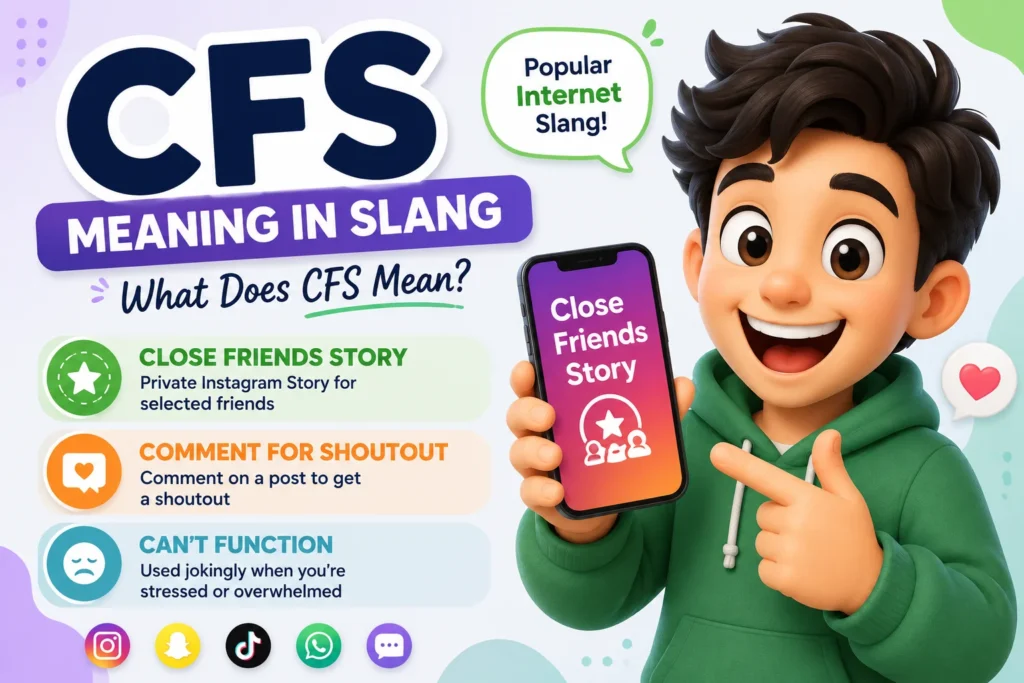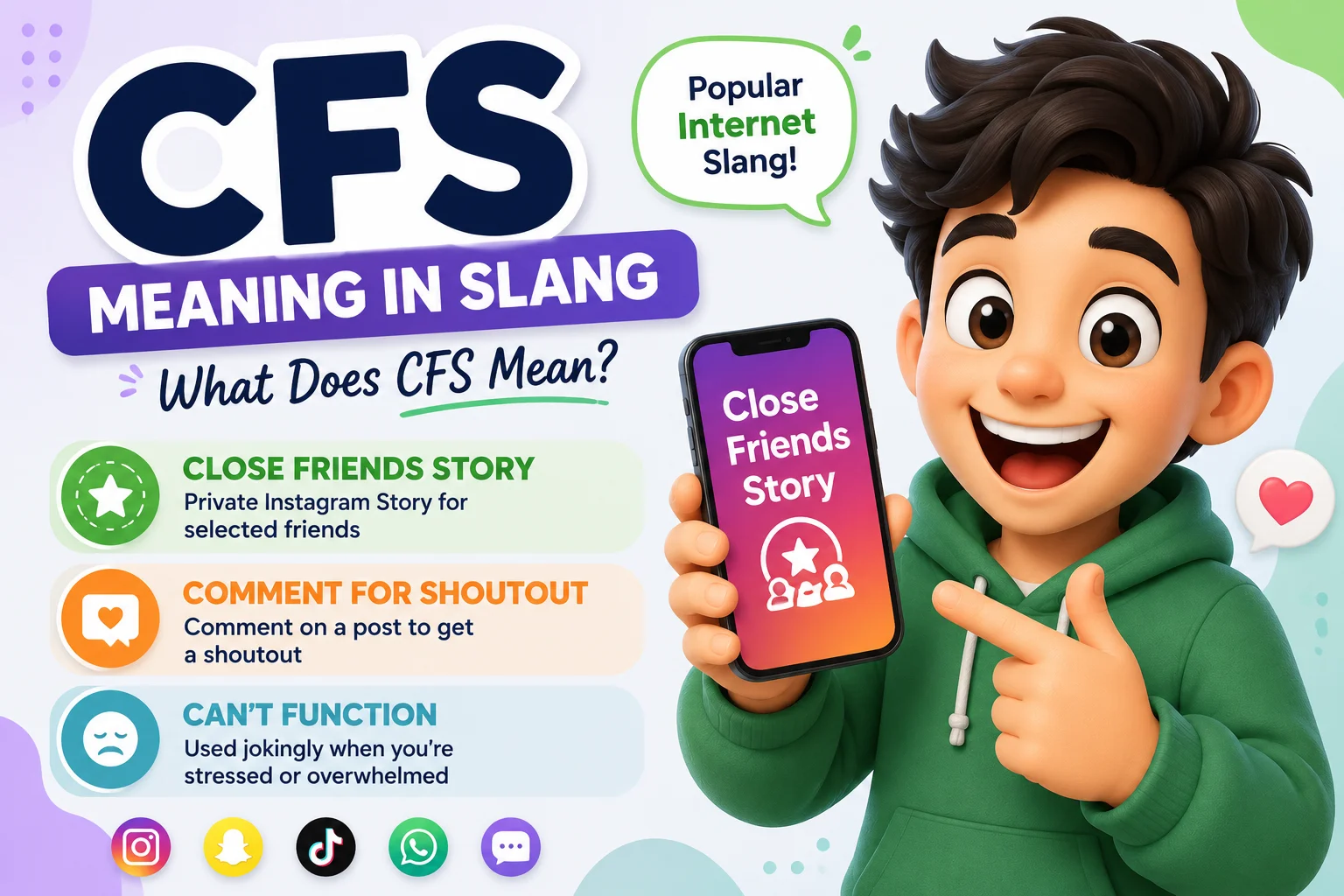
CFS most commonly stands for “Close Friends Story” in internet slang. It refers to a private Instagram Story shared only with a selected group of trusted followers instead of your entire audience. People often search for this acronym after seeing messages like “Check my CFS” or “Add me to your CFS” and wondering what it means.
As social media has become more personal, many users prefer sharing certain photos, videos, or updates with close friends rather than everyone who follows them. That’s why CFS has become a familiar term in texting and Instagram conversations.
While Close Friends Story is by far the most common slang meaning, CFS can also have a few other definitions depending on the platform and context.
What Does CFS Mean in Slang?
The primary slang meaning of CFS is:
CFS = Close Friends Story
A Close Friends Story is a private Instagram Story that can only be viewed by people you’ve personally added to your Close Friends list. Instead of sharing every update publicly, users often reserve more personal, funny, behind-the-scenes, or casual content for this smaller audience.
When someone says:
“Did you see my CFS?”
They’re asking whether you’ve viewed the Story they shared exclusively with their Close Friends list.
Likewise, if someone messages:
“Add me to your CFS.”
They’re asking to be included in that private group so they can see future exclusive Stories.
Unlike regular Instagram Stories, a Close Friends Story is identified by a green circle around the profile picture, making it easy for selected viewers to recognize exclusive content.
Why Do People Use CFS?
People use CFS because it allows them to share content with a trusted audience without making it visible to every follower.
Common reasons include:
- Sharing personal updates
- Posting funny behind-the-scenes moments
- Showing unedited photos
- Asking for opinions
- Posting inside jokes
- Sharing everyday life with close friends
Instead of worrying about a large public audience, users feel more comfortable posting naturally within their Close Friends circle.
Is CFS an Acronym, Abbreviation, or Slang?
Technically, CFS is an acronym because each letter represents a word:
- C = Close
- F = Friends
- S = Story
In online conversations, it also functions as internet slang because people use the shortened form instead of writing the full phrase every time.
Over time, “Close Friends Story” became so common among Instagram users that most people simply write CFS in texts, comments, and direct messages.
Why Is CFS So Popular?
Instagram users increasingly separate their online presence into two audiences:
- Everyone who follows them
- The people they trust most
A Close Friends Story gives users more control over who sees personal content.
Instead of posting everything publicly, they might save certain updates for:
- Best friends
- Family members
- Classmates
- Close coworkers
- Trusted online friends
As a result, CFS has become part of everyday internet vocabulary, especially among younger social media users.
Other Meanings of CFS
Although Close Friends Story is the primary slang meaning, CFS may refer to other things depending on the conversation.
Comment for Shoutout
One older Instagram meaning is:
Comment for Shoutout
Several years ago, some Instagram creators encouraged followers to comment on their posts in exchange for promoting the follower’s account in their Stories or feed.
Example:
“CFS if you want a shoutout!”
This engagement strategy was more common during Instagram’s early growth years but appears much less frequently today.
Unlike Close Friends Story, this meaning is no longer widely used.
Can’t Function
In some texting conversations, CFS is jokingly used to mean:
Can’t Function
People use it after something stressful, embarrassing, or exhausting happens.
For example:
A: I left my wallet at home again.
B: CFS 😭
Here, the sender humorously means:
“I can’t function today.”
This usage is much less common than Close Friends Story, but you may occasionally see it in casual chats.
Other Non-Slang Meanings
Outside social media, CFS has many unrelated meanings depending on the industry.
Examples include:
- Medical terms
- Business abbreviations
- Government organizations
- Scientific terminology
If you encounter CFS in a professional document, academic paper, or healthcare discussion, it almost certainly has a different meaning than the internet slang explained in this article.
Read More: Cross Faded Meaning: What This Slang Term Really Refers To
How CFS Is Used on Social Media
Although CFS is closely associated with Instagram, you’ll also see people mention it across several other platforms when talking about private Stories or social media activity.
Instagram is where CFS is used most often.
Users commonly say:
- “Check my CFS.”
- “I only posted it on my CFS.”
- “You’re on my CFS.”
- “Can you add me to your CFS?”
Because Instagram’s Close Friends feature is built directly into the app, most people immediately understand what CFS means in this context.
Typical content shared on a Close Friends Story includes:
- Daily life updates
- Funny moments
- Personal selfies
- Travel photos
- Private opinions
- Inside jokes
Many creators also use their CFS to interact more casually with their closest followers.
TikTok
Although TikTok doesn’t have an official Close Friends Story feature, users frequently mention CFS when referring to content they’ve shared on Instagram.
Examples include:
“This is definitely going on my CFS.”
or
“I only posted the full video on my CFS.”
Here, CFS acts as shorthand for a private Instagram Story rather than a TikTok feature.
Snapchat
Snapchat users occasionally borrow the term CFS during conversations about private sharing.
For example:
“I already put that on my CFS.”
Even though Snapchat has its own private sharing features, many users continue using Instagram terminology because they’re active on multiple social media platforms.
In WhatsApp group chats and private conversations, people often reference their Instagram activity.
Examples include:
“Go check my CFS.”
or
“Only my CFS saw this.”
The acronym simply refers back to an Instagram Close Friends Story rather than a WhatsApp feature.
X (formerly Twitter)
You’ll see CFS less frequently on X than on Instagram or TikTok.
When it does appear, it’s usually in tweets discussing Instagram habits or social media culture.
For example:
“Some posts belong on the timeline, others belong on the CFS.”
In these conversations, users assume readers already understand Instagram slang.
Read More: What Does THT Mean in Slang? Texting Meaning Explained
Where You’re Most Likely to See CFS
If you’re wondering where CFS appears most often, these are the places you’re most likely to encounter it:
- Instagram Direct Messages
- Instagram Story replies
- Instagram comments
- TikTok comments discussing Instagram
- WhatsApp chats
- Snapchat conversations
- Text messages between friends
- Social media group chats
Real Chat Examples of CFS in Slang
The easiest way to understand CFS is by seeing how people naturally use it in everyday conversations. In most cases, the acronym refers to an Instagram Close Friends Story, where users share content with a select group of trusted followers.
Friends Planning a Weekend
A: I posted all the concert videos on my CFS.
B: Really? I didn’t see them.
A: You’re not on my Close Friends list yet.
B: Wow, add me already!
Instagram Direct Message
A: Did you watch my CFS today?
B: Yeah! That café looked amazing.
A: I’m definitely going back next weekend.
B: Save me a seat next time.
College Friends
A: I only shared my presentation bloopers on my CFS.
B: Good choice. They were hilarious.
A: I didn’t want everyone to see them.
B: That’s exactly what CFS is for.
TikTok Conversation
A: I couldn’t post the full story here.
B: Where did you share it?
A: On my CFS.
B: I’ll check Instagram later.
WhatsApp Group Chat
A: Did everyone see my CFS?
B: Yes! The beach photos were incredible.
A: Those were my favorite shots.
B: They looked like a perfect vacation.
Best Friends Chat
A: I only tell my real opinions on my CFS.
B: Same. I feel more comfortable there.
A: It’s way less stressful than posting publicly.
B: Exactly.
School Friends
A: I finally made a CFS list.
B: Who’s on it?
A: Just my closest friends.
B: That’s probably the smartest way to use Stories.
Siblings
A: Why didn’t you upload that selfie?
B: I did.
A: I can’t find it.
B: It was only on my CFS.
Coworkers
A: I shared behind-the-scenes photos from the office party.
B: Public Story?
A: No, just my CFS.
B: That makes sense.
Travel Friends
A: My CFS got all the sunset pictures.
B: Lucky them.
A: I wanted to keep those private.
B: They were worth sharing.
Casual Text Conversation
A: Check my CFS when you get a chance.
B: I will after class.
A: Let me know what you think.
B: Deal.
CFS in Different Tones
Although CFS usually has the same meaning, the tone changes depending on the conversation.
Funny
A: I accidentally uploaded my breakfast selfie upside down.
B: Please tell me that’s on your CFS.
A: Of course it is.
B: I’m laughing already.
Here, CFS refers to a private Story where friends can laugh together.
Sarcastic
A: Apparently everyone suddenly wants to join my CFS.
B: Funny how that happens after your vacation photos.
A: What a coincidence.
B: I’m sure it’s totally about the friendship.
The sarcasm is playful rather than hurtful.
Playful
A: Guess who’s finally on my CFS?
B: Me?
A: Maybe…
B: I’ll take that as a yes.
This tone reflects friendly teasing.
Serious
A: I only shared the news on my CFS.
B: I understand. You probably wanted to tell close friends first.
A: Exactly.
B: Thanks for trusting us.
Here, CFS creates a sense of privacy and trust rather than humor.
Grammar and Language Role
Understanding how CFS works grammatically helps you use it naturally.
Part of Speech
CFS usually functions as a noun because it refers to a specific feature on Instagram.
Examples:
- My CFS
- Your CFS
- Their CFS
It behaves similarly to words like:
- Story
- Feed
- Reel
- Profile
Sentence Position
You can place CFS almost anywhere in a sentence.
Beginning
CFS is where I post personal updates.
Middle
I only shared those photos on my CFS yesterday.
End
I uploaded everything to my CFS.
The middle and end positions are the most common in everyday conversation.
Can CFS Replace a Full Sentence?
Not usually.
Unlike reaction acronyms such as LOL or LMAO, CFS names something rather than expressing emotion.
Instead of replying with only “CFS,” people typically write:
- “It’s on my CFS.”
- “Check my CFS.”
- “I posted it on my CFS.”
Formal vs. Informal Register
| Situation | Appropriate? |
|---|---|
| Text messages | ✅ Yes |
| Instagram DMs | ✅ Yes |
| WhatsApp chats | ✅ Yes |
| Snapchat conversations | ✅ Yes |
| TikTok comments | ✅ Yes |
| Casual social media posts | ✅ Yes |
| Business emails | ❌ No |
| Academic writing | ❌ No |
| Professional reports | ❌ No |
Because CFS is internet slang, it’s best suited to casual online communication.
How to Reply When Someone Mentions CFS
Your response depends on what the other person is saying.
Funny Reply
- “Now I’m curious—I need to see it!”
- “Don’t leave me out of the CFS!”
- “That better be worth the green circle.”
Serious Reply
- “I’ll check it when I open Instagram.”
- “Thanks for letting me know.”
- “I appreciate you sharing it with me.”
Flirty Reply
If the conversation already has a playful tone:
- “Guess I need to earn a spot on your CFS. 😊”
- “Being on your Close Friends list feels special.”
Only use flirty replies when they match the relationship and context.
Neutral Reply
- “I’ll take a look.”
- “Just watched it.”
- “Looks great!”
- “Thanks for sharing.”
Comparison Table
| Term | Meaning | Usage Context | Tone | Popularity | Confusion Risk |
|---|---|---|---|---|---|
| CFS | Close Friends Story | Instagram private Story | Casual | Very High | Medium |
| CF | Close Friends | Instagram conversations | Casual | High | Medium |
| Private Story | Story visible to selected users | Snapchat and other apps | Casual | High | Low |
| Finsta | Private Instagram account | Social media | Casual | Medium | Low |
| Story | Standard Instagram Story | General posting | Neutral | Very High | Low |
| Public Story | Story visible to all followers | Opposite of CFS | Neutral | High | Low |
The biggest confusion happens between CFS and CF. While they’re closely related, CF usually refers to the Close Friends list, whereas CFS refers specifically to the Close Friends Story shared with that list.
Who Uses CFS?
Teenagers (13–19)
Teenagers are the most frequent users of CFS. Many use Close Friends Stories to share daily updates, jokes, school moments, and personal photos with a trusted circle instead of their full follower list.
Young Adults (20–35)
Young adults also use CFS extensively, especially for travel updates, behind-the-scenes content, opinions, and life events they don’t want to post publicly.
Many creators and influencers maintain separate public content while reserving more authentic posts for their Close Friends audience.
Adults Over 35
Older adults who actively use Instagram may recognize the Close Friends feature, but they’re generally less likely to shorten it to CFS in conversations. Instead, they often say “Close Friends Story” in full.
Gen Z vs. Millennials
Gen Z
Gen Z uses CFS naturally in texts, Instagram DMs, TikTok conversations, and group chats. For many younger users, the acronym is part of everyday social media vocabulary.
They’re also more likely to joke about who “made the CFS” or celebrate being added to someone’s Close Friends list.
Millennials
Millennials tend to understand CFS, especially if they’re active Instagram users, but many still use the full phrase instead of the acronym. They often view the feature as a way to separate close relationships from broader social sharing.
Regional Usage
There is no reliable evidence that CFS originated in one specific English-speaking country. Instead, the term spread globally through Instagram as users adopted the Close Friends feature.
Today, you’ll commonly see CFS used in:
- United States
- United Kingdom
- Canada
- Australia
- New Zealand
- Other English-speaking communities worldwide
Its popularity depends more on Instagram usage than geography.
Where You’re Most Likely to See CFS
Although people mention CFS across several platforms, it appears most often in conversations connected to Instagram.
You’ll commonly see it in:
- Instagram Direct Messages
- Instagram Story replies
- Instagram group chats
- WhatsApp conversations
- TikTok comments discussing Instagram
- Text messages between friends
- Snapchat chats referencing Instagram
In nearly all of these situations, CFS means “Close Friends Story”—a private Story shared with a carefully selected audience.
Origin and Internet Culture
The slang meaning of CFS is closely tied to Instagram’s Close Friends feature. When Instagram introduced the ability to share Stories with a selected list of followers, users quickly began shortening “Close Friends Story” to CFS in text messages, direct messages, and social media conversations.
As the feature became more popular, the acronym spread beyond Instagram itself. People started mentioning their CFS on TikTok, WhatsApp, Snapchat, and other messaging platforms whenever they wanted friends to check a private Story or explain where they had shared certain content.
Unlike many internet slang terms that originate in forums or gaming communities, CFS developed directly from a built-in social media feature. It’s an example of how users naturally shorten commonly used phrases to make online conversations faster and more convenient.
Is CFS Connected to AAVE?
There is no verified evidence that CFS originated from African American Vernacular English (AAVE). Its origin is linked to Instagram’s Close Friends feature rather than a specific cultural or linguistic community.
CFS and Social Media Culture
One reason CFS became popular is that it reflects how people now separate their online audiences.
Many users no longer want to share every moment publicly. Instead, they prefer dividing their content into two categories:
- Posts meant for everyone
- Posts meant only for close friends
Using a Close Friends Story allows people to be more relaxed, authentic, and personal without worrying about a wider audience.
Today, it’s common to hear phrases such as:
- “I only posted it on my CFS.”
- “You’re on my CFS.”
- “That belongs on the CFS, not the main Story.”
These expressions have become part of everyday internet language among active Instagram users.
Is CFS Rude or Offensive?
Generally, no.
The slang meaning Close Friends Story is completely neutral and isn’t considered rude, offensive, or inappropriate.
Does CFS Contain Profanity?
No.
Unlike some internet abbreviations, CFS contains no profanity or explicit language. It’s simply a shortened form of Close Friends Story.
Can CFS Be Misunderstood?
Yes, sometimes.
Because CFS also has several professional, medical, and technical meanings, someone unfamiliar with Instagram slang may assume it refers to something else.
The surrounding conversation usually makes the intended meaning clear.
Is CFS Appropriate for School and Work?
If you’re discussing Instagram features or social media marketing, mentioning CFS is perfectly acceptable.
However, in formal writing or professional communication, it’s usually better to write “Close Friends Story” in full, especially if your audience may not recognize the acronym.
Cultural Sensitivity
The slang meaning of CFS doesn’t carry any cultural, political, or offensive associations. It’s simply a piece of social media vocabulary used by people who are familiar with Instagram’s features.
Real-World Observation
The popularity of CFS reflects a broader shift in how people use social media. Instead of sharing every photo or opinion with hundreds or thousands of followers, many users now prefer communicating with a smaller, trusted audience. A Close Friends Story offers a space for more genuine, spontaneous, and personal content. As a result, saying “It’s on my CFS” has become shorthand for “I shared this only with people I trust.” That simple idea explains why the acronym has remained relevant even as online trends continue to change.
Frequently Asked Questions
What does CFS mean in texting?
In texting, CFS most commonly means “Close Friends Story.” It’s used when someone is talking about a private Instagram Story that’s visible only to selected followers. Friends often mention it when asking others to view their Story or requesting to be added to someone’s Close Friends list.
What does CFS mean on Instagram?
On Instagram, CFS stands for Close Friends Story. This feature lets users share Stories with a handpicked group of followers instead of everyone who follows their account. It’s commonly used for personal updates, behind-the-scenes moments, or content intended only for trusted friends.
Does CFS always mean Close Friends Story?
No. While Close Friends Story is the primary slang meaning, CFS can also stand for Comment for Shoutout in older Instagram posts or Can’t Function in some casual text conversations. Outside social media, it has many unrelated professional and technical meanings.
What does CFS mean on TikTok?
TikTok doesn’t have a Close Friends Story feature, but users often mention CFS when referring to content they’ve posted privately on Instagram. For example, someone might say, “The full video is on my CFS,” directing followers to their Instagram account.
Is CFS the same as a Private Story?
They’re similar but not identical. A Close Friends Story is Instagram’s version of private Story sharing, while Private Story is a broader term that may refer to similar features on other social media platforms. The exact feature depends on the app being discussed.
Can anyone see my CFS?
No. Only the people you’ve added to your Close Friends list can view your Close Friends Story. Other followers won’t know what you’ve shared unless you choose to add them to the list.
Why do people use CFS instead of posting publicly?
Many users want to share personal thoughts, funny moments, travel updates, or everyday experiences without broadcasting them to every follower. A Close Friends Story offers a more private and comfortable space for those updates.
Is CFS still popular?
Yes. As Instagram continues to be one of the world’s most popular social media platforms, CFS remains a widely recognized abbreviation among active users. It’s especially common among people who regularly use Stories and direct messages.
What does CFS stand for in slang?
In internet slang, CFS most commonly stands for Close Friends Story, referring to a private Instagram Story shared only with selected followers.
What does CFS mean in a text message?
When someone mentions CFS in a text message, they’re usually talking about their Instagram Close Friends Story. They’re often asking you to check it or referring to something they shared privately.
What does “Add me to your CFS” mean?
This means the person wants to be included in your Instagram Close Friends list so they can view the Stories you share exclusively with trusted followers.
What is the difference between CFS and CF?
CF usually refers to the Close Friends list, while CFS refers to the Close Friends Story that’s shared with that list. Although they’re closely related, they aren’t exactly the same thing.
Is CFS only used on Instagram?
The feature belongs to Instagram, but people also mention CFS in text messages, WhatsApp chats, TikTok comments, Snapchat conversations, and other platforms when talking about their Instagram activity.
Can businesses use CFS?
Yes. Some creators and businesses use Close Friends Stories to share exclusive updates, behind-the-scenes content, early product previews, or special offers with loyal followers. However, the feature is most commonly used for personal sharing.
Conclusion
CFS most commonly means “Close Friends Story” in internet slang. It refers to Instagram’s feature that allows users to share Stories with a selected group of trusted followers instead of their entire audience. As private sharing has become more popular, the acronym has become a familiar part of texting and social media conversations.
Although CFS can occasionally mean “Comment for Shoutout” or the humorous phrase “Can’t Function,” these meanings are much less common today. In most conversations, especially those involving Instagram, CFS almost always refers to a Close Friends Story.
Usage Tips
- Use CFS when referring to an Instagram Close Friends Story.
- Remember that the acronym is best suited to casual conversations and social media.
- Consider writing “Close Friends Story” in full if your audience may not know the abbreviation.
- Use context to determine whether CFS has a different meaning outside social media.
Common Mistakes
- Assuming CFS has the same meaning on every platform.
- Confusing CFS with CF (Close Friends).
- Using the acronym in formal writing without explanation.
- Forgetting that CFS also has several non-slang meanings in professional fields.
When to Use CFS
Use CFS when talking about Instagram’s Close Friends feature, asking someone to view your private Story, or discussing content shared with a trusted audience.
When to Avoid CFS
Avoid using CFS in formal emails, academic writing, or professional documents unless you’ve clearly explained what the acronym means. In those settings, writing the full phrase helps prevent confusion.