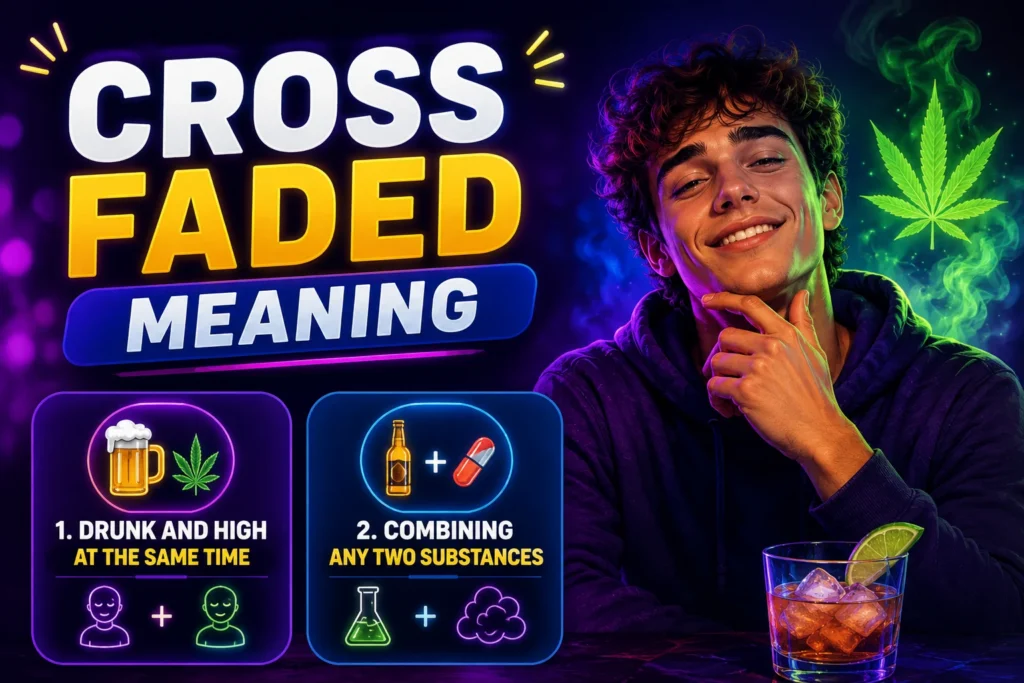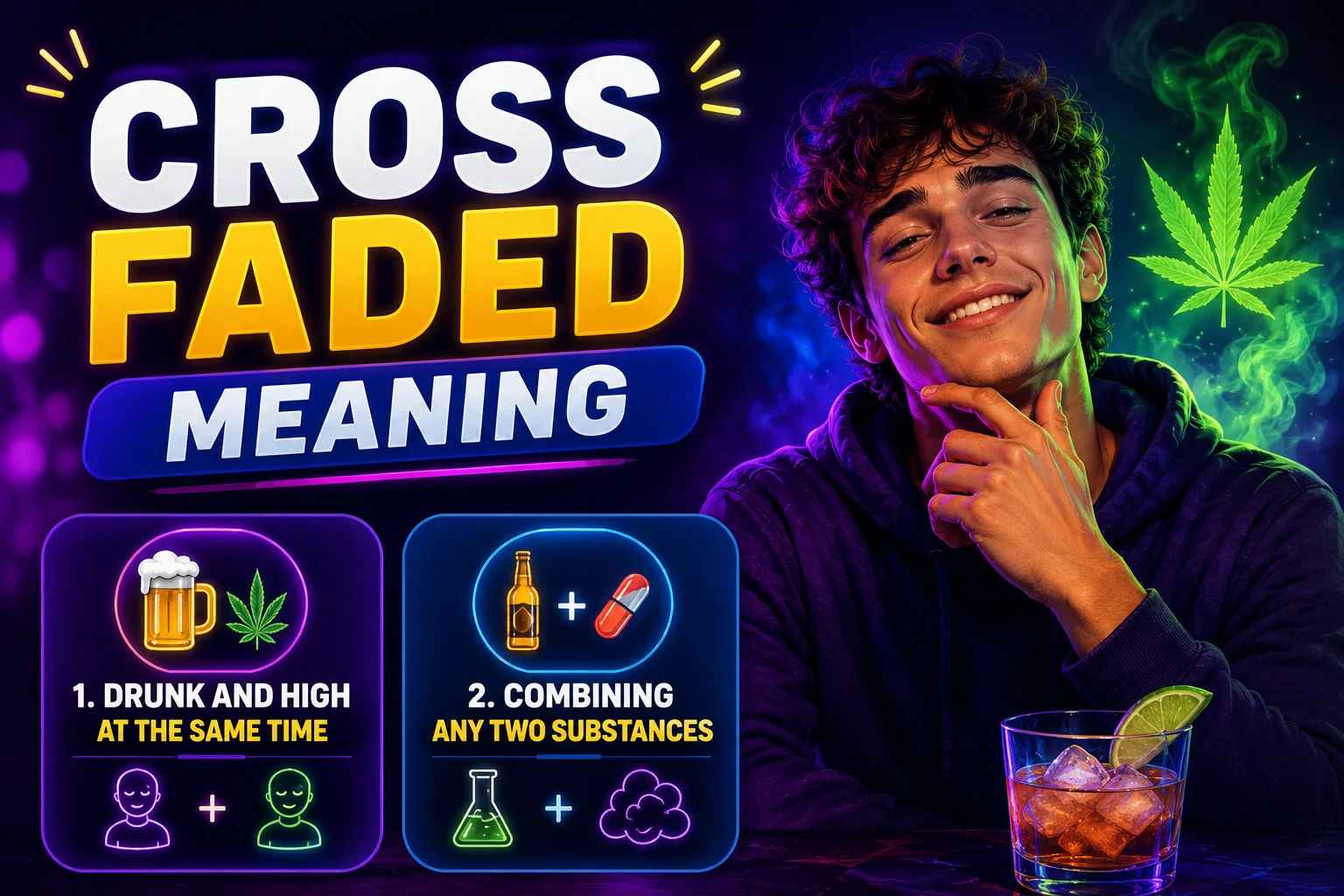
“Cross faded” means being drunk and high at the same time — specifically, under the effects of both alcohol and marijuana simultaneously. It’s slang, not a formal or medical term, and it’s searched constantly because people hear it in songs, TikTok captions, and group chats without ever getting a clear definition attached.
The confusion it solves is simple: the phrase sounds like it could mean almost anything — tired, distracted, emotionally drained — but it has one specific, consistent meaning across the contexts where it actually gets used.
This guide covers that meaning in full, plus how the term behaves in real conversations, its origins, and the safety context worth knowing before using or encountering it.
What Does “Cross Faded” Actually Mean?
Drunk and High at the Same Time
The overwhelming majority of usage refers to the state of being simultaneously intoxicated by alcohol and impaired by cannabis. It’s not describing two separate experiences happening back-to-back — it describes the combined, overlapping effect of both substances active in a person’s system at once.
This is a slang phrase, built from two ordinary words combined for a specific meaning — not an acronym or a formal abbreviation. “Faded” on its own has long been slang for being high, and “cross” signals the crossing-over or combination of two states rather than just one.
Secondary Usage: Combining Any Two Substances
Less frequently, people stretch “cross faded” to describe combining alcohol with a substance other than marijuana, or even mixing two non-alcohol substances. This usage is far less common than the alcohol-plus-weed meaning and typically still gets clarified by context (“cross faded on edibles and beer,” for example).
Platform Breakdown
TikTok
“Cross faded” appears frequently in caption text and comments on party-recap videos, late-night vlogs, and “get ready with me” content, usually as a lighthearted or self-deprecating label for how someone felt the night before.
Shows up mostly in captions and comments on party or nightlife photos, often paired with a laughing emoji rather than a serious tone.
Snapchat
Common in quick captions on Snap stories from parties or gatherings, functioning as a short status update rather than a detailed explanation.
X (Twitter)
Appears in casual posts and replies, often as a one-line observation about a past night out rather than in real time.
Platforms Where It Doesn’t Really Appear
Platforms like LinkedIn or formal messaging tools built for work don’t show meaningful use of this term, since it’s tied entirely to social, party-adjacent contexts.
Read More: LOFL Meaning in Slang: What It Really Means in Texts
Tone & Context Variations
Funny
A: how are you even standing right now
B: honestly no clue, I think I’m cross faded
A: you had ONE drink
B: it was a very powerful drink apparently
Sarcastic
A: you seem a little off tonight
B: oh I’m just mildly cross faded, nothing to worry about
A: “mildly” is doing a lot of work in that sentence
B: I contain multitudes
Playful
A: don’t let me order food tonight
B: why, what’s wrong with tonight
A: I’m a little cross faded and last time I ordered three pizzas
B: say no more, phone confiscated
Serious
A: hey, are you good to drive home?
B: honestly no, I think I’m pretty cross faded right now
A: okay, stay put, I’m coming to get you
B: thank you, I didn’t want to risk it
Platform Breakdown
TikTok
“Cross faded” appears frequently in caption text and comments on party-recap videos, late-night vlogs, and “get ready with me” content, usually as a lighthearted or self-deprecating label for how someone felt the night before.
Shows up mostly in captions and comments on party or nightlife photos, often paired with a laughing emoji rather than a serious tone.
Snapchat
Common in quick captions on Snap stories from parties or gatherings, functioning as a short status update rather than a detailed explanation.
X (Twitter)
Appears in casual posts and replies, often as a one-line observation about a past night out rather than in real time.
Platforms Where It Doesn’t Really Appear
Platforms like LinkedIn or formal messaging tools built for work don’t show meaningful use of this term, since it’s tied entirely to social, party-adjacent contexts.
Tone & Context Variations
Funny
A: how are you even standing right now
B: honestly no clue, I think I’m cross faded
A: you had ONE drink
B: it was a very powerful drink apparently
Sarcastic
A: you seem a little off tonight
B: oh I’m just mildly cross faded, nothing to worry about
A: “mildly” is doing a lot of work in that sentence
B: I contain multitudes
Playful
A: don’t let me order food tonight
B: why, what’s wrong with tonight
A: I’m a little cross faded and last time I ordered three pizzas
B: say no more, phone confiscated
Serious
A: hey, are you good to drive home?
B: honestly no, I think I’m pretty cross faded right now
A: okay, stay put, I’m coming to get you
B: thank you, I didn’t want to risk it
Real Chat Examples
Friends, Texting After a Party
A: how’d last night end for you
B: don’t even remember, I was cross faded by 11
Roommates, Group Chat
A: did you eat the leftover pizza
B: yeah sorry, I was cross faded and it looked too good to leave alone
Siblings, Texting
A: mom’s asking why you slept until 2pm
B: tell her I was cross faded and needed the recovery time
Coworkers, Casual DM Outside Work Hours
A: you good? you left the party pretty fast
B: yeah just got a little too cross faded, needed air
Couple, Texting
A: you seemed out of it at dinner
B: I was low-key cross faded, sorry if I was quiet
A: you’re fine, just wanted to check
College Friends, Group Chat
A: rating last night’s party 1-10
B: 10, but I was so cross faded I don’t remember the ending
Concert Friends, Texting
A: that show was insane
B: I barely remember half of it, I was way too cross faded
New Acquaintances, Party Small Talk Over Text
A: you left kind of early last night
B: yeah I was getting cross faded fast, figured I should head out before it got worse
Friend Checking In, Texting
A: you okay? you went quiet at the bonfire
B: yeah just cross faded, sat down for a bit to reset
Older Friend to Younger Friend, Texting
A: be careful mixing stuff tonight, don’t want you cross faded and driving anywhere
B: don’t worry, I’ve got a ride already lined up
Friends Recapping a Wedding, Texting
A: the open bar destroyed me
B: same, I was fully cross faded by the reception dinner
Read More: NTN Meaning in Slang: What It Means in Texting
Grammar & Language Role
“Cross faded” functions as an adjective, describing a person’s state (“I’m cross faded,” “she got cross faded”). It doesn’t act as a noun or verb on its own, though “cross-fading” (the gerund form) is sometimes used to describe the act of combining the substances.
Sentence position:
It typically follows a form of “to be” (“I’m cross faded,” “they were cross faded”) or appears after “getting” (“getting cross faded”).
Can it replace a full sentence?
Not on its own — it needs at least a subject and a verb around it to form a complete thought, unlike single-word slang that can stand alone as a full reply.
Register:
Entirely informal. It belongs in casual conversation between friends and doesn’t appear in professional, academic, or formal writing.
How to Reply to “I’m Cross Faded”
Funny reply:
“incredible timing, we’re about to leave”
Serious reply:
“okay, let’s get you some water and figure out how you’re getting home.”
Flirty reply:
Not applicable — this term describes a substance-related state, not a social or romantic context, so a flirty framing isn’t appropriate here.
Neutral/unbothered reply:
“got it, let me know if you need anything.”
Comparison Table
| Term | Meaning | Usage Context | Tone | Popularity | Confusion Risk |
|---|---|---|---|---|---|
| Cross faded | Drunk and high at the same time | Party/social texting | Casual, sometimes joking | High | Medium (people confuse it with just “faded”) |
| Faded | High, usually from marijuana alone | Casual conversation | Relaxed | High | Medium |
| Zooted | Very high, cannabis-focused | Casual conversation | Playful | Medium | Low |
| Tipsy | Mildly affected by alcohol only | Casual conversation | Light | Very high | Low |
| Blackout drunk | Extremely intoxicated to the point of memory loss | Casual conversation | Serious/cautionary | High | Low |
| Sober (opposite meaning) | Not under the influence of any substance | Everyday conversation | Neutral | Very high | Low |
Who Uses This Term
Age group breakdown:
Primarily used by people in their late teens through late twenties, especially in college and early post-college social settings where drinking and cannabis use overlap most often.
Gen Z vs. Millennials:
Gen Z tends to use the term casually and publicly, including in captions on social platforms, while Millennials more often use it privately in texts or conversation rather than as public content.
Regional usage:
The term is used broadly across the US, particularly in college towns and cities where cannabis is legal or widely accessible, making the combined use it describes more common. It also appears in the UK, though “faded” and “cross faded” are somewhat less dominant there compared to other regional drinking-and-smoking slang.
Platforms:
The meaning stays consistent everywhere it appears — TikTok, Instagram, Snapchat, and X all use it to describe the same combined alcohol-and-cannabis state, just in slightly different formats (captions vs. quick posts vs. direct messages).
Origin & Internet Culture
The word “faded” has been used in slang for decades to describe being under the influence, particularly of marijuana, with roots tracing through hip-hop culture where the term described a hazy, altered mental state. “Cross faded” built on that existing word by adding “cross” to signal a crossing or combination of two separate substances rather than one.
The term spread through college and party culture before becoming widely recognized in mainstream slang, and it gained further reach through references in music, where several well-known hip-hop and rap lyrics use the phrase directly, cementing it in pop-culture vocabulary well beyond people who regularly use both substances.
On TikTok, the term shows up most in party-recap and “story time” style videos, where creators use it as shorthand to explain confusing or funny moments from a night out rather than to describe the term itself. It has become common enough that most people recognize the phrase on sight, even if they’ve never used it to describe their own experience.
The meaning hasn’t shifted much since it entered wider slang use — it has stayed consistently tied to the alcohol-and-cannabis combination rather than drifting toward unrelated meanings, which is somewhat unusual for internet slang.
Safety & Appropriateness
“Cross faded” itself is not profanity and doesn’t contain explicit language — it’s a descriptive slang phrase, not a slur or vulgar term. That said, it directly references substance use, which shapes where it’s appropriate to use.
School and workplace appropriateness:
Not appropriate in academic or professional settings. Using the term in a school assignment, workplace chat, or any formal context reads as out of place at best and could raise concerns at worst, given its direct connection to drug and alcohol use.
Cultural sensitivity notes:
The term itself doesn’t carry slur status or target any group, but it does reference substance combination that carries real health risks, including impaired coordination, unpredictable intensity of effects, and increased risk of accidents.
It’s discussed here descriptively, not as encouragement, and anyone concerned about their own or someone else’s substance use should reach out to a medical professional or a local support service rather than relying on slang definitions for guidance.
Real-World Observation
What’s notable about “cross faded” is how consistently descriptive it stays compared to most slang, which tends to drift toward exaggeration or irony over time. People use it almost clinically in casual conversation — as a quick, efficient way to explain a specific state to a friend without a longer explanation, similar to how someone might say “hungover” instead of describing symptoms one by one. It functions less as an identity or personality marker and more as a status update, which is part of why it has stayed remarkably stable in meaning across nearly two decades of use, even as the platforms people say it on have changed completely.
Frequently Asked Questions
What does “cross faded” mean in slang?
“Cross faded” describes being under the influence of both alcohol and marijuana at the same time, rather than just one substance alone. It’s used to explain a specific combined state, and the meaning stays fairly consistent whether it shows up in a text, a caption, or in conversation.
Is “cross faded” the same as being “faded”?
Not exactly. “Faded” on its own usually refers to being high, most often from marijuana, without necessarily involving alcohol. “Cross faded” specifically signals that both alcohol and cannabis are involved at the same time, which is why the two terms aren’t fully interchangeable.
Where did the term “cross faded” come from?
It grew out of the existing slang word “faded,” which has long meant being high, with “cross” added to indicate the combination of two substances rather than one. The phrase spread through college and party culture and later gained wider recognition through references in music.
Is it offensive to say “cross faded”?
No, the term itself isn’t offensive or a slur. It’s a casual descriptive phrase tied to substance use, so its appropriateness depends more on the setting — casual conversation versus school or work — than on the word itself carrying any inherent offensiveness.
Can “cross faded” refer to substances other than alcohol and weed?
Occasionally, people use it loosely to describe combining other substances, but this is far less common than the standard alcohol-and-marijuana meaning, and the specific substances involved are usually clarified separately in those cases.
Why is combining alcohol and marijuana considered risky?
Combining the two can intensify and complicate the effects of each substance in ways that are harder to predict than using either one alone, which can affect coordination, judgment, and physical wellbeing. Because of this, it’s a state people should approach cautiously, and anyone with ongoing questions or concerns about substance use should speak with a healthcare provider.
Is “cross faded” a recent term or has it been around a while?
It’s not new — the phrase has circulated in party and college culture for well over a decade, predating its more recent spread through TikTok and other social platforms. Its meaning has stayed largely unchanged over that time.
Do older generations use “cross faded”?
Rarely. It’s mostly used by younger adults, particularly people in their late teens through twenties, and it’s less commonly used or recognized by older generations who may be more familiar with older equivalent slang terms.
Conclusion
“Cross faded” is a stable, well-defined slang phrase describing the state of being drunk and high at the same time, most often from alcohol and marijuana combined. Unlike many slang terms, its meaning hasn’t shifted much since it entered common use, and it remains tied specifically to that combined substance state across every platform where it appears.
Usage tips:
- Use it only in casual, informal conversation — never in professional or academic contexts.
- Remember it describes a specific combined state, not just being high or just being drunk.
- Context around it (captions, texts, conversation) is usually enough to make the meaning clear without extra explanation.
- If someone tells you they’re cross faded, treat it as useful information about their current state, especially around decisions like driving.
Common mistakes:
- Assuming it’s interchangeable with “faded” when it specifically implies two substances, not one.
- Using it in formal writing or professional messages where it reads as out of place.
- Overlooking that it’s referencing a real physical state with real risks, not just a throwaway phrase.
- Misapplying it to situations involving only one substance.
When to use it:
Casual conversations among friends describing a past or current state, especially where clarity matters, like letting someone know you’re not in a state to drive.
When to avoid it:
Formal writing, workplace communication, conversations with people who may not be familiar with or comfortable with substance-related topics, or any context where a more serious or medically accurate description is needed.