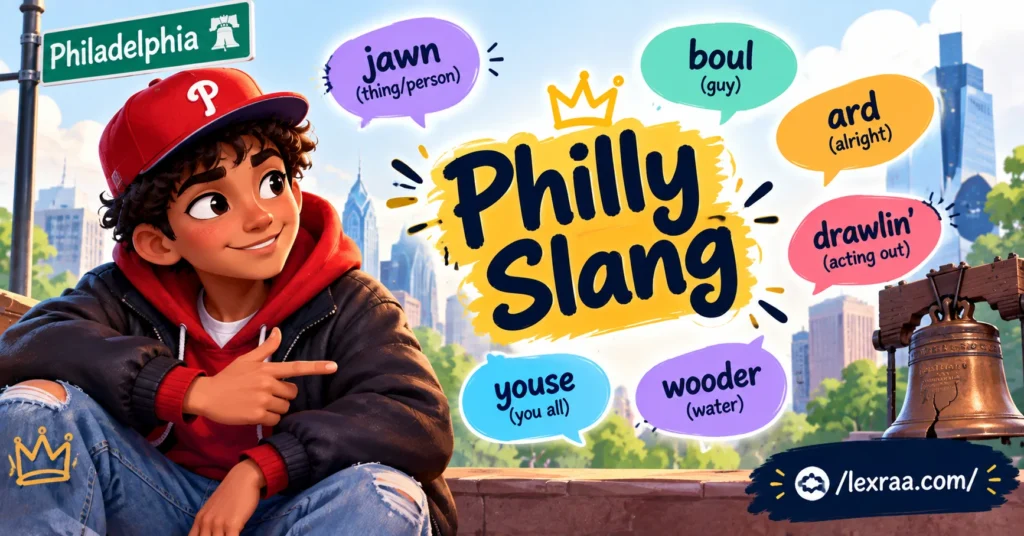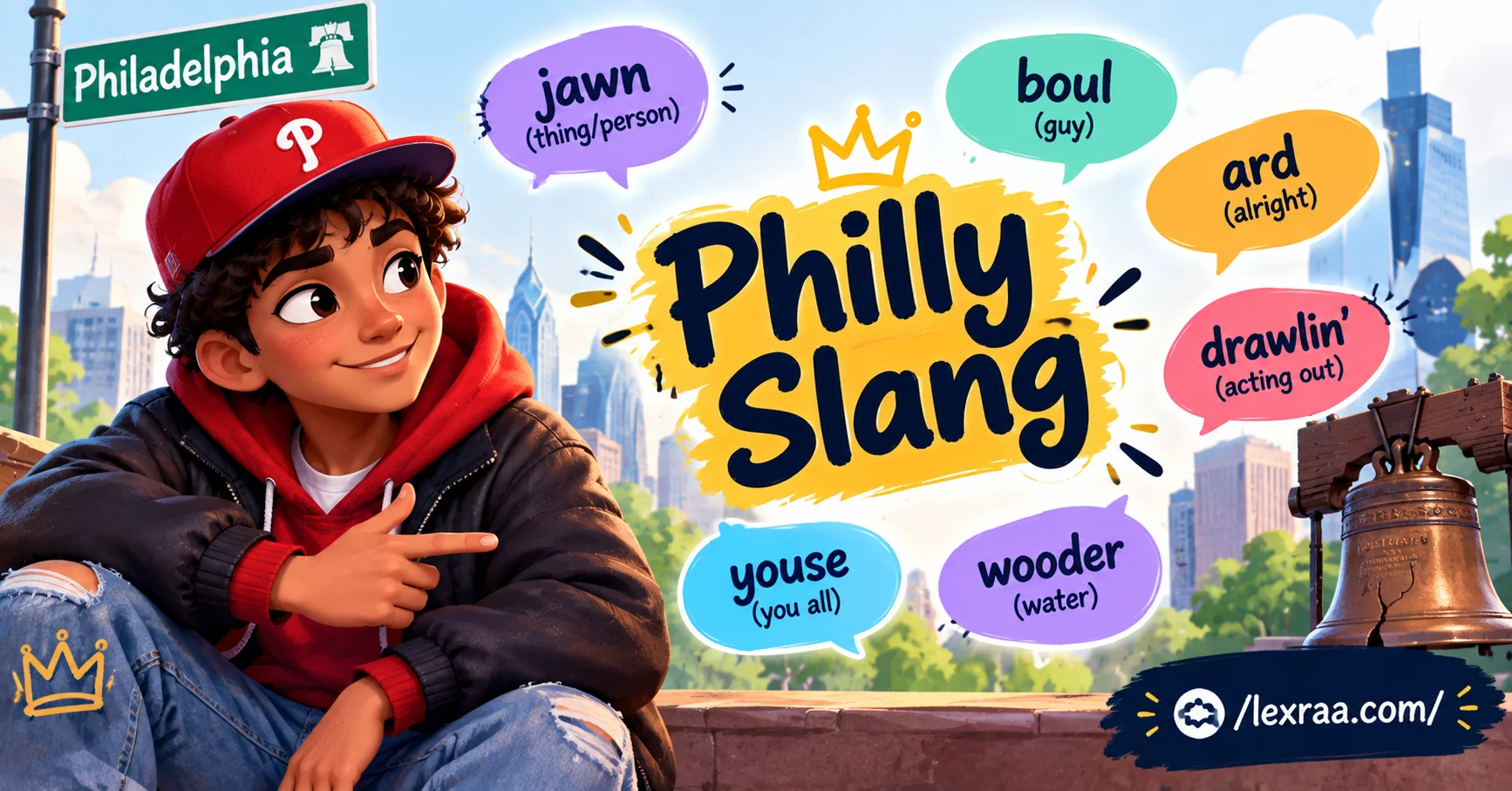
If you’re looking for Philly slang, you’ll quickly run into words like jawn, boul, drawlin, ard, youse, and wooder. Some are true slang; others are regional vocabulary or pronunciation features of Philadelphia English.
What Does “Philly Slang” Mean?
Philly slang is a broad term for informal words, expressions, pronunciations, and speech patterns associated with Philadelphia and the surrounding Delaware Valley.
It is not an acronym or abbreviation. It describes a regional variety of informal language rather than one specific word.
The most recognizable example is jawn, an all-purpose noun that can stand for a person, place, thing, event, or situation depending on context. The Encyclopedia of Greater Philadelphia describes it as a locally developed variant of joint that became especially flexible in Philadelphia.
But Philly speech is bigger than jawn. Some expressions are closely associated with local slang, while others are better classified as regional vocabulary or features of the Philadelphia accent.
Common Philly Slang Words and Meanings
Jawn
Jawn is the classic Philly slang word. It can replace almost any noun when the exact name isn’t necessary.
- “Pass me that jawn.” → Pass me that thing.
- “We going to that jawn tonight?” → We’re going to that place/event tonight.
- “That jawn was crazy.” → That thing/place/event was crazy.
Dictionary.com describes jawn as an all-encompassing substitute for a person, place, or thing.
Boul
Boul is an informal Philadelphia term for a guy, boy, man, or person, depending on context.
You might hear:
“That boul over there is my friend.”
The Philadelphia School District’s handbook for new teachers included boul as a local word for describing a person.
Drawlin’
Drawlin’ means acting out, doing too much, behaving unreasonably, or crossing a line.
It can be playful between friends or more serious when someone is genuinely annoyed.
“Why you drawlin’ right now?”
The term was included in a Philadelphia School District student-authored handbook in 2018, and older user-submitted records also document the Philadelphia usage.
Ard
Ard is a Philly spelling/pronunciation of “alright.” It can mean okay, agreed, understood, or sounds good.
“Meet me at seven.”
“Ard.”
Dictionary.com specifically identifies ard as Philadelphia youth slang and notes its use in texting, social media, and everyday speech.
Youse
Youse means “you” when talking to two or more people, similar to “you all” or “you guys.”
“Youse coming with us?”
It is not exclusive to Philadelphia; Dictionary.com classifies it more broadly as a Northeastern and North Midland U.S. form. Philadelphia is nevertheless strongly associated with its use.
Wooder
Wooder is the famous Philadelphia pronunciation of water.
It is useful to distinguish this from actual slang: wooder is primarily a pronunciation feature of Philadelphia speech, rather than a separate slang word with a different meaning. Visit Philadelphia and Drexel both use it when explaining local Philadelphia speech.
Hoagie
A hoagie is a long sandwich that many other parts of the United States would call a sub.
It is better described as regional Philadelphia vocabulary than as youth slang. Visit Philadelphia includes hoagie in its local dictionary and defines it as a hero or sub sandwich.
Water Ice
Water ice refers to the frozen fruit-flavored dessert associated especially with Philadelphia.
In Philly speech, it is commonly pronounced along the lines of “wooder ice.” The Philadelphia School District’s handbook included water ice as part of its local vocabulary.
Iggles
Iggles is a familiar Philadelphia pronunciation/nickname for the Philadelphia Eagles. Visit Philadelphia specifically lists “Iggles” alongside other local speech features.
Yo
Yo can work as a greeting or a way to get someone’s attention. It is associated with Philadelphia speech but is not uniquely Philly slang today.
The Important Difference: Philly Slang vs. Philly Speech
This is one point many quick “50 Philly slang words” lists blur together.
Jawn, boul, drawlin’, and ard function as recognizable local slang terms. But wooder is pronunciation, while hoagie and water ice are better understood as regional vocabulary. Youse is a regional grammatical form that occurs outside Philadelphia too.
That distinction matters because calling every Philadelphia-specific word “slang” makes the language look more uniform than it really is.
Philadelphia English combines vocabulary, grammar, pronunciation, neighborhood speech, and influences from different communities. A local might use hoagie in completely ordinary conversation without treating it as slang at all.
Where Did Philly Slang Come From?
There isn’t one origin story for Philadelphia slang because the vocabulary developed from different linguistic and cultural sources.
The history of jawn is particularly well documented. The Encyclopedia of Greater Philadelphia explains that it developed locally from joint, a word that had already broadened in New York and East Coast speech. Philadelphia’s Black English speakers adapted the pronunciation and expanded its use into the extremely flexible jawn.
The history is more complicated than simply saying “jawn was invented in Philly.” Researchers have traced earlier forms of joint much further back, while the specifically Philadelphia form developed later.
Other expressions have different histories. Youse, for example, is documented outside Philadelphia and was recorded in the 19th century, so it shouldn’t be presented as a word Philadelphia invented.
Philly Slang in Real Conversations
1. Friends texting
Maya: You still coming to the party?
Chris: Ard, I’m leaving now.
Maya: Bet. Bring that jawn I left at your house.
Chris: Which jawn? 😂
2. Two friends arguing
Jordan: Why you telling everybody what happened?
Malik: I wasn’t trying to start anything.
Jordan: Bro, you drawlin’.
Malik: Ard, my bad.
3. Talking about someone
A: Who’s that boul with you?
B: That’s my cousin.
A: Oh, word. I thought he was your coworker.
B: Nah, he just came through.
4. Group chat
Sam: Youse ready yet?
Nia: Almost.
Sam: Ard, I’m outside.
Nia: Give us five minutes.
5. Ordering food
Customer: Lemme get a hoagie and a water ice.
Friend: You getting the mango?
Customer: Of course. That’s the best jawn.
Here, jawn works naturally because its exact meaning is supplied by the surrounding context.
What Makes “Jawn” Different From Other Slang?
The unusual part about jawn isn’t simply that it means “thing.” Its grammatical flexibility is what makes it interesting.
The Encyclopedia of Greater Philadelphia describes it as a neutral, all-purpose noun that can refer to people, places, situations, or objects. Its meaning is recovered from context rather than from the word itself.
That creates a useful linguistic trick: the speaker doesn’t have to name something precisely when everyone already knows what they’re referring to.
Compare:
- “Pass me that thing.”
- “Pass me that jawn.”
The second sentence carries Philadelphia identity as well as the basic meaning.
Philly Slang vs. Similar Terms
| Term | Meaning | Tone | Popularity | Confusion Risk |
|---|---|---|---|---|
| Philly slang | Informal Philadelphia-associated vocabulary and expressions | Casual/regional | High | Low |
| Jawn | Flexible noun for a person, place, thing, etc. | Casual | Very high | Medium |
| Boul | Guy, boy, man, or person | Casual | High locally | Medium |
| Drawlin’ | Acting out, doing too much, crossing a line | Casual/critical | High locally | Medium |
| Ard | Alright, okay, agreed | Casual | High locally | Low |
| Youse | Plural “you” | Informal/regional | High regionally | Medium |
| Formal English | Standard language used in formal contexts | Neutral/formal | Very high | Low |
There isn’t a true single opposite of Philly slang. Formal/standard English is the closest contrast in terms of register, but it isn’t an exact linguistic opposite.
Is Philly Slang Used Outside Philadelphia?
Some Philly expressions have traveled far beyond the city, particularly jawn.
Its appearance in popular culture, social media, and entertainment has made the word recognizable to people who aren’t from Philadelphia. The Encyclopedia of Greater Philadelphia notes its increasing normalization and presence in popular culture.
That doesn’t mean everyone outside Philly uses it naturally. Local speakers also point out that outsiders sometimes imitate the vocabulary without understanding how it works in actual Philadelphia speech. Community discussions on Reddit show that some Philadelphia speakers feel jawn has become overused or misused outside its original context.
Is Philly Slang Rude?
Most Philly slang isn’t inherently rude or offensive.
Words such as jawn, ard, boul, youse, and wooder can appear in ordinary conversation. Drawlin’, however, is more evaluative because you’re telling someone they’re acting out or doing too much.
Context matters. A friend saying “you drawlin’ 😂” can be playful, while the same phrase during an argument can be a genuine criticism.
For school, business emails, formal presentations, and professional documents, standard wording is usually clearer.
How to Reply to Philly Slang
If someone uses Philly slang with you and you understand it, you don’t need to imitate the dialect.
Simple:
“Got you.”
Curious:
“Wait, what does ‘jawn’ mean here?”
Playful:
“I’m still learning Philly 😂”
Asking about a word is often better than forcing a local expression you haven’t heard used naturally.
Who Uses Philly Slang?
Philly slang isn’t limited to one age group. The Philadelphia School District’s 2018 handbook was created partly to help new teachers understand expressions students were using, while long-established regional vocabulary such as hoagie and youse extends beyond youth speech.
Usage can also vary by neighborhood, generation, family, community, and individual speaker. So a list of “Philly slang” shouldn’t be treated as a vocabulary checklist that every Philadelphian uses.
Related Searches About Philly Slang
Current search results show recurring interest around several specific Philly-language questions, including:
- Philly slang words
- Philly slang dictionary
- Philadelphia slang
- what does jawn mean
- what does ard mean
- what does drawlin mean
- what does boul mean
- what is Philly slang
These searches also reveal why a useful Philly guide needs more than a long word list: people frequently want to understand individual words and how context changes them, especially jawn, ard, drawlin’, and boul.
FAQ’s
What is the most famous Philly slang word?
Jawn is probably the most recognizable Philadelphia slang term. It can substitute for almost any person, place, thing, or situation, with context supplying the intended meaning.
What does “jawn” mean in Philadelphia?
It is an all-purpose noun that can refer to a thing, person, place, event, or situation. “Pass me that jawn” could mean “pass me that thing,” while “that jawn was packed” could refer to a place or event.
What does “ard” mean in Philly slang?
Ard means “alright” and can express agreement, understanding, or acceptance. It is particularly associated with Philadelphia youth slang and is used in texting and everyday speech.
What does “drawlin” mean in Philly?
Drawlin’ generally means acting out, doing too much, behaving unreasonably, or crossing a social line. The tone can be teasing among friends or more serious during a disagreement.
What does “boul” mean in Philadelphia?
Boul is a casual term for a guy, boy, man, or person. It is strongly associated with Philadelphia speech and can be friendly, neutral, or slightly dismissive depending on context.
Is “youse” only Philly slang?
No. Youse is used in several Northeastern and North Midland varieties of American English. It is strongly associated with Philadelphia, but it isn’t uniquely Philadelphia.
Is “wooder” actually a Philly slang word?
Not exactly. Wooder represents a well-known Philadelphia pronunciation of water, so it is better understood as an accent feature than as a separate slang word.
Conclusion
Philly slang is really a mixture of local slang, regional vocabulary, pronunciation, and Philadelphia English. If you’re learning the basics, start with jawn, boul, drawlin’, and ard, then recognize youse, wooder, hoagie, and water ice as broader regional features rather than treating every local word as slang.
Most importantly, don’t force the vocabulary. Jawn is understood through context, drawlin’ depends heavily on tone, and words such as youse and wooder belong to a wider regional speech system.