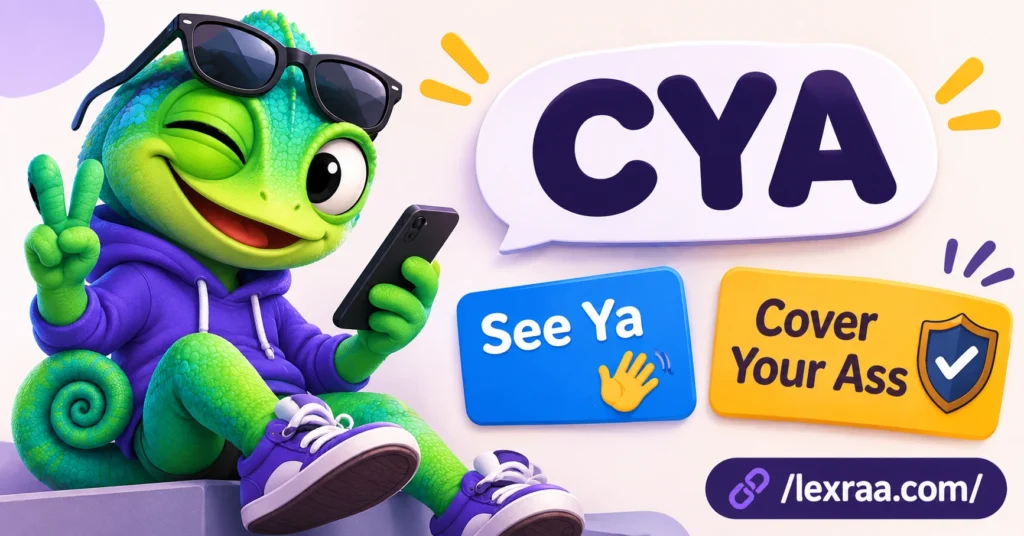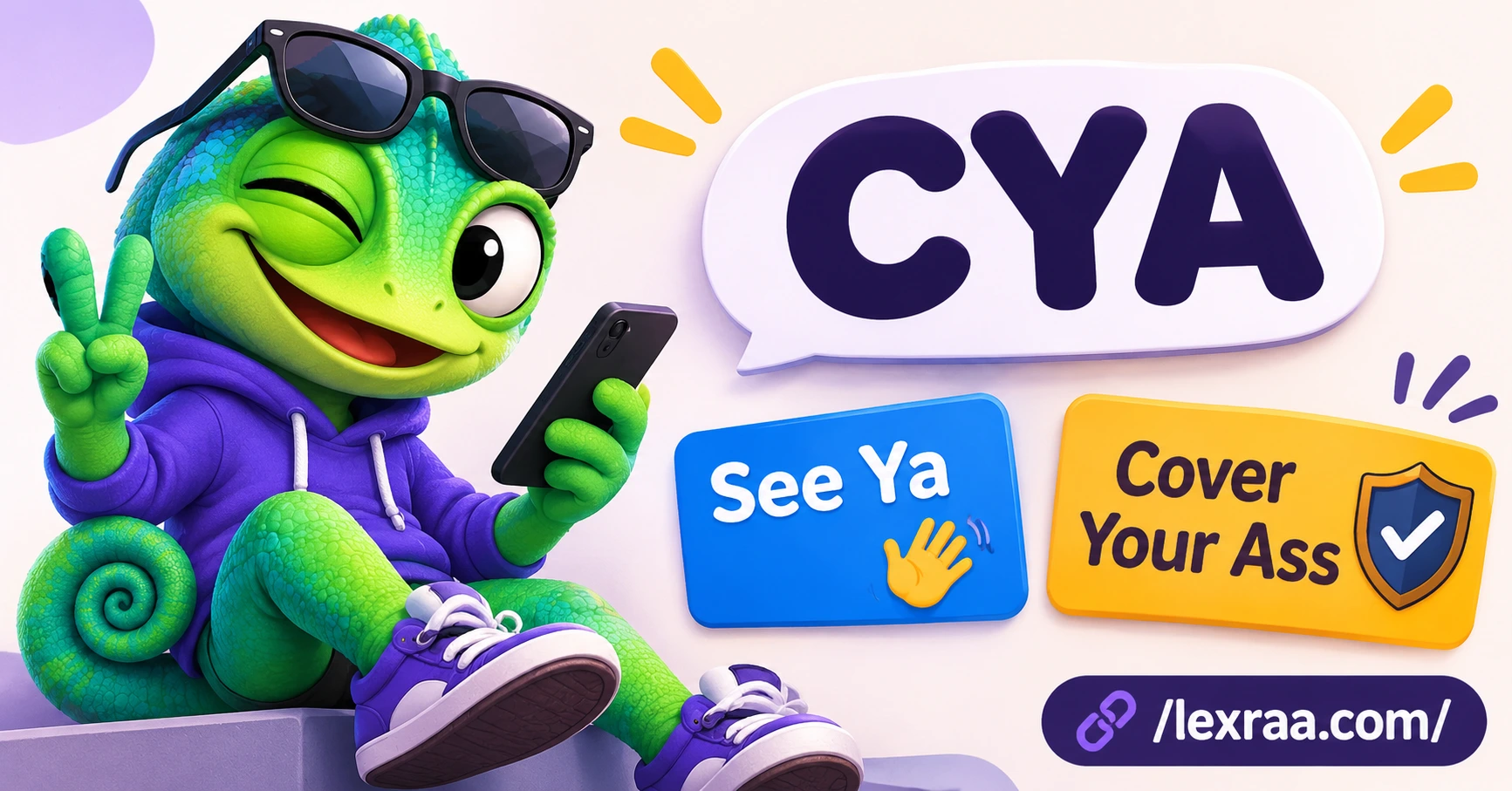
If someone sends you CYA in a text, they usually mean “see ya” or “see you.” It’s a casual way to say goodbye or confirm you’ll meet again. In work-related conversations, however, CYA can mean “cover your ass,” so context matters.
The first meaning is the one to consider when someone is wrapping up an ordinary conversation:
“I have to head out. CYA tomorrow!”
They’re simply saying they’ll see you tomorrow. No hidden message, argument, or complicated interpretation is necessary.
But if someone mentions saving emails, avoiding blame, or protecting themselves from responsibility, the second meaning may be intended.
The two meanings of CYA
CYA is an abbreviation rather than a conventional acronym with one fixed expansion. Its meaning changes with the situation.
1. CYA means “See Ya”
In casual messages, CYA means “see ya,” an informal way of saying “see you.” It works as a quick farewell when someone is leaving a conversation, signing off, or confirming a future meeting.
For example:
- “Gotta go, CYA!”
- “CYA after class.”
- “It was fun hanging out. CYA soon.”
- “Heading home now, cya tomorrow.”
The phrase doesn’t necessarily mean the person is leaving permanently. Usually, it suggests that you’ll see or speak to each other again.
2. CYA means “Cover Your Ass”
CYA has another established meaning: “cover your ass.” This is a vulgar informal expression about protecting yourself from blame, trouble, or responsibility.
It often appears in workplace or organizational discussions. For instance, someone might recommend keeping a written record of an agreement so there’s proof of what happened if a disagreement arises later.
Example:
“Send the confirmation by email. It’s good CYA.”
Here, CYA doesn’t mean goodbye. It refers to keeping documentation as a form of protection.
This meaning is recognized by major dictionaries, including Dictionary.com and Collins. Collins also notes its use in business contexts involving protective policies and practices. (Dictionary.com; Collins Dictionary)
How to tell which CYA meaning someone intends
The easiest way to understand CYA is to look at the conversation around it. Don’t rely on capitalization alone; both meanings can appear as CYA.
| Message or situation | Likely meaning | Why |
|---|---|---|
| “Okay, CYA later!” | See ya | The person is ending a conversation |
| “CYA at the game tomorrow.” | See ya | They’re confirming a meeting |
| “Keep a copy of that email for CYA.” | Cover your ass | They’re discussing documentation and protection |
| “Make sure the approval is in writing. CYA.” | Cover your ass | They’re trying to prevent future blame |
| “I have to leave now, cya!” | See ya | It’s a casual farewell |
A quick rule: If CYA appears beside a goodbye, a time, or a future plan, read it as “see ya.” If the conversation involves records, mistakes, responsibility, or possible blame, consider “cover your ass.”
You don’t need to treat every short message as a puzzle. The surrounding conversation usually provides enough information.
Is CYA used on social media and in text messages?
CYA is a general written abbreviation, not a special term belonging to one social-media platform. Collins identifies its use in text messages and emails. The same farewell can naturally appear in informal digital conversations wherever people exchange messages, but there isn’t enough reason to claim that one particular app owns or popularized it.
For a simple example, someone might end a private conversation with:
“I’m going offline now. CYA tomorrow!”
The meaning remains “see ya tomorrow,” regardless of the messaging service.
Example conversations: CYA in different tones
These examples show how the abbreviation can fit different relationships and situations. The first five use the farewell meaning; the final example shows the workplace meaning.
1. Friendly: Two friends making plans
Alex: Are we still meeting at the library tomorrow?
Sam: Yep, around 3?
Alex: Perfect. CYA then!
Meaning: Alex is confirming the plan and saying they’ll see Sam tomorrow.
2. Funny: A sibling ending a conversation
Mia: Did you finish the snacks I saved?
Leo: I have no idea what you’re talking about.
Mia: There are crumbs on your shirt. CYA, snack criminal.
Meaning: Mia uses CYA as a playful goodbye while joking with her sibling.
3. Playful: Friends leaving a group chat
Jordan: I’m logging off. My eyes need a break.
Taylor: Fair enough. Go rest!
Jordan: CYA later, everyone.
Meaning: Jordan is signing off and expects to talk to the group again.
4. Sarcastic: A friend after a long discussion
Chris: So we’re finally done debating which movie to watch?
Riley: Yes. We only needed 45 minutes.
Chris: Incredible teamwork. CYA at the cinema.
Meaning: Chris is saying goodbye with a sarcastic joke about how long the discussion took.
5. Serious: A family member checking in
Nora: I’ve reached the station. Everything’s fine.
Dad: Good. Message me when you get home.
Nora: I will. CYA later.
Meaning: Nora is ending the conversation and expects to speak with her dad again.
6. Workplace: Protecting against confusion
Employee: Should I confirm the revised deadline in writing?
Colleague: Yes. Keep the approval email too, just for CYA.
Employee: Got it. I’ll make sure the details are documented.
Meaning: The colleague means “cover your ass”: keep a record so there’s less room for confusion or unfair blame later.
How should you reply when someone texts CYA?
When CYA means “see ya,” you don’t need a special response. A simple goodbye works just fine.
| Your tone | Possible reply |
|---|---|
| Neutral | “See you!” |
| Friendly | “Cya later!” |
| Funny | “Don’t be late next time 😂” |
| Playful | “Later, alligator!” |
| Serious | “Take care. Talk soon.” |
| Warm or affectionate | “See you soon 😊” |
If the sender means “cover your ass,” respond to the actual subject instead of treating it as a farewell.
For example:
Them: “Keep that confirmation email for CYA.”
You: “Good idea. I’ll save a copy.”
Is CYA flirty?
Not by itself. When someone sends “CYA,” they’re generally saying goodbye, not expressing romantic interest.
A warmer message, an affectionate emoji, or a separate personal comment may change the tone of the conversation. But the abbreviation alone isn’t evidence that someone is flirting.
CYA compared with similar texting abbreviations
Several other abbreviations can end a conversation. They aren’t all interchangeable, though: some suggest a future meeting, while others simply mean the conversation is over for now.
| Term | Meaning | Tone | Commonness | Confusion Risk |
|---|---|---|---|---|
| CYA | See ya | Casual | Common | Low with context |
| CU | See you | Casual | Less common | Low |
| CUL8R | See you later | Playful, informal | Less common | Low |
| TTYL | Talk to you later | Friendly, casual | Common | Medium |
| BFN | Bye for now | Casual | Less common | Low |
| GTG | Got to go | Direct, casual | Common | Medium |
Commonness here is a general qualitative description, not a measured popularity ranking.
“CYA is similar to TTYL, but the two expressions aren’t identical. If you’re unsure what someone means when they use TTYL, read our guide to what TTYL means when someone ends a conversation.”
The most useful distinction is between CYA and GTG. CYA is a goodbye that points toward seeing someone again, while GTG explains that the sender has to leave.
Similarly, TTYL focuses on talking again rather than necessarily meeting in person.
Is CYA rude or appropriate?
When CYA means “see ya,” it’s generally harmless and informal. It isn’t an insult or an inherently disrespectful expression.
However, it may feel too casual in situations where a more complete goodbye is expected. For example, a formal email to a teacher, employer, or unfamiliar professional contact is better finished with a conventional sign-off.
The other meaning needs more care. “Cover your ass” includes profanity, so it may be inappropriate in formal communication or settings where that language isn’t welcome.
A useful distinction:
- With friends and family: “CYA” is usually fine as a casual farewell.
- In school or professional messages: Consider “See you later” or “Talk soon” instead.
- In formal writing: Avoid the abbreviation unless you’re explaining the expression itself.
- In workplace discussions: Understand the “cover your ass” meaning before interpreting the message.
Why CYA works so well in short messages
CYA is easy to understand because it imitates the sound of a spoken phrase. The letter C sounds like “see,” while “ya” represents the casual pronunciation of “you.” That makes the abbreviation quick to type without changing the basic message.
It also does something useful: it gives a conversation a clear ending while leaving the door open for another one. “CYA tomorrow” is shorter than “I’ll see you tomorrow,” but the intended meaning is still easy to follow.
The second meaning survives for a different reason. In workplace conversations, three letters can refer to a familiar idea: keeping records and protecting yourself if someone later questions what happened.
Frequently asked questions
1. Does CYA mean “see you” or “see ya”?
It can mean either. In casual texting, CYA is commonly read as “see ya,” which is an informal pronunciation of “see you.” Both express a goodbye or an expectation of meeting again.
2. Does CYA mean goodbye forever?
No. CYA usually works as an ordinary farewell, not a permanent goodbye. If someone writes “CYA tomorrow,” they’re specifically suggesting they’ll see you the next day.
“Unlike CYA, which usually ends a conversation, BRB suggests that someone will return shortly. You can learn more about the difference between BRB and other texting sign-offs.”
3. What does CYA mean when a girl or guy sends it?
The abbreviation doesn’t have a separate meaning based on the sender’s gender. It generally means “see ya” in a casual conversation. Look at the surrounding message rather than assuming it carries a hidden romantic meaning.
4. Is CYA the same as CU?
They’re very similar because both can mean “see you.” CYA is based on the spoken phrase “see ya,” while CU uses the letter C to represent “see.” Either can work as an informal goodbye.
5. What does CYA mean in a work email?
In a work-related discussion, CYA may mean “cover your ass.” It refers to taking steps to protect yourself from blame or responsibility, often by keeping records or confirming decisions in writing. Because the expression includes profanity, it’s not ideal for formal business writing.
6. Is CYA an acronym or an abbreviation?
It’s best described as an abbreviation. In its farewell meaning, it works as a sound-based shortening of “see ya.” In its workplace meaning, it is an initialism formed from the first letters of “cover your ass.”
7. Does CYA mean the same thing on every app?
There is no special platform-specific definition established by the sources reviewed. The farewell meaning is a general texting and email abbreviation, while the workplace meaning depends on the subject being discussed. The conversation matters more than the app.
Final thoughts
When someone texts CYA, the most likely meaning is “see ya” or “see you.” It’s a simple, informal way to end a conversation or confirm that you’ll meet again. Just remember that CYA can also mean “cover your ass” when people are discussing documentation, responsibility, or avoiding blame. Read the surrounding message, choose a reply that matches the tone, and you should have no trouble understanding it.