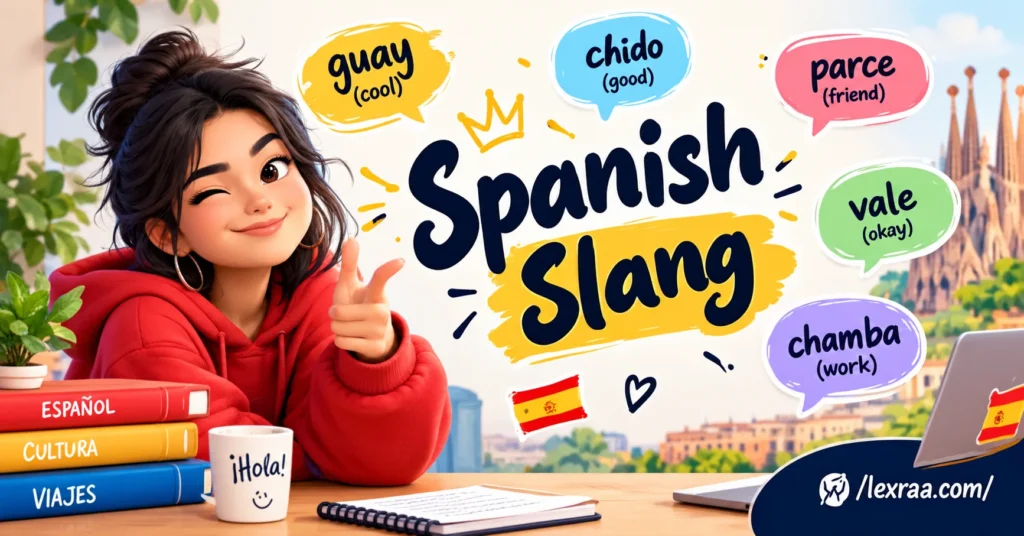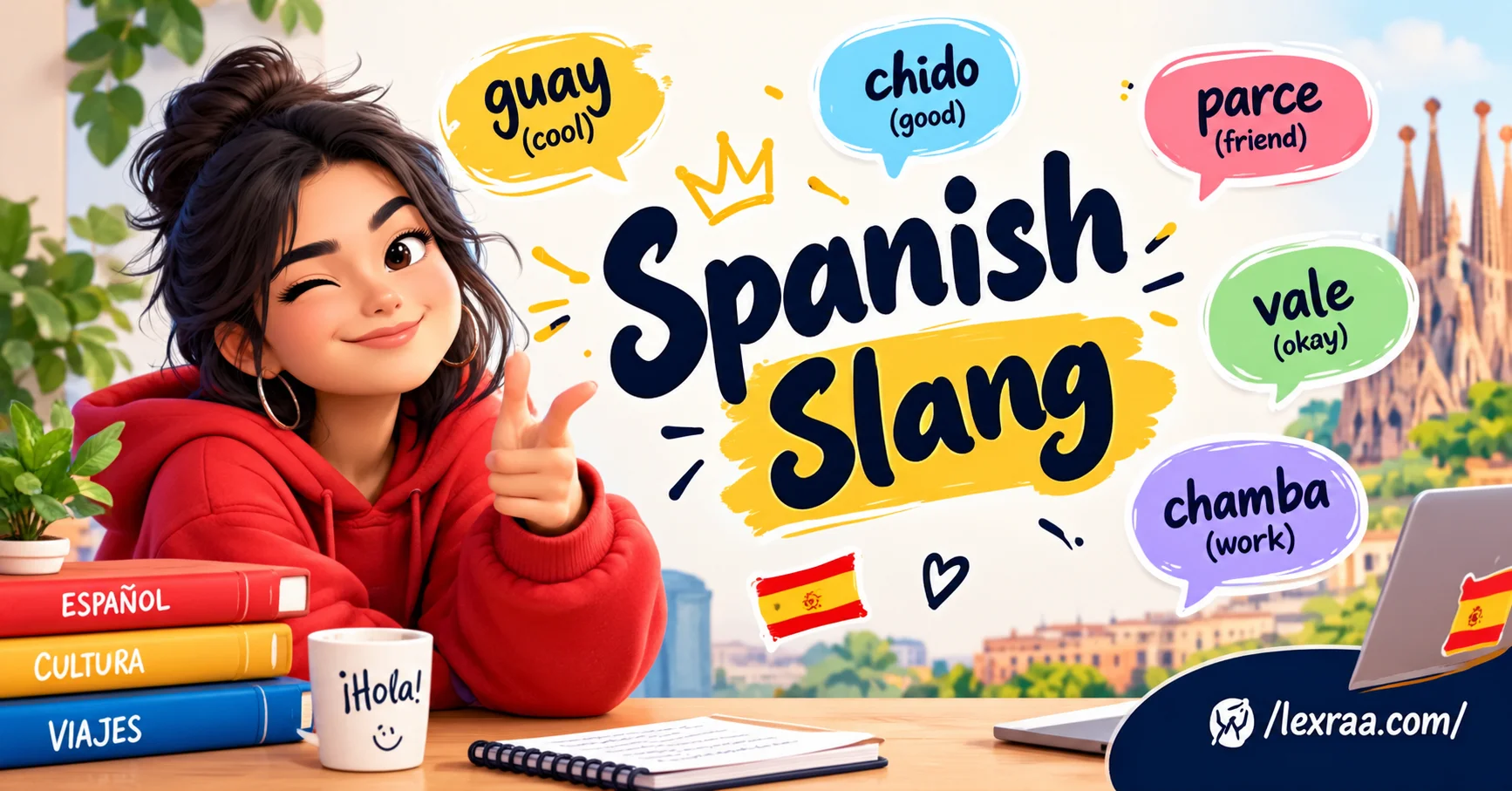
Spanish slang refers to informal words, expressions, and phrases used in everyday Spanish. It is not one fixed vocabulary: slang changes considerably between Spain, Mexico, Argentina, Colombia, Chile, and other Spanish-speaking regions, so the same idea may have several local forms.
What Does “Spanish Slang” Mean?
“Spanish slang” is a general language category, not an acronym or abbreviation.
It covers informal vocabulary and expressions that may be associated with particular countries, cities, communities, age groups, or social situations. The RAE defines jerga as specialized or familiar language used among particular groups, while the ASALE Diccionario de americanismos documents thousands of words and expressions specific to varieties of Spanish in the Americas.
Some Spanish slang is very mild:
- guay — cool/great in Spain
- chido — cool/good in Mexico
- vale — okay/alright in Spain
- chamba — work/job in several parts of Latin America
- güey — dude/friend/person in Mexican usage, with nuances depending on context
- che — an informal form of address associated especially with Argentina and Uruguay
- parce — informal friend/buddy in Colombia
These are not interchangeable just because they have similar English translations. Regional usage matters.
Spanish Slang by Region
The biggest mistake with a phrase like “Spanish slang” is treating Spanish-speaking countries as if they share one slang dictionary.
🇪🇸 Spain
Some recognizable informal Spanish from Spain includes:
guay — cool or great
vale — okay/alright
tío / tía — dude, guy, or informal way of addressing someone
currar — to work
molar — to like something or think something is cool
flipar — to be amazed or surprised
Current Spanish-learning references consistently identify these as informal expressions associated with Spain.
🇲🇽 Mexico
Mexican Spanish has its own highly recognizable informal vocabulary.
chido / chida — cool, nice, or very good
güey / wey — dude, friend, or person, depending on context
chamba — work or job
qué onda — what’s up / what’s going on
no manches — no way / you’re kidding
órale — an expression that can signal agreement, encouragement, surprise, or a prompt to act, depending on context
ASALE’s dictionary, for example, records güey with several Mexican meanings, including friend/companion and an unknown person, while chido is recorded as Mexican informal vocabulary meaning something nice or very good.
🇦🇷 Argentina and Uruguay
Rioplatense Spanish has its own recognizable informal vocabulary.
che — informal way to address someone
boludo/a — can refer to a foolish person, but can also function as a familiar form of address among friends; tone matters
laburo — work/job
piola — cool, good, or agreeable in informal usage
The word boludo, in particular, should not be translated mechanically as one English insult. Its tone can change substantially according to relationship and context. ASALE labels several of its uses as popular or vulgar and documents its use across Argentina, Uruguay, and other countries.
🇨🇴 Colombia
Colombian informal vocabulary includes expressions such as:
parce / parcero — friend or buddy
chévere — cool/great
bacano — cool or excellent
vaina — a highly context-dependent word that can refer broadly to a thing, situation, or matter
These terms should be treated as regional vocabulary rather than universal Spanish replacements.
Why Spanish Slang Changes So Much by Country
A useful way to understand Spanish slang is to stop looking for the Spanish word for something.
Take the English idea “work.”
You may encounter:
- curro in Spain
- chamba in Mexico and several other Latin American countries
- laburo in Argentina and Uruguay
- pega in Chile
These can all point toward the same general idea, but they belong to different regional speech patterns. Current Spanish-language slang guides specifically emphasize this regional variation rather than treating the expressions as universal.
This is one of the most useful things to know before using slang yourself: recognizing a word and naturally using it are two different skills.
Spanish Slang vs. Standard Spanish
Slang does not mean that the standard word is “wrong.”
For example:
trabajo → standard word for work
chamba → informal regional alternative in several Latin American varieties
curro → informal Spanish usage for work/job
laburo → informal usage especially associated with Argentina and Uruguay
The regional form adds information about setting and social context. It does not simply replace the standard vocabulary everywhere.
That distinction is especially useful for Spanish learners who encounter slang in films, music, social media, or conversations and assume that every unfamiliar word is a new dictionary definition.
A Genuine Edge Case: The Same Word Can Change Meaning by Country
Regional variation can go beyond different words for the same thing.
For example, güey has several documented Mexican uses. ASALE records it as referring to a foolish person, a close friend or companion, or an unspecified person, with different grammatical and pragmatic uses. It also records ¡güey! as a Mexican youthful expression used to call someone’s attention or express surprise.
That means an English translation such as simply “bro” can miss part of what the speaker is doing.
The same principle applies across Spanish slang: translation gives you the approximate meaning; context tells you the actual use.
5 Spanish Slang Conversations
1. Spain — Making Plans
Lucía: ¿Quedamos a las ocho?
Pablo: Vale.
Lucía: ¿En el centro?
Pablo: Sí, perfecto.
Here, vale is an informal “okay/alright.”
2. Mexico — Talking About a New Car
Ana: ¿Viste el coche nuevo de Carlos?
Luis: Sí, está bien chido.
Ana: ¿En serio?
Luis: Sí, me encanta.
Here, chido expresses approval or that something is very good. ASALE records it as Mexican popular vocabulary.
3. Argentina — Talking to a Friend
Martín: Che, ¿vamos a comer?
Sofi: Dale, tengo hambre.
Martín: ¿A la misma hora?
Sofi: Sí, obvio.
Here, che functions as an informal form of address.
4. Mexico — Asking About Work
Diego: ¿Cómo va el trabajo?
Marco: Tengo mucha chamba esta semana.
Diego: ¿Otra vez?
Marco: Sí, estoy agotado.
Chamba means work/job in several Latin American varieties, including Mexico. ASALE documents it across multiple countries with regional differences in meaning.
5. Spain — Reacting to Something Cool
Sara: Mira este video.
Álvaro: ¡Qué guay!
Sara: ¿Te gusta?
Álvaro: Mucho.
Here, guay is an informal Spanish expression associated with Spain for something cool or great.
Spanish Slang Compared With Similar Terms
| Term | Meaning | Tone | Popularity | Confusion Risk |
|---|---|---|---|---|
| Spanish slang | Informal/regional Spanish vocabulary and expressions | Casual | Very broad | — |
| Colloquial Spanish | Everyday conversational Spanish, including many informal expressions | Casual | Very broad | High |
| Regional Spanish | Spanish varieties associated with particular places | Neutral–casual | Very broad | Medium |
| Jargon | Specialized language used by a profession or group | Context-specific | Broad | Medium |
| Idioms | Fixed expressions whose meaning may not be literal | Varies | Very broad | Medium |
| Formal Spanish | Language appropriate for formal or professional situations | Formal | Very broad | Low |
One important distinction: not every colloquial expression is slang, and not every regional word is slang. The categories overlap, but they are not identical.
FAQ’s
Is Spanish slang the same in every Spanish-speaking country?
No. Spanish slang varies significantly by country and sometimes by smaller regions or social groups. Words such as guay, chido, laburo, and chamba illustrate why a slang term should be checked for regional usage rather than treated as universal.
What is the most common Spanish slang word?
There is no single objectively “most common” Spanish slang word across all Spanish-speaking countries. Frequency depends on country, region, age, and situation, which is why major slang references organize their material geographically.
What is Spanish slang for “cool”?
It depends on where the speaker is from. Guay is strongly associated with Spain, while chido is a documented Mexican term; other regions use different expressions such as chévere or bacano.
What is Spanish slang for “friend”?
There is no single universal slang equivalent. For example, güey can refer to a friend or companion in Mexican usage, while other regions have their own informal terms.
Is Spanish slang appropriate for beginners?
It is useful for beginners to understand slang, especially when watching Spanish-language media or talking with native speakers. Using it immediately is different: learn the region and tone first so you do not accidentally use a vulgar or overly familiar expression in the wrong situation.
Is Spanish slang the same as Mexican slang?
No. Mexican slang is one regional part of the much broader category of Spanish slang. Mexican Spanish has expressions such as güey, chido, chamba, and qué onda, while Spain, Argentina, Colombia, Chile, and other regions have their own vocabulary.
Why does Spanish slang sound different from textbook Spanish?
Textbooks generally prioritize widely understood or standard vocabulary, while slang develops through everyday social interaction. Informal speech can contain regional words, shortened forms, idioms, and expressions whose meaning depends heavily on context.
Conclusion
Spanish slang is not one universal list of words. It is a broad collection of informal and regional expressions that can differ sharply between Spain, Mexico, Argentina, Colombia, Chile, and other Spanish-speaking communities.
If you’re learning Spanish, don’t memorize slang only as English translations. Learn the meaning, region, tone, and situation together. That makes it much easier to understand what people actually mean—and much less likely that you’ll use a perfectly real slang word in the wrong place.