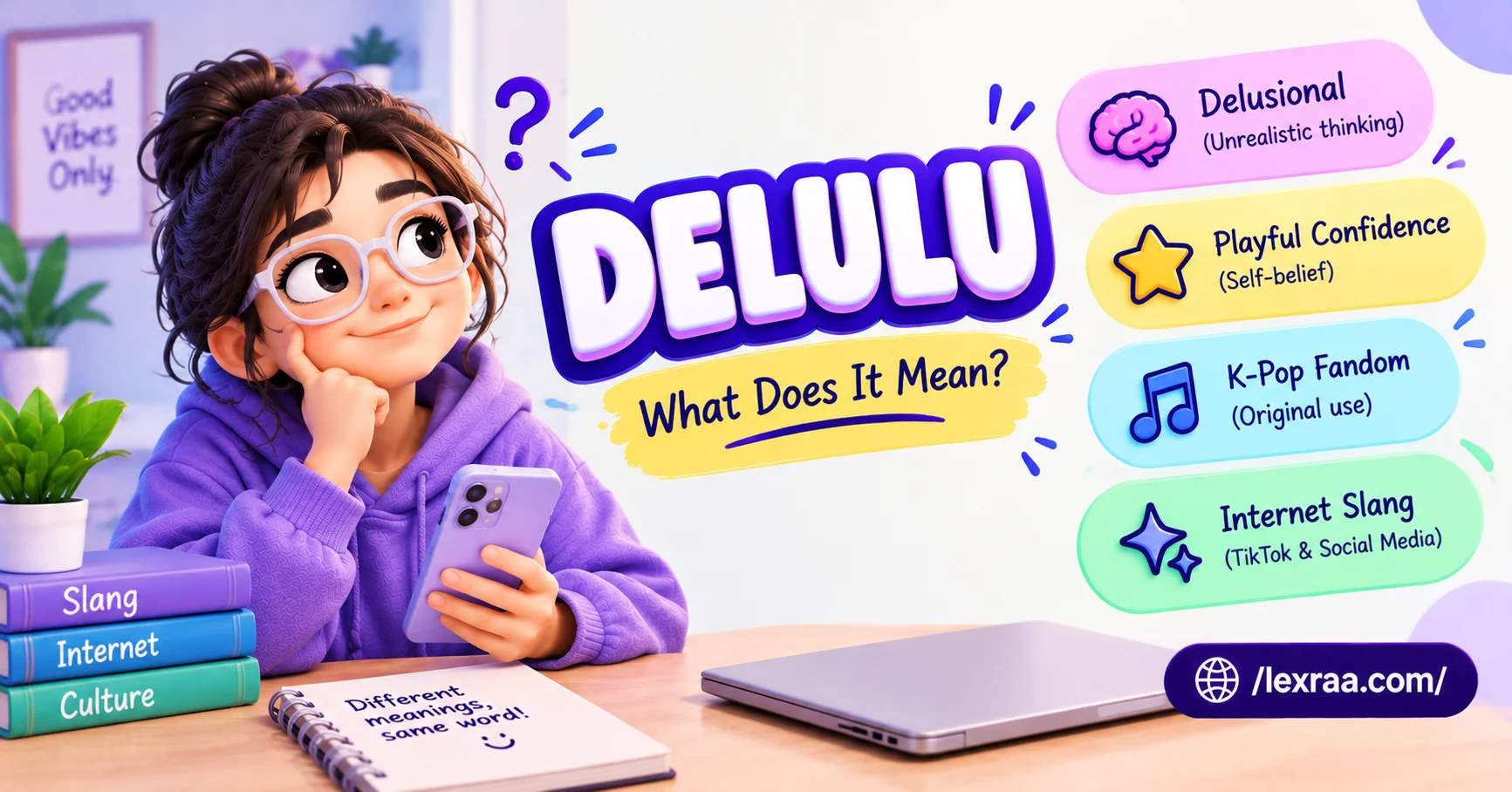
Delulu is internet slang for “delusional,” usually describing someone who believes, hopes, or imagines something unrealistic in a playful or self-aware way. It can be teasing, especially around crushes, celebrities, or impossible expectations, but it can also mean boldly believing in yourself.
What Does Delulu Mean?
“Delulu” is a shortened, playful form of delusional. It is not an acronym and does not stand for a longer phrase letter by letter.
Someone might call themselves delulu when they know their expectations are unrealistic but are choosing to enjoy the fantasy anyway.
For example:
“He liked my story, so obviously we’re getting married. I’m delulu.”
The speaker probably does not literally believe a wedding is happening. The humor comes from exaggerating a tiny piece of evidence into a wildly optimistic conclusion.
Cambridge defines delulu as slang that is often humorous and describes believing something isn’t real or true, usually because you choose to believe it. Collins similarly lists it as slang for unrealistic or mistaken beliefs and traces the word to a playful alteration of delusional.
The two main ways people use “delulu”
There are two closely related meanings worth separating:
1. Unrealistic or fantasy-based thinking
This is the older and still very common sense. Someone is “delulu” because they are convinced something will happen despite little evidence.
“She thinks her favorite actor is secretly in love with her. She’s so delulu.”
2. Playfully extreme self-confidence
In newer social-media usage, being delulu can be almost positive. Someone may deliberately convince themselves that they can achieve something unlikely.
“I’m probably delulu for applying, but I’m getting that job.”
This second sense became strongly associated with the viral phrase “delulu is the solulu,” meaning that extreme optimism or self-belief is supposedly the solution. Merriam-Webster notes this shift particularly in TikTok culture from 2023 onward.
A Common Misunderstanding About “Delulu”
A common mistake is assuming delulu always means “crazy” or that the person genuinely cannot distinguish reality from fantasy.
That’s too literal.
Online, delulu is frequently self-aware exaggeration. A person can know perfectly well that their idea is unrealistic and still call themselves delulu for comedic effect.
Compare:
- “He’s delusional.” → Can sound serious, critical, or clinical depending on context.
- “I’m delulu.” → Usually sounds lighter, humorous, exaggerated, or knowingly unrealistic.
That distinction matters because delulu is internet slang rather than a medical diagnosis. Calling someone “delulu” should not be treated as a clinical statement about their mental health.
Is Delulu Used on TikTok, Instagram, Snapchat, WhatsApp, and X?
Yes, there is strong evidence of delulu being used across social-media and online communication, but the strength of the evidence differs by platform.
TikTok
TikTok is particularly important to the modern spread of delulu. The term moved beyond K-pop fandom and became a broader internet expression during the early 2020s, with the “delulu is the solulu” trend helping give it a new, self-affirming meaning.
You might see it in:
- captions
- comments
- relationship jokes
- manifestation content
- fandom videos
- reaction videos
- “delulu era” posts
Instagram also uses delulu in captions, comments, memes, Reels, and fandom discussions. Its meaning generally remains the same rather than having a special Instagram-specific definition.
The term’s spread from K-pop communities into mainstream social media is well documented.
Snapchat
There is direct evidence of delulu appearing in Snapchat’s Spotlight ecosystem. Snapchat currently has topic pages built around “Delulu Meaning” and “What Does Delulu Mean,” showing the term being used in humorous short-form content.
X
X, formerly Twitter, has also been part of the term’s history. Documented examples of delulu appeared on Twitter/X during its earlier K-pop-fandom phase, before the term became mainstream.
There isn’t strong evidence that delulu has a special or distinct WhatsApp meaning. People can certainly use the word in private chats and group conversations, but that is different from saying WhatsApp created or uniquely popularized it.
So if someone sends:
“You’re so delulu 😂”
in a WhatsApp conversation, interpret it according to the surrounding conversation, just as you would on other messaging platforms.
Where Did Delulu Come From?
The safest answer is that delulu emerged in online K-pop fandom communities in the early 2010s, although the exact individual who coined it is not established.
Merriam-Webster describes it as emerging in the early 2010s among online K-pop fandom, while Know Your Meme documents an early example on the OneHallyu K-pop forum from April 6, 2014. That post used delulu to describe fans whose interpretations of celebrity relationships were considered unrealistic.
This history is important because the original usage was more specific than today’s TikTok meaning.
In K-pop fandom, delulu was often connected with stan culture, shipping, celebrity crushes, and parasocial relationships. A fan might be called delulu for believing an idol secretly loved them, that a celebrity interaction contained a romantic message, or that they had a realistic chance of becoming personally involved with the celebrity.
The word itself is linguistically simple: it is a clipping of “delusional” with repetition of the “lu” syllable. Wiktionary describes this as clipping plus reduplication, while Collins calls it a “reduplicative alteration” of delusional.
There is no reliable evidence that a particular individual invented the word, so claims naming one definitive creator should be treated cautiously.
There is also no strong evidence that delulu originated as AAVE slang. Its documented history points instead toward international online K-pop fandom communities.
How “Delulu” Changed Meaning
The interesting part of delulu is not simply that it became popular. Its social meaning changed.
Originally, calling someone delulu was generally a criticism. It suggested that a fan had gone too far with a fantasy about an idol or fictional relationship.
By the early 2020s, the word had escaped its K-pop niche and became a general internet expression for unrealistic thinking. Then TikTok gave it another layer: delusion could be intentionally used as a form of confidence.
That produced phrases such as:
- “delulu is the solulu” — delusion is the solution
- “may all your delulu come trululu” — a playful wish that unrealistic hopes become reality
- “delulu era” — a period of exaggerated confidence or fantasy
- “delulu land” — an imaginary or unrealistic mental space
The important distinction is that these expressions are extensions of the documented slang, not separate dictionary meanings that should be treated as completely unrelated words.
10 Natural Examples of “Delulu” in Conversation
1. Funny — Crush
Friend: He liked your Instagram story.
You: I know.
Friend: You don’t actually think that means anything, right?
You: Too late. We’re basically married. I’m delulu.
Here, delulu makes the exaggeration obviously humorous.
2. Sarcastic — Celebrity
Friend: Did you see the actor smile during the interview?
You: Yes.
Friend: He smiled at the camera, not you.
You: Let me be delulu in peace.
The speaker knowingly jokes about having an unrealistic celebrity fantasy.
3. Playful — Dating
You: He replied “haha” to my message.
Friend: That’s your evidence?
You: It’s enough for me.
Friend: Girl, you’re delulu.
The word works because both people understand the exaggeration.
4. Serious — Relationship Reality Check
Friend: I think I’m reading too much into his messages.
You: What makes you think that?
Friend: He takes hours to reply but I keep making excuses.
You: Maybe take a step back before you go fully delulu.
Here, delulu is still informal, but the underlying conversation is genuinely serious.
5. Friends — Career
Friend: I’m applying for that senior position even though I’m underqualified.
You: That’s ambitious.
Friend: I’m choosing to believe they need someone exactly like me.
You: A little delulu, but I respect it.
This reflects the newer positive sense of the word.
6. Family — Exam Results
Sibling: Did you study for the test?
You: Not nearly enough.
Sibling: And you still think you’ll get an A?
You: Absolutely.
Sibling: You’re actually delulu.
The humor comes from unrealistic confidence.
7. Group Chat — Sports
Friend 1: We haven’t won in six games.
Friend 2: This is definitely our year.
Friend 3: Based on what?
Friend 2: Nothing. I’m simply choosing delulu.
This uses the word as deliberate optimism.
8. Coworkers — Job Search
Coworker: I applied for the director role.
You: Do you meet all the requirements?
Coworker: Absolutely not.
You: Bold.
Coworker: I’m entering my delulu era.
Here, the word signals playful confidence rather than literal irrationality.
9. Fandom
Friend: The singer looked toward the crowd.
You: I think he saw me.
Friend: You were in the upper balcony.
You: Details. Let me be delulu.
This is close to the word’s original fandom context.
10. Self-Mocking
You: I made one good presentation and now I think I’m a professional speaker.
Friend: That’s a pretty big leap.
You: I know.
Friend: Delulu?
You: Extremely.
Self-directed use is one reason the term can sound less hostile than calling another person delusional.
How to Reply to “Delulu”
Your response should match whether the person is joking, flirting, or genuinely discussing an unrealistic expectation.
Funny reply
“Let me know when you return from delulu land.”
Serious reply
“Maybe, but let’s look at what actually happened before assuming.”
Flirty reply
If the conversation is already romantic:
“Maybe you’re delulu, but I’m not exactly complaining.”
Neutral reply
“Haha, maybe a little. What makes you think that?”
The safest response is usually to acknowledge the joke instead of treating delulu as a serious accusation.
Delulu vs. Similar Words
| Term | Meaning | Tone | Popularity | Confusion Risk |
|---|---|---|---|---|
| Delulu | Playfully unrealistic, fantasy-based, or excessively optimistic | Humorous, teasing, self-aware | High online | — |
| Delusional | Believing something untrue or unrealistic | More serious | Very high | High |
| Unrealistic | Not reasonably likely or practical | Neutral | Very high | Medium |
| Clueless | Lacking awareness or understanding | Casual, sometimes insulting | High | Medium |
| Naive | Lacking experience or realistic judgment | Neutral to critical | High | Medium |
| Overconfident | Having excessive confidence in one’s abilities | Critical or neutral | High | Medium |
| Realistic | Based on facts and likely circumstances | Neutral | Very high | Opposite |
The biggest distinction is between delulu and delusional. They overlap in basic meaning, but delulu usually carries a playful internet tone. Cambridge explicitly labels delulu as slang and often humorous.
Who Uses “Delulu”?
The term is strongly associated with younger internet users, particularly Gen Z, because its major mainstream explosion happened through TikTok and related social-media culture.
However, it would be inaccurate to say that only Gen Z uses it. The word has moved well beyond its original K-pop fandom and is now recognized by mainstream dictionaries, including Cambridge, Collins, and Merriam-Webster.
There is also evidence of the word crossing into mainstream public language. In 2025, Australian Prime Minister Anthony Albanese used the phrase “delulu with no solulu” in parliamentary political commentary.
There is no reliable basis for saying that delulu belongs specifically to one country, gender, or ethnic group today. Its history is much better explained through global internet culture and K-pop fandom than through a particular regional dialect.
Is “Delulu” Rude or Safe to Use?
Generally, delulu is mild internet slang rather than profanity.
It can be perfectly harmless when someone uses it about themselves:
“I’m being delulu, but I’m applying anyway.”
It can also become insulting when directed at someone who does not appreciate the joke:
“You’re completely delulu.”
The context changes the impact.
At school
It is fine in casual conversation with friends, but it is still slang. Avoid it in formal essays or academic writing unless you are specifically discussing internet language.
At work
Use caution. Among coworkers who already joke casually, it may be understood. In professional emails, reports, interviews, and formal meetings, unrealistic, overly optimistic, or another precise term is usually better.
Is it offensive?
The word itself is not a profanity or slur. But because it comes from delusional, using it to mock someone who is genuinely struggling with mental health can be insensitive.
The safest use is playful, self-aware, and clearly connected to an exaggerated situation.
Why Does “Delulu” Work So Well in Conversation?
The appeal of delulu comes partly from its sound. “Delusional” is long and serious; “delulu” is short, rhythmic, childish-sounding, and immediately feels less formal. That makes it perfect for turning an unrealistic thought into a joke without completely abandoning the underlying meaning.
It also gives people a linguistic shortcut for a surprisingly specific idea: “I know this isn’t entirely realistic, but I’m going to entertain the possibility anyway.” That is different from simply saying “I believe this.” The word communicates both the fantasy and the speaker’s awareness of the fantasy.
That self-awareness is a major reason the term transitioned from a K-pop fandom insult into a broader form of online humor and even optimistic self-talk.
Frequently Asked Questions About Delulu
Is delulu short for delusional?
Yes. Delulu is a playful shortening of “delusional.” Linguistically, it uses clipping and repetition of the “lu” syllable. It is slang rather than an acronym.
What does “I’m delulu” mean?
“I’m delulu” usually means “I know I’m being unrealistic, but I’m choosing to believe or hope for this anyway.” It can describe a crush, celebrity fantasy, career ambition, or exaggerated optimism. The self-directed version is often humorous rather than genuinely serious.
What does “delulu is the solulu” mean?
“Delulu is the solulu” is a playful phrase meaning that being unrealistically optimistic is supposedly the solution. It became strongly associated with TikTok’s positive, manifestation-style version of delulu.
Is delulu a bad word?
No. Delulu is not profanity, and it is generally mild slang. However, calling another person delulu can sound insulting if they do not understand that you are joking.
Is delulu only used for romantic relationships?
No. Romance and celebrity fandom are common contexts, but the modern word can describe unrealistic expectations about work, money, exams, sports, personal goals, popularity, or almost anything else. The positive TikTok usage especially broadened the term beyond relationships.
Is delulu a Gen Z word?
It is strongly associated with Gen Z internet culture, especially because TikTok helped popularize it. But it is not exclusively used by Gen Z, and its roots actually predate the mainstream Gen Z trend in K-pop fandom communities.
Did TikTok invent delulu?
No. TikTok helped popularize and transform the word, but it did not invent it. Documented examples place delulu in K-pop fandom communities years before its TikTok explosion.
Does delulu mean mentally ill?
No. In ordinary internet slang, delulu is generally a humorous way to describe unrealistic thinking or expectations. It should not be confused with a clinical diagnosis or used as a substitute for a mental-health term.
Conclusion
The simplest delulu meaning is “delusional,” but in a playful, exaggerated, and often self-aware way.
The word began in online K-pop fandom culture, where it was used for fans whose celebrity fantasies or shipping beliefs seemed unrealistic. It later spread into mainstream social media, especially TikTok, where delulu gained a second life as a humorous form of radical optimism and self-confidence.
If someone says, “I’m so delulu,” they may be admitting that their expectations are unrealistic while deliberately enjoying the fantasy. If someone calls another person “delulu,” it can be affectionate teasing or criticism depending on the relationship and context.
The safest rule is simple: use it casually, understand the joke behind it, and don’t treat it as a serious psychological label.