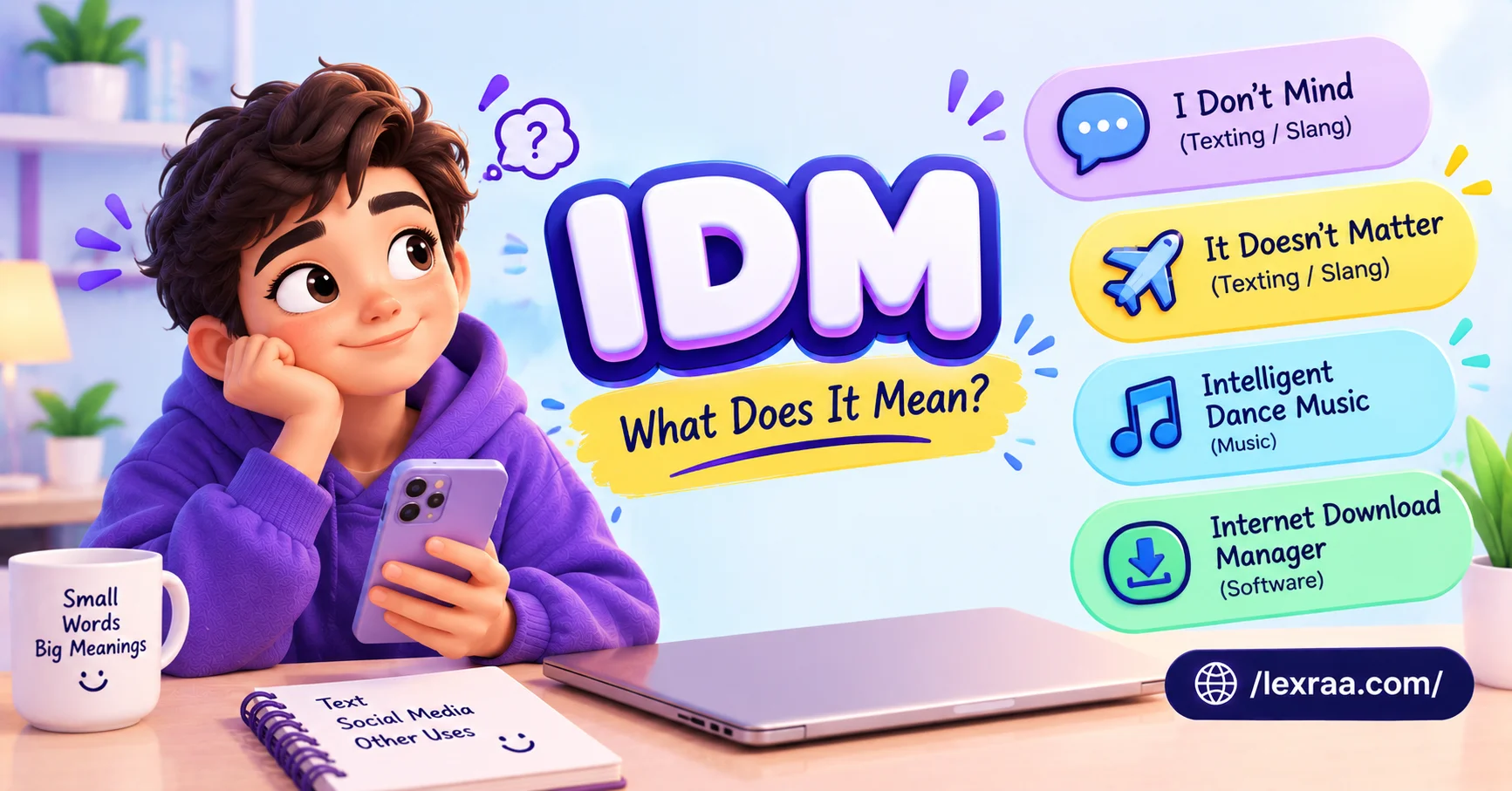
IDM usually means “I Don’t Mind” in a text message. It tells the other person that you’re okay with something, have no objection, or don’t have a strong preference. In some texting contexts, IDM also means “It Doesn’t Matter.”
What Does IDM Mean in a Text Message?
When someone sends “idm” in a text, the most established casual meaning is “I don’t mind.”
It generally communicates one of three closely related ideas:
- I’m okay with that.
- Either option is fine with me.
- I have no objection.
For example:
“Do you want pizza or burgers?”
“idm, you choose.”
The person isn’t necessarily saying they dislike both choices. They’re saying they don’t have a preference and are happy to let the other person decide.
IDM is an initialism/texting abbreviation, not a standalone slang word. Wiktionary specifically records IDM as Internet slang and text-messaging shorthand for “I don’t mind.”
IDM can express flexibility
The phrase becomes especially useful when someone wants to show they’re flexible:
“Can we meet tomorrow instead?”
“idm.”
In that situation, IDM means “I don’t mind” or “that’s okay with me.”
It can also appear after someone offers two choices:
“Coffee or tea?”
“IDM.”
The implied answer is:
“Either one is fine.”
That is why IDM is often closer to “I’m fine either way” than to a stronger statement such as “I don’t care.”
What Are the Other Real Meanings of IDM?
Texting is not the only environment where IDM appears. The letters have several established meanings, so context matters.
1. “I Don’t Mind” — texting and online chat
This is the main meaning relevant to your search.
“You can pick the movie, idm.”
Here, the speaker is saying they don’t have an objection or strong preference.
2. “It Doesn’t Matter” — informal texting
Some texting references also record IDM as “It Doesn’t Matter.” CyberDefinitions lists both “I Don’t Mind” and “It Doesn’t Matter” as texting meanings, while NetLingo specifically records “It Doesn’t Matter” as an online/text-message abbreviation.
These meanings overlap considerably:
“Which color should I get?”
“idm.”
Depending on the conversation, that could mean either:
- “I don’t mind which one you choose.”
- “It doesn’t matter to me.”
The surrounding sentence usually makes the intended sense clear.
3. Intelligent Dance Music — electronic music
In music discussions, IDM means Intelligent Dance Music, a label associated with experimental electronic music.
The term became associated with electronic music culture in the early 1990s, particularly following the 1992 Warp Records compilation Artificial Intelligence and the creation of the IDM mailing list in 1993. The label has also been criticized by artists and listeners who consider the name misleading or unnecessarily elitist.
So:
“I’ve been listening to IDM lately.”
probably isn’t a texting abbreviation at all. The person may be talking about electronic music.
4. Internet Download Manager — software
IDM is also widely used as shorthand for Internet Download Manager, software designed to accelerate and manage downloads.
Its official site describes it as a download accelerator that can resume interrupted downloads, organize files, and integrate with popular web browsers. The company says development of the software dates back to 1999.
For example:
“Download it with IDM.”
Here, the meaning has nothing to do with “I don’t mind.”
5. Other specialized meanings
IDM is also used for specialized concepts such as identity management and the intelligent design movement. These are legitimate meanings, but they aren’t normally relevant to casual texting.
For someone searching specifically for “what does IDM mean in text message?”, the practical order is:
I Don’t Mind → It Doesn’t Matter → check context for another specialized meaning.
A Common Misunderstanding About IDM
The biggest misunderstanding is treating “I don’t mind” and “I don’t care” as exact equivalents.
They’re not always the same.
Compare:
“Do you want pizza or burgers?”
“IDM.”
This normally sounds like “Either is fine.”
Now compare:
“I spent hours working on this and you didn’t even look at it.”
“IDM.”
That could sound dismissive, even though the literal expansion is still “I don’t mind.”
This is why IDC (“I Don’t Care”) can feel noticeably harsher than IDM. “I don’t mind” generally indicates a lack of objection, while “I don’t care” can imply that the subject isn’t important to the speaker.
The difference becomes particularly noticeable when IDM is sent as a one-word reply.
“idm”
can sound perfectly relaxed in a conversation about dinner, but cold in a conversation about someone’s feelings.
Where Is IDM Used?
The abbreviation is most strongly documented in casual online communication and messaging.
Snapchat
Wiktionary’s documentation of the texting meaning cites a 2022 explanation specifically describing IDM as part of the language used on Snapchat.
A Snapchat conversation might look like:
“Want to go out later?”
“idm.”
IDM is also documented as part of casual WhatsApp communication.
There is no special WhatsApp-specific meaning. It still means “I don’t mind” or, depending on context, “It doesn’t matter.”
The same abbreviation appears in Instagram DMs and other casual Instagram communication. Wiktionary’s cited usage specifically groups Instagram with Snapchat and WhatsApp.
For example:
“Should I post this pic?”
“idm, I think it looks good.”
TikTok and X
There is less reliable evidence for claiming that TikTok or X has a distinctive IDM culture or platform-specific definition.
People can obviously use the abbreviation there, but there is no reason to claim that TikTok or X created the expression or gave it a new meaning.
So the safest description is that IDM belongs to general informal internet and messaging language, with documented use in services such as Snapchat, WhatsApp, and Instagram.
Where Did IDM Come From?
There is no reliably documented single inventor of the texting abbreviation IDM.
That matters because many slang explanations present a guessed origin as if it were historical fact. The available evidence doesn’t support naming one person, one app, or one generation as the creator.
What we can establish is that IDM was documented online in the late 2000s.
Urban Dictionary has an entry dated December 31, 2009 defining IDM as “I don’t mind.” Another user-submitted entry from February 28, 2008 describes IDM as being used in gaming and chat for “I don’t mind” or “It doesn’t matter.” These entries prove that the shorthand was documented by those dates, but they don’t prove that either contributor invented it.
The formation itself is unsurprising: users took the initial letters of I Don’t Mind and turned them into a compact three-letter message.
There is also no strong evidence that IDM originated in AAVE, a particular national dialect, or a specific social-media community. It is better understood as straightforward English texting shorthand.
10 Real-World IDM Text Examples
1. Funny — Choosing Food
Maya: “Pizza or tacos?”
Lena: “idm.”
Maya: “You always say that.”
Lena: “Because I fully support letting other people make difficult decisions.”
Here IDM means there is no food preference.
2. Sarcastic — Picking a Movie
Alex: “Horror or comedy tonight?”
Chris: “idm.”
Alex: “You literally hate horror movies.”
Chris: “Fine. I mind a little.”
The final response reveals that the original IDM was playful rather than completely literal.
3. Playful — Dating
Sam: “Can I choose where we eat?”
Taylor: “idm 👀.”
Sam: “That’s suspiciously easy.”
Taylor: “I’m just trying to see what you pick.”
The abbreviation remains neutral; the surrounding exchange creates the flirtatious tone.
4. Serious — Changing Plans
Jordan: “Can we move our meeting to Friday?”
Casey: “idm, Friday works.”
Jordan: “Thanks, I appreciate it.”
Casey: “No problem.”
Here IDM clearly communicates flexibility.
5. Family Group Chat
Dad: “Should we eat at home or go out?”
Mom: “idm.”
Son: “Let’s go out.”
Dad: “Works for me.”
The abbreviation simply means the speaker has no strong preference.
6. Instagram DM
Nina: “Should I delete the Reel?”
Ava: “idm, I actually like it.”
Nina: “Really?”
Ava: “Yeah, keep it.”
Here the additional words prevent IDM from sounding like a dismissive one-word answer.
7. WhatsApp
Chris: “Can we meet an hour later?”
Dan: “idm.”
Chris: “Thanks!”
Dan: “Anytime.”
The meaning is essentially “I don’t mind; that’s fine.”
8. Workplace Chat
Employee: “Would you mind if I sent the report tomorrow morning?”
Coworker: “IDM, just make sure it’s before the meeting.”
Employee: “Will do.”
Coworker: “Perfect.”
This demonstrates that IDM can appear in an informal workplace chat even though it isn’t appropriate for formal documents.
9. Group Chat
A: “Beach or bowling Saturday?”
B: “idm.”
C: “Same.”
D: “Bowling it is.”
Both people are effectively giving up their preference and letting someone else choose.
10. When IDM Sounds Cold
Emma: “Did you like the gift I gave you?”
Ryan: “idm.”
Emma: “Oh…”
Ryan: “Wait, that came out wrong. I meant I don’t mind the gift—I actually love it.”
This illustrates why context and wording matter. A technically correct abbreviation can still communicate the wrong emotional impression.
How to Reply to IDM
Your response depends on what the sender means by it.
Funny reply
“Translation: you are officially responsible for choosing 😂.”
Serious reply
“Okay, just wanted to make sure you’re genuinely fine with it.”
Flirty reply
If the conversation is already romantic:
“You don’t mind? Good, because I already picked our place 😉.”
Neutral reply
“Okay, I’ll choose then.”
Or:
“Sounds good.”
IDM vs. Similar Texting Abbreviations
| Term | Meaning | Tone | Popularity | Confusion Risk |
|---|---|---|---|---|
| IDM | I Don’t Mind / sometimes It Doesn’t Matter | Relaxed, flexible | Moderate | Low–Medium |
| IDC | I Don’t Care | Neutral to blunt | Very high | Medium |
| IDK | I Don’t Know | Uncertain | Very high | Low |
| NP | No Problem | Reassuring, casual | Very high | Low |
| W/E | Whatever | Indifferent, sometimes dismissive | High | Medium |
| I care / I have a preference | Shows concern or a definite preference | Direct | Universal | Low |
The closest comparison is IDC, but the two aren’t interchangeable in every emotional situation.
IDM usually means:
“I’m okay with this.”
IDC can mean:
“This isn’t important to me.”
That distinction is small grammatically but significant socially.
Why “IDM” Can Sound Dry
Text removes many of the signals people normally use to communicate attitude.
When someone says aloud:
“I don’t mind!”
their voice can make it obvious whether they’re enthusiastic, relaxed, annoyed, or indifferent.
When they type:
“idm”
you only see three letters.
That is why adding a few words or an emoji can change the impression:
“idm :)”
feels warmer than:
“idm.”
And:
“idm, whatever works for you”
is clearer than simply:
“idm.”
The abbreviation isn’t inherently cold. Its brevity creates room for interpretation.
Who Uses IDM?
There isn’t strong evidence that IDM belongs exclusively to Gen Z or Millennials, and there is no reliable basis for claiming that men or women use it more.
It fits the broader tradition of online shorthand used by people who communicate through informal digital messaging.
Some slang references describe typical users broadly as adults and teenagers, but that shouldn’t be interpreted as a precise demographic study.
There is also no established US-versus-UK difference in the core texting meaning.
The important distinction is context, not age or nationality.
Someone discussing electronic music may use IDM for Intelligent Dance Music. Someone downloading a file may use IDM for Internet Download Manager. Someone replying to a friend may mean “I don’t mind.”
Is IDM Rude or Safe to Use?
IDM is not profanity and isn’t inherently offensive.
It’s generally safe in:
- Casual texts
- Friend group chats
- Instagram DMs
- Snapchat
- Informal conversations
The problem is tone, not offensiveness.
A one-word “idm” can sound dismissive when someone expects emotional engagement.
For example:
“Do you care that I’m upset?”
“idm.”
That response could be interpreted very differently from:
“I don’t mind if we talk about it.”
For school or professional communication, writing the complete phrase is usually clearer:
“I don’t mind.”
rather than:
“IDM.”
The abbreviation isn’t inappropriate because it’s vulgar; it’s simply more informal.
Why Has IDM Stuck Around?
IDM works because it solves a small but frequent communication problem: how to say “I’m okay with that” without typing the entire sentence. Its meaning is also flexible enough to cover both lack of objection and lack of preference, while the three-letter form is easy to type and recognize. At the same time, its similarity to IDC and the existence of unrelated meanings such as Intelligent Dance Music and Internet Download Manager make context essential. The abbreviation survives not because it carries a complicated hidden meaning, but because it efficiently handles a very common conversational response.
FAQ
What does IDM mean in a text message from a girl?
If someone sends “IDM” in a normal personal conversation, the most likely meaning is “I don’t mind.” It does not automatically indicate flirting, attraction, annoyance, or disinterest. The surrounding messages are much more useful for interpreting the person’s intention.
Is IDM the same as IDC?
Not exactly. IDM usually means “I don’t mind,” which often communicates that you’re okay with something or have no preference. IDC means “I don’t care” and can sound more detached or blunt depending on context.
What does IDM mean on Snapchat?
On Snapchat, IDM generally means “I don’t mind.” Wiktionary documents this texting meaning and cites Snapchat among the social platforms where the abbreviation is used.
Can IDM mean “It Doesn’t Matter”?
Yes. Some texting references document “It Doesn’t Matter” as another meaning of IDM. The two meanings overlap, so the surrounding conversation usually determines which expansion sounds more natural.
Does IDM mean “I don’t care”?
Not exactly. “I don’t mind” usually suggests that something doesn’t bother you, while “I don’t care” can communicate stronger indifference. In everyday texting, the two can sometimes overlap, but IDM generally sounds softer.
What does IDM mean in music?
In music, IDM means Intelligent Dance Music, a term associated with experimental electronic music that emerged in the early 1990s. It is unrelated to the texting abbreviation “I don’t mind.”
What does IDM mean on a computer?
In computing conversations, IDM commonly refers to Internet Download Manager, software used to manage and accelerate downloads. The official software site uses IDM as the abbreviation throughout its documentation.
Is IDM okay to use at work?
It can be acceptable in an informal workplace chat with people you already communicate casually with. For formal emails, reports, applications, or professional documents, writing “I don’t mind” or “That works for me” is clearer and more polished.
Conclusion
If someone asks “what does IDM mean in text message?”, the answer to start with is “I Don’t Mind.”
It usually tells you that the person is okay with something, has no objection, or doesn’t have a strong preference. “It Doesn’t Matter” is another documented texting interpretation, although the exact meaning depends on context.
IDM isn’t inherently rude, vulgar, or offensive. The main issue is that a very short reply can sometimes sound colder than the sender intended, especially in an emotional conversation.
And remember that IDM has completely unrelated meanings. In music, it can mean Intelligent Dance Music, while in software discussions it can mean Internet Download Manager.
So when you see “idm” in a personal text, read it as “I don’t mind” first. Then let the conversation decide how warm, neutral, or dismissive the response actually is.