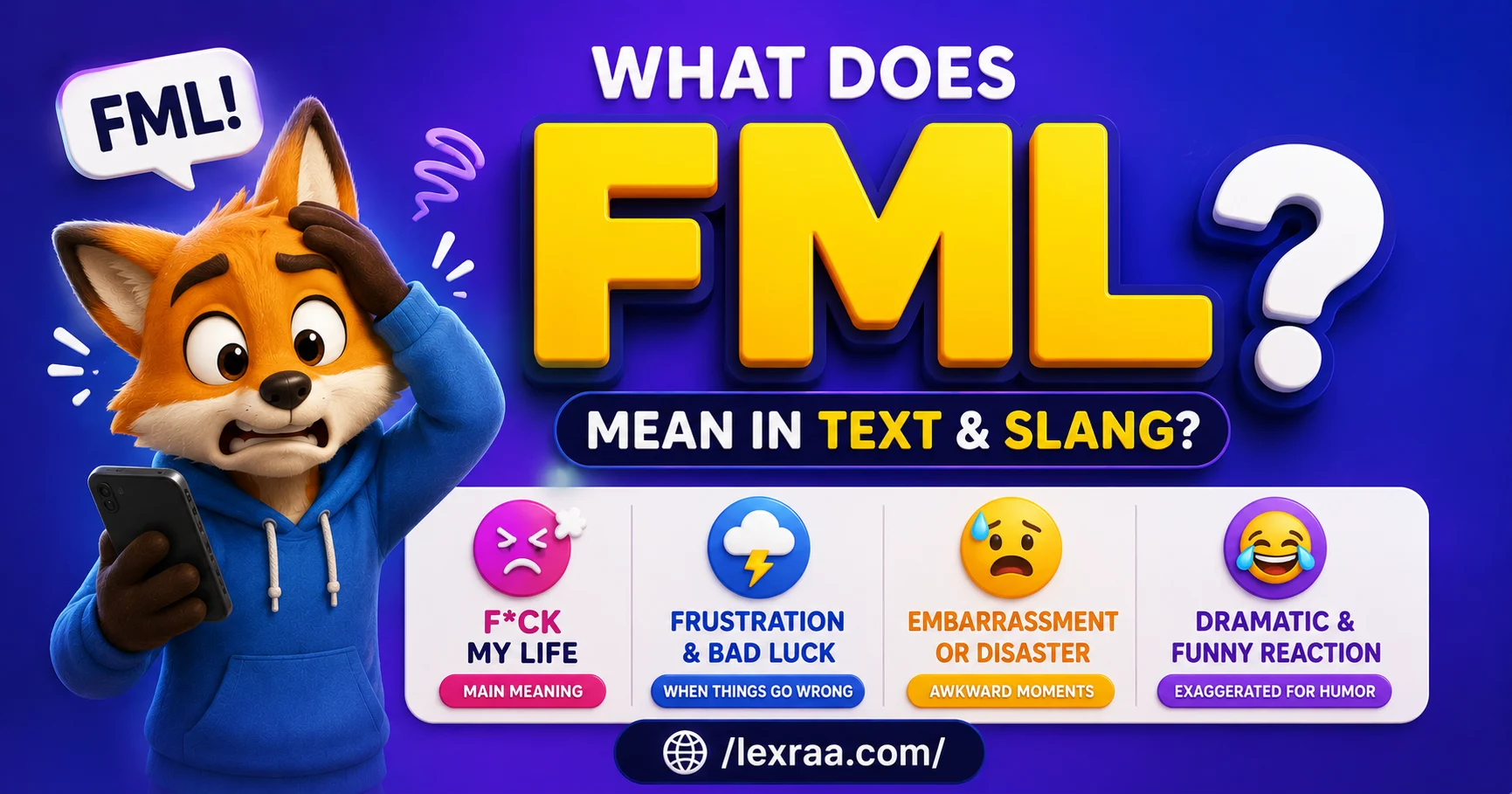
FML usually means “fuck my life.” It is an informal internet initialism people use after something frustrating, embarrassing, disappointing, unlucky, or unexpectedly awful happens. Depending on the situation, it can be genuinely annoyed or deliberately dramatic and funny.
For example, if someone studies all night and then discovers the exam was postponed until next week, they might text, “FML.” The phrase is essentially a compact way of saying, “Seriously? Why is this happening to me?”
What Does FML Mean?
In texting and internet slang, FML = “fuck my life.” Dictionaries classify it as an informal or offensive abbreviation/initialism because the full phrase contains profanity.
It is usually a reaction rather than a literal statement about someone’s entire life. A person might use FML over something as small as dropping their lunch or missing a bus. In those situations, the expression is intentionally exaggerated for comic effect.
Compare these:
- “I forgot my wallet at home. FML.”
- “My laptop crashed before I saved the project. FML.”
- “I have to work Saturday again. FML 😭”
- “I accidentally sent that private message to the group chat. FML.”
The surrounding situation tells you how seriously to interpret it.
FML is an initialism, not a normal word
Technically, FML is an initialism because its letters represent the initial letters of fuck my life. In casual conversation, however, people usually encounter it in written form rather than as a spoken word.
Merriam-Webster describes FML as an internet-popularized abbreviation, while Wiktionary classifies the slang use as an initialism used to express despairing annoyance.
The Different Ways People Use FML
FML does not always carry exactly the same emotional weight. The same three letters can sound very different depending on what happened immediately before them.
1. Frustration
This is probably the most straightforward use.
“The printer stopped working five minutes before my presentation. FML.”
Here, FML means something like “This is incredibly frustrating.”
2. Bad luck
Someone can use it when several unlucky events happen close together.
“Missed my bus, dropped my phone, and now it’s raining. FML.”
The person is summarizing a streak of bad luck rather than making a serious statement about their life.
3. Embarrassment
FML also works after an awkward mistake.
“I waved back at someone who wasn’t waving at me. FML.”
The humor comes from turning a small social mistake into a dramatic disaster.
4. Self-deprecating humor
Sometimes FML is almost a punchline.
“I spent 20 minutes looking for my phone. It was in my hand. FML.”
In this use, the speaker is mostly laughing at themselves.
5. Genuine distress
Not every use is a joke. If someone sends FML after describing losing a job, receiving serious bad news, or going through a difficult personal situation, it may signal real frustration or emotional exhaustion.
That is why replying to a standalone “FML” with a joke is not always the best choice. The safest first response can simply be, “What happened?”
Read More: Brainrot Slang Meaning: What Does Brainrot Mean?
A Common Misunderstanding About FML
A common mistake is assuming that FML always means the person is seriously miserable or hates their entire life.
Usually, it does not.
The expression is often deliberately hyperbolic. Someone can say “FML” because their coffee spilled, their Wi-Fi stopped working, or they forgot their headphones. In those situations, the speaker is exaggerating a minor problem for humor.
At the same time, you should not automatically dismiss it as a joke. Context matters, particularly when someone is talking about a genuinely serious event.
Another misconception is that FML is simply a modern TikTok expression. It is much older than TikTok and became recognizable during the earlier era of blogs, forums, social networking, and texting.
FML on TikTok, Instagram, Snapchat, WhatsApp, and X
FML is not a platform-specific abbreviation. Its basic meaning remains “fuck my life” wherever it appears.
Current usage references show it in texts and social media, and examples can be found in Instagram, TikTok, Snapchat, WhatsApp, and X-related conversations. However, there is no evidence that these platforms have their own special definition of FML. It is simply borrowed internet slang used within informal communication.
FML on TikTok
On TikTok, FML can appear in captions, comments, or text accompanying a story about an embarrassing or unlucky moment. It often works as a quick reaction to a relatable failure.
FML on Instagram
On Instagram, it can appear in captions, comments, Stories, or DMs. Dictionary.com specifically notes that FML has appeared on social-media sites such as Twitter and Instagram, including hashtagged forms like #FML.
FML on Snapchat
On Snapchat, the meaning is generally the same. Someone might add FML to a Snap showing a broken phone, failed meal, bad weather, or another annoying event.
FML on WhatsApp
WhatsApp conversations can use FML in exactly the same way as ordinary texting:
“My train got cancelled again. FML.”
It is particularly natural in casual conversations with friends, although the profanity still makes it inappropriate for some professional or formal chats.
FML on X
FML has also appeared in Twitter/X-style posts, where short expressions and hashtags fit naturally into brief updates. The meaning does not change simply because the message is posted publicly.
Where Did FML Come From?
This is where it is important to separate the history of the phrase from the history of the abbreviation.
The exact person or moment that first coined “fuck my life” is unclear. Dictionary.com identifies May 13, 2005, as the earliest known Urban Dictionary submission defining FML as “fuck my life,” but also explicitly notes that this does not prove the contributor invented the expression.
The phrase itself was already appearing in popular culture by the late 2000s. Dictionary.com points to a 2007 use in the film Superbad, where the full expression appears rather than simply the three-letter abbreviation.
A major turning point came with FMyLife, an English-language website built around people sharing unfortunate, embarrassing, and unlucky experiences. The site’s own FAQ says its roots go back to an IRC channel in France, which developed into a microblog in January 2008 before becoming the FMyLife site. Its characteristic format involved stories beginning with “Today” and ending with “FML.”
The website was connected to the French Vie de merde (VDM) concept, roughly meaning “life of shit.” FMyLife adapted that idea for English-speaking audiences, helping make FML highly recognizable online.
So it would be inaccurate to say that FMyLife invented FML. The abbreviation was documented before the website, and the website itself helped popularize and reinforce the expression.
There is also no solid evidence that FML originated specifically in AAVE, Gen Z speech, or one particular American regional community. The reliable history points more broadly to internet and informal English usage.
10 Natural FML Conversations
1. Funny — Friends
Maya: “I spent an hour looking for my glasses.”
Leo: “Where were they?”
Maya: “On my face.”
Leo: “FML for you 😂”
Here, FML is being used humorously to exaggerate a harmless mistake.
2. Sarcastic — Group Chat
Sam: “Guess who has to present first tomorrow?”
Nora: “Not me.”
Sam: “Me.”
Nora: “FML 😭”
The reaction is exaggerated because the speaker is unhappy about presenting first.
3. Playful — Dating
Alex: “I finally planned our date.”
Jamie: “Nice. Where are we going?”
Alex: “The restaurant is closed today.”
Jamie: “FML 😂 Try again.”
The expression makes the disappointment sound playful rather than genuinely serious.
4. Serious — Work
Daniel: “Did you finish the report?”
Chris: “Almost. My laptop crashed.”
Daniel: “Did you save a copy?”
Chris: “No. FML.”
Here, the phrase carries genuine frustration.
5. Family Text
Mom: “Did you remember your passport?”
Son: “I remembered everything except that.”
Mom: “You have got to be kidding.”
Son: “FML. I’m turning around.”
The phrase adds frustration to an otherwise ordinary family exchange.
6. Instagram Comment
Ava: “Posted my graduation pictures and noticed my shirt was inside out.”
Lena: “NO 😭”
Ava: “I didn’t notice until three hours later.”
Lena: “FML is the only possible caption.”
This is a humorous public use where the embarrassing detail becomes the joke.
7. Snapchat
Ryan: “Bro, I just dropped my phone.”
Eli: “Is it okay?”
Ryan: “Screen is completely cracked.”
Eli: “FML 💀”
The abbreviation summarizes the bad luck without requiring a long explanation.
8. WhatsApp
Nadia: “Are you still coming?”
Sara: “Was about to leave.”
Nadia: “What happened?”
Sara: “Locked myself out. FML.”
Here, FML acts as a quick emotional reaction to an immediate problem.
9. Gaming Chat
Player 1: “We were one point away.”
Player 2: “And then?”
Player 1: “My internet disconnected.”
Player 2: “FML 💀”
In gaming conversations, FML can emphasize the frustration of losing because of circumstances outside the player’s control.
10. Everyday Bad Luck
Ben: “Got coffee this morning.”
Tom: “Nice.”
Ben: “Spilled it on my laptop five minutes later.”
Tom: “Oh no.”
Ben: “FML.”
This is one of the simplest and most recognizable uses.
How Should You Reply to FML?
The best response depends on whether the person is joking or genuinely upset.
Funny reply:
“Congratulations, you’ve unlocked today’s disaster achievement.”
Serious reply:
“Okay, what happened? Are you alright?”
Flirty reply:
“Sounds like you need someone to make your day better 😉”
Neutral reply:
“Yikes. What happened?”
If the person has just described something genuinely painful, choose the serious or neutral response instead of making fun of the situation.
FML vs. Similar Slang
| Term | Meaning | Tone | Popularity | Confusion Risk |
|---|---|---|---|---|
| FML | Fuck my life; frustration/bad luck | Frustrated, dramatic, humorous | High | Low |
| SMH | Shaking my head | Disappointed, amused, critical | High | Medium |
| WTF | What the fuck | Shock, disbelief, anger | High | Medium |
| OMG | Oh my God | Surprise, excitement, shock | Very high | Low |
| HML | Hate my life | Negative/frustrated | Lower | Medium |
| LML | Laughing mad loud / love my life, depending on context | Humorous or positive | Lower | High |
| FTW | For the win | Positive, celebratory | Established | Low |
The most useful distinction is between FML and HML. Both can describe dissatisfaction, but FML is much more strongly associated with the established phrase “fuck my life,” while HML literally uses “hate my life” and is less standardized.
FML and SMH are also easy to confuse because both can appear after something goes wrong. SMH focuses more on disbelief, disappointment, or shaking one’s head at a situation, while FML focuses on the speaker’s feeling that their own circumstances have gone badly.
Who Uses FML?
FML is not limited to one age group. Its history stretches back to the early internet era, and it has continued into newer social-media and messaging environments. Babbel describes it as being used by Millennials and Gen Z, while dictionary evidence confirms its broader presence in texting and social media.
It is better understood as established internet slang than as a term belonging exclusively to Gen Z. Older users may recognize it because it became prominent online well before today’s short-video platforms became dominant.
There is also no strong evidence that FML has a substantially different meaning in American versus British English. Collins lists the same slang expression in British English, describing it as an abbreviation used particularly in social media and text messages.
Is FML Rude or Safe to Use?
FML contains profanity. Cambridge Dictionary explicitly labels the expression offensive, while Collins calls the underlying phrase a taboo expression.
That does not mean it is automatically insulting toward another person. Usually, the profanity is directed at the speaker’s own situation rather than at a specific individual.
Still, FML is best kept to informal settings such as:
- Close-friend chats
- Casual group chats
- Informal social-media posts
- Memes
- Personal texting
It is generally better to avoid the full expression in:
- School assignments
- Formal emails
- Job applications
- Professional reports
- Customer communication
- Messages to people you do not know well
A useful clean alternative is “ugh,” “what a day,” “my luck,” “this is awful,” or “well, that went badly.”
Why Does FML Work So Well in Conversation?
FML survives because it compresses a surprisingly complicated reaction into three letters. Instead of explaining frustration, embarrassment, bad timing, and self-directed humor separately, the speaker can attach FML to the end of a story and let the reader infer the emotional punchline. Its usefulness is also helped by its flexibility: the same abbreviation can describe a genuinely terrible day or something as trivial as dropping a cookie, with context and tone doing most of the interpretive work. The FMyLife format strengthened this storytelling function by repeatedly pairing everyday misfortune with the same short ending.
Frequently Asked Questions
What does FML mean in text?
FML usually means “fuck my life.” It is used after something frustrating, embarrassing, disappointing, or unlucky happens. The tone can be serious, sarcastic, or humorous depending on the situation.
What does FML mean from a girl or guy?
There is no special male or female meaning of FML. Whoever sends it is generally expressing frustration or bad luck. The meaning comes from the situation, not the sender’s gender.
Does FML always mean something serious?
No. FML is very often exaggerated for humor. Someone might write it because they missed a bus or spilled coffee, while another person might use it after a genuinely difficult event. The surrounding message tells you which interpretation makes sense.
Is FML a swear word?
The abbreviation itself represents the profane phrase “fuck my life,” so it carries profanity even when the letters are used instead of the full words. Cambridge categorizes the expression as offensive.
What does FML mean on Instagram?
On Instagram, FML generally has the same meaning: “fuck my life.” It can appear in captions, comments, Stories, or messages when someone is describing bad luck or an embarrassing situation. There is no separate Instagram-specific definition.
What does FML mean on WhatsApp?
On WhatsApp, FML usually means “fuck my life.” Someone may use it after telling a friend about an annoying or unlucky event. It is informal slang rather than a WhatsApp-specific abbreviation.
Is FML older than TikTok?
Yes. FML became established online during the 2000s, with an early documented Urban Dictionary entry dating to 2005 and the FMyLife website helping popularize the expression in the late 2000s. TikTok came much later.
What is the opposite of FML?
There is no single universally accepted direct opposite. FTW (“for the win”) can provide a useful positive contrast because it celebrates a successful outcome, but it is not a literal antonym. LML (“love my life”) has also been used as a positive counterpart to FML, although its meaning is less standardized.
Final Thoughts
When you see FML in a text, comment, caption, or group chat, the safest interpretation is “fuck my life.” It usually means that something has gone wrong and the person is expressing frustration, bad luck, embarrassment, or exaggerated self-pity.
The important part is the context. “FML” after a broken phone may be funny; “FML” after serious personal news may be a genuine expression of distress. The abbreviation is old enough to predate today’s major social platforms, and although its exact original coinage is unclear, its internet history and later popularization are well documented.
If you use it yourself, remember that the underlying phrase contains profanity. It works naturally among people who are comfortable with casual slang, but a cleaner expression is preferable in school, work, and formal communication.