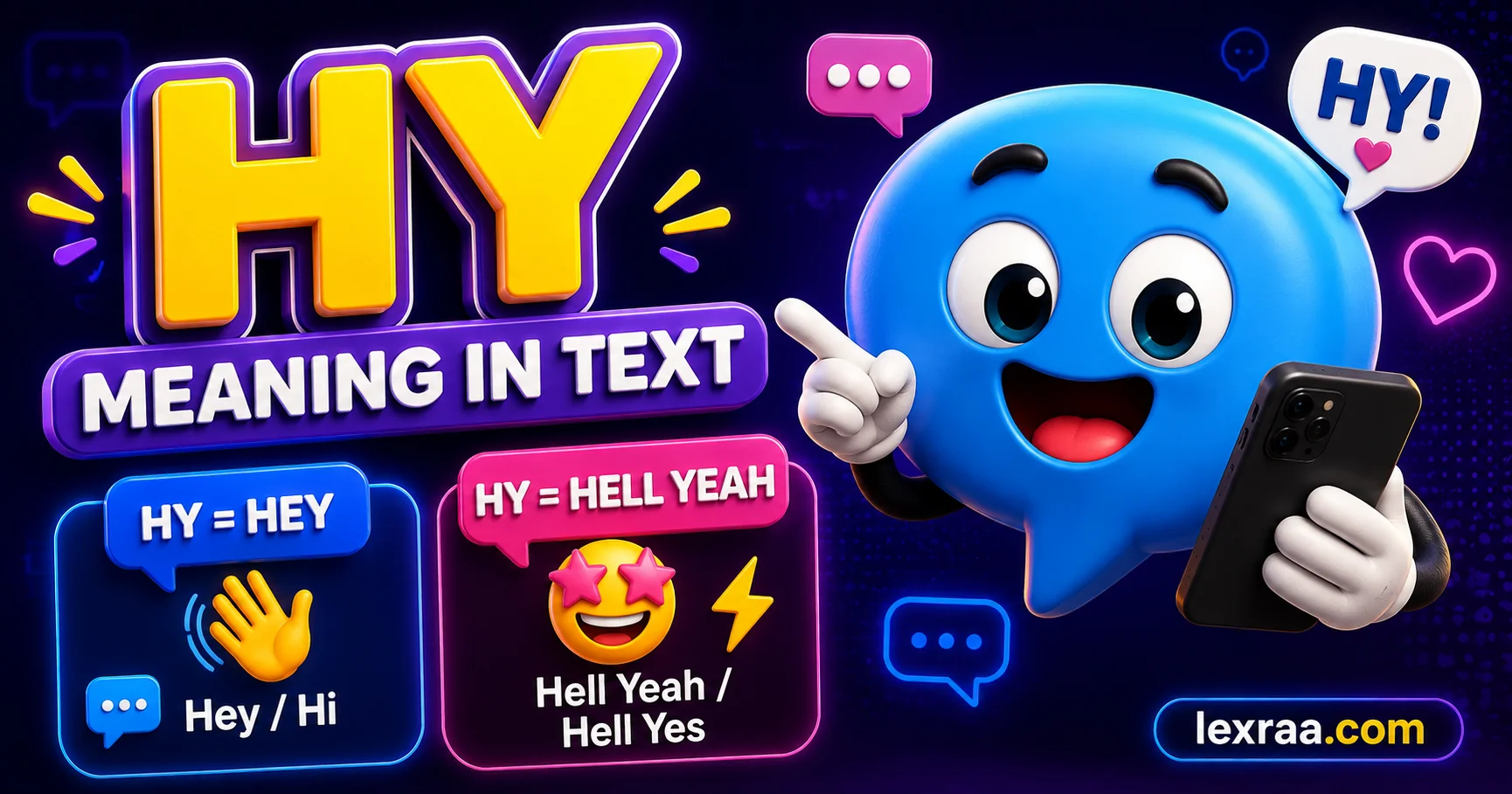
If someone texts “HY,” context matters. It can be used as a casual “hey/hi” greeting or as shorthand for an enthusiastic “hell yeah/hell yes.” The tricky part is that online sources disagree about which meaning is most common, so the surrounding message is the best guide.
The most useful way to decode HY
Rather than treating HY as a fixed acronym, look at its position in the conversation:
- “hy, what are you doing?” → almost certainly hey/hi
- “You coming tonight?” “HY!” → likely hell yeah/hell yes
- “HY 😏” → probably a greeting, with the emoji potentially making it playful or flirty
- “That concert was insane!” “HY it was” → enthusiastic agreement is the likely reading
A review of current top-ranking explanations shows a genuine split: some sources present “Hey” as the primary meaning, while others lead with “Hell Yeah.” That disagreement is important, because it means an article should not confidently claim that one interpretation is universal.
What HY Really Means—and What It Does Not
The strongest evidence supports two practical meanings in casual text conversations:
- HY = Hell yeah / hell yes — an enthusiastic yes or strong agreement.
- hy = hey / hi — a casual greeting, often functioning more like an informal spelling or shorthand than a strict acronym.
A slang reference such as Cyber Definitions lists “Hell Yes” as the texting definition and explicitly notes that HY is relatively uncommon and can mean something else. Meanwhile, current usage discussions and competing meaning guides document hy as a greeting in some conversations.
That distinction leads to a more accurate answer than the usual “HY always means X” explanation.
HY = “Hell Yeah” or “Hell Yes”
When HY appears as a response, particularly to a question, invitation, suggestion, or exciting statement, this is usually the most sensible interpretation.
Example:
“Want to get pizza after the game?”
“HY!”
Translated naturally, that means:
“Hell yeah!”
The abbreviation expresses more energy than a plain yes. It can signal excitement, strong agreement, approval, or eagerness.
Real online discussion also shows people interpreting HY this way in ordinary conversations, although the evidence is informal and should not be treated as proof that every speaker uses it identically.
hy = “Hey” or “Hi”
When hy appears at the beginning of a message and is followed by a question or statement, it often functions as a casual greeting.
Example:
“hy, are you free later?”
Here, reading HY as hell yeah would make no grammatical sense. The intended meaning is almost certainly similar to:
“Hey, are you free later?”
This use may also simply be an informal spelling choice rather than a carefully constructed abbreviation. That is one reason you should not assume that every lowercase hy represents the same slang term as uppercase HY.
The Best Clue Is Where HY Appears
One of the most useful details missing from many articles is sentence position.
You can often decode HY without knowing anything about the sender’s age, gender, or preferred app.
| Where HY appears | Most likely interpretation |
|---|---|
| At the start: “hy, what’s up?” | Hey / Hi |
| As a one-word reply: “HY!” | Hell yeah / Hell yes |
| After an invitation: “HY, let’s go” | Enthusiastic agreement |
| Before a question: “hy, you awake?” | Hey / Hi |
| After exciting news: “HY!!!” | Hell yeah |
| Alone, with no context | Ambiguous—ask if necessary |
This is not a perfect rule, but it is more useful than claiming that one platform has a completely different definition.
Is HY an Acronym, Abbreviation, or Just Slang?
When it means “Hell Yeah” or “Hell Yes,” HY is an initialism or abbreviation formed from the first letters of the words.
When someone writes “hy” to mean “hey” or “hi,” the situation is less formal. It behaves more like a texting spelling variant or shortcut than a universally standardized abbreviation.
That difference matters because the internet often treats all short forms as “acronyms.” Linguistically, they do not all work in exactly the same way.
A Common Misunderstanding: HY Is Not Automatically Flirting
Receiving “hy” from someone you like can make two letters feel suspiciously important.
But HY by itself does not prove romantic interest.
Compare:
“hy, did you get the homework?”
That is probably just a greeting.
Now compare:
“hyyy 😏 you awake?”
The extra letters, emoji, timing, previous conversation, and relationship may make the second message feel more playful or flirtatious.
The key point is that the flirting comes from context, not from the letters HY alone. It would be misleading to claim that HY means one thing “from a guy” and another “from a girl.”
Where Did HY Come From?
The honest answer is: there is no reliably documented single origin for HY as modern text slang.
Many current articles claim that it began in AOL, Yahoo chatrooms, early SMS culture, or a particular decade. However, those origin stories are often presented without verifiable primary evidence. I would not treat them as established history.
What can be said more carefully is that HY fits a broader pattern of informal digital shortening. As instant messaging and mobile texting encouraged shorter, faster messages, existing phrases such as “hell yeah” could naturally be reduced to initials, while informal spellings such as “hy” could be used as greetings.
The underlying phrase “hell yeah” also existed in spoken English long before social media. The exact person, platform, or moment that turned it into HY is unclear.
So the most accurate origin is:
HY developed organically as informal written shorthand; a precise first use or single inventor cannot be confirmed from reliable evidence currently available.
That is less dramatic than a neat “it started on AOL in 2002” story, but it is more honest.
Which Apps Is HY Used On?
HY is not a platform-specific feature or official abbreviation. It is ordinary user-created shorthand, so the meaning generally travels with the conversation.
Current slang guides and examples associate it with texting, Snapchat, Instagram, TikTok, and other online chats, but hard comparative evidence about exactly where it is most popular is limited.
Text Messages
In ordinary texting, both meanings are possible.
Greeting:
“hy, sorry I missed your call”
Enthusiastic reply:
“You got tickets?”
“HY!!”
Snapchat
HY can work as either a fast greeting or an enthusiastic reply. The conversation itself is more useful than the app name when decoding it.
In DMs and comment-style conversations, hy may open a conversation, while HY can react enthusiastically to something someone says.
TikTok
HY can appear in conversational comments or messages as general internet shorthand. There is not strong evidence that TikTok created a unique meaning for it.
The same principle applies. Someone may use hy as a quick hello or HY as an excited agreement, depending on the conversation.
X
HY can theoretically appear in replies and informal posts, but there is no strong basis for claiming a special X-specific meaning.
Bottom line: HY belongs to informal digital communication more than it belongs to any one app.
10 HY Conversation Examples in Different Situations
The examples below show how context changes the meaning.
1. Funny: Friends Making Plans
Maya: I found a restaurant that serves dessert first.
Leo: HY. That’s the kind of responsible decision-making I support.
Maya: So we’re going?
Leo: Obviously.
Here, HY = hell yeah.
2. Sarcastic: A Friend Catches a Mistake
Nina: You said you were “five minutes away” an hour ago.
Eli: HY, technically I was five minutes away at some point.
Nina: That’s not how time works.
Eli: Details.
The sarcastic tone comes from the rest of the message, not from HY itself.
3. Playful: Starting a Conversation
Ari: hyyy 👀
Sam: hy lol, what’s with the eyes?
Ari: I have a proposal.
Sam: This already sounds dangerous.
Here, hyyy functions as a playful greeting.
4. Serious: Checking In
Jamie: hy, are you okay? You seemed quiet earlier.
Morgan: Yeah, just had a rough day.
Jamie: Want to talk about it?
Morgan: Maybe later. Thanks for asking.
In this context, hy = hey.
5. Family Group Chat
Sibling: Who wants to help Mom move furniture tomorrow?
You: HY, but I’m claiming the easy boxes.
Sibling: You mean the pillows?
You: Exactly.
HY means enthusiastic agreement.
6. Dating Conversation
Riley: hy, you still awake?
Casey: Barely. You?
Riley: Same. Couldn’t sleep.
Casey: Then tell me something interesting.
The greeting itself is neutral. The conversation may become flirtatious, but HY does not create that meaning by itself.
7. Coworkers in an Informal Chat
Chris: Want to grab coffee before the meeting?
Dana: HY. I need it today.
Chris: Same. Five minutes?
Dana: Deal.
This works in a casual coworker relationship, though it is too informal for a formal work email.
8. Gaming Chat
Player 1: Rematch?
Player 2: HY. I need redemption.
Player 1: You need better aim.
Player 2: Rude.
HY means hell yeah.
9. Group Chat Excitement
Tara: The teacher canceled tomorrow’s test.
Ben: HY!!!!
Omar: Best news I’ve heard all week.
Tara: Suddenly everyone loves school announcements.
The exclamation marks reinforce the enthusiastic meaning.
10. When HY Is Ambiguous
Alex: HY
Jordan: Hey… or hell yeah? 😂
Alex: Hey. I was just saying hi.
Jordan: See? Context matters.
When there is no surrounding information, asking is sometimes easier than guessing.
How to Reply to HY
Your reply should match the meaning.
If HY Means “Hell Yeah”
Funny reply
“That’s the level of enthusiasm I was hoping for.”
Serious reply
“Great. I’ll send you the details.”
Playful or flirty reply
“I knew you’d say yes 😉”
Only use this if the conversation already has that kind of tone.
Neutral reply
“Awesome, see you then.”
If HY Means “Hey”
Funny reply
“Well, hy there 👋”
Serious reply
“Hey. What’s up?”
Playful or flirty reply
“Hyyy. Took you long enough 😏”
Neutral reply
“Hey! How are you?”
HY Compared With Similar Terms
| Term | Meaning | Tone | Popularity | Confusion Risk |
|---|---|---|---|---|
| HY | Hell yeah/hell yes; sometimes hey/hi | Energetic or casual | Less universal than major abbreviations | High |
| YH / YEAH | Yes or agreement | Neutral to casual | Common | Low |
| YAS | Enthusiastic yes | Playful, expressive | Common in internet culture | Low |
| FR | For real | Agreement or emphasis | Very common online | Medium |
| BET | Okay, agreed, understood | Confident and casual | Common slang | Medium |
| NAH | No / disagreement | Casual | Very common | Low |
For an approximate opposite to HY = hell yeah, nah is useful when rejecting or disagreeing with something:
“Want to wake up at 5 a.m. for a run?”
“Nah.”
It is not a formal antonym, but it often performs the opposite conversational function.
Who Uses HY?
There is not enough reliable demographic evidence to assign HY exclusively to Gen Z, Millennials, or any specific region.
Some slang sources associate the term with younger internet users, while the underlying phrase hell yeah is much older and widely understood in informal English. It would therefore be inaccurate to say that HY belongs only to Gen Z.
The safer conclusion is that HY is most at home in informal, fast-moving digital communication. People familiar with online shorthand are more likely to recognize it, while others may interpret it as a greeting, typo, or something entirely different.
There is also no reliable basis for claiming that HY has a different meaning depending on the sender’s gender.
Is HY Rude, Offensive, or Safe?
HY itself is not inherently offensive.
However, if you are using it for “hell yeah,” remember that it represents a phrase containing “hell.” Many people consider that mild language rather than serious profanity, but workplace, school, family, and cultural standards vary.
For casual chats with friends, HY is generally harmless.
Avoid relying on it when:
- writing a professional email
- communicating with a client
- sending an important school message
- discussing something serious or sensitive
- clarity is especially important
A manager asking whether you completed an important task probably deserves “Yes, I’ve completed it” rather than “HY.”
Why HY Works So Well in Conversation
The useful thing about HY is that two letters can do two different conversational jobs: open an interaction or amplify a reaction. When it means hey, it acts as a low-effort doorway into a conversation. When it means hell yeah, it compresses agreement and excitement into a quick burst. That efficiency is also its weakness: the shorter the message, the more context the reader must supply. HY survives because, in the right context, two letters are enough—but outside that context, they can be surprisingly ambiguous.
FAQ
What does HY mean from someone I like?
It could simply mean hey or hi, especially if it begins the conversation. If it appears as an excited response, it may mean hell yeah. The fact that the sender is someone you like does not automatically make HY flirtatious.
What does “HY!” with an exclamation mark mean?
An exclamation mark makes “hell yeah” more likely when HY is replying to an invitation or exciting statement. For example, “Concert tomorrow?” followed by “HY!” clearly signals enthusiasm. The surrounding conversation remains the deciding factor.
Does HY mean “how are you?”
Some online articles list additional expansions such as “how you,” but evidence for treating these as established, general meanings is weak and inconsistent. Do not assume that HY means “how are you” unless the conversation clearly establishes that interpretation.
Is HY the same as “hey”?
Sometimes, yes. Lowercase hy at the beginning of a message can function as a casual greeting similar to hey or hi. This usage is one reason the abbreviation can confuse readers.
What does HY mean on Snapchat?
HY does not appear to have an official Snapchat-specific definition. In an informal Snapchat conversation, context may indicate either “hey/hi” or “hell yeah/hell yes,” just as it can in ordinary text messages.
Is HY a Gen Z slang term?
It is used in modern online slang, including by younger internet users, but there is not strong evidence that only Gen Z uses or understands it. The phrase “hell yeah” itself predates Gen Z by many years.
Should I write HY in uppercase or lowercase?
Either may appear, but capitalization can help signal the intended meaning. HY! looks more like an emphatic abbreviation for hell yeah, while hy, what’s up? looks more like a greeting. This is a practical pattern, not a strict grammar rule.
What should I do if I cannot tell what HY means?
Look at the previous message first. If HY follows a question or invitation, hell yeah may fit. If it starts a conversation, hey/hi may fit. If it is still unclear, simply ask: “Do you mean hey or hell yeah?”
Final Takeaway
HY meaning in text is context-dependent. The two meanings with the clearest practical evidence are:
- HY = Hell yeah / Hell yes when showing enthusiastic agreement.
- hy = Hey / Hi when opening a casual conversation.
The origin does not have a clearly verifiable single inventor or starting point, so claims that HY was definitely created on one early chat platform should be treated cautiously.
The easiest decoding trick is simple: look at where it appears in the message. At the beginning, it is often a greeting. As a response to exciting news or an invitation, it is more likely to mean “hell yeah.”
When clarity matters, especially at school or work, use the full words instead. In a casual chat, though, HY is a compact example of how much meaning two letters can carry.