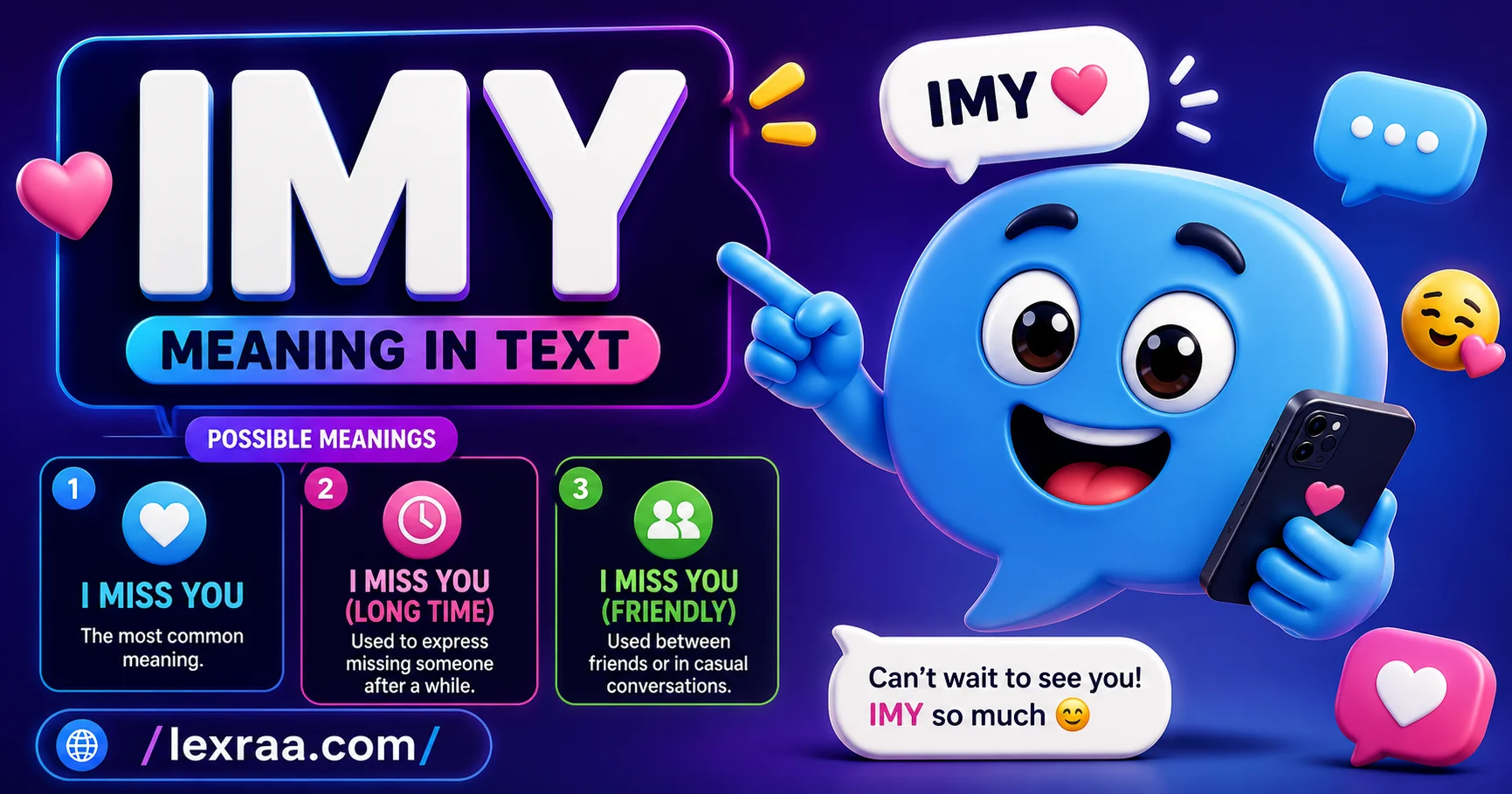
IMY means “I miss you” in text messages, DMs, and social media. It is an informal initialism people use to tell someone they miss them, whether the relationship is romantic, friendly, or familial.
What Does IMY Mean in Text?
When someone sends “IMY”, they are almost always saying “I miss you.”
It is an initialism formed from the first letters of I Miss You. Because each letter is normally pronounced separately—“I-M-Y”—it is more accurately called an initialism than an acronym.
You might receive:
“IMY ❤️”
or:
“hey imy”
or:
“IMY guys, when are we hanging out again?”
All three communicate the same basic idea: the sender feels the absence of someone and wants them around again.
Wiktionary records IMY specifically as an internet-slang and text-messaging initialism for “I miss you,” while Collins lists the same meaning in messaging and social-media usage.
The interesting part is that the emotional meaning can change without the definition changing. IMY can sound romantic from a partner, affectionate from a parent, nostalgic from an old friend, or completely playful between people who were together five minutes ago.
So the translation is simple:
IMY = I miss you.
The interpretation requires context.
Is IMY Slang, an Acronym, or an Abbreviation?
IMY is best described as an initialism and texting abbreviation.
It is commonly grouped with internet slang because it belongs to informal digital communication, alongside expressions such as ILY (“I love you”), ILYSM (“I love you so much”), and IMYSM (“I miss you so much”).
It is not a newly invented slang word with a hidden definition. The letters simply compress an existing phrase.
That distinction matters because you do not need to learn a special dictionary definition of “IMY.” Once you know the phrase it represents, the meaning is straightforward.
Is IMY Always Romantic?
No. This is the biggest misunderstanding surrounding IMY.
IMY expresses missing someone, but it does not automatically mean romantic interest.
A friend can say:
“IMY, bro.”
A daughter can text:
“IMY, Mom.”
A partner can write:
“IMY ❤️.”
All three are grammatically and emotionally natural, but the relationships are completely different.
The safest way to interpret IMY is therefore:
First identify the relationship. Then interpret the tone.
A romantic partner saying “IMY” may be expressing affection or longing. A longtime friend may simply miss spending time together. A family member may be expressing ordinary emotional closeness.
The abbreviation itself does not tell you which one it is.
Read More: ION Meaning in Text: It’s Not What You First Think
What Can IMY Communicate Beyond “I Miss You”?
Although the literal expansion is always “I miss you,” the reason someone sends it can vary.
Missing someone’s physical presence
This is the most literal use.
“I wish you were here. IMY.”
The person wants the other person physically nearby.
Missing the relationship or connection
Sometimes someone is not necessarily talking about physical distance.
“We haven’t talked properly in weeks. IMY.”
Here, the person may be missing the conversations, companionship, or emotional connection they used to have.
Reconnecting after silence
IMY can also reopen a conversation.
“Hey… IMY. How have you been?”
In this case, the message does more than describe an emotion. It creates an invitation to reconnect.
Playful exaggeration
Close friends sometimes use emotionally serious language jokingly.
“You went to the store without me. IMY already 😂”
The sender does not literally mean they have suffered from the person’s absence. The humor comes from exaggerating how quickly they supposedly started missing them.
This is why translating IMY word-for-word is not always enough. The relationship and timing determine how seriously the message should be taken.
IMY vs. ILY: Why the Difference Matters
IMY means “I miss you.”
ILY means “I love you.”
Those two messages can overlap emotionally, but they communicate different things.
“I miss you” focuses on absence.
“I love you” focuses on affection or love.
Someone can say:
“IMY”
without being ready to say:
“ILY.”
That distinction can matter in dating situations, especially when two people are still figuring out how they feel.
Likewise, a friend can comfortably say “IMY” without implying romantic feelings.
IMY vs. IMYSM, IMYT, and Similar Variations
People sometimes extend IMY rather than replacing it with a different meaning.
IMYSM = “I miss you so much.”
This intensifies the original message.
IMYT = “I miss you too.”
This is a natural response when someone says IMY first.
You may also encounter other informal extensions in user-generated slang dictionaries, but they are not equally standardized or widespread. For that reason, it is better not to treat every variation found online as mainstream texting vocabulary.
The important distinction is:
IMY → I miss you
IMYSM → I miss you so much
IMYT → I miss you too
These are variations of the same phrase rather than completely different meanings of IMY.
Is “I’m Yours” a Meaning of IMY?
No—not as a standard texting meaning.
Some online slang pages mention “I’m yours” as a possible misunderstanding, but there is no strong evidence that it is an established mainstream meaning of IMY.
The standard expansion is:
I = I
M = Miss
Y = You
So if someone sends you “IMY,” the normal interpretation is “I miss you,” not “I’m yours.”
This is a useful example of why guessing an abbreviation from its letters can be misleading. The emotional context might make “I’m yours” seem plausible, but the established texting meaning is different.
Where Is IMY Used?
IMY is not tied to one particular social platform. It is an established form of digital shorthand that appears across personal messaging and social media.
Snapchat
Snapchat is one of the platforms where IMY is explicitly documented. It can appear in direct messages, snaps, captions, or other informal interactions. Dexerto notes that IMY is commonly used on Snapchat and was not created specifically by the platform.
IMY can appear in Instagram DMs, story replies, comments, or messages between friends and partners.
The meaning remains “I miss you”; Instagram does not give the abbreviation a special platform-specific definition.
TikTok
IMY can also appear in TikTok comments, captions, and conversations. Sources covering TikTok usage describe it as the same “I miss you” abbreviation rather than a TikTok-specific term.
IMY is also used in personal WhatsApp conversations, particularly between friends, family members, and partners. The abbreviation is simply carried into the app’s messaging environment rather than originating there.
X
IMY can appear in posts, replies, and private conversations on X, although the abbreviation is less tied to the platform than some X-specific expressions.
The broader point is important: IMY belongs to internet and texting language generally, not to Snapchat, TikTok, or Instagram specifically.
Where Did IMY Come From?
There is no reliable evidence identifying one person, website, app, or exact date as the inventor of IMY.
Some newer articles claim that IMY originated specifically in AOL Instant Messenger or late-1990s/early-2000s texting culture, but those claims are not supported by a strong historical source establishing a precise origin.
What we can say with much more confidence is that IMY was already being used in online slang communities by the mid-2000s. Urban Dictionary has entries for IMY meaning “I miss you” dated May 2006, with another entry from April 2006 using the same expansion. These entries demonstrate that the abbreviation was already recognizable in online communication at that time, although they do not prove when or where it was first created.
The formation itself is unsurprising. Early internet and mobile communication encouraged people to shorten common phrases, particularly phrases that appeared frequently in personal conversations.
So the most defensible origin story is:
IMY developed as a shortened form of “I miss you” within informal digital communication, and its exact first use is unclear.
There is also no solid evidence that IMY originated in AAVE or another particular cultural community. It is better to avoid assigning it to a specific culture without historical evidence.
How Does IMY Work Grammatically?
IMY is a standalone initialism representing a complete sentence: “I miss you.”
Because of that, it can appear almost anywhere the full sentence could appear.
At the beginning:
“IMY. Call me when you’re free.”
At the end:
“It was great seeing you yesterday. IMY already.”
By itself:
“IMY ❤️”
Inside a longer message:
“I was looking through our old photos and realized how much I IMY.”
The last example sounds less natural in ordinary English because the abbreviation usually replaces the complete phrase rather than functioning like a normal verb. In casual messaging, “IMY” most naturally stands alone or appears as a short sentence.
Capitalization does not normally change the meaning:
IMY
imy
Imy
All can mean “I miss you.”
Lowercase “imy” can sometimes feel softer or more casual, but that is a stylistic interpretation rather than a different dictionary meaning.
Four Short Conversations Using IMY
Funny
Jake: You left the group chat for ten minutes.
Mia: I know.
Jake: IMY already.
Mia: You survived ten minutes without me. Proud of you.
Sarcastic
Ryan: You said you’d never leave again.
Ella: I left for two hours.
Ryan: Wow. IMY.
Ella: The drama is impressive.
Playful
Lena: We literally saw each other this morning.
Chris: I know.
Lena: Then why did you text “IMY”?
Chris: I’m emotionally efficient.
Serious
Marcus: How are you doing since you moved?
Nina: Honestly, it’s been harder than I expected.
Marcus: I understand. IMY too.
Nina: We should call this weekend.
More Natural IMY Conversations
Friends Who Haven’t Met in Months
Ava: I found our old concert pictures.
Noah: No way 😂
Ava: We need to do that again.
Noah: IMY. Seriously, we need another night like that.
Family
Mom: Did you get settled into your new apartment?
Sarah: Almost. Still unpacking.
Mom: Good. Call me tomorrow.
Sarah: I will. IMY ❤️
Dating
Ethan: Last night was fun.
Maya: It really was.
Ethan: Why do I already IMY?
Maya: Because you’re making it very hard to play it cool.
Long-Distance Relationship
Alex: What time is your flight?
Jordan: 7:40 tomorrow morning.
Alex: I’ll be awake before you leave.
Jordan: IMY so much.
Alex: IMYT.
Old Friend
Chris: Saw your name in my contacts today.
Daniel: That’s random.
Chris: Made me realize we haven’t talked in forever.
Daniel: IMY, man. Let’s fix that.
Group Chat
Mia: Who’s coming home for the holidays?
Sam: I’m trying to make it.
Mia: Please do.
Sam: IMY guys too.
Snapchat
Lily: You disappeared 😂
Emma: School has been insane.
Lily: Fair. IMY though.
Emma: IMYT! I’ll call tonight.
Instagram Story Reply
Noah: That vacation looks amazing.
Ava: It was!
Noah: IMY guys.
Ava: You should’ve come with us!
Parent and Child
Dad: How’s college going?
Alex: Busy, but good.
Dad: We’re proud of you.
Alex: IMY too, Dad.
After an Argument
Maya: I know we’re still annoyed with each other.
Ryan: Yeah.
Maya: But I still IMY.
Ryan: I miss you too. Let’s talk when we’re calmer.
These examples show why the same three letters can carry very different emotional weight. “IMY” from a romantic partner after a date is not interpreted the same way as “IMY guys” in a family group chat.
How to Reply to IMY
The best reply depends on what you actually feel.
If you miss them too
“IMYT ❤️”
This is the most direct response.
You can also write:
“I miss you too.”
Using the full phrase makes the response feel slightly more deliberate.
Funny reply
“You survived without me for that long? Impressive.”
Serious reply
“I miss you too. We should actually make plans to see each other.”
Flirty reply
“Already? I must be doing something right 😉”
A flirty reply makes sense only when the relationship already has that kind of tone.
Neutral reply
“Aww, hope we can catch up soon.”
This acknowledges the sentiment without automatically matching its emotional intensity.
If you do not feel the same way, you do not have to reply with “IMYT.” A warm but noncommittal response is often better than sending a message that communicates feelings you do not have.
How to Tell What Someone Means by “IMY”
When IMY arrives without context, use three clues.
Look at who sent it
A romantic partner, sibling, close friend, coworker, and former partner can all use the same abbreviation, but the likely emotional interpretation differs.
Look at what came before it
Compare:
“That restaurant reminded me of you. IMY.”
with:
“Where have you been? IMY 😂”
The first sounds more sentimental. The second could be casual or playful.
Look at what comes after it
“IMY ❤️”
has a different emotional signal from:
“IMY bro, let’s play tonight.”
Emojis, punctuation, nicknames, and the rest of the sentence can clarify the intended tone.
This is one area where slang dictionaries cannot give you the whole answer. The dictionary tells you what IMY means; the conversation tells you what the sender means by using it right now.
IMY vs. Similar Texting Terms
| Term | Meaning | Tone | Popularity | Confusion Risk |
|---|---|---|---|---|
| IMY | I miss you | Affectionate/casual | High | Low |
| IMYT | I miss you too | Affectionate | Medium | Low |
| IMYSM | I miss you so much | More emotional | Medium | Low |
| ILY | I love you | Stronger/intimate | Very high | Medium |
| LYSM | Love you so much | Affectionate | High | Medium |
| BRB | Be right back | Neutral/casual | High | Low |
| Emotionally distant / unavailable | Not expressing or returning emotional closeness | Opposite direction | Common phrase | Low |
The closest comparison is ILY, but these should not be treated as interchangeable.
Someone can miss a friend without loving them romantically. Someone can love a person without currently missing them. IMY describes absence; ILY describes love.
Who Uses IMY?
IMY is not limited to one age group.
Cyber Definitions lists both adults and teenagers among typical users, and the abbreviation has been documented online since at least 2006.
It is reasonable to associate IMY with people comfortable with digital shorthand, but it would be inaccurate to claim that Gen Z invented it or exclusively uses it.
The abbreviation can appear between friends, romantic partners, family members, and other people with an established personal relationship.
There is also no reliable evidence that the “I miss you” meaning belongs specifically to the United States, United Kingdom, or another single English-speaking region. Collins explicitly lists the meaning in British English messaging and social-media usage as well.
Is IMY Rude or Safe?
IMY is not rude, offensive, or profanity.
It is generally a safe expression of affection or longing.
The issue is not offensiveness but appropriateness.
Using “IMY” with a close friend or partner is normal. Using it with a professional contact can sound overly personal because “I miss you” itself is an intimate statement.
For example:
“IMY, hope you’re doing well!”
is perfectly natural between friends.
But sending:
“IMY ❤️”
to a manager you barely know would be inappropriate in most workplace situations.
In formal communication, write the complete phrase when the sentiment genuinely needs to be expressed.
Why Does IMY Work So Well as a Text?
IMY succeeds because it compresses a surprisingly vulnerable statement into three letters.
Writing “I miss you” can feel emotionally exposed. Writing “IMY” communicates the same basic message while fitting naturally into the quick, abbreviated rhythm of texting.
That does not necessarily make it less sincere. In a familiar relationship, the abbreviation can actually feel more natural because both people already understand the emotional language of the conversation.
Its flexibility also helps it survive across different relationships. The same letters can express romantic longing, friendship, family affection, nostalgia, or a joke.
The abbreviation stays constant while the relationship supplies the emotional meaning.
FAQ About IMY Meaning in Text
What does IMY mean in a text message?
IMY means “I miss you.” It is an informal initialism commonly used in texting, DMs, and social-media conversations. The person is telling you that they miss your presence, conversation, or connection.
Is IMY always romantic?
No. Friends, family members, and romantic partners can all use IMY. The relationship and surrounding conversation determine whether the message is romantic, friendly, sentimental, or playful.
What does IMY mean from a girl or guy?
The abbreviation itself has the same meaning regardless of who sends it: “I miss you.” Whether it signals romantic interest cannot be determined from the sender’s gender or the abbreviation alone. Look at your relationship and the surrounding messages instead.
What does IMY mean on Snapchat?
On Snapchat, IMY means “I miss you.” It is commonly used in informal communication, including chats and snaps, and the abbreviation was not created specifically for Snapchat.
What does IMY mean on TikTok?
IMY can mean “I miss you” on TikTok as well. It may appear in comments, captions, or conversations, but it is general texting shorthand rather than a special TikTok definition.
What should I reply to IMY?
If you miss the person too, “IMYT” or “I miss you too” is a natural response. If you want to stay casual, you can say “Aww, hope we can hang out soon.” If you are unsure about the sender’s intentions, reply warmly without automatically matching the emotional intensity.
Does IMY mean “I’m yours”?
No. “I’m yours” is sometimes suggested as a possible interpretation online, but it is not the established mainstream texting meaning. In ordinary digital communication, IMY means “I miss you.”
What is the difference between IMY and ILY?
IMY means “I miss you,” while ILY means “I love you.” IMY focuses on someone’s absence and the desire to have them around, whereas ILY expresses love. Because of that difference, IMY does not automatically imply romantic feelings.
Conclusion
IMY means “I miss you.” It is a common texting initialism used to express that someone is missed, whether the relationship is romantic, friendly, or familial.
The main mistake is assuming that IMY automatically means romantic interest. It does not. A friend can say it, a parent can say it, a partner can say it, and even someone joking with a friend can use it.
Its history is also less mysterious than some internet articles suggest. The exact origin is unclear, but documented online examples date back to at least 2006, and the abbreviation naturally follows the long-standing habit of shortening common phrases in digital communication.
If you receive “IMY,” read the relationship, timing, previous messages, punctuation, and emojis before deciding how emotionally serious it is.
And if you’re sending it yourself, remember that three letters can still carry a lot of meaning. Use IMY when you genuinely want someone to know you miss them—not when you want to create a feeling you don’t actually have.