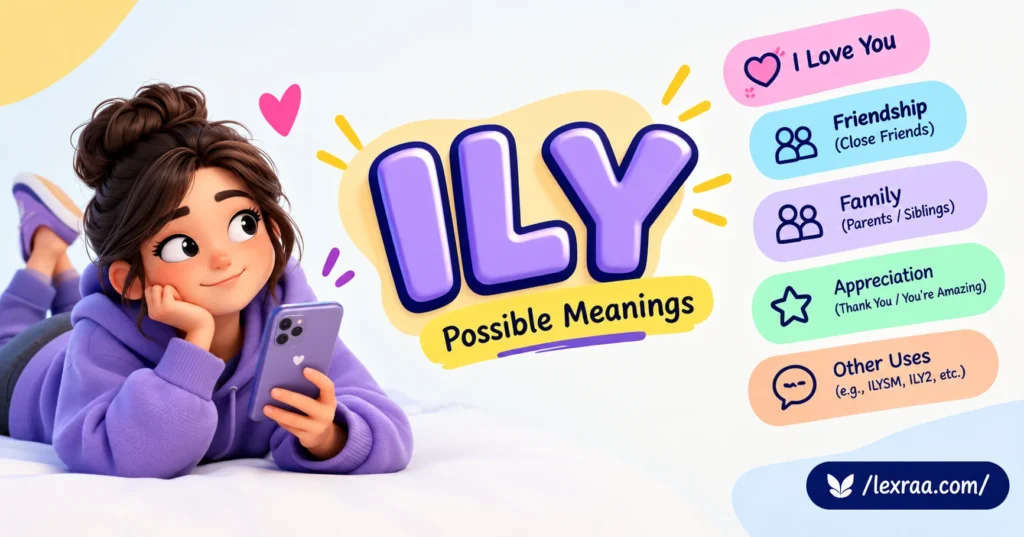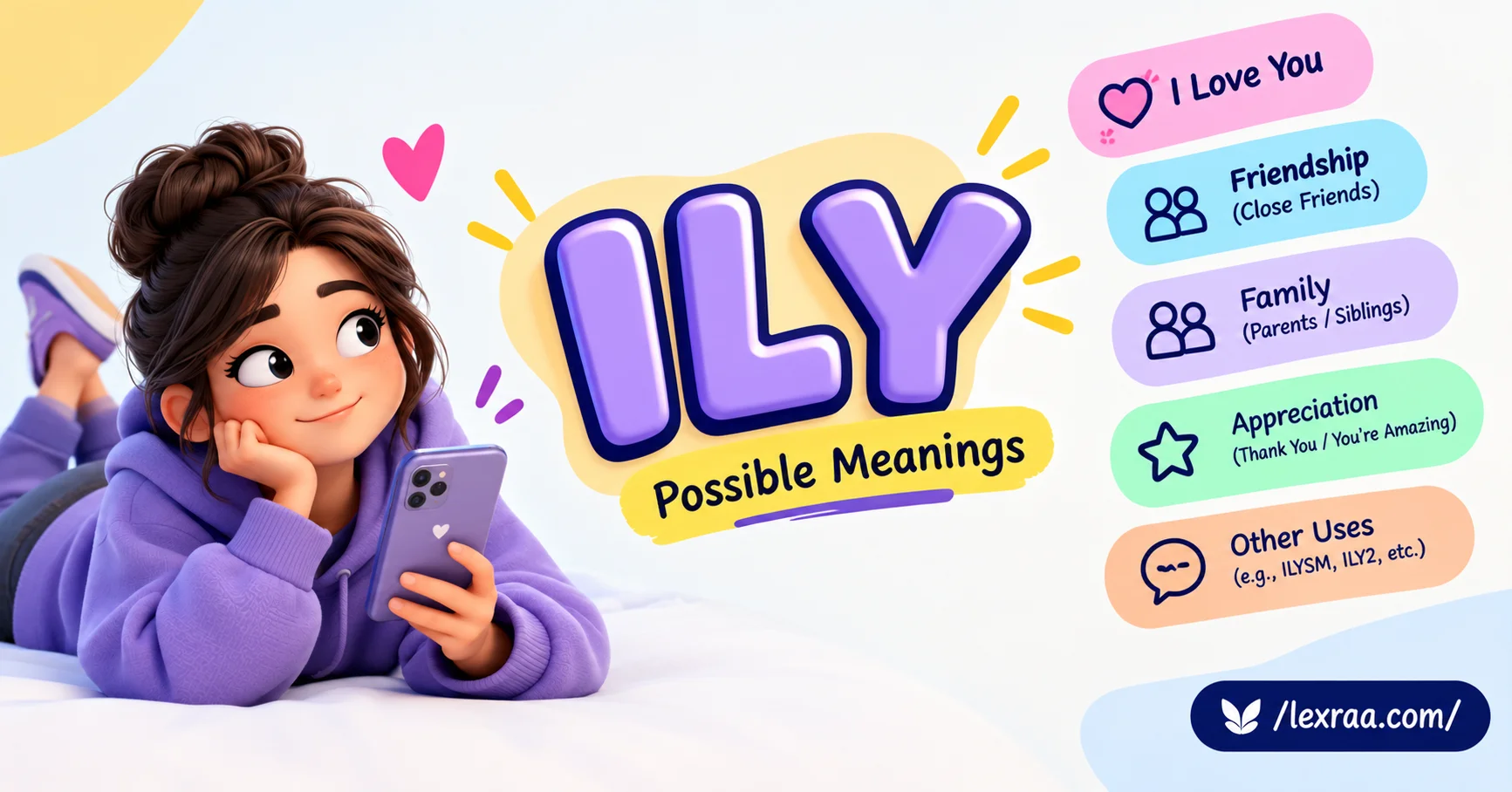
ILY means “I love you.” It is a short, informal abbreviation used in texts, DMs, comments, and other digital conversations to express love, affection, care, or appreciation. The exact emotional strength depends on who sends it and the situation.
What Does ILY Mean?
ILY = I Love You.
The three letters come directly from the first letters of I, Love, and You. In everyday digital communication, it functions as an informal abbreviation or initialism rather than a separate slang word with an unrelated definition.
You may see it written as ILY, ily, or occasionally Ily. Lowercase “ily” often looks more casual, while capitalized “ILY” can give the message a little more emphasis, although capitalization alone does not change its meaning.
For example:
“Goodnight, ily ❤️”
usually means:
“Goodnight, I love you.”
It can be romantic, but it does not automatically mean romantic love. Close friends, siblings, parents, relatives, and other people with strong personal bonds can use it too. Current dictionary and texting references describe ILY as an expression of affection used in digital communication.
Is ILY an Acronym, Abbreviation, or Slang?
The safest description is a texting abbreviation or initialism.
ILY is formed from the initial letters of “I love you.” Some websites casually call it an acronym, but technically, an initialism is a better description when the letters represent the beginning of several words rather than forming a normally pronounced word.
It is also part of internet and texting slang because it belongs to the informal shorthand people use in digital conversations. Unlike slang with a completely new definition, however, ILY simply compresses an existing phrase.
That distinction helps explain why ILY can feel informal without being mysterious: the letters are shortened, but the underlying phrase remains recognizable.
What Does ILY Mean From a Girl or Guy?
If a girl sends “ILY,” it means “I love you,” but the three letters alone cannot tell you whether she means it romantically, platonically, jokingly, or as casual affection.
The same applies if a guy sends ILY. Gender does not determine the meaning. You have to look at the relationship, the conversation immediately before it, and whether the person normally uses affectionate language.
For example:
“Thanks for helping me study, ily 😭”
from a close friend may simply express appreciation.
Compare that with:
“I miss you so much. ILY ❤️”
from a romantic partner, where the surrounding conversation makes the romantic meaning much clearer.
So searches such as “ILY meaning from a girl” or “ILY meaning from a guy” have the same basic answer: ILY means “I love you”; context tells you what kind of love or affection is intended.
A Common Misunderstanding: ILY Isn’t Always Romantic
One of the easiest mistakes is assuming that ILY automatically means the sender has romantic feelings.
That is not how the abbreviation is consistently used. Historical user-generated examples show ILY being used between friends as well as romantic partners, while current dictionaries describe it broadly as an expression of love or affection.
A friend might say:
“You brought me food? ily!”
A parent might text:
“Good luck today. ILY.”
A romantic partner might write:
“Sleep well, ILY ❤️.”
All three can be natural uses.
What about “ILY” meaning “I’m leaving you”?
You may encounter this alternative online, particularly on Urban Dictionary or other user-generated slang pages. However, it is very rare and not the standard meaning of ILY. CyberDefinitions also lists “I’m Leaving You” but explicitly describes it as a very uncommon alternative.
Therefore, if someone simply sends “ILY,” you should not assume it means “I’m leaving you” unless the surrounding conversation clearly establishes that unusual meaning.
Where Is ILY Used?
ILY is well established in digital communication, and its core meaning generally stays the same across platforms. Dictionary sources specifically classify it as a messaging and social-media abbreviation.
ILY on Instagram
On Instagram, ILY can appear in DMs, comments, captions, and story replies. It can be directed toward a romantic partner, friend, family member, or even a creator as an expression of appreciation.
For example:
“This made my whole day 😭 ily!”
A comment like that does not necessarily mean the commenter is romantically interested in the creator. It can simply communicate strong appreciation.
ILY on TikTok
On TikTok, ILY can appear in comments, replies, captions, and casual conversations. Its meaning remains “I love you,” but the emotional intensity can be lighter when it is directed toward a creator, fandom, friend, or piece of content.
For example:
“ILY for making this video 😂”
Here, ILY works more like an affectionate thank-you.
ILY on Snapchat
ILY fits naturally into Snapchat’s short, informal messaging style. It can appear between friends, family members, or romantic partners.
“Goodnighttt ily 🫶”
The surrounding relationship matters more than the app itself.
ILY on WhatsApp
ILY is also documented in WhatsApp-style personal conversations, particularly in messages between people who already have a close relationship.
“Made it home safe. ily ❤️”
WhatsApp does not give ILY a special meaning; it remains the same abbreviation.
ILY on X
ILY is also used on X/Twitter in informal posts and conversations. Older Twitter-language research has documented ILY as “I love you,” and contemporary abbreviation references list the same meaning for Twitter/X.
The important point is that ILY is not a platform-specific code. Seeing it on Snapchat rather than WhatsApp does not give it a different dictionary definition.
Where Did ILY Come From?
The texting abbreviation’s exact first use is unclear.
It is tempting to say that ILY was invented at a particular moment by a particular group, but the available evidence does not establish a single inventor or exact starting date. Modern references generally connect its spread with digital communication, including text messaging and internet chat.
There is evidence that the abbreviation was already being used online by the mid-2000s. For example, Urban Dictionary entries for “ily” date back to 2004 and 2006. Because Urban Dictionary is user-generated, those entries demonstrate documented usage rather than proving when the abbreviation was invented.
There is also an important distinction between the text abbreviation ILY and the ILY handshape in American Sign Language (ASL).
The ASL ILY handshape combines the handshapes for the letters I, L, and Y and has its own history in Deaf culture. It is used to express “I love you” and related affectionate meanings in appropriate contexts.
The handshape is also represented by the 🤟 Love-You Gesture emoji, which was added to Unicode/Emoji standards in 2017.
So, while the letters ILY and the ASL ILY sign share the same three-letter association, you should not claim that the texting abbreviation was invented from the ASL gesture. The evidence supports treating their histories separately.
ILY vs. I Love You: Is There a Difference?
The basic meaning is the same, but the presentation can feel different.
Writing:
“I love you.”
uses the complete phrase and can feel more deliberate or emotionally direct.
Writing:
“ily”
is shorter and more casual.
That does not mean ILY is automatically less sincere. A person may use it simply because it matches their normal texting style. Conversely, some people personally feel that typing the full phrase carries more emotional weight. Those are differences in individual communication style, not fixed rules about what ILY means.
This is one reason you should avoid interpreting the number of letters as a reliable measurement of someone’s feelings.
10 Natural ILY Conversations
1. Funny — Best Friends
Mia: You ate the last slice of pizza.
Zoe: You said you didn’t want it.
Mia: I wanted to change my mind 😭
Zoe: Sorryyy. ily though.
Here, ILY softens the playful argument between friends.
2. Sarcastic — Close Friends
Sam: I sent you the notes you forgot.
Alex: You saved my entire semester.
Sam: Obviously. I expect payment.
Alex: Ily, but you’re still charging me? 😂
The abbreviation can appear jokingly without changing its basic meaning.
3. Playful — Dating
Lena: You actually remembered my favorite snack.
Noah: I listen sometimes.
Lena: Sometimes?
Noah: Fine. ILY. Happy now? 😭
The context makes the affectionate tone clear.
4. Serious — Romantic Partner
Emma: I know today was hard.
Ryan: Thanks for staying with me through it.
Emma: Always. You don’t have to handle everything alone.
Ryan: ILY. ❤️
Here, ILY is part of a more emotionally serious exchange.
5. Family
Mom: Text me when you get there.
Daughter: I will.
Mom: And don’t forget your jacket.
Daughter: Yes, Mom 😂 ily.
The relationship makes the affectionate meaning obvious without being romantic.
6. Group Chat
Chris: Everyone actually showed up on time.
Nora: This is a historical event.
Chris: Screenshot it before it ends.
Nora: ILY all 😂
In a group chat, ILY can refer to affection toward the whole group.
7. Instagram Comment
Ava: Posted the photos from our trip!
Maya: These are so good 😭
Ava: Thank you!!
Maya: ILY bestie 🫶
“Bestie” makes the friendship context particularly clear.
8. TikTok
Leo: This is exactly what happened to me yesterday.
Kai: 😂😂
Leo: I can’t believe someone made a video about it.
Kai: ILY for posting this.
Here, ILY expresses appreciation for the creator or content.
9. Coworkers Who Are Also Friends
Nina: I covered your shift tomorrow.
Ella: Seriously? Thank you!
Nina: You owe me coffee.
Ella: Done. ILY 😂
This works because the relationship is friendly rather than formal.
10. Soft, Neutral Affection
Jordan: Thanks for listening earlier.
Taylor: Anytime.
Jordan: I really appreciate you.
Taylor: Of course. ily.
Without additional romantic language, the exact nature of the relationship is still determined by context.
How to Reply to ILY
You do not have to respond with the exact same words. Your reply should match what you genuinely feel.
Funny reply:
“Ily too, but I’m still stealing your fries 😂”
Serious reply:
“I love you too. That really means a lot to me.”
Flirty reply:
“I was waiting for you to say it first 😉”
Neutral/warm reply:
“Aww, thank you. That’s really sweet of you.”
If you are not comfortable saying “I love you,” you can acknowledge the affection without pretending:
“That’s really sweet. Thank you ❤️”
That can be especially useful when you are unsure whether the sender intended ILY romantically.
ILY vs. Similar Texting Abbreviations
| Term | Meaning | Tone | Popularity | Confusion Risk |
|---|---|---|---|---|
| ILY | I love you | Affectionate, casual | Very high | Low |
| ILU | I love you | Casual, affectionate | High | Low |
| ILYSM | I love you so much | Stronger, affectionate | High | Low |
| LY | Love you | Very casual | High | Medium |
| 143 | I love you | Coded, old-school texting | Moderate | Medium |
| IDC | I don’t care | Indifferent | Very high | High if read without context |
ILYSM is particularly close to ILY because it adds “so much” for emphasis. ILU is another direct variant meaning “I love you.” Current texting references commonly group ILY, ILU, ILYSM, and LY as related expressions.
143 is different in construction: it represents the number of letters in “I,” “love,” and “you.” It belongs to an older numeric-message tradition rather than simply taking the first letters. That makes it useful as a comparison when discussing the history of digital shorthand.
Who Uses ILY?
There is evidence of ILY being used across different generations rather than belonging exclusively to Gen Z.
Older online records show ILY in contexts associated with early social networking, instant messaging, and texting, while current sources continue to document it in modern social-media communication.
Gen Z users may encounter it frequently because short abbreviations remain normal in DMs, comments, and group chats, but there is no reliable basis for saying ILY belongs only to Gen Z. Millennials and older users who participated in SMS, AIM, MSN, MySpace, Facebook, and other early forms of online communication also have a long history of using or recognizing it.
There is likewise no reliable gender rule saying women use ILY differently from men. The relationship and conversational context matter more than the sender’s gender.
Is ILY Rude or Safe?
ILY is generally safe and affectionate. It contains no profanity and is not inherently offensive.
It is appropriate in casual conversations with friends, family, partners, and other people with whom affectionate language makes sense.
The main issue is professional context, not offensiveness. Sending “ILY” to a teacher, client, manager, customer, or professional contact can be inappropriate or confusing unless there is an unusually close personal relationship and the context clearly permits that kind of language.
There is also a cultural consideration: the 🤟 hand gesture and ILY sign have a specific connection to American Sign Language and Deaf culture. The sign should not be treated merely as a trendy hand pose without recognizing that history.
Why Does ILY Work So Well in Conversation?
ILY survives because it compresses a surprisingly large emotional message into three characters without making the recipient decode a complicated slang expression. The phrase is already familiar, so shortening it does not destroy its meaning; instead, the abbreviation lets people attach it naturally to everyday moments such as “goodnight,” “thanks,” or “talk later.” It also leaves room for context to determine whether the affection is romantic, familial, friendly, playful, or simply appreciative. That flexibility is probably more important to its longevity than typing speed alone.
Frequently Asked Questions
What does ILY mean in chat?
ILY means “I love you.” It is a casual abbreviation used in texts, chats, DMs, comments, and social media. Depending on the relationship, it can express romantic love, friendship, family affection, or general appreciation.
Does ILY always mean romantic love?
No. Friends and family can use ILY as an affectionate expression too. A message from a romantic partner may naturally carry romantic meaning, while “ily bestie” is more clearly friendly. The surrounding conversation is more useful than the abbreviation by itself.
What does ILY mean from a girl?
It means “I love you,” but it does not automatically reveal whether the feeling is romantic. A girl can use ILY with a partner, friend, sibling, family member, or someone she appreciates. Look at the relationship and the surrounding messages rather than trying to assign a fixed meaning based on gender.
What does ILY mean from a guy?
The basic meaning is also “I love you.” It can be romantic or platonic depending on the relationship. There is no reliable rule that gives ILY a different definition when a guy sends it.
Is ILY the same as ILYSM?
Not exactly. ILY means “I love you,” while ILYSM means “I love you so much,” adding extra emphasis. Both can be romantic or friendly depending on context.
Does ILY have a dirty meaning?
There is no standard dirty meaning of ILY in ordinary texting. User-generated slang sites contain many joke, invented, or extremely unusual alternative definitions, but these should not be treated as established meanings. In normal conversation, ILY means “I love you.”
What does ILY mean on Snapchat or TikTok?
It normally still means “I love you.” On social platforms it can be used romantically, between friends, toward family, or as enthusiastic appreciation for content. The platform does not create a separate standard definition for ILY.
Is ILY appropriate for work?
Usually, no. ILY is an informal expression of affection and can sound overly personal in professional communication. For a coworker or client, phrases such as “I really appreciate your help” or “Thank you so much” are generally clearer and more appropriate.
Conclusion
The meaning of ILY is “I love you.” It is an informal digital abbreviation used to express affection, care, appreciation, or love in a compact way.
The important detail is that ILY does not automatically equal romantic love. Friends, family members, partners, and close acquaintances can all use it, so the relationship and surrounding conversation matter more than the three letters themselves.
You may see ILY on Instagram, TikTok, Snapchat, WhatsApp, X, and ordinary text messages. Related forms such as ILU, ILYSM, LY, and ILY2 can add different degrees or directions of affection.
The texting abbreviation’s exact invention date is unclear, although documented online usage goes back at least to the 2000s. Its history should also be distinguished from the ILY handshape in American Sign Language, which has its own Deaf-cultural history.
Use ILY naturally with people who are comfortable with affectionate language, and avoid treating it as a secret code that automatically reveals someone’s romantic intentions. Context is what turns three letters into the right meaning.