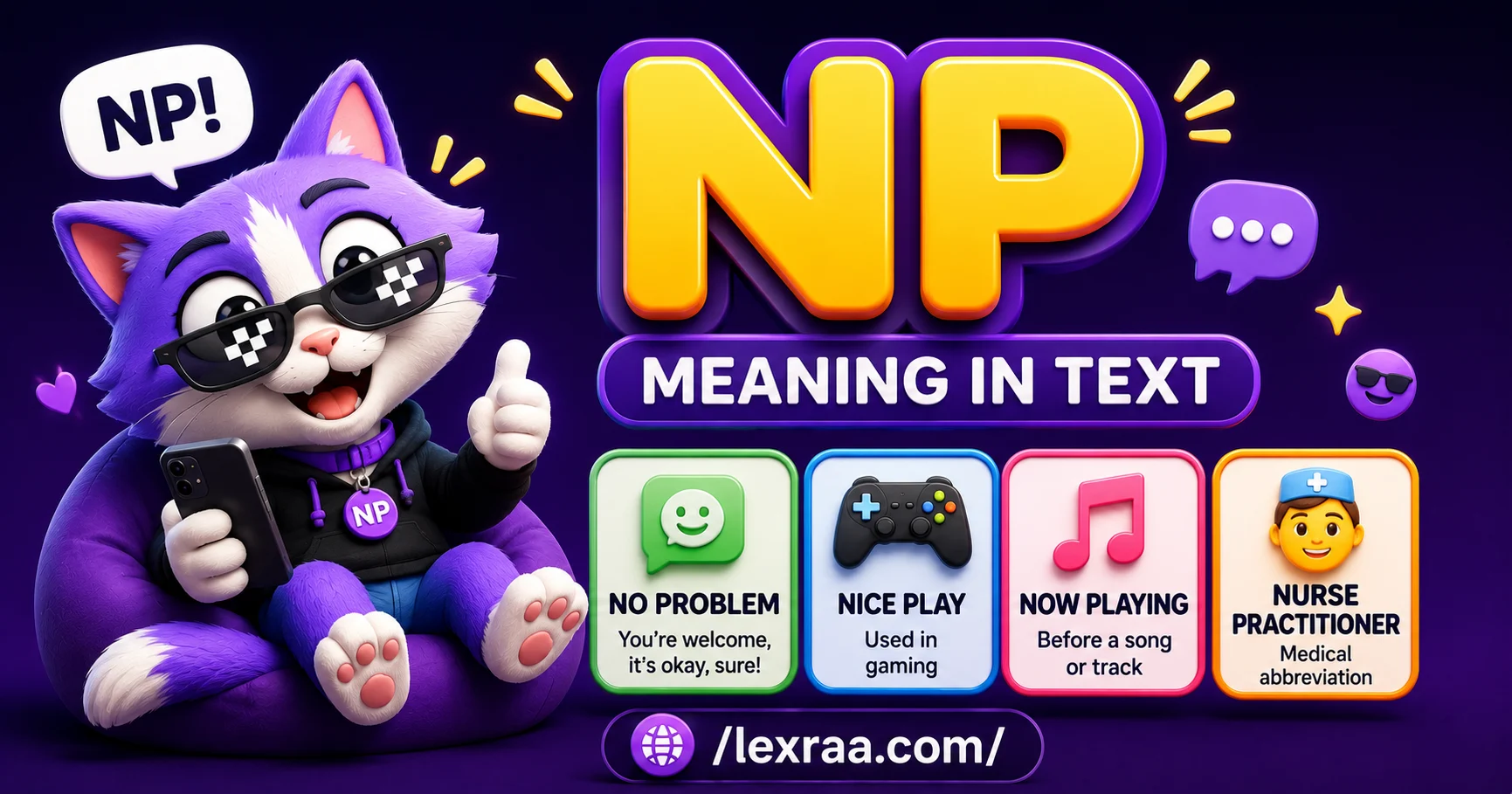
If you see “NP” in a text, it usually means “no problem.” It can mean “you’re welcome,” “it’s okay,” or “sure” depending on what came before it. In gaming, NP can also mean “nice play.”
What Does NP Mean?
NP is an initialism commonly used in texting, online messaging, and internet slang. The most common meaning is “no problem.”
For example:
You: Thanks for helping me with that.
Them: NP.
Here, “NP” is essentially “you’re welcome” or “no problem at all.”
The same two letters can perform slightly different conversational jobs:
- After “thank you” → “You’re welcome.”
- After an apology → “It’s okay.”
- After a request → “Sure, no problem.”
- After someone worries about inconveniencing you → “Don’t worry about it.”
That flexibility is why NP is more than a simple abbreviation. The surrounding message determines the most natural interpretation.
NP Is Usually an Abbreviation, Not Traditional Slang
Technically, NP is an initialism or abbreviation, rather than a slang word in the same sense as a term such as “sus” or “yeet.” It represents the initial letters of no problem, and it is normally pronounced as the individual letters “N-P.”
In casual digital communication, however, it is often grouped with texting slang because it belongs to the same family of shortened expressions as TY (“thank you”), YW (“you’re welcome”), BRB (“be right back”), and NBD (“no big deal”).
Other Real Meanings of NP
Although “no problem” is the default meaning in ordinary texting, NP has other established meanings in particular contexts.
NP = Nice Play
In online gaming, NP can mean “nice play.” It is used to compliment another player’s move, strategy, shot, or overall play.
For example:
Player 1: That flank actually worked 😂
Player 2: NP
Here, NP is not “no problem.” It is a compliment meaning “nice play.”
This is one of the most important context-dependent meanings because gaming conversations can contain both definitions.
NP = Now Playing
NP can also mean “now playing,” particularly when it appears before a song, artist, album, or other media title. Wiktionary records this as an internet initialism, although it is much less likely than “no problem” in an ordinary conversation.
For example:
NP: Radiohead — Creep
In this format, NP means “now playing.”
So if you encounter NP followed by a music title, don’t automatically assume the person is saying “no problem.”
NP in Specialized Contexts
Outside internet slang, NP has many unrelated meanings. Depending on the subject, it can refer to a nurse practitioner, noun phrase, national park, or the computer-science concept NP associated with nondeterministic polynomial time.
Those meanings normally have nothing to do with texting slang.
The easiest rule is simple: look at the conversation before deciding what NP means.
A Common Misunderstanding About NP
A common mistake is assuming that NP always means “you’re welcome.”
It doesn’t.
“You’re welcome” is one possible conversational translation, particularly when someone has said “thanks,” but the literal phrase behind NP is “no problem.”
Compare:
“Thanks for sending that!”
“NP.”
Here, “you’re welcome” makes sense.
But:
“Can you send that again?”
“NP.”
Now it means “Sure, no problem.”
And:
“Sorry I missed your call.”
“NP.”
Here it means “It’s okay” or “No problem.”
The abbreviation stays the same while its conversational function changes.
Where Is NP Used?
NP appears in online messaging, texting, social media, gaming chats, and other informal digital conversations. Sources documenting the term include text messaging, online chat, gaming, and social-media communication.
You may encounter it in:
- Text messages
- Instagram DMs and comments
- TikTok comments
- WhatsApp conversations
- X conversations
- Discord
- Online gaming chats
- Group chats
The evidence is strongest for general online messaging and gaming. It would be misleading to claim that NP has a special meaning unique to any one platform.
For example, seeing “NP” on WhatsApp doesn’t change its definition. If someone writes:
“Thanks! NP”
the same basic meaning applies whether the conversation happens through SMS, WhatsApp, Instagram, or another messaging service.
Where Did NP Come From?
The exact person, website, or moment that first created NP = “no problem” is not clearly documented.
What is clear is that NP belongs to the broader tradition of abbreviated online communication that developed through chatrooms, instant messaging, SMS, and other forms of text-based communication. Historical research on chat language specifically records NP as “no problem,” often in response to “thank you.”
Some sources place its widespread internet use in the 1990s and early 2000s, while an Urban Dictionary entry for the meaning dates to 2002. Those records demonstrate that the abbreviation was established by that period, but they do not prove that 2002 was the year NP was invented.
So the safest historical explanation is that NP emerged as part of early digital shorthand, with its exact origin unclear.
There is also no good reason to attribute the term to a particular ethnic or regional dialect. It is better understood as a general English-language abbreviation that spread through digital communication.
How NP Works in a Sentence
NP is unusually flexible because it can stand by itself as a complete response.
“Thanks!”
“NP.”
It can also appear as part of a longer message:
“NP, I was heading that way anyway.”
“NP at all!”
“NP, take your time.”
Grammatically, it functions like a short conversational response rather than a conventional noun or verb. It is particularly natural as a standalone reply.
10 Natural Examples of NP in Conversation
1. Funny tone
Friend: Thanks for saving me a slice of pizza.
You: NP.
Friend: You saved my entire night.
You: I accept payment in garlic bread.
Here, NP keeps the initial response casual before the conversation becomes playful.
2. Sarcastic tone
Friend: Sorry I borrowed your charger again.
You: NP.
Friend: You’re not mad?
You: Totally not. My phone dying is one of my hobbies.
The abbreviation itself is neutral, while the following message makes the sarcasm clear.
3. Playful tone
Them: Thanks for waiting for me!
You: NP 😊
Them: I was only 20 minutes late.
You: Exactly. Basically early.
The emoji and follow-up turn NP into a warmer, teasing response.
4. Serious tone
Coworker: Sorry for sending this so late.
You: NP.
Coworker: I appreciate you taking a look.
You: No worries. I’ll review it tonight.
Here, NP reassures the other person that the delay isn’t an issue.
5. Between friends
Friend: Can you send me yesterday’s notes?
You: NP.
Friend: You’re a lifesaver.
You: Check your inbox.
This is the straightforward “sure, no problem” use.
6. Family conversation
Sibling: Can you pick me up after work?
You: NP.
Sibling: Around 7?
You: Yep, I’ll be there.
The abbreviation communicates agreement to a request.
7. Dating conversation
Them: Sorry, I need to reschedule tonight.
You: NP, another day works.
Them: You sure?
You: Yeah, no stress.
Here, NP means “it’s okay”, not “you’re welcome.”
8. Group chat
Friend 1: Can someone send me the address?
Friend 2: NP.
Friend 2: Sending it now.
Friend 1: Thanks!
In a fast-moving group chat, NP can be a quick way of accepting a small request.
9. Gaming — “no problem”
Teammate: Sorry I couldn’t revive you.
You: NP.
Teammate: We’ll get them next round.
You: Absolutely.
The surrounding message makes “no problem” the natural interpretation.
10. Gaming — “nice play”
Player 1: Did you see that last-second move?
Player 2: NP.
Player 1: That was lucky 😂
Player 2: Still counts.
In this gaming context, NP can be interpreted as “nice play.”
How to Tell Which NP Meaning Someone Intended
When NP is ambiguous, don’t focus on the abbreviation alone. Look at what comes immediately before and after it.
| Context | Most likely meaning |
|---|---|
| Someone says “thanks” | No problem |
| Someone apologizes | No problem / It’s okay |
| Someone asks for a favor | Sure, no problem |
| Gaming compliment | Nice play |
| Gaming after a mistake | No problem |
| Before a song title | Now playing |
| Medical setting | Nurse practitioner |
| Computer-science discussion | Nondeterministic polynomial time |
The strongest clue is often the speech act immediately before NP. If someone thanks you, “no problem” is overwhelmingly more natural than a specialized interpretation.
NP vs. Similar Texting Abbreviations
| Term | Meaning | Tone | Popularity | Confusion Risk |
|---|---|---|---|---|
| NP | No problem | Casual, reassuring | High | Low |
| NBD | No big deal | Casual, relaxed | Moderate | Medium |
| NW | No worries | Friendly, reassuring | Moderate | Medium |
| YW | You’re welcome | Casual/polite | Moderate | Medium |
| TY | Thank you | Friendly | High | Low |
| No worries | It’s okay / don’t worry | Friendly | High | Low |
NP and NBD overlap, but they aren’t identical. “No big deal” usually minimizes the importance of an issue, whereas “no problem” more directly reassures someone that you don’t mind.
YW is also different because it specifically answers gratitude. NP can answer gratitude, but it can also respond to an apology or request.
Who Uses NP?
NP is not exclusively a Gen Z expression. Its history in internet chat and texting predates today’s Gen Z-dominated social platforms, and historical sources document it as established chat shorthand well before current social media.
That means Millennials, Gen X users who participate in online communication, younger users, gamers, and other internet users can all use or recognize it.
There is also no strong evidence that NP belongs specifically to one U.S. region or that its use is inherently gender-specific. Claims that only a particular age, gender, or region uses NP should therefore be treated cautiously.
Is NP Rude or Safe to Use?
NP is generally considered polite, harmless, and casual. It is not profanity or inherently offensive. Sources describing its everyday use characterize it as a casual response to thanks, apologies, and minor inconveniences.
The main issue is formality, not offensiveness.
With a close friend:
“Thanks for helping!”
“NP!”
sounds completely natural.
With a client or formal business contact, a fuller response such as “You’re welcome,” “Happy to help,” or “Certainly” may be more appropriate.
There’s another subtle issue: a bare “NP.” can sometimes feel dry. That doesn’t mean the sender is annoyed. Some people simply communicate with very short messages.
Compare:
NP.
with:
No problem! 😊
The second version provides more obvious warmth because of the additional words and emoji.
Is NP Flirty?
NP does not inherently mean flirting.
If someone you’re dating sends:
“Thanks for coming to see me.”
“NP 😊”
the message can be warm, but NP itself doesn’t establish romantic interest.
Likewise, if someone sends:
“Sorry I had to cancel.”
“NP.”
there is no reliable romantic or emotional signal in those two letters alone.
If you want to understand someone’s interest, look at the broader conversation rather than assigning hidden meaning to a common abbreviation.
How to Reply to NP
Usually, you don’t need to reply to NP at all. It can naturally close the exchange.
If the conversation is continuing, your response can depend on the situation.
Neutral reply
“Thanks!”
Friendly reply
“Appreciate it 😊”
Funny reply
“You’re officially on my emergency contact list now 😂”
Flirty reply
“Careful, I might start asking you for favors more often 😉”
The flirty option only makes sense when the existing conversation already has a romantic or playful tone. NP itself isn’t a flirty abbreviation.
Why NP Works So Well in Conversation
NP survives because it compresses several socially useful ideas into two letters: I don’t mind, you’re welcome, it’s okay, and this wasn’t difficult for me. That makes it efficient without requiring the sender to explain their attitude every time. Its usefulness is especially obvious in fast-moving digital conversations, where short responses can maintain conversational flow without sounding overly formal. Research on chat language has likewise documented NP as a recurring shorthand used in response to thanks.
Frequently Asked Questions
What does NP mean in texting?
NP most commonly means “no problem.” It can be used after someone says thank you, apologizes, or asks whether something is okay.
Depending on the situation, it can therefore translate naturally as “you’re welcome,” “it’s okay,” or “sure.”
What does NP mean after thank you?
After “thank you,” NP normally means “no problem” and functions much like “you’re welcome.”
For example:
“Thanks for helping me!”
“NP!”
The person is saying that helping wasn’t a burden.
What does NP mean after sorry?
After an apology, NP usually means “it’s okay” or “no problem.”
For example:
“Sorry I’m late.”
“NP.”
It reassures the other person that their mistake or delay isn’t being treated as a serious problem.
What does NP mean in gaming?
In gaming, NP most commonly means “no problem,” but it can also mean “nice play.”
If someone apologizes for a mistake and receives NP, “no problem” is likely. If someone uses NP after praising a successful move, “nice play” may fit the context.
Can NP mean “now playing”?
Yes. NP can mean “now playing” when it introduces a song or other media currently being played. This is a recognized internet use, although it is far less common than “no problem” in ordinary text conversations.
For example:
“NP: Fleetwood Mac — Dreams”
Here, NP means “now playing.”
Is NP formal or informal?
NP is informal and is best suited to casual texting, messaging, social media, and gaming conversations.
For professional communication, especially when speaking with a client, manager, teacher, or unfamiliar person, a complete phrase such as “You’re welcome” or “Happy to help” is usually safer.
Does NP mean “no pressure”?
Some online sources list “no pressure” as a possible contextual interpretation, but it is not the primary meaning of NP in ordinary texting.
If someone says:
“You don’t have to come if you’re busy.”
and responds with “NP,” context alone may not be enough to establish that meaning. When ambiguity matters, asking what they meant is better than assuming.
Is NP the same as NBD?
Not exactly. NP means “no problem,” while NBD means “no big deal.”
They can overlap when someone is minimizing a minor inconvenience, but NP is more commonly used as a direct response to thanks, requests, or apologies.
Final Takeaway
When someone sends “NP” in an ordinary text or DM, read it as “no problem” first. Depending on the preceding message, that can mean “you’re welcome,” “it’s okay,” “don’t worry about it,” or “sure.”
Gaming introduces another legitimate meaning: “nice play.” And in music-related posts, NP can sometimes mean “now playing.”
The safest way to interpret NP is to read the surrounding conversation. Two letters don’t carry a fixed emotional meaning by themselves, so don’t assume that a short “NP” is rude, cold, or secretly flirty without additional context.
For everyday texting, though, the rule is simple: NP = no problem.