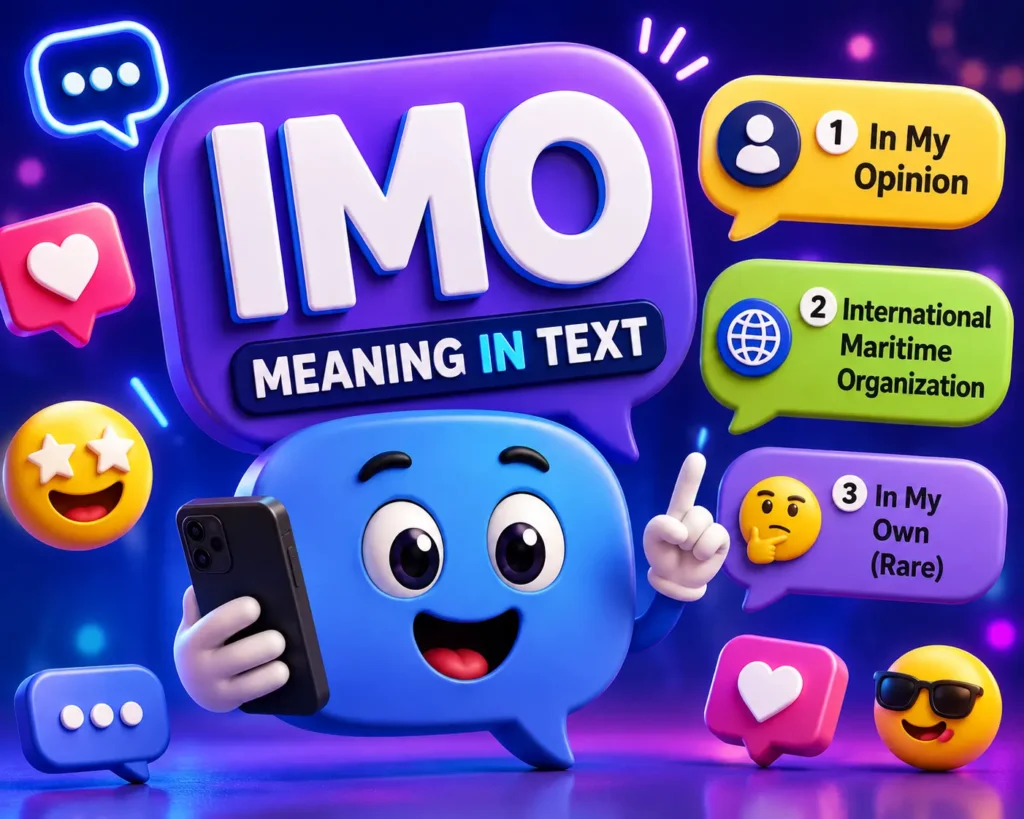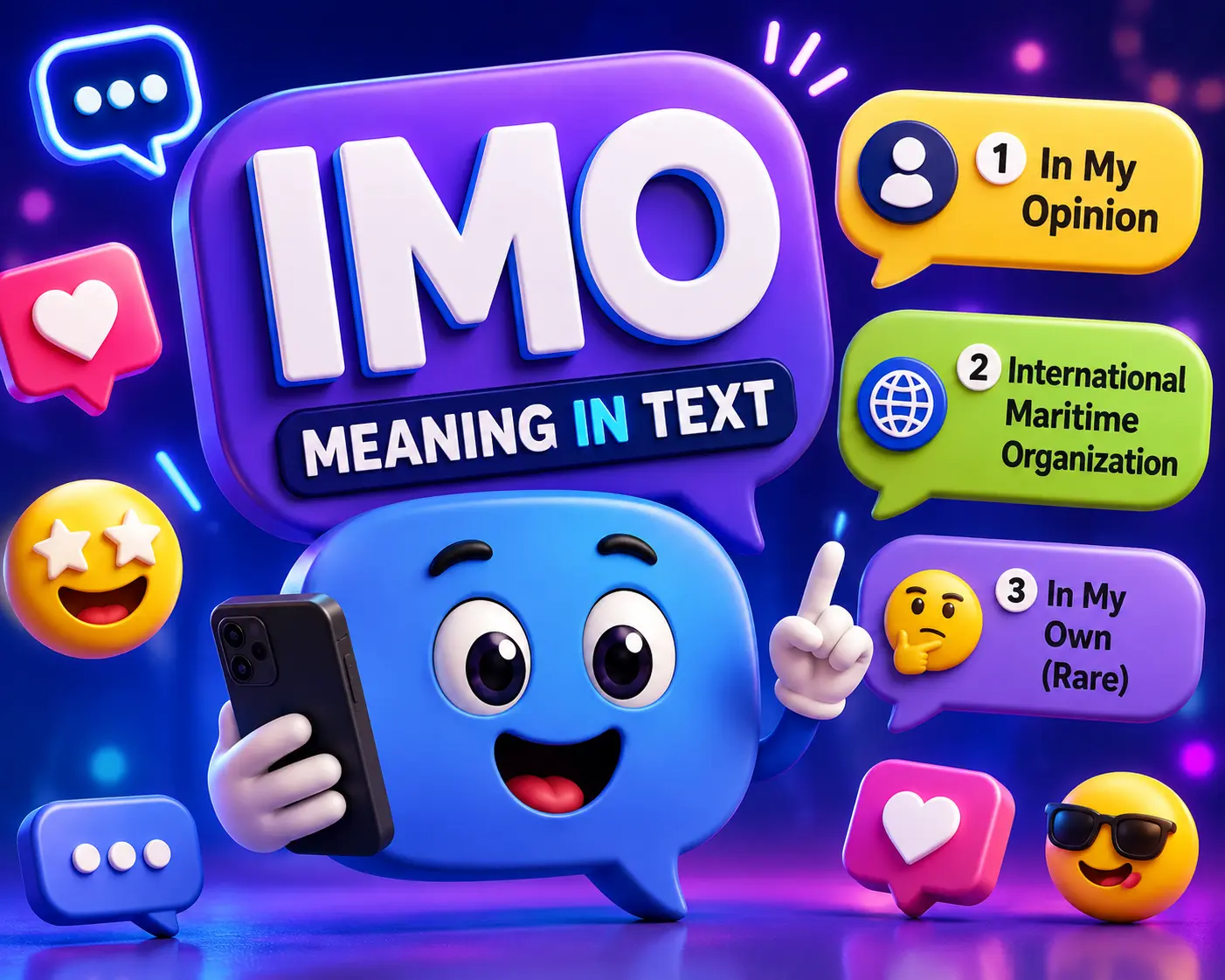
IMO most commonly means “In My Opinion.” When someone texts IMO, they’re letting you know that what follows is their personal view rather than an objective fact. It’s one of the oldest and most widely recognized internet abbreviations still used today.
Unlike many newer slang terms that rise and disappear within a few months, IMO has remained popular for decades because it solves a simple communication problem: it softens opinions and helps people express disagreement without sounding overly forceful.
What Does IMO Mean in Text?
The primary meaning is:
IMO = In My Opinion
It’s an internet abbreviation (or initialism) used before or after a statement to show that the speaker is sharing a personal opinion rather than stating a proven fact. Dictionaries consistently define it this way.
Examples:
- IMO, that movie deserved the Oscar.
- This pizza place is the best IMO.
- You should wait another year, IMO.
- IMO, blue looks better than red.
Notice that none of these statements claim to be universally true. IMO simply signals:
“This is what I think.”
Is IMO an Acronym, Abbreviation, or Slang?
IMO is best described as an internet abbreviation or initialism.
It consists of the first letters of:
- In
- My
- Opinion
Unlike abbreviations such as LOL, which sometimes become spoken words, IMO is primarily a written shorthand used in digital communication. Many people say the full phrase “in my opinion” aloud instead of pronouncing the letters individually.
All Real Meanings of IMO
Although one meaning dominates everyday texting, there are a few legitimate alternatives.
1. In My Opinion (Most Common)
This is overwhelmingly the meaning you’ll encounter in:
- Text messages
- Online forums
- Discord
- Social media discussions
It introduces an opinion politely.
Example:
A: Which phone should I buy?
B: IMO, the newer model is worth the extra money.
2. International Maritime Organization (Formal)
Outside internet slang, IMO also stands for the International Maritime Organization, a United Nations agency responsible for international shipping regulations.
However, if someone sends you:
IMO, that’s a great restaurant.
they are not talking about shipping.
The texting meaning is almost always “In My Opinion.”
Read More: ASL Meaning in Text: What It Really Means in Messages and Social Media
A Common Misunderstanding
One misunderstanding is that IMO always means “In My Honest Opinion.”
It doesn’t.
That phrase actually belongs to:
IMHO = In My Humble Opinion
Some people also interpret IMHO as “In My Honest Opinion,” but IMO itself simply means “In My Opinion.”
Which Apps Actually Use IMO?
Unlike many abbreviations associated with a single platform, IMO is used almost everywhere people write informal English.
SMS and iMessage
Traditional texting remains one of the most common places for IMO.
Examples:
- IMO we should leave early.
- It’s the better option IMO.
WhatsApp users frequently use IMO in family chats, work groups, and conversations with friends when discussing recommendations or making decisions.
Example:
IMO we should book the hotel now.
IMO appears regularly in Instagram DMs when discussing fashion, music, restaurants, movies, or personal opinions.
Example:
IMO your first photo should be the cover.
Snapchat
Snapchat conversations are informal and fast-paced, making IMO a natural fit.
Example:
IMO that filter looks better.
Discord
Discord users often include IMO while discussing games, updates, strategies, or community topics.
Example:
IMO this build is stronger.
X (formerly Twitter)
IMO frequently appears in replies, debates, and discussion threads where people want to clarify they’re expressing a personal opinion instead of presenting a fact.
Where Did IMO Come From?
Unlike slang born from a viral TikTok trend, IMO predates social media by many years.
Language references and historical internet sources trace its widespread use back to early online discussion forums, bulletin board systems (BBS), and Usenet communities during the late 1980s and early 1990s. Users needed quick ways to signal that a statement reflected personal opinion rather than fact, and abbreviations like IMO and IMHO became standard shorthand.
From there, IMO spread naturally into:
- IRC chat rooms
- AOL Instant Messenger
- MSN Messenger
- SMS texting
- Twitter/X
- Discord
- Modern messaging apps
Unlike many internet expressions tied to memes, IMO has remained useful because people will always need an efficient way to introduce opinions.
Does IMO Have Roots in AAVE?
There is no reliable evidence that IMO originated in African American Vernacular English (AAVE).
Instead, its documented history points toward early internet communication communities, where abbreviations were created to save typing time and improve clarity during online discussions.
Grammar and Language Role
IMO behaves a little differently from many abbreviations because it modifies an entire statement rather than replacing a noun or verb.
Part of Speech
It functions as a discourse marker or introductory phrase that signals the writer is expressing an opinion.
Where Does It Go?
It commonly appears:
- At the beginning IMO, the sequel was better.
- At the end The sequel was better IMO.
- Occasionally in the middle That is, IMO, the smartest choice.
Can It Stand Alone?
Generally, no.
Unlike “LOL” or “OK,” IMO usually introduces or qualifies another sentence.
For example:
❌ IMO
✅ IMO, that’s a bad idea.
Tone Variations of IMO in Text
Although IMO always introduces a personal opinion, its tone depends on the conversation. The same abbreviation can sound lighthearted, playful, serious, or even slightly sarcastic.
Funny
A: Pineapple belongs on every pizza.
B: IMO, you’ve just declared war on Italy.
A: Worth it.
B: 😂
Playful
A: Which selfie should I post?
B: IMO, the second one wins.
A: You’re just saying that.
B: Maybe… but I’m still right.
Sarcastic
A: I forgot my umbrella during the storm.
B: IMO, excellent planning.
A: Thanks for the support.
B: Anytime.
Serious
A: I’m thinking about changing jobs.
B: IMO, don’t rush the decision.
A: That’s fair. I’ll think it through.
B: Good idea.
Real Chat Examples
Here are realistic conversations showing how IMO naturally appears in different relationships and messaging contexts.
1. Friends Planning Dinner (WhatsApp)
A: Sushi or burgers tonight?
B: IMO, sushi sounds better.
A: Works for me.
B: Great, I’ll book a table.
2. Siblings
A: Which laptop should I buy?
B: IMO, spend a little extra for the faster processor.
A: It’ll last longer?
B: Definitely.
3. Dating Conversation
A: Should I wear the blue shirt tonight?
B: IMO, yes. It suits you more.
A: Glad you noticed.
B: I always do.
4. Group Chat
A: Who should drive tomorrow?
B: IMO, Sarah should.
A: She’s the safest driver.
B: Exactly.
5. Coworkers on Slack
A: Should we launch on Friday?
B: IMO, Monday would give us more time to test.
A: Good point.
B: Better safe than sorry.
6. Parent and Teen
Parent: Which backpack do you like?
Teen: IMO, the black one looks cooler.
Parent: It’ll hide dirt too.
Teen: That’s another bonus.
7. Gaming Friends (Discord)
A: Which character should I unlock first?
B: IMO, save your coins for the new update.
A: Better stats?
B: Much better.
8. Instagram DM
A: Which vacation picture should I post first?
B: IMO, the beach photo.
A: That’s my favorite too.
B: Then it’s an easy choice.
9. Movie Discussion
A: Was the sequel worth watching?
B: IMO, yes. It’s better than the first movie.
A: Really?
B: Especially the ending.
10. Student Friends
A: Should I take the morning class?
B: IMO, afternoon is less stressful.
A: I hate waking up early anyway.
B: Same here.
How to Reply to IMO
Because IMO simply introduces someone’s opinion, your reply depends on whether you agree, disagree, or want to keep the conversation going.
Funny Reply
“Your opinion has been officially noted… and respectfully challenged. 😄”
Serious Reply
“That’s a good point. I’ll think about it.”
Flirty Reply
“IMO, your opinion matters more than everyone else’s.”
Neutral Reply
“Makes sense. Thanks for sharing.”
IMO vs Similar Texting Terms
| Term | Meaning | Usage Context | Tone | Popularity | Confusion Risk |
|---|---|---|---|---|---|
| IMO | In My Opinion | Sharing a personal opinion | Neutral | Very High | Low |
| IMHO | In My Humble Opinion | Opinion with added humility (or sometimes humor) | Polite | High | Medium |
| TBH | To Be Honest | Introducing honesty or frankness | Honest | Very High | Low |
| AFAIK | As Far As I Know | Sharing limited knowledge | Neutral | Medium | Medium |
| IIRC | If I Recall Correctly | Referring to memory | Neutral | Medium | Medium |
| FWIW | For What It’s Worth | Offering advice without pressure | Helpful | Medium | Low |
There isn’t a true opposite abbreviation to IMO. If someone wants to present a statement as objective rather than personal, they typically avoid using opinion markers altogether instead of using an opposite acronym.
Who Uses IMO?
Age Groups
Teens (13–19)
Many teenagers recognize IMO, although some now prefer writing out “I think” or using newer internet expressions in casual chats.
Young Adults (20–35)
This age group uses IMO frequently in texting, Reddit discussions, Discord servers, and workplace messaging. It remains one of the most common opinion markers.
Adults Over 35
Many people who experienced early internet forums, instant messaging, or SMS texting continue to use IMO naturally because they’ve seen it for decades.
Gen Z vs Millennials
Gen Z
- Often mixes IMO with emojis or lowercase writing (“imo”).
- May alternate between “imo,” “tbh,” or simply “I think.”
- Uses it mainly in private chats, DMs, and group conversations.
Millennials
- Grew up during the MSN Messenger, AIM, and forum era.
- Tend to use IMO more consistently in both casual and professional online conversations.
- Frequently combine it with abbreviations like IMHO or FWIW.
Regional Usage
IMO is widely understood across English-speaking countries, including:
- United States
- Canada
- United Kingdom
- Australia
- New Zealand
Because it’s an internet abbreviation rather than regional slang, there is no strong evidence that one country uses it in a significantly different way than another.
Is IMO Rude or Safe?
Generally, IMO is polite rather than rude because it signals that you’re expressing a personal opinion instead of presenting your view as absolute fact.
Is It Offensive?
No.
The abbreviation contains no profanity or offensive language.
Is It Safe for School?
Yes.
Students regularly use IMO in group chats and informal conversations. However, teachers may prefer the full phrase “in my opinion” in formal assignments.
Can You Text It to Your Boss?
In casual workplace chats such as Slack or Microsoft Teams, IMO is usually acceptable if your company has an informal communication style.
Example:
IMO, we should wait until Monday before launching.
For formal emails, writing the full phrase “In my opinion” looks more professional.
A Real-World Observation
One reason IMO has survived while countless internet abbreviations have faded is that it solves a genuine communication problem. Written messages lack facial expressions and vocal tone, making opinions easier to misinterpret as facts. By adding three simple letters, writers soften disagreements, invite discussion, and reduce the chance of sounding overly confident or confrontational. That’s why IMO continues to appear across generations and platforms, even as newer slang terms come and go.
Frequently Asked Questions About IMO Meaning in Text
What does IMO mean in a text message?
In a text message, IMO almost always means “In My Opinion.” It’s a quick way to show that you’re sharing a personal viewpoint rather than stating a fact. For example, if someone texts, “IMO, the blue jacket looks better,” they’re simply expressing what they think. The abbreviation helps make opinions sound less forceful and more conversational.
Is IMO the same as IMHO?
Not exactly. IMO means “In My Opinion,” while IMHO traditionally stands for “In My Humble Opinion.” Some people also interpret IMHO as “In My Honest Opinion,” but its original meaning is “humble.” In everyday texting, both introduce personal opinions, although IMHO can sound slightly more polite or, in some cases, sarcastic depending on the context.
Is it rude to reply with just “IMO”?
Usually, no—but it depends on the conversation. Replying with only “IMO” doesn’t communicate much because it introduces an opinion without actually stating one. It’s better to follow it with your actual thought, such as “IMO, we should leave earlier.” Giving the full opinion keeps the conversation clear and avoids confusion.
Does IMO always come at the beginning of a sentence?
No. Although many people start a message with IMO, it can also appear at the end or occasionally in the middle. For example, “That restaurant is overrated, IMO” sounds just as natural as “IMO, that restaurant is overrated.” Both forms are widely accepted in texting and online discussions.
Is IMO used only in texting?
No. While texting is one of its most common uses, IMO also appears in WhatsApp chats, Instagram DMs, Discord servers, Reddit discussions, online forums, and comments on X (formerly Twitter). It’s especially common anywhere people exchange opinions quickly. In formal writing or professional emails, however, most people write the full phrase “in my opinion” instead.
Should I capitalize IMO?
Both IMO and imo are correct. Writing it in uppercase was more common during the early internet era, while lowercase has become increasingly popular in modern messaging apps. The capitalization doesn’t change the meaning, though lowercase often feels a little more casual.
Is IMO outdated?
No. Although many internet abbreviations have faded over time, IMO remains widely recognized because it’s practical and easy to understand. Younger users may sometimes prefer typing “I think” or “personally,” but IMO continues to appear regularly across texting apps, forums, and social media conversations. Its usefulness has helped it stay relevant for decades.
What’s the difference between saying “in my opinion” and typing IMO?
The meaning is exactly the same. The main difference is style and speed. IMO is quicker to type and fits naturally into informal digital conversations, while “in my opinion” looks more polished in essays, business emails, or professional communication. Choosing between them depends on how formal the conversation is.
Final Thoughts
IMO has remained one of the internet’s most useful abbreviations because it’s simple, respectful, and easy to understand. Instead of presenting an opinion as absolute truth, it signals that you’re offering your own perspective. Whether you’re texting a friend, chatting in a group, or discussing ideas online, those three letters can make conversations feel more balanced and less confrontational.
Unlike many viral slang terms that disappear after a few months, IMO has survived from the early days of internet forums through modern messaging apps because it serves a lasting purpose. If you receive it in a text, the sender is usually just sharing what they personally think—not trying to end the conversation.
Usage Tips
- Use IMO before or after a personal opinion to make your point sound more conversational.
- It’s perfect for texting, WhatsApp, Discord, Reddit, Instagram DMs, and other informal chats.
- Write the full phrase “In my opinion” in formal emails, reports, or academic writing.
- Remember that IMO introduces an opinion—it doesn’t prove a fact.
Common Mistakes to Avoid
- Don’t confuse IMO with IMHO; they are related but not identical.
- Don’t assume IMO means “In My Honest Opinion.” Its established meaning is “In My Opinion.”
- Don’t send “IMO” by itself without explaining your opinion.
- Don’t use it in highly formal documents where standard writing is expected.
When to Use IMO
Use IMO when:
- You’re sharing a personal preference.
- You’re giving advice informally.
- You’re discussing movies, games, food, fashion, or everyday decisions.
- You want to soften disagreement in a friendly way.
Avoid using IMO when:
- Writing formal business emails.
- Preparing academic assignments.
- Drafting legal or official documents.
- Speaking with audiences unfamiliar with internet abbreviations.