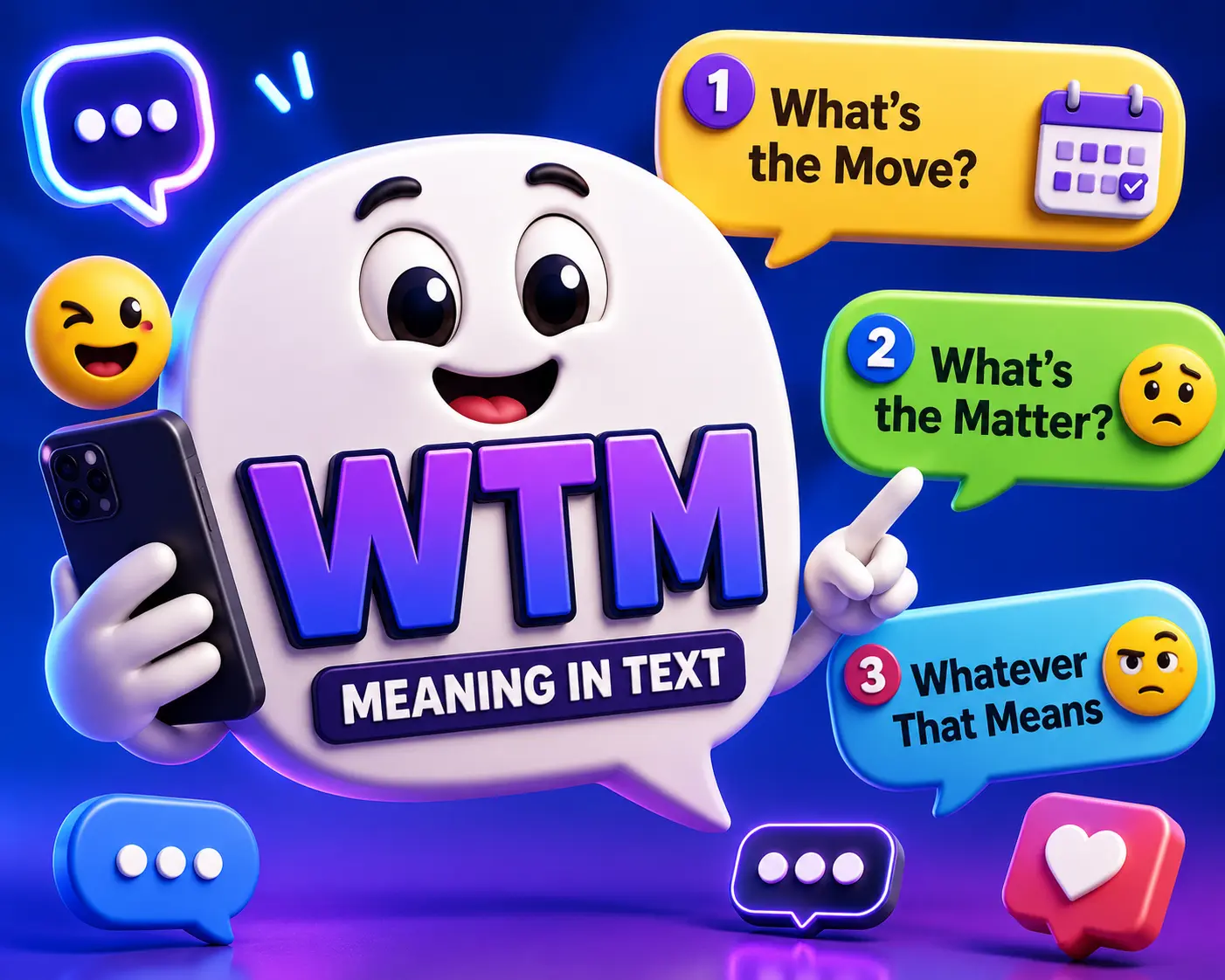
WTM most commonly means “What’s the Move?” in text. When someone sends WTM, they’re usually asking what the plans are, whether anything is happening, or if you’re free to hang out. In some conversations, it can also mean “What’s the Matter?”, depending on the context.
Because the same three letters can represent different phrases, people often search “WTM meaning in text” after receiving a message that isn’t immediately clear. The surrounding conversation almost always tells you which meaning the sender intended.
What Does WTM Mean in Text?
In modern texting, WTM is an internet abbreviation (sometimes called a texting acronym) that most often stands for:
What’s the Move?
Here, “the move” means the plan, the activity, or what everyone is doing next.
Someone asking WTM? is usually asking questions like:
- What’s everyone doing tonight?
- What’s the plan?
- Are we hanging out?
- Is anything happening?
- Where are we meeting?
Examples:
Friend: WTM tonight?
You: We’re meeting at Jake’s around 8.
Or:
A: WTM after class?
B: A few of us are grabbing coffee.
In both cases, WTM is simply asking about plans.
Is WTM an Acronym, Abbreviation, or Slang?
WTM is best described as a texting abbreviation and internet slang acronym.
Unlike formal acronyms used in business or technology, WTM exists almost entirely in casual digital communication.
It appears in:
- SMS text messages
- iMessage
- Instagram DMs
- Snapchat
- Discord
- X (formerly Twitter) conversations
People usually type it because it’s much faster than writing “What’s the move?”
All Real Meanings of WTM
Although “What’s the Move?” is by far the most common meaning today, WTM has a few legitimate interpretations depending on the conversation.
1. What’s the Move? (Most Common)
This is the meaning most people intend.
It asks about:
- Plans
- Activities
- Meetups
- Parties
- Weekend events
- What everyone is doing next
Examples:
- WTM tonight?
- WTM this weekend?
- WTM after work?
- WTM later?
It doesn’t necessarily mean there’s already a plan—it often starts the planning process.
2. What’s the Matter?
The second most common meaning is:
What’s the Matter?
Here, the sender is asking if something is wrong.
Example:
A: You’ve been quiet all day.
B: I’m okay.
A: WTM?
This use is much less common than “What’s the Move?”, but it’s still found in personal conversations where someone notices another person’s mood.
3. Whatever That Means (Less Common)
Occasionally, WTM stands for:
Whatever That Means
This version is usually sarcastic or dismissive.
Example:
A: He said he’s “manifesting success.”
B: WTM.
Here the speaker is implying:
“Whatever that means.”
This interpretation is relatively uncommon compared with the first two and usually depends on obvious context.
Read More: IMO Meaning in Text: What It Really Means & How to Use It
A Common Misunderstanding
Many people assume WTM always means “What’s the Matter?” because it’s similar to abbreviations like WYD (“What You Doing?”) or WYA (“Where You At?”).
In reality, if someone texts:
WTM tonight?
They’re almost certainly asking:
What’s the move?
—not whether something is wrong.
Likewise, if someone writes:
WTM? You seem upset.
The meaning shifts naturally to:
What’s the matter?
The surrounding conversation is the key to interpreting the abbreviation correctly.
Which Apps Is WTM Actually Used On?
Unlike some abbreviations that belong to one platform, WTM appears across several messaging apps. However, usage isn’t equally common everywhere.
SMS and iMessage
Traditional texting remains one of the most common places to see WTM.
Typical messages include:
- WTM tonight?
- WTM after work?
- WTM this weekend?
Friends often use it to coordinate plans without typing an entire sentence.
WTM is regularly used in WhatsApp chats, especially among younger users and friend groups.
Examples:
- WTM after dinner?
- WTM tomorrow?
- WTM this Friday?
The meaning is almost always “What’s the move?”
Instagram Direct Messages
Instagram DMs frequently feature WTM when someone wants to continue chatting after responding to a Story or Reel.
For example:
WTM later?
or
So WTM this weekend?
Again, the abbreviation refers to plans rather than emotions.
Snapchat
Snapchat’s fast, informal messaging style makes WTM a natural fit.
You’ll often see:
- WTM 👀
- WTM tonight
- WTM after school
Because conversations disappear quickly, abbreviations like WTM remain especially popular.
Discord
Discord users occasionally type WTM while organizing games, voice chats, or community events.
Example:
WTM after this match?
Although gaming isn’t the primary meaning, Discord conversations often use WTM while planning what happens next.
X (formerly Twitter)
WTM occasionally appears in replies or casual conversations on X, especially when discussing plans or reacting to local events.
However, it’s considerably less common in public posts than in private messaging.
Where Did WTM Come From?
Unlike internet slang that can be traced to one viral meme or creator, WTM doesn’t have a single documented origin.
Available evidence suggests it developed naturally during the rise of:
- SMS texting
- Online chat rooms
- Instant messaging
- Mobile phone shorthand
As texting encouraged shorter messages, people began abbreviating common questions.
One of those questions was:
What’s the move?
Over time, this naturally became:
WTM
The Phrase “What’s the Move?”
Importantly, “What’s the move?” existed as spoken conversational English before it became an abbreviation.
The expression has long been documented in African American Vernacular English (AAVE), where “the move” refers to the plan, event, or next activity. As with many conversational expressions, it later spread into mainstream internet culture through texting, music, and social media.
Rather than being invented by TikTok, WTM became popular because the existing spoken phrase was shortened for faster typing.
Did TikTok Create WTM?
No.
TikTok helped expose the abbreviation to a larger audience, but WTM was already widely used in texting and messaging before TikTok became popular.
Its history is more closely connected to early SMS culture and informal online messaging than to any single social media trend.
Grammar and Language Role
Understanding how WTM functions grammatically makes it easier to recognize in conversations.
Part of Speech
WTM functions as an abbreviated interrogative phrase.
It replaces a complete question such as:
- What’s the move?
- What’s the matter?
Can It Stand Alone?
Yes.
Most people simply text:
WTM?
without any additional words.
The recipient naturally understands it as a question.
Sentence Position
WTM usually appears:
- At the beginning of a conversation
- Before making plans
- After greeting someone
- As an entire message
Examples:
- WTM?
- Hey, WTM?
- WTM after work?
- WTM this weekend?
Formal or Informal?
WTM is highly informal.
It’s appropriate for:
- Friends
- Family
- Classmates
- Dating conversations
- Online communities
It’s generally inappropriate for:
- Business emails
- Professional Slack messages
- Customer communication
- Academic writing
In formal settings, writing the complete question is the better choice.
Real Chat Examples
1. Friends Planning the Evening
A: WTM tonight?
B: Thinking about grabbing pizza.
A: I’m definitely in.
B: Meet us at 7.
2. College Classmates
A: WTM after the lecture?
B: Library first, then coffee.
A: Sounds good.
B: See you there.
3. Checking on Someone
A: You’ve barely replied today. WTM?
B: Just feeling stressed.
A: Want to talk about it?
B: Yeah, thanks.
4. Group Chat
A: Friday’s finally here! WTM?
B: Movie night?
C: I’m down.
A: Let’s book the tickets.
Tone Variations of WTM in Text
Although WTM usually asks about plans, its tone changes depending on the relationship between the people texting and the situation. Here are four common ways it appears in real conversations.
Funny Tone
A: WTM tonight?
B: Trying to survive my laundry pile first.
A: So… laundry party?
B: Only if pizza is invited.
Sarcastic Tone
A: WTM after waiting three hours for you?
B: Ouch… I deserve that.
A: You definitely do.
B: Coffee’s on me.
Playful Tone
A: WTM later? 👀
B: Depends… are snacks involved?
A: Always.
B: Then count me in.
Serious Tone
A: WTM? You don’t seem like yourself today.
B: I’ve had a rough day at work.
A: Want to talk?
B: Yeah, I’d appreciate that.
More Real Chat Examples
5. Dating Conversation
A: WTM this weekend?
B: Nothing planned yet. Why?
A: Dinner together?
B: I’d like that.
6. Coworkers
A: WTM after today’s meeting?
B: I’m heading home.
A: Same here. Long day.
B: Definitely.
7. Siblings
A: WTM after school?
B: Mom wants us home early.
A: Guess gaming later then.
B: Deal.
8. Parent and Teen
Parent: WTM tonight?
Teen: Just hanging out with friends.
Parent: What time will you be back?
Teen: Around nine.
9. Gaming Friends (Discord)
A: WTM after this match?
B: Ranked again?
A: One more game.
B: I’m ready.
10. Stranger Becoming Friends
A: WTM this Friday?
B: Nothing much.
A: Some friends are grabbing burgers.
B: Sounds fun.
11. Weekend Group Chat
A: WTM tomorrow?
B: Beach trip?
C: I’m bringing snacks.
A: Perfect.
12. Long-Time Friends
A: Haven’t seen you in weeks. WTM?
B: Been busy with work.
A: Let’s fix that this weekend.
B: Absolutely.
How to Reply to WTM
Since WTM is usually asking about plans, your reply depends on what you’re doing or the tone you want to set.
Funny Reply
“Trying to become a millionaire before dinner. 😆”
Serious Reply
“I’m staying home tonight. I’ve got an early meeting tomorrow.”
Flirty Reply
“Hopefully making plans with you.”
Neutral Reply
“Nothing much. What do you have in mind?”
WTM Compared With Similar Texting Abbreviations
| Term | Meaning | Usage Context | Tone | Popularity | Confusion Risk |
|---|---|---|---|---|---|
| WTM | What’s the Move? / What’s the Matter? | Planning or checking in | Casual | Very High | Medium |
| WYD | What You Doing? | Asking current activity | Casual | Very High | Low |
| WYA | Where You At? | Asking location | Casual | Very High | Low |
| HMU | Hit Me Up | Asking someone to contact you | Friendly | High | Low |
| LMK | Let Me Know | Requesting an update | Neutral | High | Low |
| NVM (opposite context) | Never Mind | Ending the conversation or withdrawing a request | Neutral | High | Low |
Who Uses WTM?
Gen Z
Gen Z uses WTM frequently in text messages, Snapchat, Instagram DMs, and group chats. It’s often the quickest way to ask whether friends have plans without typing a full sentence.
Millennials
Millennials understand WTM but are generally a little more likely to type the full question, especially in one-on-one conversations. Those who grew up with SMS abbreviations still use it comfortably in casual chats.
Regional Usage
WTM is most common in the United States, where the phrase “What’s the move?” is part of everyday conversational English in many communities. It is also understood by English-speaking users in Canada and appears internationally among people familiar with American internet slang, although usage is less widespread outside North America.
Platform Breakdown
- SMS/iMessage: Very common for making plans.
- WhatsApp: Frequently used in friend groups.
- Instagram DMs: Common when starting conversations or arranging meetups.
- Snapchat: Popular because of quick, casual messaging.
- Discord: Used when planning games or voice chats.
- X (formerly Twitter): Occasionally appears in replies, but less often than in private messages.
Is WTM Rude or Offensive?
No. WTM is not considered rude, offensive, or profanity.
However, context still matters.
WTM is perfectly acceptable when texting:
- Friends
- Siblings
- Partners
- Classmates
- Gaming friends
It is usually too informal for:
- Teachers
- Professors
- Managers
- Clients
- Professional emails
If you’re contacting someone in a formal setting, writing “What are the plans?” or “What would you like to do?” sounds more appropriate.
Real-World Observation
One reason WTM has remained popular is that it opens a conversation without assuming a plan already exists. Instead of asking a yes-or-no question like “Are we going out?”, it invites the other person to suggest ideas. That flexibility makes it useful in everyday texting, whether friends are organizing dinner, gamers are deciding what to play next, or classmates are figuring out weekend plans. It survives because it’s short, natural, and easy to answer in almost any casual conversation.
Frequently Asked Questions
What does WTM mean in text from a girl?
Most of the time, it means “What’s the Move?” She’s asking about your plans or seeing if you’d like to do something together. It isn’t automatically flirtatious—the meaning depends on your relationship and the conversation. If you’ve been chatting casually or getting to know each other, it can also be an invitation to keep the conversation going or make plans.
What does WTM mean in text from a guy?
In most cases, a guy texting WTM is simply asking what you’re doing or whether you have plans. Friends often use it to organize hangouts, while someone you’re dating may use it to suggest spending time together. The abbreviation itself isn’t romantic; the surrounding messages determine the tone.
Does WTM always mean “What’s the Move”?
No. While “What’s the Move?” is by far the most common meaning in texting today, WTM can also mean “What’s the Matter?” if someone is checking on you. A less common meaning is “Whatever That Means,” usually used sarcastically. Reading the surrounding conversation is the easiest way to identify the intended meaning.
Is WTM the same as WYD?
No. Although they’re related, they ask different questions.
- WTM = What’s the Move? (What are the plans?)
- WYD = What You Doing? (What are you doing right now?)
Someone might text WYD to start a conversation, while WTM usually comes after they’re thinking about making plans.
Can WTM be used in a group chat?
Yes. In fact, group chats are one of the most common places to see it. Someone may send “WTM tonight?” to ask if anyone wants to hang out or suggest an activity. Since multiple people can reply with ideas, it’s a quick way to start planning.
Is it rude to reply with just “WTM”?
Not usually. Among friends, sending only WTM? feels natural and conversational. However, with someone you don’t know well or in a professional context, it can seem abrupt. Adding a greeting or a little context often makes your message friendlier.
Should I use WTM at work or school?
For casual chats with classmates or close coworkers, it’s generally fine. However, avoid using it in emails, formal messages, or conversations with teachers, professors, managers, or clients. Writing the full question sounds more professional and avoids confusion.
Is WTM still popular?
Yes. WTM remains a common texting abbreviation because it’s short, easy to type, and immediately understood by many younger English speakers. While new slang terms appear every year, WTM has stayed useful because asking about plans is something people do every day.
Conclusion
If someone texts WTM, they usually mean “What’s the Move?” and want to know the plans for later. In other situations, it can mean “What’s the Matter?” or, more rarely, “Whatever That Means.” Looking at the surrounding conversation will almost always reveal the correct interpretation.
Unlike many internet abbreviations that fade quickly, WTM continues to be useful because it saves time while expressing a question people ask every day. Whether you’re arranging a weekend meetup, checking in with a friend, or chatting in a group message, it’s a simple shorthand that fits naturally into modern texting.
Usage Tips
- Use WTM when asking friends what the plans are.
- Read the surrounding conversation to determine which meaning is intended.
- Reply with your plans or suggest an activity if it means “What’s the Move?”
- Use the full phrase instead of the abbreviation in formal or professional conversations.
Common Mistakes
- Assuming WTM always means “What’s the Matter.”
- Using it in business emails or professional messages.
- Ignoring the conversation context before deciding what it means.
- Thinking it’s exclusive to one app when it’s used across several messaging platforms.
When to Use WTM
Use WTM when:
- You’re texting friends or family.
- You’re making plans.
- You’re chatting casually on WhatsApp, Snapchat, Instagram DMs, Discord, or SMS.
- You want a quick, informal way to ask what’s happening.
Avoid WTM when:
- Writing formal emails.
- Messaging your boss, teacher, or clients.
- The recipient may not be familiar with texting abbreviations.
- Clarity is more important than brevity.