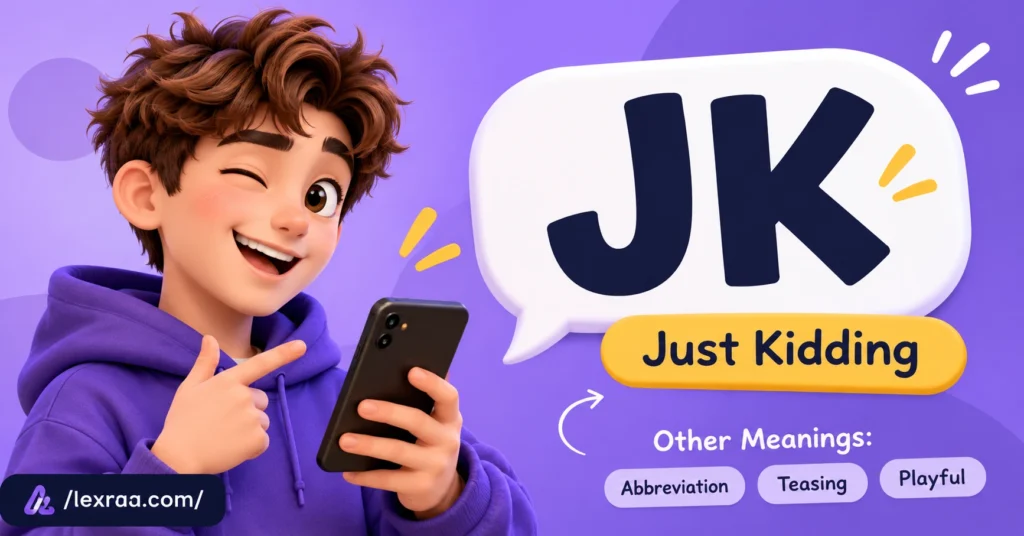
Someone sends you a surprising message, then adds two letters: JK. What does it mean? In texting and online conversations, JK stands for “just kidding.” It tells the reader that the previous comment was meant as a joke, tease, or playful exaggeration rather than a serious statement.
For example:
“I told everyone you forgot your own birthday. JK 😂”
The sender is letting you know that the statement was not meant to be taken literally. You may also see it written as jk or j/k.
What Does JK Stand For?
JK is an initialism formed from the first letters of just kidding. People normally pronounce the letters separately as “jay-kay,” rather than saying them as one word.
It works as a quick tone clarification. Someone might make an exaggerated comment, tease a friend, or pretend to announce something dramatic, then add JK to show that they are joking.
Here is a simple example:
- Without JK: “I’m never speaking to you again.”
- With JK: “I’m never speaking to you again, JK.”
The second version signals that the statement is playful, although the relationship and surrounding conversation still matter.
How People Use JK in Conversations
JK has a few closely related uses. Understanding the purpose behind it can help you read the message more accurately.
1. To Make a Teasing Comment Sound Playful
Friends sometimes use JK after light teasing to make their intentions clearer.
“Your cooking should come with a warning label, JK.”
The sender is probably joking about the food rather than making a serious complaint. Whether the comment feels funny or hurtful depends on the relationship and the subject.
2. To Take Back an Exaggerated Statement
People also use JK after pretending to make a dramatic announcement.
“I’m selling all my clothes and moving to the moon. JK.”
The second part tells the reader not to treat the first statement as an actual plan.
3. To Soften a Potentially Awkward Comment
A person may add JK after a remark that could sound too direct in a text message.
“You are impossible to shop for, JK.”
Here, the abbreviation signals that the sender intends a playful tone. However, it cannot guarantee that the other person will interpret the comment that way.
4. To Test the Reaction to a Joke
Sometimes someone makes a playful suggestion or slightly risky comment and uses JK to leave room to retreat if the other person reacts badly.
For example:
“We should run away and open a coffee shop together. JK.”
The sender may simply be joking, or they may be testing how the other person responds. The abbreviation alone cannot tell you which interpretation is correct.
JK vs. J/K: Are They Different?
No. JK and J/K have the same meaning: “just kidding.”
The slash in J/K is an older-looking written variation. Lowercase jk is also common in casual messages. These are formatting differences, not separate expressions.
| Form | Meaning | Typical use |
|---|---|---|
| JK | Just kidding | Texts and online messages |
| jk | Just kidding | Casual, informal messages |
| J/K | Just kidding | Alternative written form |
You do not need to interpret them differently when reading a conversation.
Example Conversations Using JK
These examples show how the abbreviation can work in different relationships and tones.
1. Funny: Friends in a Group Chat
Alex: I just signed you up to sing at karaoke tonight.
Sam: You did WHAT?
Alex: Relax, I didn’t. JK 😂
Sam: I was about to block you.
2. Sarcastic: Siblings
Mia: You finished the last slice of pizza again?
Leo: It was sitting there looking lonely.
Mia: You’re officially banned from this kitchen. JK.
Leo: Too late. I’m already making a sandwich.
3. Playful: Dating Conversation
Chris: I think you owe me dinner after making me laugh all day.
Taylor: That’s a very expensive sense of humor.
Chris: Fine, I’ll accept dessert instead. JK… unless?
Taylor: Maybe we can negotiate.
4. Serious: Coworkers
Jordan: I might have sent the wrong attachment to the client.
Casey: Please tell me you’re joking.
Jordan: JK, I checked before sending. The correct file went through.
Casey: Good. You nearly gave me a heart attack.
5. Family: Parent and Teenager
Dad: I’m changing the Wi-Fi password tonight.
Riley: You wouldn’t dare.
Dad: JK. Finish your homework first.
Riley: That was unnecessarily stressful.
6. Playful: Close Friends
Nina: Your playlist has officially ruined my music taste.
Ava: You’re welcome. My work here is done.
Nina: I’m deleting your music app access. JK.
Ava: You wouldn’t survive without my recommendations.
How to Reply When Someone Texts JK
Your response depends on whether the person is teasing, making a joke, or clarifying something that sounded serious.
- Funny: “You almost had me 😂”
- Serious: “Okay, I just wanted to make sure you meant that as a joke.”
- Neutral: “Haha, got it.”
- Flirty: “I was hoping you weren’t kidding 😉”
You do not have to laugh along if the original comment made you uncomfortable. A simple “I know you’re joking, but that didn’t feel great” is a reasonable response.
Does JK Always Mean the Person Was Only Joking?
Not necessarily. JK tells you how the sender wants the earlier statement to be understood, but it does not prove what they genuinely intended.
Imagine someone texts:
“Your presentation was terrible. JK.”
They may be teasing, trying to soften an honest criticism, or attempting to avoid responsibility for an unkind remark. You need the surrounding conversation and your relationship with the sender to judge the tone.
This is an important distinction: JK can clarify intent, but it cannot automatically erase the effect of the original words.
A 2015 study published in the Journal of Pragmatics examined “just kidding” and variants such as JK in American English. The researchers identified several conversational functions, including signaling non-serious intent, repairing humor that did not land, and helping speakers return to a serious topic. In other words, the expression does more than simply announce that something was funny.
JK vs. Similar Text Abbreviations
JK is sometimes confused with other short expressions because they can appear in the same conversation. However, each one serves a different purpose.
| Term | Meaning | Tone | Popularity | Confusion Risk |
|---|---|---|---|---|
| JK | Just kidding | Playful, teasing | Commonly recognized | Low |
| LOL | Laughing out loud | Amused, casual | Commonly recognized | Medium |
| TBH | To be honest | Direct, sincere | Commonly recognized | Low |
| FR | For real | Serious, emphatic | Commonly recognized | Medium |
| NGL | Not gonna lie | Candid, informal | Commonly recognized | Medium |
| No joke | Seriously; not joking | Emphatic | Common phrase | Medium |
There is no exact universal opposite of JK, but expressions such as “seriously,” “for real,” and “no joke” can communicate that a statement should be taken literally.
The biggest distinction is between JK and honesty markers:
- JK: The previous comment was meant as a joke.
- TBH: The sender is presenting something as their honest opinion.
- FR: The sender is emphasizing that something is genuine or serious.
For example, “You’re the funniest person I know, JK” changes the meaning of the compliment. “You’re the funniest person I know, TBH” presents it as a sincere opinion.
Another expression with a similar playful purpose is JSP meaning in text, which can stand for “Just Playing” in English-language conversations.
Is JK Rude or Safe to Use?
JK is not inherently rude, offensive, or profane. It is an informal abbreviation that is generally suitable for casual conversations.
However, the words before it matter.
Consider these two messages:
- “You’re terrible at choosing movies, JK 😂”
- “Nobody likes you, JK.”
The first might be friendly teasing between people who know each other well. The second could still be hurtful, even with JK at the end.
At school: JK is generally fine in informal messages with classmates and friends. Use complete, clear language in assignments or formal communication.
At work: It can fit a relaxed team chat, but it is usually better to avoid it in formal emails, client communication, or serious discussions where clarity matters.
With people you do not know well: Be careful with teasing. A stranger may not recognize your humor, and JK may not be enough to prevent misunderstanding.
Why JK Still Works in Text Conversations
JK solves a small but common communication problem: written messages do not automatically show facial expressions, vocal tone, or playful intent.
A sentence that sounds harmless when spoken with a smile can look insulting when read on a screen. Adding JK gives the reader a clue about how the sender wants the message interpreted.
It also gives people a quick way to shift between joking and serious conversation. That flexibility helps explain why the abbreviation remains recognizable even though it has been around for decades.
When someone wants to emphasize that they are telling the truth rather than joking, STG meaning in text is a useful comparison.
The catch is that the reader still has to decide whether the joke feels appropriate. Two letters can clarify tone, but they cannot make every comment harmless.
Frequently Asked Questions
1. What does JK mean from a girl or a guy?
JK means “just kidding” regardless of who sends it. It does not have a different standard meaning based on the sender’s gender. The relationship and conversation provide more useful clues about the intended tone.
2. What does JK mean at the end of a sentence?
At the end of a sentence, JK usually tells you that the preceding statement was not meant seriously. It may soften a tease, clarify an exaggerated comment, or signal a joke. Read the entire message before deciding how the person intended it.
3. What does JK mean when someone says something mean?
It usually means the sender is claiming the comment was a joke. However, adding JK does not guarantee that the remark was harmless or that the recipient should accept it. If it bothered you, you can say so directly.
4. What does “JK LOL” mean?
“JK LOL” combines “just kidding” with “laughing out loud.” Together, they reinforce a playful or joking tone. People may use both to make a message sound less serious, although neither guarantees that the joke will land well.
5. What does “JK unless” mean?
“JK unless” can appear when someone makes a suggestion and then jokingly takes it back while leaving open the possibility that they meant it. For example, “We should go on a date. JK unless you want to?” The wording is playful, but the person may be checking whether the other person is interested.
6. Is JK the same as joking?
They are closely related, but they are not exactly the same form. “Joking” describes the action of making a joke, while JK is a short written signal meaning “just kidding.” In a message, both can communicate that a statement should not be taken literally.
7. Is JK still used in texting?
Yes, JK remains a recognizable abbreviation in digital communication. It is not limited to a particular age group or one social platform. People can use it in ordinary messages whenever they want to clarify that a comment was meant as a joke.
Final Thoughts
In slang and texting, JK means “just kidding.” It is a short way to mark a comment as playful, teasing, or not entirely serious. You may see it as JK, jk, or J/K, but the meaning stays the same.
The most useful thing to remember is that JK explains how someone wants a message to sound; it does not automatically make a hurtful remark acceptable. Use it for lighthearted jokes when the other person is likely to understand your humor, and choose clearer wording when the conversation is serious.