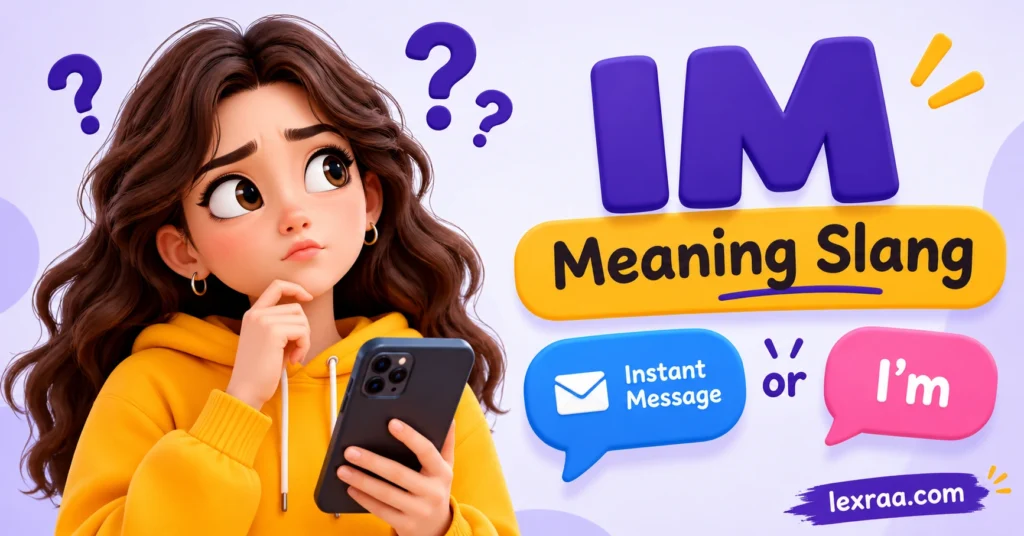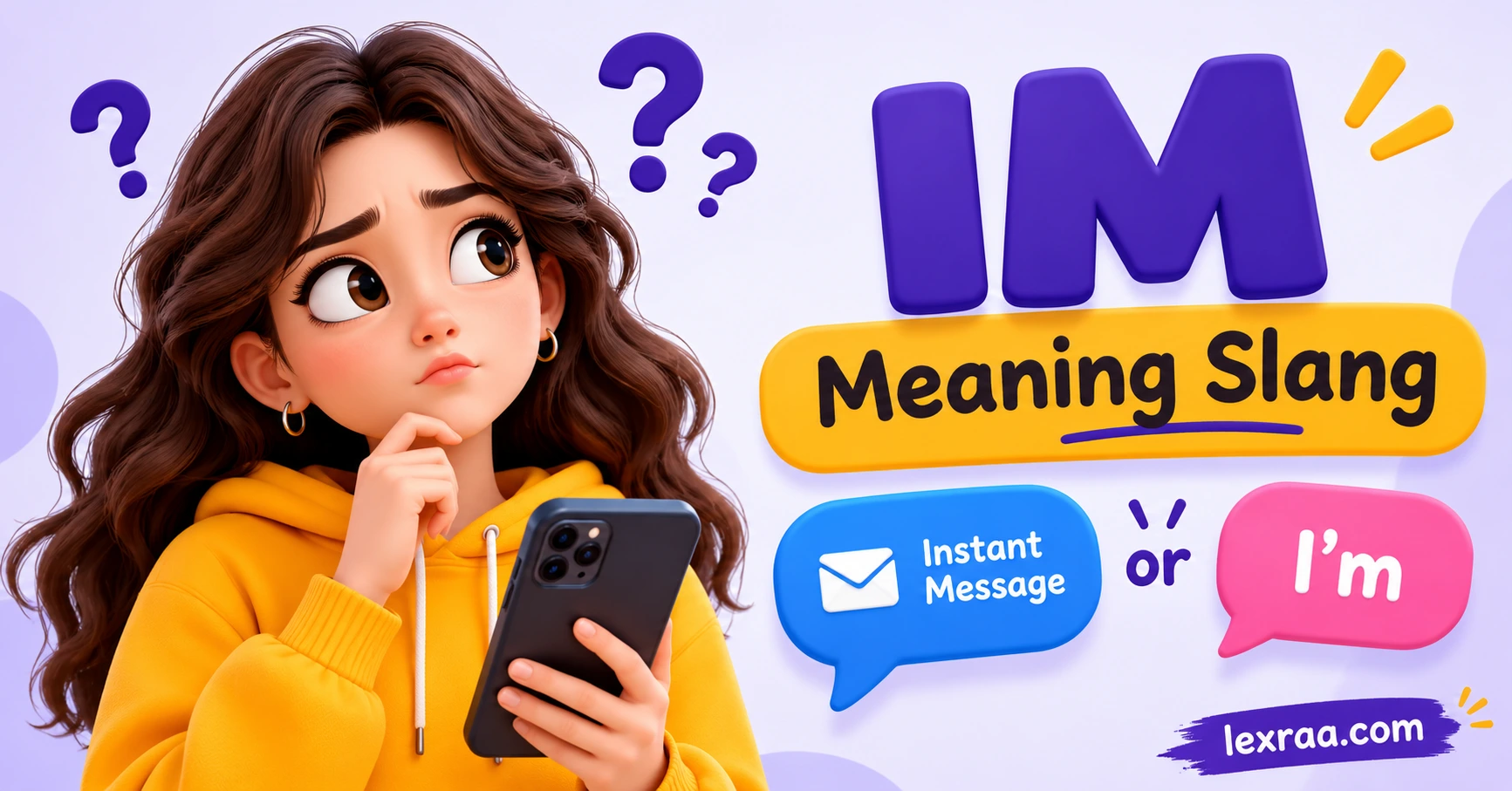
Two letters can mean different things depending on where they appear in a message. If someone tells you, “Send me an IM,” they’re probably asking you to send an instant message. However, if someone writes, “im tired,” they probably mean “I’m tired.”
IM most commonly stands for “instant message” or “instant messaging” in online communication. It’s an abbreviation for sending or receiving messages over the internet. In casual texting, lowercase “im” can also be an informal way of writing “I’m” (I am) without the apostrophe.
The difference comes down to context, capitalization, and how the letters fit into the sentence. Let’s look at both meanings so you can understand what someone actually intends.
What Does IM Mean in Texting?
The most established digital meaning of IM is Instant Message. It refers to a written message exchanged through an online messaging service, usually allowing people to communicate in real time.
For example:
- “I’ll send you an IM later.”
- “Did you get my IM?”
- “You can IM me whenever you need help.”
In these sentences, IM refers to a private digital message or the act of sending one.
There’s also a closely related meaning: Instant Messaging. This describes the communication method or service itself rather than one individual message.
Here’s the simple distinction:
| Expression | Meaning |
|---|---|
| IM | Instant Message |
| Instant messaging | The process of exchanging online messages |
| IM me | Send me an instant message |
| I got an IM | I received an instant message |
| I’m | I am |
IM is an abbreviation, not technically a newly invented slang word. However, it belongs to the informal vocabulary of internet communication.
The Other Meaning: Does IM Mean I’m?
Yes, lowercase “im” can mean “I’m” in casual messages.
“I’m” is the standard contraction of “I am.” Some people leave out the apostrophe when typing quickly, especially in informal conversations.
For example:
- “im coming home” = “I’m coming home.”
- “im so excited” = “I’m so excited.”
- “im not ready yet” = “I’m not ready yet.”
- “im watching a movie” = “I’m watching a movie.”
This usage is different from the abbreviation for instant messaging.
Consider these two messages:
Message 1: “IM you after work.”
Meaning: I’ll send you an instant message after work.
Message 2: “im leaving after work.”
Meaning: I’m leaving after work.
The first uses IM as a messaging abbreviation. The second uses im as an informal spelling of a contraction.
One small punctuation mark can completely change how you interpret the message.
How to Tell Which Meaning Someone Intends
If you’re unsure whether someone means instant message or “I’m,” look at the sentence structure.
Here are three useful clues:
1. Check what comes after IM.
If someone writes “IM me,” “send an IM,” or “check your IM,” they’re almost certainly talking about instant messaging.
If the letters are followed by an adjective, feeling, or activity, the intended meaning may be “I’m.”
For example, “im happy” makes sense as “I’m happy,” not “instant message happy.”
2. Look at capitalization.
IM is commonly written in uppercase when referring to instant messaging.
Lowercase im frequently appears as an informal version of I’m, although capitalization alone isn’t definitive. People don’t always follow consistent typing habits.
3. Read the complete conversation.
The surrounding messages can reveal whether someone is discussing a messaging service or describing themselves.
For example, if a friend asks, “Where should I contact you?” and you reply, “IM me,” the meaning is clear.
If you reply, “im at home,” you’re describing your location.
The best approach is to interpret the whole sentence rather than treating the two letters as having just one meaning.
Where Is IM Used?
IM developed alongside internet-based communication, and its meaning isn’t tied to one particular social media platform.
The abbreviation can appear in several digital communication settings:
- WhatsApp: Someone might use IM when referring to sending a private online message.
- Facebook Messenger: IM can describe a message exchanged through the messaging service.
- Instagram: People may use the abbreviation when discussing private online conversations.
- Online gaming: Players can use IM to refer to private messages exchanged while gaming.
- Workplace communication: Employees may use IM when discussing quick messages through workplace communication tools.
These are examples of contexts where instant messaging takes place, not evidence that IM is an official feature name or widely established abbreviation on every platform.
The term is also found in dictionaries and technology terminology. Cambridge defines IM as an abbreviation for instant messaging and recognizes its use as a verb meaning to communicate through an online messaging program. definition in the Cambridge English Dictionary+1
Where Did IM Come From?
IM didn’t originate as a TikTok expression or a recently invented Gen Z abbreviation. Its history goes back to the earlier days of computer communication.
The concept of instant messaging existed long before smartphones and modern social media.
Some important developments include:
- 1960s: Early computer systems supported forms of electronic messaging between users.
- 1970s: The UNIX
talkprogram allowed two users to exchange text interactively on their computer terminals. - 1985: Quantum Link introduced an online messaging service for Commodore 64 users.
- 1996: ICQ helped bring internet-based instant messaging to a much wider audience.
- Late 1990s and early 2000s: Services such as AOL Instant Messenger and Windows Messenger helped make online messaging familiar to everyday computer users.
Swansea University’s History of Computing Collection documents these developments, including the introduction of Quantum Link and the later growth of internet messaging. Swansea University Digital Collections+1
The abbreviation IM comes directly from the first letters of instant messaging or instant message. There isn’t a reliably established individual who invented the abbreviation, so attributing it to a particular person or social media platform would be misleading.
IM vs. Similar Texting Abbreviations
IM is easy to confuse with other short forms used in digital conversations. However, these abbreviations serve different purposes.
| Term | Meaning | Tone | Popularity | Confusion Risk |
|---|---|---|---|---|
| IM | Instant Message | Casual | Established | Medium |
| DM | Direct Message | Casual | Very common | High |
| PM | Private Message | Neutral | Established | Medium |
| SMS | Short Message Service | Neutral | Common | Low |
| TXT | Text | Casual | Informal | Low |
| I’m | I am | Everyday | Very common | High |
IM is related to other common texting abbreviations. For example, what WYD means in texting is another useful abbreviation to understand when chatting online.
A few distinctions are especially useful:
- IM vs. DM: IM refers to instant messaging generally, while DM specifically refers to a direct or private message.
- IM vs. PM: Both can refer to private online communication, but PM emphasizes the private nature of the message.
- IM vs. SMS: IM generally involves internet-based messaging, whereas SMS is a mobile text messaging service.
- IM vs. I’m: IM refers to online messaging, while I’m is a contraction meaning I am.
There isn’t a genuine opposite of IM. These terms describe different communication methods rather than opposing ideas.
Example Conversations Using IM
The easiest way to understand IM is to see how it fits into everyday conversations. These examples show both its instant-messaging meaning and the informal use of im for I’m.
People often use abbreviations such as HYD to start conversations. You can also learn more about the HYD meaning in chat.
1. Casual Conversation Between Friends
Alex: Are you free to discuss the weekend plans?
Jordan: Yeah, just send me an IM.
Alex: Okay, I’ll message you after dinner.
Jordan: Perfect, I’ll be around.
Here, IM means instant message. Jordan is asking Alex to contact them through an online messaging service.
2. Funny Conversation Between Siblings
Sister: Did you eat the last slice of pizza?
Brother: No idea what you’re talking about.
Sister: im literally looking at the empty box.
Brother: The pizza disappeared mysteriously. Case closed.
Here, im means “I’m.” The sister is casually saying, “I’m literally looking at the empty box.”
3. Sarcastic Conversation in a Group Chat
Ryan: Anyone know why the project file isn’t updated?
Mia: Maybe we should communicate before the deadline.
Ryan: Brilliant idea. Should I send you an IM?
Mia: Sure. Revolutionary technology, apparently.
Ryan uses IM to refer to an instant message. The sarcasm comes from pretending that online messaging is a groundbreaking solution.
4. Serious Conversation Between Coworkers
Manager: I need to discuss the revised schedule with you.
Employee: Of course. Would you prefer an email?
Manager: An IM is fine. It should only take a few minutes.
Employee: Sounds good. I’ll look out for it.
In a workplace setting, IM refers to a quick online message. It can be used when a full email or meeting isn’t necessary.
5. Playful Conversation Between Two People Dating
Ella: Why are you smiling at your phone?
Noah: Someone just sent me a really sweet message.
Ella: im guessing it wasn’t your boss.
Noah: Definitely not. She’s much prettier.
Ella uses im as an informal spelling of “I’m.” Her sentence means “I’m guessing it wasn’t your boss.”
6. Family Conversation
Mom: Can you tell me when you’re coming home?
Sam: im leaving in about 20 minutes.
Mom: Okay, drive carefully.
Sam: I will. See you soon!
Here, im means “I’m.” Sam is simply telling their mother that they’re leaving shortly.
These examples demonstrate why context matters more than capitalization alone.
How to Reply When Someone Uses IM
Your response depends on what the other person is asking.
If someone says “IM me,” they’re inviting you to send them an instant message. You can respond naturally without overthinking the abbreviation.
Neutral replies:
- “Sure, I’ll message you.”
- “Okay, I’ll send you one.”
- “Sounds good!”
Funny replies:
- “Only if you promise to reply!”
- “Incoming message in three, two, one.”
- “Prepare yourself for my legendary typing skills.”
Serious replies:
- “Of course. I’ll contact you shortly.”
- “Sure, I’ll send you the details.”
- “I’ll message you when I’m available.”
Playful or flirty replies:
- “Only if you’re going to keep the conversation interesting.”
- “I was hoping you’d ask.”
- “You don’t need to ask twice.”
If someone writes “im” as part of a sentence, there’s usually no need to respond to the abbreviation itself. Simply answer what they’re saying.
For example:
Friend: im so excited for tomorrow!
You: Same! It’s going to be amazing.
Is IM Rude or Appropriate to Use?
No. IM isn’t inherently rude, offensive, or inappropriate. It’s a neutral abbreviation associated with online communication.
However, the setting matters.
| Situation | Appropriate? | Reason |
|---|---|---|
| Texting friends | Yes | Casual communication |
| Family group chats | Yes | Easy to understand |
| Online gaming | Yes | Fits digital conversations |
| Workplace messaging | Usually | Common communication shorthand |
| Formal business emails | Better to spell it out | Abbreviations may reduce clarity |
| Academic writing | Generally avoid | Use formal terminology |
The same applies to writing “im” instead of “I’m.” Friends may understand it perfectly, but standard spelling is preferable in school assignments, professional messages, and formal writing.
If you’re communicating with someone unfamiliar with internet abbreviations, writing “instant message” instead of IM can prevent confusion.
Why Does IM Still Work in Online Conversations?
IM has stayed useful because it describes something people do constantly: exchange messages without waiting for a formal email or arranging a phone call.
Its strength is simplicity. Instead of explaining that someone should contact you through an internet-based messaging service, you can simply say, “IM me.”
There’s another interesting detail: IM can function as both a noun and a verb. You can receive an IM, send an IM, or IM someone. Oxford recognizes this informal verb usage, including forms such as IMing and IM’d. oxfordlearnersdictionaries.co.uk+1
However, the abbreviation has a slightly different feel from newer terms such as DM. IM is strongly associated with the broader history of instant messaging, while DM is more closely associated with direct-message features on modern social platforms.
Frequently Asked Questions About IM
1. Does IM mean instant message or instant messaging?
It can mean both, depending on the sentence. Instant message refers to an individual message, while instant messaging describes the activity or service of exchanging messages online. Both meanings are established in English dictionaries.
2. Is IM an old-fashioned texting abbreviation?
IM has been around since the early days of internet communication. Some people may associate it with older messaging services such as AOL Instant Messenger. However, the abbreviation remains understandable and is still used in technology and communication contexts.
3. Can IM be used as a verb?
Yes. You can use IM as a verb when asking someone to send you an online message. For example, “I’ll IM you tomorrow” means “I’ll send you an instant message tomorrow.” Its past-tense form can be written as IM’d or IMed.
4. Does IM mean the same thing as iMessage?
No. IM is a general abbreviation for instant messaging or an instant message. iMessage is Apple’s specific messaging service. An iMessage can be an instant message, but the two terms aren’t interchangeable.
5. What does IM mean when someone says “IM me”?
It means “send me an instant message.” The person is asking you to contact them through an online messaging service rather than necessarily calling them or sending a traditional email. It’s a casual way of requesting a digital conversation.
6. Is im without an apostrophe grammatically correct?
Not when you’re using it as a replacement for “I’m” in standard English. The correct spelling is “I’m,” with an apostrophe representing the omitted letter in “I am.” Lowercase im is common in informal typing, but it isn’t the standard grammatical form.
7. Is IM the same as texting?
Not exactly. Texting often refers to exchanging mobile text messages, including SMS, while instant messaging generally refers to internet-based communication. Modern messaging applications can blur this distinction because they may support several types of messages in one place.
8. Should I write IM or I’m?
Choose the spelling according to what you’re trying to communicate. Use IM when referring to an instant message or instant messaging, and use I’m when you mean “I am.” In professional writing, avoid replacing I’m with im just to save a few characters.
Conclusion
IM usually means Instant Message or Instant Messaging in digital communication. It’s an established abbreviation that describes exchanging messages online and can also be used as a verb.
However, lowercase “im” can mean “I’m” when someone leaves out the apostrophe in casual texting.
Remember these simple distinctions:
- IM: Instant Message.
- Instant messaging: Exchanging messages online.
- IM me: Send me an instant message.
- I’m: I am.
- im: An informal, nonstandard spelling of I’m in casual messages.
The most important thing is to read the surrounding sentence before deciding what someone means. Once you understand the context, distinguishing IM from I’m becomes much easier.