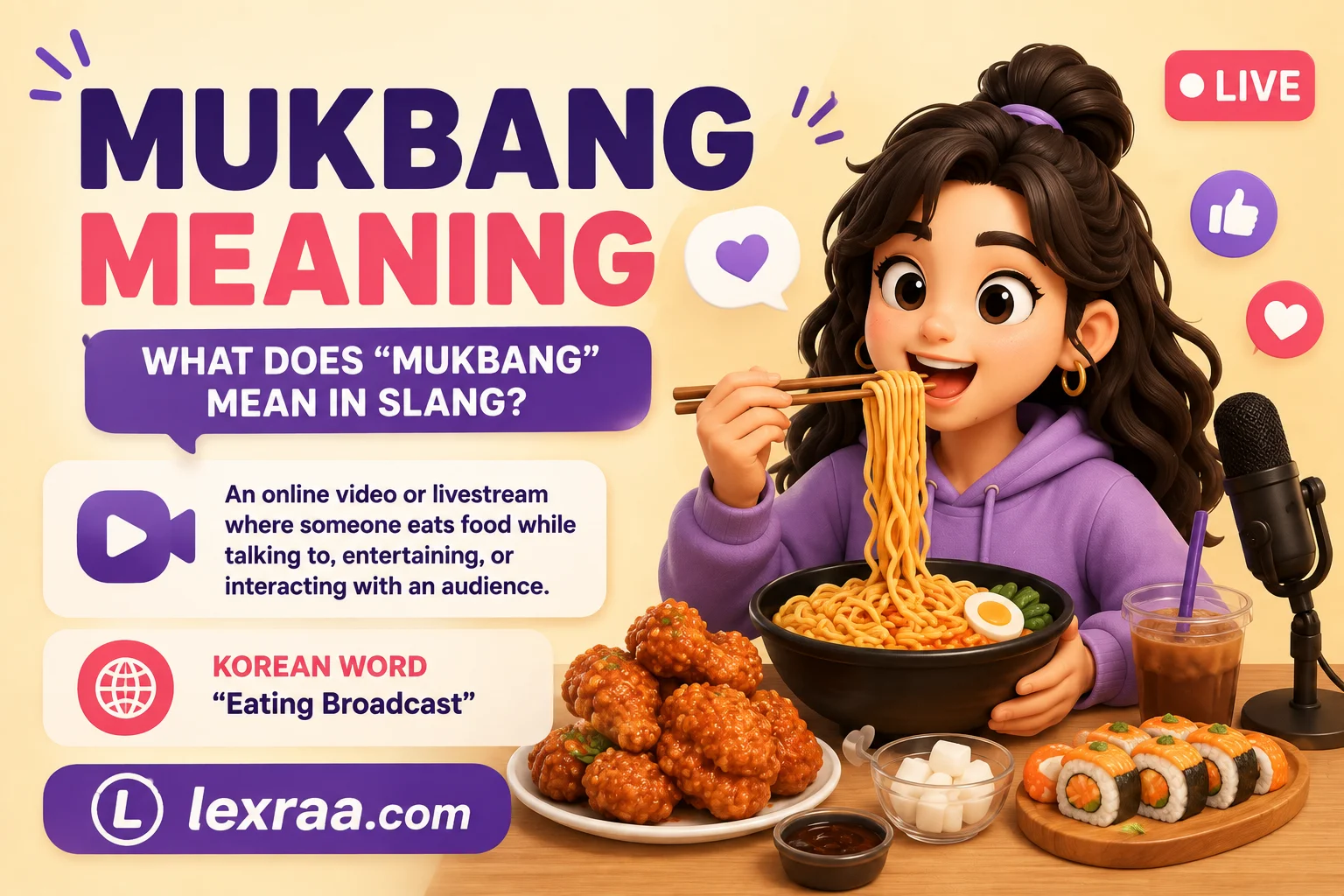
Mukbang means an online video or livestream where someone eats food while talking to, entertaining, or interacting with an audience. The word comes from Korean and is best understood as “eating broadcast.”
Unlike abbreviations such as LOL or BRB, mukbang is not an acronym. It is a Korean word formed by combining shortened parts of words associated with eating and broadcasting, and it became the name of an entire internet-content genre.
What Does Mukbang Mean?
In everyday internet use, a mukbang is content centered around someone eating in front of a camera.
The creator might eat ramen, fried chicken, seafood, burgers, desserts, Korean dishes, or another meal while chatting with viewers. Some videos are heavily edited, while others are livestreams where the audience can comment in real time.
The food itself is only part of the attraction. The host’s personality, conversation, reactions, presentation, and interaction with viewers can be equally important.
That’s why calling mukbang simply “a person eating a lot of food” misses part of the idea. Large portions are common and are part of the genre’s history, but mukbang can take different forms, including more ordinary meals and food-focused videos.
Is Mukbang Slang?
It’s more accurate to call mukbang a Korean internet term or borrowed cultural term than ordinary English slang.
The Korean term is 먹방 (meokbang). In English-language internet culture, mukbang became the commonly used spelling for the genre. Oxford classifies it as a noun from Korean.
So if someone says:
“I watched a mukbang last night.”
They mean they watched an eating-focused video or livestream.
If someone says:
“She makes mukbang videos.”
They mean her content involves eating on camera, usually while engaging with viewers.
What Does Mukbang Literally Mean?
The word is a blend of Korean terms connected with eating and broadcasting.
Oxford gives the origin as a blend of meokda, meaning “to eat,” and bangsong, meaning “broadcast.” Korean-language references also explain 먹방 as a shortened form associated with 먹는 방송, essentially “eating broadcast.”
This is why “eating broadcast” is a better literal explanation than trying to translate mukbang into an English slang phrase.
Read More: GC Meaning: What Does “GC” Mean in Text and Slang?
A Common Misunderstanding About Mukbang
One common misunderstanding is that every mukbang is automatically a binge-eating video.
Large quantities of food are certainly associated with the genre, and many well-known examples deliberately emphasize enormous meals. But the broader definition is about broadcasting or recording the experience of eating for an audience, not a strict requirement that someone consume a particular amount of food.
Another misconception is that mukbang is simply an English internet trend. It isn’t. The modern genre developed in South Korea before becoming widely popular internationally.
Where Did Mukbang Come From?
The modern mukbang phenomenon emerged in South Korea in the late 2000s, particularly around online livestreaming.
Research literature commonly places its emergence around 2008–2010, with AfreecaTV playing an important role in developing the format. AfreecaTV is now known as SOOP.
There isn’t a reliable basis for saying that one person definitively “invented” all mukbang. Early eating broadcasts appeared within the developing Korean livestreaming ecosystem, and the format gradually became recognizable as its own genre. One historical account traces early eating-show broadcasts on AfreecaTV to around 2008, while academic sources generally describe the phenomenon as emerging in the late 2000s.
The format became particularly associated with hosts known as broadcast jockeys, or BJs, who interacted with viewers while eating on camera.
Why Did It Become Popular?
Mukbang offered something more than watching somebody consume food.
The host could talk to viewers, respond to comments, react to the food, and create the feeling of sharing a meal with another person. That social element is frequently discussed as part of the appeal of the format.
This helps explain why a seemingly ordinary activity—eating dinner—could become entertainment.
Over time, the format moved beyond Korean livestreaming platforms and became a global online-content category. YouTube and later short-form platforms helped transform livestream-style eating shows into edited videos, clips, challenges, food reviews, and ASMR-oriented content.
Which Apps Is Mukbang Used On?
Mukbang is not tied to one specific app anymore.
YouTube
YouTube is one of the clearest places to encounter mukbang today. Creators use the format for both long-form videos and shorter clips, with some videos focusing heavily on conversation and others emphasizing food sounds, presentation, or huge portions.
TikTok
Mukbang is also an established category on TikTok. TikTok itself has a dedicated mukbang browsing category and includes #mukbang among its food-related hashtag interests.
The short-video format has also encouraged creators to turn longer eating sessions into quick clips centered on reactions, food sounds, unusual dishes, or visually impressive meals.
Mukbang content also appears on Instagram, particularly through video-based content. References to Instagram as a mukbang distribution platform are well established, although that does not mean every food video on Instagram should be called a mukbang.
Twitch
Mukbang-style livestreaming can also appear on Twitch, where live audience interaction is central to the platform. The term is used across multiple streaming environments rather than belonging exclusively to Korean platforms.
SOOP / Formerly AfreecaTV
For the history of mukbang, AfreecaTV is especially important. The platform was a major home for the genre during its early development and was rebranded as SOOP in 2024.
There is much stronger historical evidence for mukbang on these platforms than for claims that Snapchat or WhatsApp have their own distinctive “mukbang” meaning. Those apps may contain shared mukbang clips, but there is no reason to treat them as separate definitions.
10 Natural Examples of “Mukbang”
1. Funny
Friend: Why are you watching someone eat six burgers?
You: It’s a mukbang 😂
Friend: They’re actually going to finish all of that?
You: Apparently that’s the entertainment.
2. Sarcastic
Coworker: Did you spend lunch watching food videos again?
You: Absolutely. Very productive use of my break.
Coworker: What kind of video?
You: A mukbang. I basically had lunch emotionally.
3. Playful
You: Want to watch a mukbang tonight?
Friend: Only if we order food while watching it.
You: That’s how this works, right?
Friend: That’s how we’re doing it.
4. Serious
Parent: What exactly is a mukbang?
You: It’s a video or livestream where someone eats while interacting with an audience.
Parent: So it’s like an online eating show?
You: Exactly.
5. Dating
Them: What are you watching?
You: A Korean mukbang.
Them: You actually enjoy watching people eat?
You: Sometimes. It’s weirdly relaxing.
6. Group Chat
Friend 1: Who sent this 40-minute food video?
Friend 2: Me 😭
Friend 3: Is this another mukbang?
Friend 2: Yes, and the noodles look incredible.
7. TikTok
You: Why does my TikTok keep showing me giant bowls of noodles?
Friend: You watched one mukbang too many.
You: So the algorithm remembers everything?
Friend: Unfortunately, yes.
8. Family Conversation
Sibling: Mom thinks mukbang means eating competitions.
You: Not exactly.
Sibling: What’s the difference?
You: Mukbang is broader—it’s content built around eating and interacting with an audience.
9. Coworker Conversation
Coworker: I saw your food channel. Are those mukbang videos?
Creator: Some are.
Coworker: Do they have to be livestreams?
Creator: No. Mukbang can be recorded or livestreamed.
10. ASMR Context
Friend: Why is there barely any talking in this mukbang?
You: Some creators focus more on the sounds of eating.
Friend: So it’s partly ASMR?
You: In some videos, yes.
How Do You Reply When Someone Says “Mukbang”?
Because mukbang usually describes a type of content rather than an emotional message, your reply depends on the conversation.
Funny reply:
“Watching somebody eat while I’m supposed to be dieting is dangerous 😂.”
Serious reply:
“Oh, you mean an eating livestream where the creator talks to the audience?”
Flirty reply:
“Sure, but only if we’re ordering the food together.”
Neutral reply:
“I’ve seen those. What kind of mukbang are you watching?”
If someone uses mukbang as a recommendation, asking what food or creator they’re watching is usually more natural than trying to decode the word as an acronym.
Mukbang vs. Similar Terms
| Term | Meaning | Tone | Popularity | Confusion Risk |
|---|---|---|---|---|
| Mukbang | Eating-focused video or livestream with audience interaction | Casual / entertainment | High | Low |
| Food vlog | Video documenting food, meals, restaurants, or eating experiences | Casual / informational | High | Medium |
| ASMR | Content designed around sounds or sensory responses | Relaxing / sensory | Very high | Medium |
| Food review | Content evaluating or describing food | Informational / entertainment | High | Medium |
| Eating show | Broad English description of content centered on watching someone eat | Casual | Medium | Low |
| Cooking video | Content focused primarily on preparing food | Educational / entertainment | Very high | High |
| Cooking show | Program centered on preparing or demonstrating food | Informational / entertainment | High | Medium |
The most important distinction is that mukbang focuses on the act of eating and the relationship between the host and audience, while a cooking video primarily focuses on preparing food.
A food review can include eating, but its central purpose is usually evaluation. An ASMR video may contain eating sounds, but ASMR describes a broader sensory-content concept rather than the specific mukbang format.
There isn’t a clean opposite of mukbang. “Cooking content” is sometimes treated as a contrast, but it isn’t a true opposite because a creator can cook food and then make a mukbang from it.
Who Uses the Word “Mukbang”?
Mukbang originated in Korean internet culture, so Korean speakers have longstanding familiarity with 먹방/meokbang as a media and content term. The word later entered wider international English-language internet culture through the globalization of Korean entertainment and online video.
There is no strong evidence that mukbang belongs exclusively to Gen Z or Gen Alpha. People of different ages can use or recognize the term because it describes a recognizable online content format.
Likewise, there isn’t a reliable US-versus-UK difference in the basic English meaning. The international meaning remains centered on eating-focused video or livestream content.
One important cultural point is that the English-language spelling mukbang is an adaptation of Korean meokbang. That makes it part of a larger pattern in which Korean cultural terms have entered international English alongside the global popularity of Korean food, entertainment, and media. Oxford added mukbang to its English dictionary in 2021.
Is “Mukbang” Rude or Safe to Use?
Mukbang is not a profanity or an inherently offensive word.
It is a descriptive term for a type of online content, so using it in conversation is generally safe.
For example, saying:
“I found a Korean mukbang on YouTube.”
is simply describing what you watched.
The potential sensitivity comes from how the content itself is discussed, particularly when conversations turn toward body size, eating disorders, weight, health, or judgments about how much someone eats. The word mukbang itself isn’t the insult.
It is also worth remembering that not every mukbang creator is presenting the same kind of eating behavior. Some focus on food discovery, cultural dishes, conversation, ASMR, or entertainment rather than simply trying to consume the largest possible amount.
Why Does “Mukbang” Work So Well as an Internet Word?
Mukbang survived the jump from Korean into global internet English because it names a very specific media format that English previously lacked a compact, widely recognized label for. Instead of saying “a livestream where someone sits and eats while talking to viewers,” one borrowed word can identify the entire format. Its short, memorable structure also fits naturally into titles, hashtags, creator descriptions, and online conversation.
FAQ
1. What does mukbang mean in simple words?
Mukbang means an online eating show or video. A person eats food while talking to, entertaining, or interacting with an audience. It can be livestreamed or prerecorded.
2. Is mukbang a Korean word?
Yes. 먹방 (meokbang) is Korean, and the English spelling mukbang comes from that term. It is associated with a shortened form of the idea of an “eating broadcast.”
3. Does mukbang mean eating a huge amount of food?
Not necessarily. Large portions are strongly associated with the genre, but mukbang broadly refers to eating-centered online content involving an audience. Different creators use very different formats and amounts of food.
4. Is mukbang the same as ASMR?
No. They can overlap, but they aren’t the same thing. Mukbang describes the eating-show format, while ASMR is a broader concept involving sensory experiences, often including sounds such as chewing or crunching.
5. Where did mukbang start?
The modern internet genre developed in South Korea in the late 2000s, with AfreecaTV playing a major role in its early growth. Sources place its emergence around 2008–2010 rather than identifying one universally accepted inventor.
6. Is mukbang still popular?
Yes. The format has expanded from Korean livestreaming into international video and short-form platforms, including YouTube and TikTok. Its presentation has also evolved from long live broadcasts into edited clips and other formats.
7. How do you pronounce mukbang?
English dictionaries give pronunciations roughly along the lines of “muk-bang,” with variations depending on accent. The original Korean pronunciation is closer to meokbang.
8. Is mukbang a type of slang?
It originated as Korean internet terminology and is often described as Korean internet slang, but in modern English it functions more like a borrowed noun for a specific media genre than casual slang such as “LOL” or “sus.”
Final Thoughts
If you see mukbang in a TikTok caption, YouTube title, Instagram post, or conversation about food videos, the safest interpretation is an eating-focused video or livestream where a host eats and often interacts with viewers.
The word comes from Korean 먹방 (meokbang) and developed alongside South Korea’s livestreaming culture in the late 2000s. It later became a global internet-content term.
The biggest mistake is treating mukbang as simply “binge eating.” Large meals are common, but the defining idea is the broadcasted or recorded social experience of eating, not one fixed quantity of food.
So when someone says, “I’m watching a mukbang,” they’re essentially saying, “I’m watching an online eating show.”