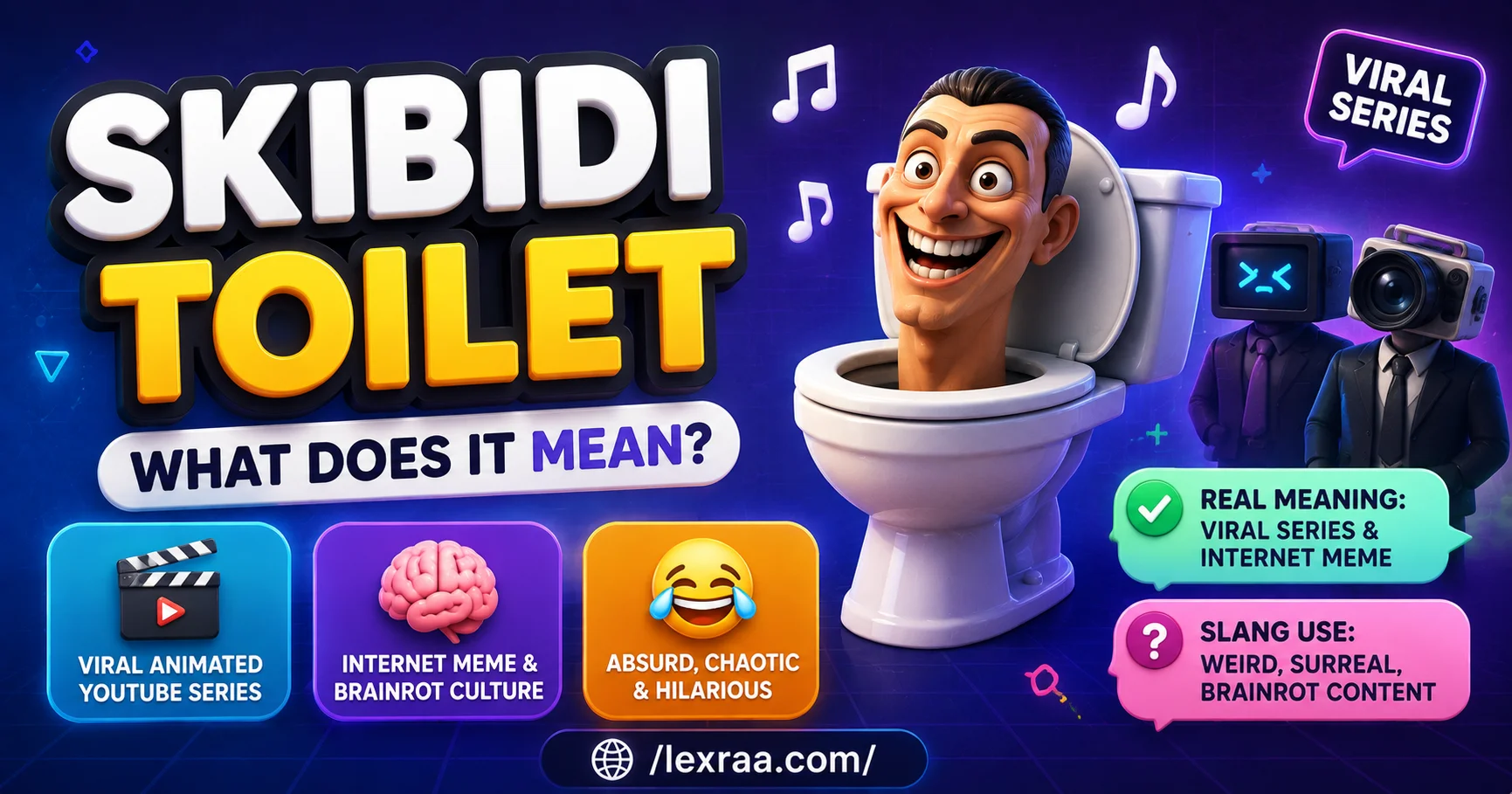
Skibidi Toilet primarily refers to the viral animated YouTube series created by Alexey Gerasimov, but online the phrase can also be used jokingly for something absurd, chaotic, bizarre, or “brainrot.” It does not have one fixed slang definition like “LOL” or “BRB.”
What Does Skibidi Toilet Mean?
There are two closely connected ways you are likely to encounter “Skibidi Toilet.”
First, Skibidi Toilet is the name of a web-animation series in which human heads emerge from toilets and battle humanoid characters with cameras, speakers, and televisions for heads. The first episode appeared on YouTube on February 7, 2023, created by animator Alexey Gerasimov, better known online as DaFuq!?Boom!
Second, the phrase has become a meme-cultural reference. When someone says something is “Skibidi Toilet” or uses the phrase jokingly, they may be invoking the show’s deliberately bizarre, chaotic, surreal, and absurd style rather than assigning the words a literal dictionary meaning. That use overlaps heavily with what people call brainrot content.
The important distinction is that “Skibidi Toilet” is not an acronym or abbreviation. It is a proper name that became an internet meme and then influenced slang.
Is “Skibidi Toilet” actually slang?
Sometimes, but calling it only slang is misleading.
The capitalized phrase Skibidi Toilet most accurately identifies the web series and the culture surrounding it. The related word skibidi is what developed into a flexible piece of Gen Alpha internet slang.
Merriam-Webster describes skibidi as a nonsense internet term connected to the series and specifically notes that it has no set meaning. It can be used humorously or ironically rather than functioning like a conventional word with one stable definition.
So if someone says:
“I watched Skibidi Toilet.”
they are probably talking about the series.
If they say:
“That is so skibidi.”
they may simply be using internet nonsense slang.
And if they say:
“Bro, this whole situation is Skibidi Toilet.”
they are probably making a meme reference to something extremely weird or chaotic.
The Main Meanings You May See
1. The actual animated series
This is the clearest and most established meaning.
Skibidi Toilet is a short-form animated web series created by Alexey Gerasimov. Its central conflict involves the Skibidi Toilets and humanoid characters known as Cameramen, Speakermen, and later TV Men and other characters.
The videos were made using Source Filmmaker, a tool associated with the machinima and gaming-video culture that influenced the creator’s earlier work. Forbes reported that Gerasimov’s creative background included the older Garry’s Mod-style internet animation culture.
2. A reference to absurd internet humor
The phrase can also work as a shorthand reference to the strange humor associated with the series.
Calling something “Skibidi Toilet” can suggest that it is:
- bizarre
- surreal
- chaotic
- intentionally ridiculous
- heavily meme-based
- difficult to explain seriously
This usage does not have a precise definition. It depends on the speaker and context.
That is why trying to translate “Skibidi Toilet” into one ordinary English word usually fails.
3. A broader “brainrot” reference
Skibidi Toilet became strongly associated with the broader internet idea of brainrot: absurd or repetitive online content that people consume, repeat, and joke about excessively.
Oxford specifically connected the modern “brain rot” phenomenon with Skibidi Toilet and related online language such as skibidi, Ohio, rizz, sigma, and Fanum tax.
But “brainrot” and “Skibidi Toilet” are not synonyms.
Brainrot is the broader category. Skibidi Toilet is one particular cultural phenomenon that became associated with it.
A Common Misunderstanding: Does “Skibidi” Actually Mean Something?
Not in the normal dictionary sense.
One of the biggest misunderstandings is assuming that skibidi has a secret literal translation. Current dictionary coverage says the opposite: it is essentially nonsense internet language whose meaning can change with context.
Dictionary.com notes that skibidi can be used to suggest things such as “cool,” “bad,” or “weird,” while sometimes functioning as little more than a deliberately nonsensical filler.
That flexibility is part of the joke.
The word does not need to communicate a precise proposition every time someone says it. Sometimes the humor comes from using a recognizable internet sound where a normal word would usually go.
Where Did Skibidi Toilet Come From?
The history has an important distinction between “skibidi” and “Skibidi Toilet.”
The nonsense sound existed before the series.
Merriam-Webster notes that Russian satirical group Little Big released a song titled “Skibidi” in 2018. It also traces the musical material used in the Skibidi Toilet videos to Biser King’s 2022 song “Dom Dom Yes Yes.”
But the specific Skibidi Toilet series began on February 7, 2023.
Gerasimov uploaded an extremely short animated video to his DaFuq!?Boom! YouTube channel. It showed a human head emerging from a toilet and singing along to the recognizable vocal hook. The video became the first episode of what would develop into the larger series.
The concept expanded rapidly from a bizarre one-off joke into a serialized conflict involving increasingly elaborate characters and battles.
Know Your Meme records the first episode as a YouTube Short and documents how subsequent episodes accumulated tens of millions of views and inspired fan art, memes, remixes, and other user-generated content.
Why did it become so popular?
The format was almost perfectly suited to short-form internet viewing.
The videos were:
- extremely short
- visually strange
- easy to understand without much dialogue
- built around a recognizable recurring character
- connected to familiar gaming and meme aesthetics
- easy to remix or parody
WIRED noted that the largely wordless format helped the series travel internationally because viewers did not need to understand a particular language to follow the basic visual conflict.
That matters because visual absurdity travels unusually well online.
A person who cannot explain the lore can still recognize “a singing human head coming out of a toilet.”
Which Apps Is Skibidi Toilet Used On?
The strongest evidence points to YouTube, TikTok, Instagram, and X, rather than every messaging app having its own version of the term.
YouTube
YouTube is the most important platform because that is where the series originated.
The original Skibidi Toilet episodes were published through Gerasimov’s YouTube channel, and the series developed there before spreading widely through other platforms.
TikTok
TikTok played a major role in spreading Skibidi-related memes and remixes.
Merriam-Webster documents later skibidi-related TikTok culture, while other documented histories show the series itself being reposted and remixed in the TikTok ecosystem.
The series and its associated memes also appeared in Instagram content.
Dictionary.com gives an Instagram example involving someone describing Skibidi Toilet as simultaneously ridiculous, frightening, and entertaining.
X
The phrase and related skibidi slang also appear on X. Merriam-Webster gives examples of people using combinations such as “skibidi sigma” in posts, showing how the word became part of broader meme vocabulary.
What about Snapchat and WhatsApp?
There is no strong reason to assign Snapchat or WhatsApp a special Skibidi Toilet meaning.
People can obviously type the phrase in private messages, group chats, or Snaps, but the available evidence does not establish a distinct platform-specific definition. It is more accurate to treat those as ordinary communication channels rather than claim that Skibidi Toilet is uniquely associated with them.
10 Natural Skibidi Toilet Conversations
1. Funny — Friends
Mia: “Why did you send me a video of a toilet with a human head?”
Noah: “Because it was hilarious.”
Mia: “That explanation made it worse.”
Noah: “Welcome to Skibidi Toilet.”
Here, the phrase is being used as a humorous reference to the absurdity of the video.
2. Sarcastic — Group Chat
Ethan: “Guys, I have a very serious presentation tomorrow.”
Liam: “Good luck.”
Ethan: “My little brother just renamed the file ‘skibidi toilet final FINAL.’”
Liam: “Excellent. Academic excellence achieved.”
The phrase is being used sarcastically because the situation has become ridiculous.
3. Playful — Dating
Ella: “Why is your playlist called ‘Skibidi Toilet Classics’?”
Jake: “You said my music needed personality.”
Ella: “I did not mean this.”
Jake: “Too late. You’re dating the meme now.”
The reference is playful rather than a literal description.
4. Serious — Parent and Teen
Dad: “What exactly is Skibidi Toilet?”
Sam: “It’s an animated series.”
Dad: “And you actually follow the story?”
Sam: “Yeah. It’s weird, but there is more to it than the first videos make it look.”
This conversation shows why the term can refer to an actual series rather than merely random nonsense.
5. Instagram Comment
Ava: “Why does this video look like it came from another dimension?”
Lena: “Because the internet has officially lost it.”
Ava: “Should I be concerned?”
Lena: “No. Just accept the Skibidi Toilet.”
Here, the phrase is functioning as a meme-style reaction.
6. TikTok Conversation
Ryan: “Did you see the new remix?”
Kai: “The one with all the Gen Alpha slang?”
Ryan: “Yeah.”
Kai: “This is peak skibidi.”
The speaker is using skibidi rather than literally referring to a toilet.
7. Family Chat
Mom: “Your cousin keeps saying ‘skibidi.’”
Alex: “That’s internet slang.”
Mom: “Does it actually mean anything?”
Alex: “Honestly, sometimes the joke is that it doesn’t.”
That is one of the most useful explanations of the slang.
8. Gaming Friends
Player 1: “Why did you name your character that?”
Player 2: “I couldn’t think of anything.”
Player 1: “You chose ‘Skibidi Toilet 9000’?”
Player 2: “It was available.”
The reference works because the name itself is intentionally ridiculous.
9. Coworker Chat
Jordan: “My nephew just explained his favorite show to me.”
Chris: “What is it?”
Jordan: “Apparently toilets are fighting camera people.”
Chris: “Skibidi Toilet?”
Jordan: “Exactly.”
This is a straightforward recognition of the series.
10. Online Meme Discussion
Nora: “I don’t understand why this meme is funny.”
Sam: “You’re trying to find logic in it.”
Nora: “Shouldn’t there be logic?”
Sam: “Not in brainrot culture.”
The important point is that the humor often comes from absurdity rather than a conventional punchline.
How Do You Reply to “Skibidi Toilet”?
Your response depends on whether someone is making a genuine reference or simply joking around.
Funny reply:
“Bro, I just wanted to have a normal conversation 😭”
Serious reply:
“Do you mean the actual YouTube series?”
Flirty reply:
“If you’re going to send me Skibidi memes, at least send me the good ones 😂”
Neutral reply:
“Lol, what do you mean by Skibidi Toilet here?”
That last response is especially useful because the phrase has no single fixed slang meaning outside its established reference to the series.
Skibidi Toilet vs. Similar Internet Terms
| Term | Meaning | Tone | Popularity | Confusion Risk |
|---|---|---|---|---|
| Skibidi Toilet | Viral animated series and meme-cultural reference | Absurd, playful | Very high | Low |
| Skibidi | Nonsense internet slang associated with the series; no fixed meaning | Playful, ironic | Very high | High |
| Brainrot | Mindless/low-value content or excessive fixation on it | Humorous, critical | Very high | Medium |
| Sigma | Meme term associated with an exaggerated “lone-wolf” persona | Ironic, humorous | High | Medium |
| Ohio | Meme reference to bizarre, strange, or absurd situations | Mocking, surreal | High | Medium |
| Rizz | Charm or ability to attract someone romantically | Playful | Very high | Low |
The easiest pair to confuse is Skibidi Toilet and brainrot.
They are related but not identical. Brainrot is a broader internet-culture label, while Skibidi Toilet is a specific series and meme phenomenon that became one of the best-known examples associated with that culture. Oxford explicitly connected the two in its discussion of the 2024 “brain rot” phenomenon.
There is also no genuine slang opposite of Skibidi Toilet. “Normal,” “serious,” or “sensible” might work as contextual contrasts, but none is an established antonym.
Who Uses Skibidi Toilet?
The phrase is particularly associated with Gen Alpha, and the series became one of the most recognizable cultural references connected with that generation’s online environment. Dictionary.com specifically describes Gen Alpha as frequent users of skibidi and Skibidi Toilet.
That does not mean older generations never use it.
Gen Z, Millennials, parents, journalists, advertisers, and other adults have all discussed or referenced the phenomenon. Older users often use the phrase ironically, sometimes precisely because they recognize how strange it sounds. WIRED and The Washington Post both documented the generation gap surrounding the series.
There is no strong evidence that Skibidi Toilet has a fundamentally different meaning in American versus British English. It spread through global internet culture, so platform and community context matter more than national dialect.
Is Skibidi Toilet Rude or Safe?
Skibidi Toilet is not profanity.
The phrase is generally harmless as a meme reference. Its potentially offensive aspect comes more from context than from the words themselves.
Calling someone’s post “Skibidi Toilet” can be playful:
“This is so Skibidi Toilet 😂”
But if someone uses it sarcastically to dismiss another person’s interests, it can become mocking.
For school or workplace communication, the bigger issue is formality, not obscenity. The phrase is usually inappropriate in a formal essay unless the subject is internet culture itself.
There is also an important cultural point for parents and teachers: Skibidi Toilet is not a medical condition or evidence of brain damage. “Skibidi Toilet Syndrome,” which circulated online in 2023, was a fictional/hoax expression rather than a legitimate diagnosis.
Why Does Skibidi Toilet Stick in People’s Heads?
Skibidi Toilet works as internet culture because it combines several highly memorable elements: an instantly recognizable visual, repetitive music, extremely short videos, simple visual storytelling, gaming-style 3D animation, and a premise so strange that people can recognize it almost immediately. The phrase also benefits from semantic flexibility: someone can use “skibidi” seriously within the meme community, sarcastically as an outsider, or simply as nonsense. That combination makes the reference easy to repeat, remix, parody, and move between platforms.
Frequently Asked Questions
Is Skibidi Toilet a slang word?
Not exactly. Skibidi Toilet is primarily the name of a viral animated web series and the meme culture surrounding it. It can be used slangily as a reference to absurd or chaotic internet humor, but it does not have one standardized slang definition.
What does “skibidi” mean?
Skibidi has no fixed meaning. It can function as nonsense, a humorous intensifier, or a reference to Skibidi Toilet and related meme culture. Depending on context, people may use it to suggest something weird, funny, good, bad, or simply absurd.
Who created Skibidi Toilet?
The series was created by Alexey Gerasimov, who publishes online as DaFuq!?Boom! The first episode was uploaded to YouTube on February 7, 2023.
Why are toilets involved in Skibidi Toilet?
The toilet imagery is part of the deliberately absurd premise of the series. Human heads emerge from toilets and sing, eventually becoming part of a larger fictional conflict with camera-, speaker-, and TV-headed characters. The bizarre visual concept is a major part of the series’ recognizability.
Is Skibidi Toilet appropriate for kids?
The answer depends on the specific video and the child’s age. The series became particularly popular among younger viewers, but its surreal violence, toilet humor, and rapidly expanding lore may not appeal to every family. Parents should evaluate the actual content rather than assuming the slang term alone tells them whether something is appropriate.
Is Skibidi Toilet brainrot?
It is strongly associated with the modern idea of brainrot, but the two terms are not identical. Brainrot is the broader label for certain forms of low-value, repetitive, or absurd online content and people’s fixation on them. Oxford specifically cited Skibidi Toilet as an example associated with modern brainrot culture.
Did Skibidi Toilet come from TikTok?
No. The series originated on YouTube in February 2023. TikTok later became an important environment for spreading related clips, remixes, memes, and slang.
Does Skibidi Toilet have a secret meaning?
There is no evidence of a hidden coded definition behind the phrase. Skibidi Toilet is primarily the name of the series, while skibidi itself is deliberately flexible nonsense slang. Trying to assign one secret translation misses the point of how the expression is used.
Final Thoughts
Skibidi Toilet is first and foremost the name of a bizarre animated YouTube series created by Alexey Gerasimov in February 2023. Its human-headed toilets, camera-headed characters, repetitive music, and surreal storytelling turned it into a major internet meme and a defining reference in Gen Alpha online culture.
As slang, the phrase does not have one precise definition. It can be used to reference the series itself or, more loosely, to joke about something absurd, chaotic, nonsensical, or deeply immersed in “brainrot” internet culture.
The biggest mistake is treating skibidi like a normal abbreviation with a fixed full form. It is not. The nonsense and flexibility are part of the joke.
If someone sends you “Skibidi Toilet” in a message, look at the surrounding context. They may be talking about the actual series, quoting meme culture, or simply calling something hilariously weird.