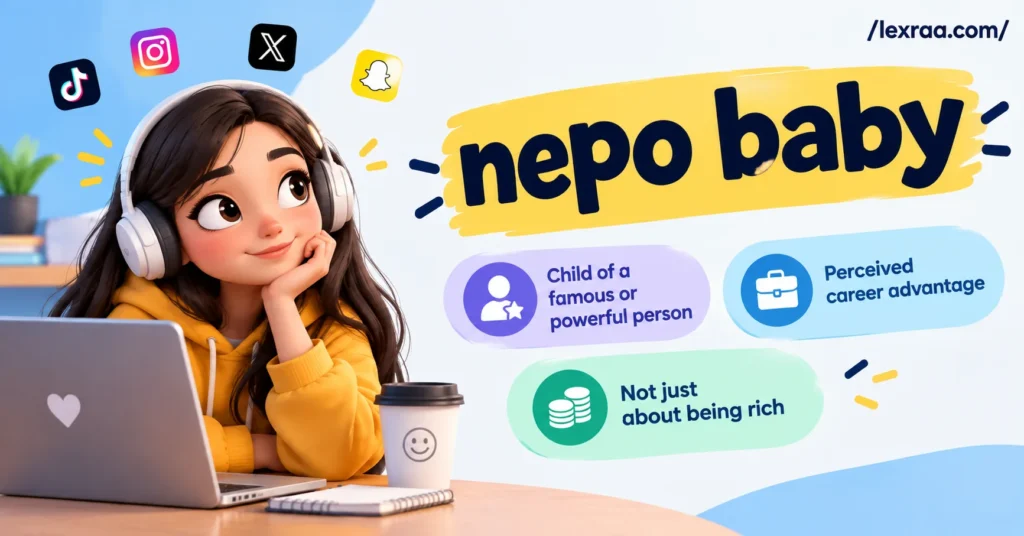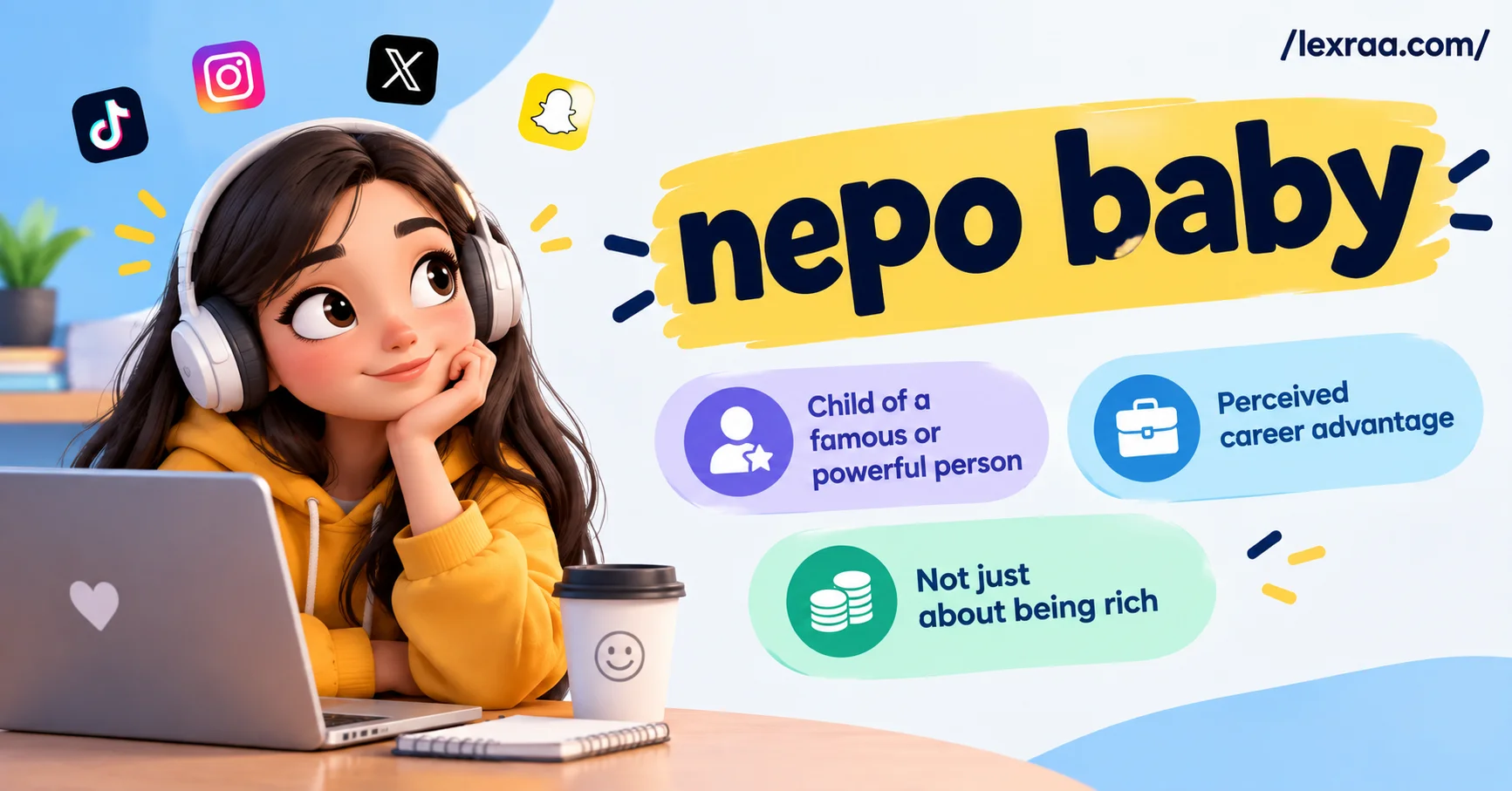
Nepo baby is slang for someone whose career or public success is perceived to have benefited from a famous, powerful, wealthy, or well-connected family member. It usually refers to children who enter a field connected to their parents, especially entertainment, but the label can extend beyond celebrities.
The Meaning Behind “Nepo Baby”
Nepo baby is an informal slang noun and a shortened form of “nepotism baby.” The “nepo” part comes from nepotism, while “baby” refers to the person’s family connection—not necessarily their age.
Oxford labels the expression informal and usually disapproving, defining it as a child of a famous person whose career success is said to come from that parent’s success. Dictionary.com similarly emphasizes the perceived importance of family connections to the person’s opportunities.
The key word is perceived.
Calling someone a nepo baby makes a claim about access or advantage. It does not automatically prove that the person’s entire career was handed to them or that they lack talent.
That distinction is easy to lose in social-media arguments.
It Means More Than “Rich Kid”
A person can grow up wealthy without being a nepo baby.
The usual nepo-baby idea involves family connections that overlap with the person’s career or field. For example, a child of a famous actor becoming an actor fits the common use much more closely than someone simply inheriting money from parents who work in an unrelated industry.
That is why “nepo baby vs. trust fund baby” is a useful distinction.
- Nepo baby: family connections or influence are perceived to help with career access or advancement.
- Trust fund baby: someone who benefits financially from a family trust or inherited wealth.
- A person can be both.
Reddit discussions show that people regularly argue over the boundary. Some users reserve “nepo baby” for major career advantages, while others use it for smaller opportunities obtained through a parent’s professional connections.
So the term has a fuzzy boundary, even though its central idea is clear.
Nepotism vs. Nepo Baby
These words are related, but they describe different things.
Nepotism is the practice of favoring relatives, especially when giving jobs, opportunities, or positions.
A nepo baby is the person who is perceived to have benefited from that kind of family advantage.
For example:
“The company hired the owner’s son because of his family connection.”
That describes a possible nepotism situation.
“He’s a nepo baby because his father’s industry connections opened doors for his career.”
That describes the person using the label.
The difference matters because someone can benefit from family connections without being the person who makes the hiring or selection decision.
Read More: Fascist Meaning: What Does “Fascist” Really Mean?
Why the Word Suddenly Became Everywhere
The phrase “nepotism baby” was already circulating before “nepo baby” became mainstream. Historical accounts cited by Wikipedia trace the shortened form to at least 2020, while Dictionary.com records the entry as first recorded in 2022.
The major explosion came in 2022.
A February 2022 tweet about actress Maude Apatow, whose parents are Judd Apatow and Leslie Mann, helped push “nepotism baby” into a much larger online conversation. The shortened “nepo baby” then spread across Twitter/X and TikTok.
Vulture’s December 2022 coverage, along with New York Magazine’s widely discussed “Year of the Nepo Baby” package, helped turn the phrase from internet shorthand into mainstream pop-culture vocabulary.
Know Your Meme also identifies Twitter as the origin point for the meme’s major 2022 breakout.
The word itself is newer than the phenomenon. Families helping relatives enter the same professions is obviously much older; “nepo baby” gave the phenomenon a compact internet-friendly label.
How “Nepo Baby” Is Used on TikTok and X
The phrase is strongly associated with social-media discussion of celebrity families.
On TikTok, it can appear in comments about an actor’s casting, a singer’s record deal, a model’s campaign, or an influencer’s access to opportunities.
For example:
“Wait, she’s a nepo baby??”
That can simply express surprise after someone discovers a celebrity’s family background.
But the same phrase can be sarcastic:
“Another nepo baby gets a starring role. Shocking.”
Here, the label carries criticism about how the opportunity was obtained.
It can also be playful rather than hostile. Someone might jokingly call a famous person’s child a nepo baby while simultaneously liking their work.
So “nepo baby” is not automatically an insult, although it often carries a skeptical or critical edge.
Read More: What Is the Meaning of HBU? Text & Slang Guide
The Tricky Question: Who Actually Counts?
This is where the definition gets interesting.
Imagine two people.
Person A has famous parents in the same industry. Their family introduces them to agents, producers, executives, and other influential people before they ever apply for a job.
Person B has wealthy parents, but those parents work in an unrelated field and never provide industry connections.
People are much more likely to use nepo baby for Person A.
Now consider a third case: someone’s parent owns a small business, and the child gets an ordinary entry-level job there.
Is that nepotism? Potentially, depending on how the job was awarded.
Is the person automatically what people mean by “nepo baby” online? Not necessarily.
Recent Reddit discussions show exactly this disagreement. Some people argue that any career opportunity gained through a parent qualifies, while others think the label is mainly used for unusually valuable access in competitive fields.
That makes degree of advantage one of the biggest hidden questions behind the phrase.
Nepo Baby Doesn’t Mean “Untalented”
This is one of the most important distinctions when interpreting the term.
Someone can have a famous parent and still be genuinely skilled at their job.
Even dictionary definitions generally frame the term around perceived family-enabled success or opportunity, not a scientific measurement of talent.
That is why statements such as:
“She’s a nepo baby, so she’s terrible.”
contain an extra judgment that the term itself does not prove.
A more precise use would be:
“She’s considered a nepo baby because her parents already had major connections in the industry.”
That identifies the family advantage without turning the label into a verdict about the person’s ability.
Example Conversations
TikTok comments — surprised
Ari: “Wait, I just found out her dad is a huge director.”
Mia: “NO WAY 😭”
Ari: “People are calling her a nepo baby now.”
Mia: “Okay, that explains why I kept seeing that comment.”
The label here signals a newly discovered family connection.
iMessage — casual discussion
Sam: “Did you see who’s starring in that new movie?”
Chris: “Yeah, her mom is famous too.”
Sam: “Ohhh, nepo baby?”
Chris: “Pretty much what everyone in the comments is saying.”
Group chat — skeptical
Nina: “How did he get that job with zero experience?”
Leo: “His dad knows the CEO.”
Nina: “Ah. Nepo baby behavior.”
Jay: “That definitely changes the story.”
The phrase is being used critically, but the conversation still distinguishes access from actual job performance.
Reddit-style discussion — nuanced
User A: “Is having rich parents enough to make someone a nepo baby?”
User B: “Not necessarily.”
User A: “So what counts?”
User B: “Usually the family connection helping with the actual career.”
Snapchat — playful
Kay: “My mom got me an audition through her old coworker 😂”
Zoe: “Girl you’re a nepo baby now.”
Kay: “STOP 😭 it was one audition.”
Zoe: “A tiny nepo baby, then.”
This shows how people can use the phrase jokingly for a much smaller family-assisted opportunity.
Nepo Baby vs. Similar Terms
| Term | Meaning | Tone | Popularity | Confusion Risk |
|---|---|---|---|---|
| Nepo baby | Person perceived to gain career advantage through family connections | Informal, often critical | High | — |
| Nepotism | Favoring relatives when giving opportunities or positions | Neutral to critical | High | Medium |
| Trust fund baby | Person financially supported by inherited family wealth or a trust | Informal, often critical | — | High |
| Industry baby | Person who inherits industry connections or knowledge without necessarily inheriting a famous name | Informal | — | High |
| Rich kid | Someone from a wealthy family | Informal | High | Medium |
| Legacy | A person admitted or hired partly because of a family connection or institutional relationship | Context-dependent | — | Medium |
The biggest confusion is trust fund baby. Wealth can create opportunities, but “nepo baby” more specifically points toward family influence or connections helping someone’s career.
Is “Nepo Baby” Rude?
It depends on how it is used.
Oxford marks the term as usually disapproving, while Dictionary.com notes that it can also be used neutrally to identify someone with a notable family connection.
Calling a friend a nepo baby as a joke may be harmless if everyone understands the context.
Calling a coworker one in a professional dispute is different. It can sound like an accusation that their position was obtained through favoritism, so the phrase is better avoided in formal workplace communication unless you are specifically discussing documented nepotism.
A Separate Internet Reference: “Nepo Baby” as a Nickname
There is one unusual search result worth knowing about.
“Nepo Baby” has also been used as a nickname for Brazilian TikTok personality Gabriel Xuxu, whose family videos involved children competing in mini-games where his parents were perceived as helping him. Know Your Meme documents this as a specific TikTok meme reference from 2023–2024.
That is not a second general dictionary meaning of the phrase. It is a particular internet nickname built from the established “nepo baby” idea.
Why the Phrase Sticks
“Nepo baby” works because it compresses a complicated argument about family, access, opportunity, and career into two memorable words. The label is short enough for a comment and flexible enough to be serious, sarcastic, or playful. Its biggest weakness is the same thing that makes it useful: people can disagree about how much family advantage is enough to earn the label.
FAQ
Does nepo baby mean the person is famous?
Not necessarily. The term is most visible in celebrity discussions, but it can describe someone whose career opportunity or advancement is perceived to come from a family connection even if they are not a major celebrity.
Why do people say “nepo baby” instead of “nepotism baby”?
“Nepo baby” is simply the shorter form. The abbreviation-like shortening makes the phrase easier to use in headlines, captions, comments, and fast-moving social-media conversations.
Can someone be a nepo baby if their parent is not famous?
Yes. Fame is common in examples, but the broader idea is family influence or connections, not celebrity alone. Dictionary.com’s definition includes notable or powerful parents, while broader usage can involve family connections within a particular industry.
Is nepo baby always about acting?
No. Acting and entertainment are the most familiar examples, but the phrase has also been applied to musicians, models, athletes, business figures, and people in other competitive fields.
What does “double nepo” mean?
“Double nepo” is an informal extension used when someone is perceived to have significant family connections from more than one side of their family. It became part of the wider “nepo” vocabulary during the celebrity discussion surrounding the term.
What does “nepo kid” mean?
“Nepo kid” is a closely related variation of nepo baby. It generally refers to someone whose career or opportunities are perceived to have benefited from family connections, although “nepo baby” remains the more established expression.
Conclusion
Nepo baby means someone whose career success or opportunities are perceived to have benefited from family connections, especially in the same industry. It is not automatically a synonym for “rich kid,” and it does not prove that the person lacks talent. Use it casually when the family connection is genuinely relevant, but avoid treating the label as proof of how every opportunity was earned. The common mistake is assuming that famous parents alone settle the question; the real idea is family-enabled access or advantage.