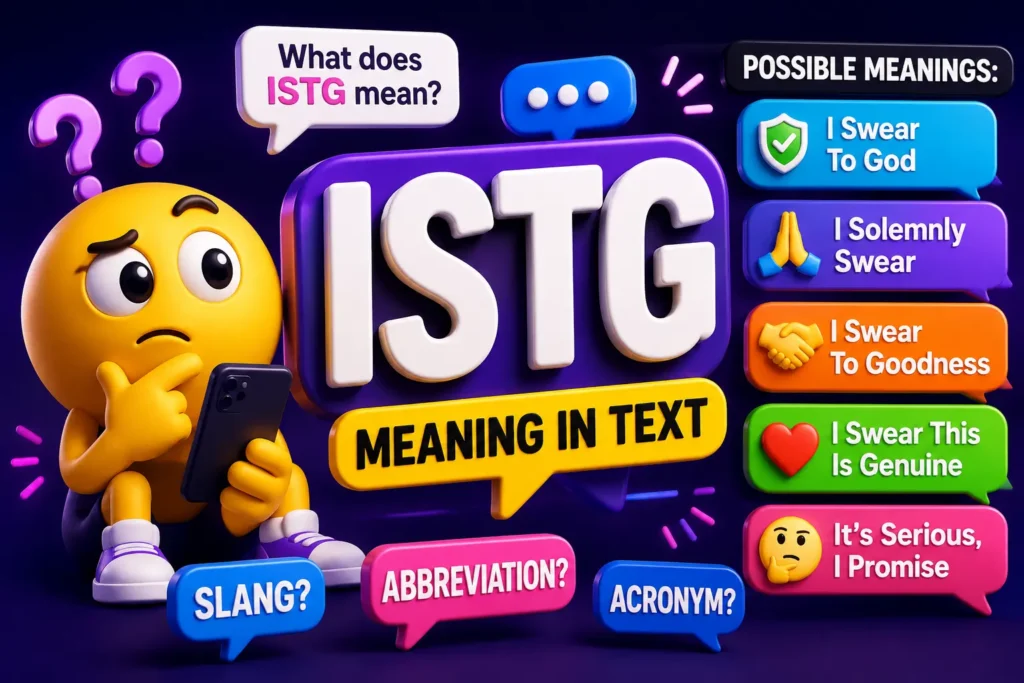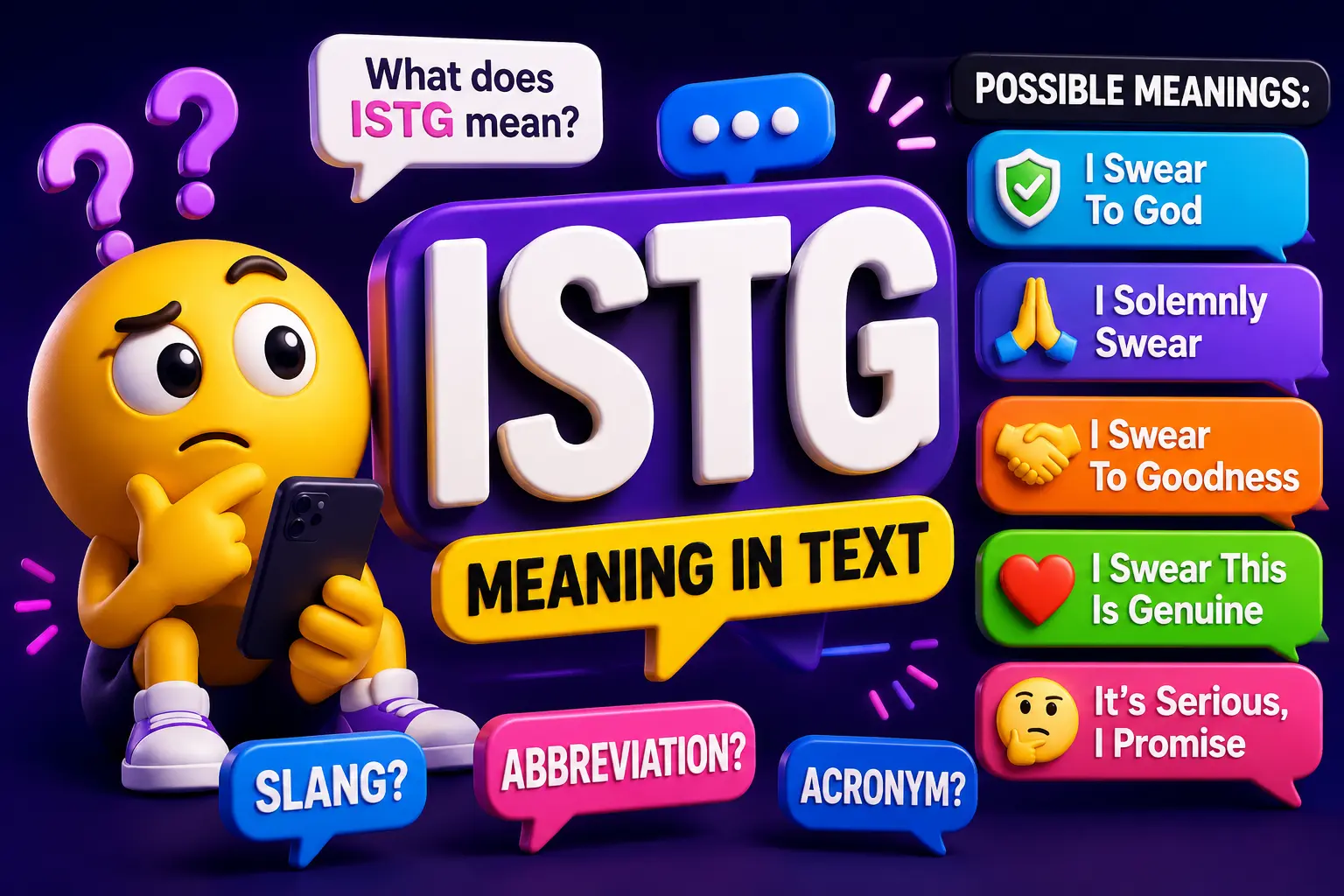
ISTG most commonly means “I Swear to God.” When someone texts you ISTG, they’re emphasizing that they’re telling the truth, expressing frustration, or reacting strongly to something. People search for “ISTG meaning in text” because the abbreviation can seem confusing if you’ve never seen it before or if it’s used without additional context.
What Does ISTG Mean in Text?
In texting and online messaging, ISTG almost always stands for:
I Swear to God
It is an initialism (a type of abbreviation) that has become a common piece of internet slang. People use it to strengthen what they’re saying, similar to how someone might say, “I promise,” or “I’m completely serious.”
Unlike abbreviations that describe an action, such as BRB (Be Right Back), ISTG communicates emotion and emphasis. It tells the reader that the sender feels strongly about what they’re saying.
For example:
ISTG I didn’t touch your phone.
Here, the sender is stressing that they’re telling the truth.
Another example:
ISTG this traffic is driving me crazy.
In this case, the abbreviation expresses frustration rather than making a promise.
The exact emotion depends on the rest of the conversation.
Is ISTG an Acronym, Abbreviation, or Slang?
ISTG is technically an initialism, which means each letter represents the first letter of a word.
It expands to:
- I = I
- S = Swear
- T = To
- G = God
Because people now use it naturally in casual conversations, it is also considered a form of internet slang.
Today, most people recognize ISTG instantly in text messages, group chats, and direct messages without needing to spell out the full phrase.
The Main Meaning of ISTG
I Swear to God
This is the standard and overwhelmingly most common meaning.
People use ISTG whenever they want to make their statement sound more sincere or emotionally charged.
Examples:
ISTG I forgot my wallet.
ISTG I’m not lying.
ISTG that scared me.
Although the full phrase contains the word God, many people use ISTG simply as an expression of emphasis rather than a literal religious statement.
In everyday texting, it’s often closer to saying:
- “I’m serious.”
- “Believe me.”
- “I’m telling the truth.”
How ISTG Changes Meaning Depending on Context
The abbreviation always expands to the same phrase, but its purpose changes based on the conversation.
Showing Honesty
Sometimes the sender wants to convince someone they’re being truthful.
Example:
A: Did you delete the file?
B: ISTG I didn’t touch it.
Here, ISTG strengthens the speaker’s denial.
Expressing Frustration
Many people use ISTG when they’re annoyed by a situation.
Example:
ISTG this app keeps crashing.
The abbreviation communicates strong frustration without needing a long explanation.
Giving a Warning
ISTG can introduce a warning or show that someone’s patience is running out.
Example:
ISTG if you hide my charger again…
The sentence often trails off because the listener understands the implied consequence.
Reacting to Something Shocking
Sometimes people use ISTG simply because something seems unbelievable.
Example:
ISTG I just saw the biggest spider ever.
The abbreviation tells the reader the story is genuine.
Adding Dramatic Emphasis
Friends also use ISTG playfully to exaggerate ordinary situations.
Example:
ISTG this is the best burger I’ve ever eaten.
Here, the speaker isn’t making a formal promise—they’re emphasizing their opinion.
Read More: TBH Meaning in Text: It’s Not Always What You Think
Does ISTG Have Other Meanings?
In casual texting, I Swear to God is by far the dominant meaning.
Outside messaging, the letters ISTG may represent organizations, technical terms, or company names, but these meanings are unrelated to internet slang.
If you receive ISTG in:
- SMS
- iMessage
- Instagram DM
- Snapchat
- Discord
you should almost always interpret it as “I Swear to God.”
Why People Use ISTG Instead of Typing the Full Phrase
Modern conversations move quickly.
Instead of typing:
I swear to God I’m telling the truth.
people simply write:
ISTG I’m telling the truth.
The abbreviation saves time while keeping exactly the same emotional impact.
It’s also easy to recognize because it has been part of internet culture for many years.
Common Situations Where People Use ISTG
You’ll frequently see ISTG when someone is:
- Defending themselves
- Trying to sound believable
- Complaining about something
- Reacting to surprising news
- Making a playful threat
- Telling an unbelievable story
- Emphasizing frustration
- Stressing a strong opinion
Its versatility is one reason it has remained popular across multiple generations of internet users.
How ISTG Is Used Across Different Messaging Platforms
SMS and iMessage
Traditional text messaging is still one of the most common places to see ISTG.
People use it naturally while chatting with friends, family members, classmates, or partners.
Example:
A: Did you eat the last cookie?
B: ISTG it wasn’t me.
Another example:
ISTG I’m already outside.
Because SMS conversations are usually short, abbreviations like ISTG fit naturally into everyday texting.
On WhatsApp, ISTG carries exactly the same meaning.
You’ll commonly find it in:
- Friend groups
- Family chats
- School conversations
- Private messages
Example:
A: Why are you late?
B: ISTG traffic was terrible.
Many WhatsApp users also combine it with emojis such as:
- ISTG 😭
- istg 😂
- ISTG 😩
These emojis help clarify whether the sender is joking, exaggerating, or genuinely frustrated.
Instagram Direct Messages
Instagram DMs are another place where ISTG appears frequently.
People use it when reacting to:
- Stories
- Photos
- Reels
- Personal conversations
Example:
A: You actually met your favorite actor?
B: ISTG!
Another example:
A: That really happened?
B: ISTG it did.
Here, the abbreviation reassures the other person that the story is true.
Snapchat
Because Snapchat conversations are casual and fast-paced, abbreviations like ISTG are extremely common.
Examples include:
ISTG you’re impossible. 😂
ISTG I almost dropped my phone.
The tone depends heavily on emojis and the relationship between the people chatting.
Discord
Discord users regularly use ISTG, particularly while gaming or chatting in online communities.
Examples:
ISTG this boss fight is impossible.
ISTG my internet disconnected again.
ISTG we almost won that match.
In these situations, the abbreviation usually expresses frustration or disbelief.
TikTok
Although ISTG is primarily a texting abbreviation, it also appears in TikTok comments and replies.
Users commonly write things like:
ISTG this is the funniest video today.
ISTG I wasn’t expecting that ending.
Its meaning remains exactly the same as in text messages.
X (Formerly Twitter)
On X, ISTG is popular because it’s short and expressive.
Examples include:
ISTG people never read the whole article.
ISTG that ending surprised me.
The platform’s conversational style makes abbreviations like ISTG especially useful.
Is ISTG Typed the Same Way Everywhere?
Yes. The meaning doesn’t change across platforms, although the formatting may vary.
Common versions include:
- ISTG
- istg
- Istg
You’ll also see punctuation and emojis added for emphasis:
- ISTG…
- ISTG!!
- istg 😭
- ISTG 😂
- istg omg
These additions affect the emotional tone but not the meaning.
Grammar and Language Role
Part of Speech
ISTG usually functions as an interjection or an introductory discourse marker.
It introduces a statement while adding emotional emphasis.
Example:
ISTG I’m serious.
Sentence Position
The abbreviation most commonly appears at the beginning of a sentence.
Examples:
ISTG I forgot.
ISTG that wasn’t my fault.
Less commonly, it appears at the end.
Example:
I’m telling the truth, ISTG.
Beginning placement is by far the most natural in texting because it prepares the reader for an emphasized statement.
Can ISTG Replace a Full Sentence?
Usually, no.
Unlike abbreviations such as LOL or SMH, ISTG normally introduces another statement.
For example:
ISTG I didn’t do it.
Sending only:
ISTG
is possible in some conversations, but it’s much less common because readers generally expect more information after it.
Capitalization Conventions
All of these spellings are acceptable:
- ISTG
- istg
- Istg
Lowercase usually feels more casual, while uppercase can make the message feel slightly stronger or more emphatic.
The meaning stays exactly the same.
Is ISTG Usually Typed Alone or Inside a Sentence?
Most people include it within a larger sentence.
Examples:
ISTG I forgot.
I’m innocent, ISTG.
ISTG this keeps happening.
Using it by itself is possible but relatively uncommon compared to other reaction abbreviations.
Formal or Informal?
ISTG is highly informal.
It’s appropriate when chatting with:
- Friends
- Family
- Classmates
- Gaming friends
- People you know well online
It’s generally not appropriate for:
- Business emails
- Professional reports
- Academic papers
- Customer service messages
- Formal communication with teachers, managers, or clients
Because the phrase expands to “I Swear to God,” some people also choose not to use it in formal or religious settings, even in casual conversation.
ISTG in Different Tones
Although ISTG always means “I Swear to God,” the emotion behind it changes depending on the conversation. It can express honesty, frustration, sarcasm, playful exaggeration, or genuine determination.
Funny
Friends often use ISTG while joking about everyday situations.
A: I accidentally ate your fries too.
B: ISTG you’re impossible. 😂
A: They were calling my name.
B: Next time, order your own.
Sarcastic
Sometimes ISTG adds dramatic sarcasm to an obvious situation.
A: I definitely meant to miss the bus.
B: ISTG you’re the king of bad timing.
A: Thanks for the encouragement.
B: Happy to help.
Playful
Among close friends or siblings, ISTG is often lighthearted.
A: I changed your phone wallpaper.
B: ISTG I’m getting you back. 😭
A: Worth it.
B: We’ll see about that.
Serious
When someone genuinely wants to be believed, ISTG carries much more weight.
A: Did you tell anyone about my secret?
B: ISTG I didn’t tell a single person.
A: Okay, I believe you.
B: I wouldn’t break your trust.
Real Chat Examples
1. Friends (SMS)
A: Did you really lose your keys again?
B: ISTG they were in my pocket five minutes ago.
A: Check your backpack.
B: Found them. 😅
2. Partners (iMessage)
A: Why didn’t you answer my call?
B: ISTG my phone died.
A: I thought you were ignoring me.
B: I plugged it in as soon as I got home.
3. Coworkers (Microsoft Teams)
A: Did the report disappear?
B: ISTG I saved it before lunch.
A: Let’s check the cloud backup.
B: Hopefully it’s there.
4. Siblings (WhatsApp)
A: Who finished the cookies?
B: ISTG it wasn’t me.
A: Then explain the crumbs.
B: Those are from yesterday!
5. College Friends
A: The exam got postponed.
B: ISTG?
A: Check the class group chat.
B: You just made my day.
6. Gaming Friends (Discord)
A: My internet disconnected again.
B: ISTG these servers hate us.
A: Every single match.
B: At least we’re not the only ones.
7. Parent and Teen
A: Did you feed the cat?
B: ISTG I already did.
A: Thanks for taking care of it.
B: No problem.
8. Instagram DM
A: You actually met that actor?
B: ISTG I did!
A: That’s incredible.
B: I still can’t believe it.
9. Roommates
A: Did you move my headphones?
B: ISTG I haven’t touched them.
A: I’ll keep looking.
B: Check the living room.
10. Family Group Chat
A: Grandma baked another chocolate cake.
B: ISTG save me a slice.
A: I’ll hide one for you.
B: You’re the best.
11. Travel Friends
A: We almost missed our flight.
B: ISTG that was way too close.
A: Good thing we ran.
B: My legs still hurt.
12. Marketplace Chat
A: Is the laptop still available?
B: Yes, ISTG it’s in excellent condition.
A: Great, I’ll come tomorrow.
B: Looking forward to meeting you.
How to Reply to ISTG
Your response should match the tone of the conversation.
Funny Reply
If they’re joking:
I’ll believe you… for now. 😂
or
Sounds suspicious, but okay!
Serious Reply
If they’re emphasizing honesty:
I believe you.
or
Thanks for being honest with me.
Flirty Reply
If the conversation is already playful:
I’ll trust you… but you owe me coffee. 😉
or
Fine, I believe you this time.
Neutral Reply
If you simply want to acknowledge what they said:
Got it.
or
Fair enough.
or
That makes sense.
ISTG Compared With Similar Texting Terms
| Term | Meaning | Usage Context | Tone | Popularity | Confusion Risk |
|---|---|---|---|---|---|
| ISTG | I Swear to God | Strong emphasis, honesty, frustration | Serious / emotional | Very High | Low |
| FR | For Real | Agreement or sincerity | Casual | Very High | Low |
| TBH | To Be Honest | Honest opinion | Neutral | Very High | Low |
| NGL | Not Gonna Lie | Honest admission | Casual | High | Low |
| ONG | On God | Promise or strong emphasis | Casual | High | Medium |
| JK | Just Kidding | Indicates something was a joke | Playful | Very High | Low |
Among these, JK works as the closest practical opposite because it tells readers that a statement shouldn’t be taken seriously, whereas ISTG emphasizes that it should.
Who Uses ISTG?
Teenagers (13–18)
Teenagers are among the heaviest users of ISTG, especially in Snapchat, Instagram DMs, Discord, and everyday text messages. They often combine it with emojis such as:
- ISTG 😭
- istg 😂
- ISTG 💀
The abbreviation helps make conversations feel more expressive without requiring long explanations.
Young Adults (18–30)
College students and young professionals frequently use ISTG when telling stories, defending themselves, reacting to frustrating situations, or emphasizing their sincerity.
Within this age group, the abbreviation is widely understood and rarely needs explaining.
Adults Over 30
Many adults who regularly text or use social media also recognize ISTG. However, they’re generally more likely to type the complete phrase “I swear to God” instead of the abbreviation, particularly in longer conversations.
Gen Z vs. Millennials
Gen Z
Gen Z often uses istg in lowercase and combines it with other internet slang, including:
- fr
- ngl
- tbh
- smh
- ong
Emojis are frequently added to soften the tone or exaggerate emotions.
Millennials
Millennials tend to use ISTG in uppercase more often and usually include it within complete sentences. Their usage typically focuses on emphasizing honesty rather than creating dramatic reactions.
Regional Usage
There is no reliable evidence that ISTG belongs to one specific English-speaking country. It is commonly understood across the United States, Canada, the United Kingdom, Australia, and many other English-speaking communities.
Its popularity comes from online messaging culture rather than regional dialects, so the meaning remains consistent regardless of location.
Origin and Internet Culture
Where Did ISTG Come From?
ISTG emerged during the early years of internet messaging and SMS texting in the late 1990s and early 2000s. As people looked for faster ways to type common expressions, frequently used phrases were shortened into memorable abbreviations.
Since “I swear to God” was already a familiar spoken expression, shortening it to ISTG became a natural part of online communication.
Rooted in Texting Culture
Unlike slang that began with a viral meme or a specific social media trend, ISTG developed from practical texting habits. Early mobile phones had strict character limits, encouraging users to compress longer phrases into shorter forms while preserving their meaning.
Even though today’s messaging apps no longer impose those same limits, the abbreviation remains popular because it’s quick, familiar, and instantly understood.
ISTG in Modern Internet Culture
Today, ISTG appears in many types of online conversations, including:
- SMS and iMessage
- WhatsApp chats
- Instagram DMs
- Snapchat conversations
- Discord servers
- TikTok comments
- X (formerly Twitter) posts
People use it to make stories sound more believable, emphasize frustration, or reinforce that they’re being truthful.
Unlike many short-lived internet expressions, ISTG has remained part of everyday digital communication because it expresses a common human emotion in just four letters.
Is ISTG Rude or Offensive?
ISTG is not inherently rude, but it can sound intense depending on the context and the relationship between the people texting.
Most people use it to:
- Emphasize that they’re telling the truth
- Express frustration
- Show disbelief
- Add dramatic emphasis to a story
- React emotionally to a situation
Among close friends, ISTG is usually understood as casual internet slang. However, if you send it to someone who doesn’t know you well, it may come across as overly dramatic or confrontational.
Is ISTG Profanity?
No.
The abbreviation itself contains no profanity or explicit language. It simply stands for “I Swear to God.”
That said, because it includes a reference to God, some people avoid using it for religious or personal reasons. Others use it purely as a figure of speech without intending any religious meaning.
Understanding your audience is important before using it.
Is ISTG Appropriate for School or Work?
Generally, ISTG is best kept to informal conversations.
It’s appropriate for:
- Friends
- Family
- Classmates
- Group chats
- Casual online communities
- Gaming chats
It’s usually not appropriate in:
- Business emails
- Professional Slack or Teams messages
- Academic papers
- Customer service communication
- Messages to teachers, professors, managers, or clients
In professional settings, writing complete sentences is clearer and more respectful.
Cultural Sensitivity
While ISTG is widely recognized internet slang, the phrase “I Swear to God” can carry religious significance for some people.
Because of that, it’s worth considering your audience. If you’re unsure how someone might interpret the expression, using alternatives such as “I’m serious” or “Honestly” may be a better choice.
Real-World Observation
One reason ISTG has remained popular for so many years is that it conveys sincerity in a way that feels immediate and conversational. Rather than typing a long explanation, people can write ISTG to show they’re being truthful, frustrated, or genuinely surprised. In everyday texting, it often acts as an emotional shortcut, helping readers understand the speaker’s tone before they even finish the sentence. That flexibility has allowed the abbreviation to survive well beyond the early days of SMS and remain common across modern messaging apps.
Frequently Asked Questions
What does ISTG mean when someone texts you?
When someone texts ISTG, they almost always mean “I Swear to God.” They’re usually emphasizing that they’re telling the truth, expressing frustration, or reacting strongly to something. The surrounding conversation will tell you whether the tone is serious, playful, or dramatic.
Is ISTG always serious?
No. Although ISTG often introduces a sincere statement, it can also be used humorously among friends. For example, someone might text “ISTG this pizza changed my life” as playful exaggeration rather than a literal statement.
Can ISTG be used by itself?
Sometimes, but it’s uncommon.
Most people follow ISTG with another statement because it introduces or emphasizes what comes next. A message containing only “ISTG” may leave the reader wondering what the sender is referring to unless the context is already clear.
Does ISTG mean the same thing on every platform?
Yes.
Whether you see ISTG in SMS, iMessage, WhatsApp, Instagram DMs, Snapchat, Discord, TikTok comments, or X posts, it almost always stands for “I Swear to God.” The wording stays the same even though the emotional tone may change.
Is ISTG still popular?
Yes.
Although internet slang changes quickly, ISTG remains one of the most recognizable abbreviations in English-language texting. It’s widely understood across different age groups and continues to appear in everyday conversations.
Is ISTG the same as ONG?
Not exactly.
Both abbreviations emphasize sincerity, but ISTG means “I Swear to God,” while ONG means “On God.” They are similar in purpose, but ONG has become especially common in newer internet slang and is often associated with younger users.
Can I use ISTG in a professional message?
It’s generally better not to.
Because ISTG is highly informal and includes a religious expression, it isn’t suitable for most workplace communication. In professional situations, writing “I assure you,” “Honestly,” or “I’m certain” is usually more appropriate.
Is it rude to reply with just ISTG in a text?
Replying with only ISTG is uncommon because the abbreviation usually introduces a statement rather than serving as a complete response. If you send only ISTG, the other person may not understand what you’re emphasizing. It’s clearer to include the statement you’re trying to reinforce.
What’s the difference between texting ISTG and saying “I swear to God” out loud?
In text, ISTG works as a quick shorthand that fits naturally into fast conversations. Saying “I swear to God” aloud often sounds more dramatic because listeners hear your tone of voice. The abbreviation feels lighter and more conversational in digital communication.
Does ISTG mean the same thing in a group chat and a one-on-one text?
Yes, the meaning is the same, but the effect can differ. In a group chat, ISTG often reacts to a shared joke, story, or event. In a private conversation, it usually feels more personal because the emphasis is directed at one individual.
Conclusion
If someone sends you ISTG, they’re almost certainly saying “I Swear to God.” It’s one of the internet’s most recognizable texting abbreviations and is commonly used to emphasize honesty, frustration, surprise, or determination.
Although the wording never changes, the emotion behind ISTG depends on the conversation. Paying attention to the surrounding messages, emojis, and relationship between the people chatting will help you interpret it correctly.
Used appropriately, ISTG is a simple and effective way to add emphasis in casual digital conversations.
Usage Tips
- Use ISTG when you want to emphasize honesty or sincerity.
- Pair it with context so readers understand exactly what you’re stressing.
- Keep it for casual conversations with friends, family, or classmates.
- Consider your audience if religious wording may be sensitive.
Common Mistakes
- Assuming ISTG always expresses anger instead of general emphasis.
- Using it without enough context for readers to understand your point.
- Sending it in formal workplace or academic communication.
- Confusing ISTG with ONG, even though they’re different abbreviations.
When to Use ISTG
Use ISTG when:
- You’re emphasizing that you’re telling the truth.
- You’re expressing frustration or disbelief.
- You’re reacting to something surprising.
- You’re chatting casually with people familiar with internet slang.
Avoid ISTG when:
- Writing professional emails.
- Messaging clients, teachers, or supervisors.
- Communicating with someone who may misunderstand the abbreviation.
- Discussing sensitive topics where a clearer, more respectful tone is needed.