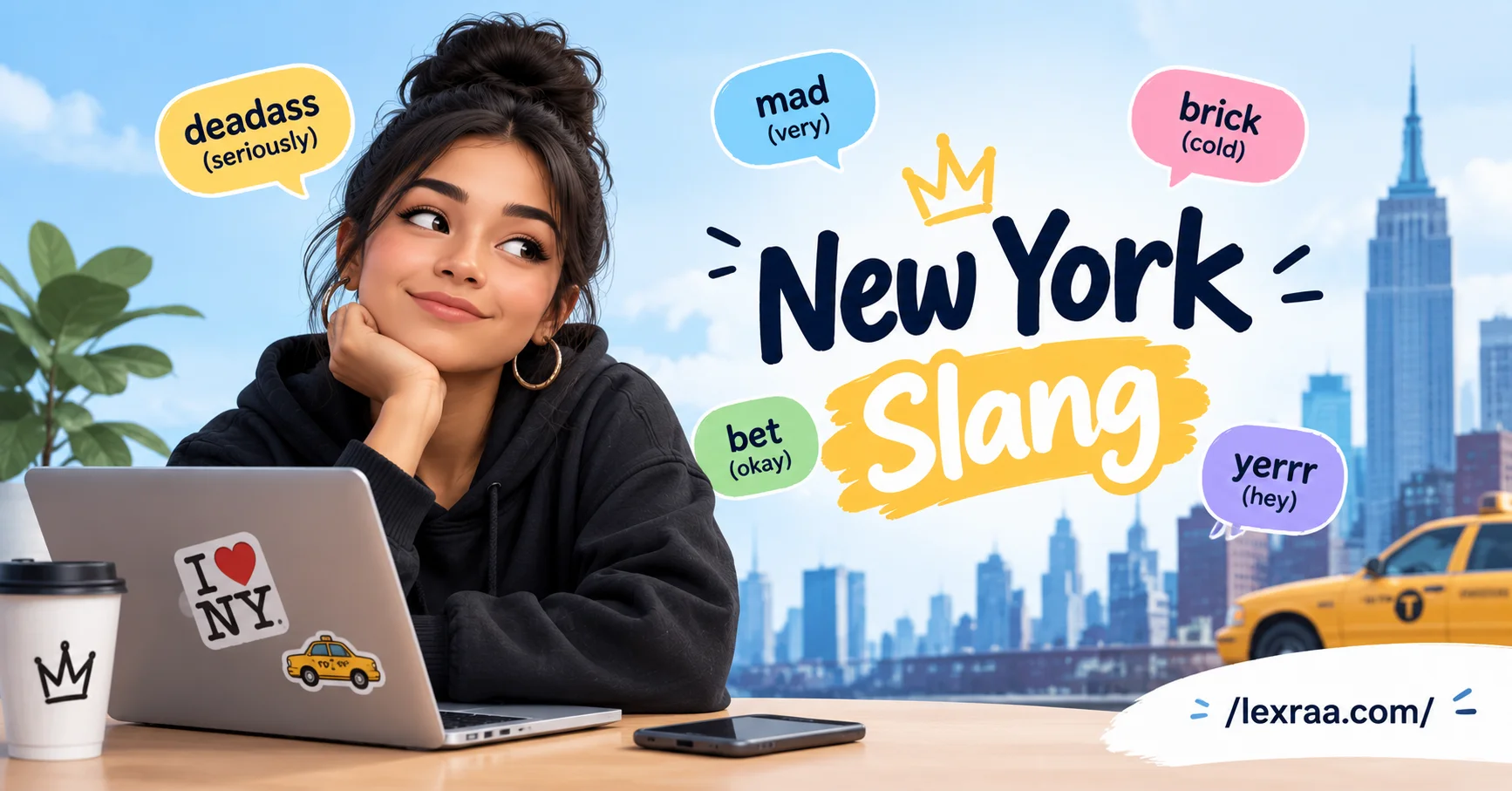
New York slang refers to informal words, phrases, and expressions associated with New York City speech and culture. Common examples include deadass, mad, brick, buggin’, son, tight, and yerrr, although many have spread far beyond NYC.
New York slang is not an acronym or abbreviation. It is a broad category of informal language rather than one fixed vocabulary list.
What Is New York Slang?
There isn’t one official dictionary of words that every New Yorker uses.
The city has five boroughs, many communities, and generations of speakers whose language overlaps in some places and differs in others. Some expressions are strongly associated with New York, while others began elsewhere and became especially common in the city.
That distinction matters.
For example, deadass has a documented connection to New York City slang, while bet and facts are now widespread across American internet and youth speech. Calling every word on a “NYC slang” list uniquely New York can give you a misleading picture of how the language actually works.
Current New York slang guides commonly highlight terms such as deadass, mad, brick, buggin’, son, tight, OD, and yerrr.
Common New York Slang Words and What They Mean
Here are some of the expressions most closely associated with contemporary NYC speech.
| New York term | Meaning | Example |
|---|---|---|
| Deadass | Seriously, genuinely, or for real | “I’m deadass tired.” |
| Mad | Very, extremely, or a lot | “That place is mad crowded.” |
| Brick | Extremely cold | “It’s brick outside.” |
| Buggin’ | Acting irrationally, overreacting, or worrying unnecessarily | “You’re buggin’.” |
| Tight | Angry, annoyed, or upset | “He’s tight about what happened.” |
| OD | Excessively or too much | “You’re OD loud.” |
| Son | Casual way of addressing another person | “Yo, son, where you been?” |
| Yerrr / Yerr | A New York-style greeting or call for attention | “Yerrr, what’s good?” |
| Bet | Okay, agreed, or sure | “Meet at eight?” “Bet.” |
| Bodega | Neighborhood convenience store or small grocery | “I’m stopping at the bodega.” |
Not every term has the same linguistic status. Bodega, for example, is an ordinary English noun for a type of neighborhood store and is not slang in every sentence. It became especially associated with New York City usage.
Likewise, mad can function as an intensifier rather than meaning anger:
“That pizza is mad good.”
Here, mad means very or extremely, not “angry.”
Deadass: One of the Most Recognizable NYC Expressions
Deadass means seriously, genuinely, honestly, or for real.
It can appear inside a statement:
“I’m deadass exhausted.”
It can also be used as a question:
“You deadass?”
That means something like “Are you serious?”
Dictionary.com documents deadass in New York City slang in the late 1990s–2000s and notes that the word itself has older history as an intensifying expression. It also identifies its later spread through online culture.
An important detail is that deadass is no longer confined to New York. Its use has spread much more broadly, so seeing it in a text or TikTok comment does not prove that the person is from NYC.
Why Does “Brick” Mean Cold?
If someone says:
“It’s brick outside.”
they aren’t talking about a building material.
In New York slang, brick can describe extremely cold weather. The expression is strongly associated with NYC speech and appears frequently in descriptions of New York winter language.
One proposed explanation connects the expression with the cold feel of brick buildings, but that origin is not settled enough to present as established fact. The useful part for everyday understanding is the meaning: brick = very cold.
What Does “Mad” Mean in New York Slang?
One of the easiest expressions to misunderstand is mad.
In a sentence such as:
“That restaurant is mad expensive.”
mad means very or extremely.
It can also describe quantity:
“There were mad people at the concert.”
This use is not exclusive to New York, but it is strongly recognizable in New York and other informal American speech.
The important difference is grammatical context. If someone says:
“He’s mad.”
they may mean angry.
But:
“He’s mad funny.”
means very funny.
The word has therefore not simply acquired one new definition; its meaning depends on how it functions in the sentence.
What Does “Son” Mean in New York Slang?
In some NYC speech, son can be used as a casual form of address.
“Yo, son, you coming or what?”
The speaker isn’t necessarily talking to their actual child.
It can function similarly to other informal forms of address such as bro or my guy, although the exact tone depends heavily on the speakers and situation.
Because son also has its ordinary family meaning, context is especially important.
What Does “Buggin’” Mean?
Buggin’ generally means someone is acting irrationally, overreacting, worrying excessively, or reacting as though something is more serious than it really is.
For example:
“You think I stole your charger? You buggin’.”
It can be playful:
“You’re buggin’ if you think I’m paying $40 for that.”
Or more confrontational:
“Why are you buggin’ right now?”
The tone changes the force of the expression.
New York Slang Isn’t the Same as New York English
This is one of the distinctions that gets lost in many online slang lists.
New York English is a broader linguistic category that includes pronunciation, grammar, vocabulary, and speech patterns associated with New York.
New York slang is only the informal vocabulary and expressions.
There are also local words that aren’t necessarily slang at all.
Bodega is a good example. So is hero when referring to a large sandwich in New York usage. These words can be part of local vocabulary without being slang in every context.
That means a person can speak with recognizable New York English without constantly using slang.
Where Did New York Slang Come From?
New York slang does not have one single cultural origin.
The city’s language has been shaped by successive waves of immigration, multilingual communities, neighborhood speech, Black American communities, Latino communities, Jewish and Yiddish influence, music, and especially New York’s long relationship with hip-hop.
The histories of individual words are therefore more useful than claiming that “New York slang” came from one source.
Black New York and African American English
Some expressions strongly associated with modern New York have documented connections to African American speech.
Deadass is one clear example. Dictionary.com describes its development in New York slang and later spread into broader American youth and internet culture.
That history should not be turned into a claim that every NYC slang term comes from AAVE. New York’s linguistic landscape is considerably more complicated than that.
Yiddish Influence
Words connected with New York’s Jewish communities also became part of wider English.
Words such as schlep and schmear are associated with Yiddish, although they are better treated as established vocabulary with cultural histories than automatically labeling them “New York slang.”
Spanish Influence
Bodega has Spanish roots. Etymonline traces it through Spanish bodega and ultimately to Greek apothēkē through Latin, while noting its later American-English meaning of a neighborhood convenience store and its particularly generic use in New York.
Hip-Hop and New York Culture
New York hip-hop, particularly its development in the Bronx, has also played a major role in spreading local language beyond the city.
But this doesn’t mean every current internet slang term was invented in New York. Music, social media, and online communities constantly move vocabulary in both directions.
New York Slang on TikTok, Instagram, X, and Reddit
New York expressions now appear well outside face-to-face NYC conversations.
Current guides document terms such as deadass, brick, mad, buggin’, and bet across social-media discussions and short-form content.
But there usually isn’t a separate “TikTok meaning” or “Instagram meaning.”
For example:
“Deadass?”
still means roughly “Seriously?” whether it appears in a text, a TikTok comment, or an X post.
What changes is the audience. A New York expression can become nationally familiar through music, memes, videos, and social media, eventually being used by people who have never lived in New York.
Reddit is particularly useful for seeing people debate whether a word feels genuinely New York-specific or has already become broader American slang.
5 Natural New York Slang Conversations
1. Friends texting
Marcus: You coming to the game?
Dev: Deadass, I’m leaving now.
Marcus: Bet.
Dev: Save me a seat.
2. Talking about the weather
Nia: Why did I leave the house without gloves?
Tasha: Because you thought it wasn’t that cold.
Nia: It’s brick outside.
Tasha: I told you.
3. Someone is overreacting
Chris: He hasn’t answered in ten minutes.
Andre: So?
Chris: Something happened.
Andre: Bro, you buggin’.
4. Instagram comment
Jay: That jacket is mad clean.
Leo: Appreciate you.
Jay: Where’d you get it?
Leo: Little spot downtown.
5. Casual conversation
Maya: Son, you still got my charger?
Dre: Yeah, my bad.
Maya: Bring it tomorrow.
Dre: Bet.
A Useful Rule: Don’t Stack NYC Slang
One of the easiest ways to make New York slang sound unnatural is to combine several recognizable expressions simply because they appear on the same slang list.
A sentence like:
“Yerrr son, it’s mad brick, deadass, OD crazy, bet?”
contains several expressions associated with NYC speech, but that doesn’t automatically make it authentic.
Real speakers choose expressions according to context, relationship, rhythm, and emphasis.
Learning five words and inserting all five into one sentence is very different from understanding when each word naturally belongs.
This is an important distinction that many “100 New York slang words” articles overlook.
New York Slang vs. Similar Language
| Term | Meaning | Tone | Popularity | Confusion Risk |
|---|---|---|---|---|
| New York slang | Informal expressions associated with NYC speech and culture | Casual | High | Medium |
| NYC English | Broader New York variety of English, including pronunciation and vocabulary | Casual to neutral | High | Medium |
| African American English | A family of English varieties with established linguistic features and histories | Depends on context | High | High |
| General American slang | Informal expressions used across the U.S. | Casual | Very high | High |
| Regional slang | Informal language associated with a particular geographic area | Casual | High | Medium |
| Formal/standard English | Language used in formal or standardized contexts rather than regional slang | Formal/neutral | Very high | Low |
The key point is that these categories overlap. A word can have a meaningful New York history and later become part of national slang.
Is New York Slang the Same in Every Borough?
No.
New York City is not linguistically uniform. Age, neighborhood, community, social setting, and personal background can all affect which expressions someone uses.
A phrase strongly associated with one group or era may be less common among another group of New Yorkers.
That is why statements such as “every New Yorker says this” are usually too broad.
It is more accurate to say that certain expressions are strongly associated with NYC or commonly documented in New York speech.
Is New York Slang Rude?
Most New York slang is not automatically rude.
Words such as deadass, mad, brick, or bet are generally informal rather than offensive.
However, some expressions can become confrontational depending on how they’re delivered. Calling someone son, saying you buggin’, or using other direct forms of address can sound friendly among people who know each other and much sharper during an argument.
The safest approach is to understand the relationship and tone before copying an expression.
For work, school, customer service, or formal writing, ordinary English is usually clearer.
How to Respond to New York Slang
You don’t need to imitate the slang to respond naturally.
If someone says:
“It’s brick outside.”
You can simply say:
“Seriously. I should’ve brought a heavier jacket.”
If someone says:
“Deadass?”
a natural response is:
“Deadass. I’m not joking.”
And if someone says:
“Bet.”
you can answer normally:
“See you then.”
Understanding the phrase matters more than trying to reproduce a particular New York speaking style.
Related New York Slang Searches
People looking for New York slang often branch into more specific questions, including “New York slang words,” “NYC slang,” “New York slang meaning,” “New York slang Reddit,” “New York slang for homie,” and “New York slang for fight.” Current online guides also focus heavily on individual expressions such as deadass, brick, mad, son, and bet.
These searches usually fall into two practical needs: learning common NYC expressions and figuring out a word or phrase someone has already used. A person searching for “New York slang for homie,” for example, is looking for a vocabulary equivalent, while someone searching “deadass meaning” is trying to decode a specific expression.
That is why learning the context matters more than memorizing a huge list. A word such as mad can mean “very” in “mad good,” while deadass can work as either a statement of seriousness or a question meaning “seriously?” The surrounding sentence tells you how the expression is functioning.
Frequently Asked Questions
What is considered New York slang?
New York slang includes informal expressions strongly associated with New York City speech and culture. Examples include deadass, mad, brick, buggin’, tight, son, and yerrr. Some have spread so widely that they are no longer exclusive to New York.
What does “deadass” mean in New York?
Deadass means seriously, genuinely, honestly, or for real. It can also be used as a question meaning “Are you serious?” The term has documented New York associations and has since spread into broader American slang.
What does “brick” mean in New York slang?
Brick means extremely cold, especially when describing the weather. “It’s brick outside” means the speaker thinks it is very cold outside.
What does “mad” mean in NYC slang?
In expressions such as “mad good” or “mad expensive,” mad means very, extremely, or a lot. It is different from the ordinary meaning of mad as angry.
What does “son” mean in New York slang?
Son can be an informal way to address another person, particularly in casual speech. It does not necessarily refer to someone’s actual child.
Is New York slang the same as AAVE?
No. Some New York expressions have documented connections with African American English, but New York slang is a broader category shaped by many communities and linguistic influences. Treating all New York slang as AAVE—or treating all AAVE as New York slang—would oversimplify both.
Do people still use New York slang?
Yes, although usage varies considerably between speakers and terms. Expressions such as deadass, mad, brick, and others continue to appear in current New York speech and online discussions, while some older expressions have become less common or have acquired broader meanings.
Conclusion
New York slang is best understood as a changing collection of informal expressions associated with New York City rather than a fixed vocabulary that every New Yorker uses.
Start with the meanings that appear most often—deadass for seriousness, mad for “very,” brick for extreme cold, buggin’ for overreacting, and bet for agreement. Then pay attention to how real speakers use them.
The biggest mistake is assuming that every slang word on an NYC list originated in New York or that using several New York expressions together will automatically sound authentic. Some terms have specific local histories, others have traveled nationally, and some are better described as local vocabulary than slang.
Use the expressions naturally in casual settings, understand the context first, and don’t force them into formal communication where straightforward English works better.