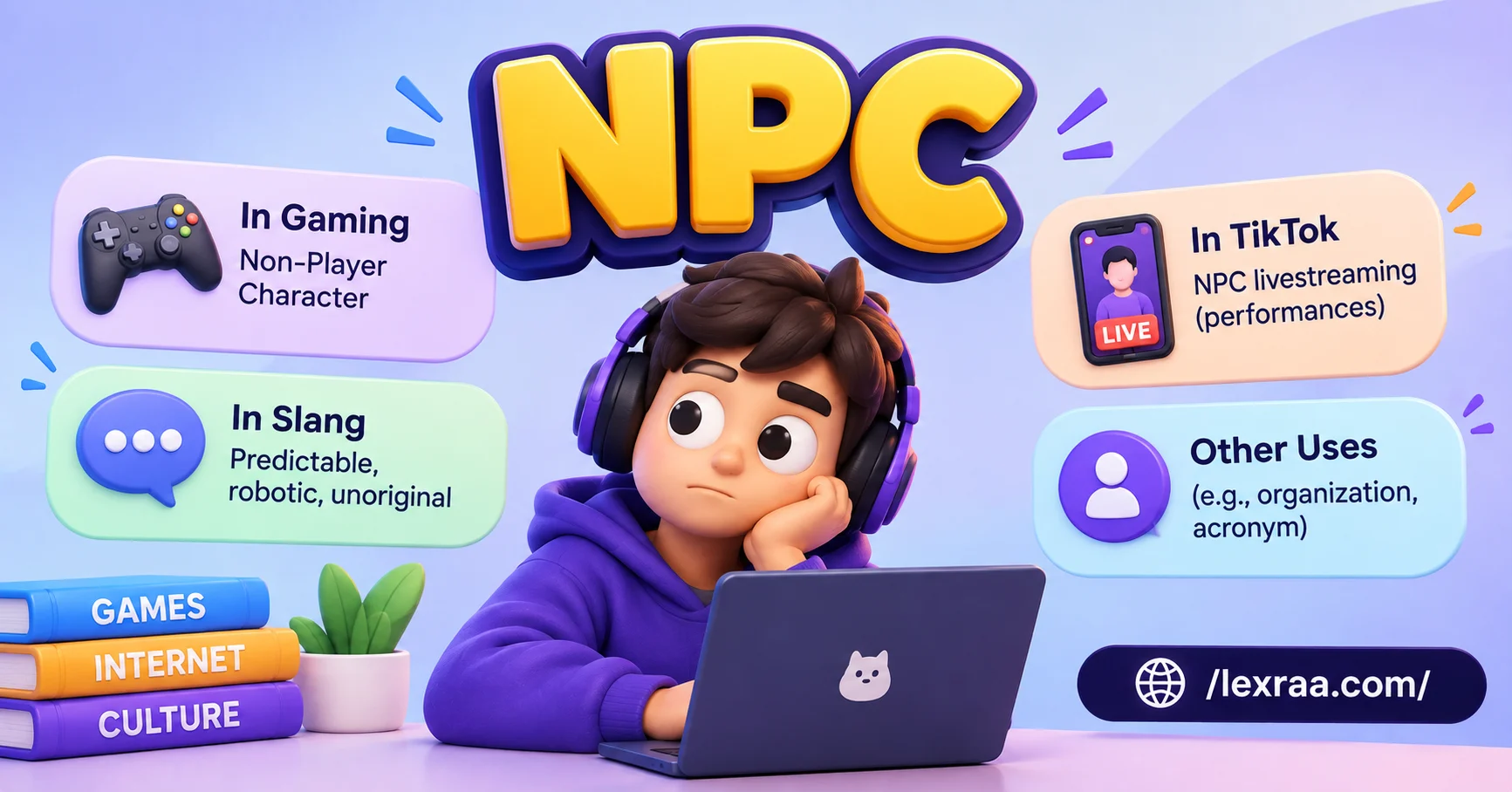
NPC stands for “non-player character.” In internet slang, calling someone an “NPC” usually means they seem predictable, robotic, unoriginal, or as if they are simply repeating what everyone else says.
The meaning changes with context. In a video game, NPC is usually completely neutral: it refers to a character controlled by the game rather than by the player. In a comment, text, meme, or argument about a real person, it can become a sarcastic or insulting comparison.
What Does NPC Mean?
There are three important ways you may encounter NPC online.
1. NPC in gaming: “Non-Player Character”
The original meaning is non-player character: a character in a game who isn’t controlled directly by the player.
An NPC might be a shopkeeper, guard, villager, quest giver, teammate controlled by the computer, or another character who exists within the game’s world. Their actions and dialogue are generally determined by the game’s programming.
For example:
“Talk to the NPC in the village to start the quest.”
Here, there is nothing insulting about the word.
You may also hear “non-playable character” used to describe the same concept. “Non-player character” is the standard expansion used by major dictionaries, while “non-playable” is a widespread gaming-language variant.
2. NPC as internet slang
When somebody calls a real person an NPC, the comparison changes.
It usually suggests that the person:
- doesn’t seem to think independently
- repeats other people’s opinions
- follows trends automatically
- behaves in a predictable or scripted way
- gives the same responses repeatedly
- seems “robotic” or disconnected
The metaphor comes directly from the characteristics people associate with game NPCs: preset dialogue, routines, and limited behavior.
So:
“Bro is an NPC.”
could mean:
“He acts like he’s following a script instead of thinking for himself.”
That can be playful between friends, but it can also be genuinely dismissive.
3. NPC streaming
There is also a newer internet meaning connected to NPC livestreaming, particularly on TikTok.
In this format, creators deliberately behave like video-game NPCs. They may repeat specific phrases, gestures, facial expressions, or movements when viewers send virtual gifts. The format became widely known in 2023 through viral TikTok livestreams, although earlier NPC-style streams appeared in 2022.
This is different from simply insulting someone by calling them an NPC.
If a TikTok caption says:
“NPC live”
it may be referring to the performance format, not saying that the streamer is unintelligent or incapable of independent thought.
Is NPC an Acronym or Abbreviation?
NPC is an initialism/acronym formed from “non-player character.”
In normal gaming conversation, the letters refer to the game-character concept.
The slang meaning doesn’t create a completely new set of letters. Instead, internet users took the existing gaming term and turned its characteristics into a metaphor for human behavior.
That distinction matters because you may see the exact same three letters used neutrally in one sentence and insultingly in another.
Compare:
“The NPC gave me a new quest.”
Neutral gaming terminology.
“Everyone in this comment section is an NPC.”
A dismissive internet comparison.
Same abbreviation, completely different social meaning.
Read More: Sigma Meme: Why Does Everyone Say “Sigma”?
A Common Misunderstanding About NPC
The biggest misunderstanding is assuming that calling someone an NPC always means they’re boring.
Boring can be part of the implication, but it isn’t the whole meaning.
An NPC insult more specifically points toward predictability, conformity, scripted behavior, or perceived lack of independent thought. Someone might be called an NPC because they repeat a popular opinion, copy a trend, use identical responses, or appear to follow a routine without questioning it.
There’s another important distinction: NPC does not literally mean the person has no thoughts or personality. It’s a metaphor and an insult/joke based on how someone is perceived.
A person can be perfectly thoughtful and still get called an NPC because someone dislikes their opinion or thinks their behavior looks predictable.
Where Is NPC Used Online?
There is strong evidence for NPC in gaming communities, TikTok, Reddit, X, and broader meme culture. Its exact tone varies considerably by platform and context.
TikTok
TikTok has two particularly visible uses.
The first is ordinary slang: someone behaving predictably or robotically may be called an NPC.
The second is NPC livestreaming, where creators intentionally imitate programmed game characters and respond to viewer gifts with repeated actions or phrases. The trend became especially prominent in 2023.
X
NPC has also been used heavily in online arguments and political discussions on X, formerly Twitter.
That usage can be much harsher because calling an opponent an NPC implies that they aren’t independently thinking and are merely repeating someone else’s talking points. The political version became particularly visible around 2018.
Reddit contains both meanings.
In gaming communities, NPC usually retains its ordinary game-related meaning.
In meme communities and debates, it can describe someone whose behavior or comments seem repetitive or unoriginal. Reddit was also one of the places where the metaphorical usage spread.
Instagram, Snapchat, and WhatsApp
You may encounter NPC in Instagram comments, Snapchat messages, WhatsApp chats, and other private conversations, but the evidence for a distinctive platform-specific meaning is much weaker.
When it appears there, it generally carries the same basic internet-slang idea: “you’re acting predictable, scripted, robotic, or like you’re just following everyone else.”
So there is no special “Instagram meaning” or separate “WhatsApp meaning” that you need to memorize.
Where Did NPC Come From?
The word itself is much older than modern social media.
NPC originated in tabletop role-playing culture, where a non-player character is controlled by the game master or another person running the game rather than by an individual player. The concept then became standard in video games, where NPCs are generally controlled by the game’s programming.
Merriam-Webster records 1977 as the first known use of “NPC” in the relevant gaming sense.
The slang meaning came much later.
How NPC Became an Insult
The metaphorical use became particularly visible online around 2016–2018.
A 2016 4chan post asked whether certain people were “NPCs” and compared them to game characters that supposedly followed programmed behavior. The concept was later revived and developed into the NPC meme, including the familiar gray, expressionless character associated with NPC Wojak.
By 2018, the term had become strongly associated with political internet arguments, especially in right-wing online communities, where it was used to accuse political opponents of simply repeating progressive talking points. Academic research documents this political development and the spread of NPC memes during that period.
The meaning subsequently broadened beyond politics.
Today, someone can be called an NPC simply because they are repetitive, predictable, overly trend-driven, awkwardly scripted, or behaving like a background character.
The 2023 TikTok Connection
NPC acquired another major burst of attention through TikTok NPC livestreaming.
Know Your Meme identifies Japanese TikToker natuecoco as one of the earliest known creators associated with the format in 2022. The trend became much more visible in 2023, especially after Pinkydoll’s livestreams went viral.
The performance style involved reacting to digital gifts with predetermined movements and phrases, deliberately mimicking the repetitive behavior associated with video-game NPCs.
This is why some people who encountered NPC through TikTok may know the word primarily from livestream culture rather than from gaming.
10 Natural Examples of NPC
1. Funny
Friend: Why do you order the exact same coffee every morning?
You: Because it’s good.
Friend: Same order, same seat, same time.
You: Apparently I’m an NPC now. 😂
2. Sarcastic
Friend: Everyone online is saying this is the best movie ever.
You: So you watched it?
Friend: No, but everyone says it’s amazing.
You: Impressive NPC dialogue.
3. Playful
You: You said “I’m fine” three times today.
Friend: Because I’m fine.
You: That’s exactly what an NPC would say.
Friend: 😭 Leave me alone.
4. Serious
Coworker: Why did he call me an NPC?
You: Probably because he thought you were just repeating the same opinion as everyone else.
Coworker: I wasn’t trying to copy anyone.
You: Then he was describing his perception, not necessarily reality.
5. Gaming
You: Where’s the weapons vendor?
Friend: Near the town entrance.
You: The NPC standing beside the red sign?
Friend: Yeah, that’s the one.
6. TikTok
Friend: Why is this creator repeating the same phrase every time someone sends a gift?
You: It’s an NPC livestream.
Friend: So they’re doing it intentionally?
You: Exactly.
7. Group Chat
Friend 1: Everyone posted the exact same meme today.
Friend 2: The whole group became NPCs overnight.
Friend 3: We have one personality between twelve people.
Friend 1: Finally, someone understands.
8. Dating
Person A: Your dating profile says the same thing as every other profile.
Person B: What’s that supposed to mean?
Person A: Nothing serious. It just feels very predictable.
Person B: So now I’m an NPC? 😂
9. School
Student 1: Everyone chose the same topic for the presentation.
Student 2: Because the teacher basically gave us five options.
Student 1: Fair. I take back the NPC accusation.
Student 2: Thank you.
10. X / Online Debate
User A: Every reply is repeating the exact same talking point.
User B: That’s the most NPC comment section I’ve seen all week.
User A: Or maybe they all independently agree.
User B: Also possible.
That last exchange illustrates an important point: NPC is often an accusation about someone’s behavior, not proof that the accusation is true.
How Do You Reply When Someone Calls You an NPC?
The best response depends on whether the person is joking or genuinely trying to insult you.
Funny reply
“Beep boop. Quest accepted. 🤖”
This plays along with the gaming metaphor rather than escalating the argument.
Serious reply
“If you disagree with me, tell me why. Calling me an NPC doesn’t explain your argument.”
This is useful when the word is being used to dismiss your opinion.
Flirty reply
If you’re already joking with someone:
“Maybe I’m an NPC, but apparently you keep coming back for the side quest.”
This only works when the conversation is already playful.
Neutral reply
“What do you mean by NPC here?”
This is surprisingly effective because the term can mean a game character, a joke about someone’s behavior, or a reference to NPC livestreams.
NPC vs. Similar Terms
| Term | Meaning | Tone | Popularity | Confusion Risk |
|---|---|---|---|---|
| NPC | Game character not controlled by the player; slang for someone perceived as scripted or unoriginal | Neutral in gaming; mocking in slang | Very high | Low |
| Bot | Automated account, program, or person behaving mechanically | Neutral to insulting | Very high | Medium |
| Sheep | Person perceived as blindly following others | Insulting | High | Medium |
| Robot | Someone behaving mechanically or without emotion | Usually mocking | Very high | Medium |
| Follower | Someone who follows another person, group, or trend | Neutral to negative depending on context | Very high | High |
| Main character | Someone treated as the central or protagonist-like figure in a situation | Often positive/playful | Very high | Medium |
Bot and NPC are especially easy to confuse.
A bot is usually an automated software system or account. An NPC is specifically borrowed from gaming and describes a character that isn’t controlled by the player.
When used as insults, however, both can suggest that someone is behaving mechanically.
There is also a cultural contrast between NPC and the idea of a main character, but they are not strict dictionary opposites. One is a gaming metaphor for a background/non-player role; the other is an internet metaphor for behaving like the protagonist of your own story.
Who Uses NPC?
There isn’t reliable evidence that NPC belongs exclusively to Gen Z, even though younger internet users helped popularize many of its current meme uses.
Gamers of different ages have used the term for decades because it is established gaming vocabulary. The metaphorical insult became especially prominent in online communities during the late 2010s, while TikTok later introduced the NPC livestream format to a much wider audience.
There is also no solid US-versus-UK difference in the basic slang definition.
One genuine regional/cultural distinction does exist in the history of the insult: its political meme usage was particularly associated with U.S. online political communities around 2018. That does not mean every current use of NPC is political.
Is NPC Rude or Safe to Use?
It depends heavily on context.
In gaming: usually safe and neutral.
“The NPC gave me a quest.”
There’s no insult there.
Between close friends: it can be harmless teasing.
“You bought the same lunch again. NPC behavior.”
About a stranger: it can sound insulting.
“This guy is such an NPC.”
During a political argument: it can be particularly dismissive because you’re essentially accusing someone of lacking independent thought. The political history of the term makes that usage more loaded than a simple joke about repetitive behavior.
NPC is not profanity, but that doesn’t make every use polite. It can be demeaning because it compares a human being to a programmed character without meaningful agency.
For school or work, it’s safer to describe the actual behavior instead:
“That response sounds repetitive.”
or:
“It seems like you’re repeating the same point.”
Those statements communicate the criticism without turning it into a personal insult.
One Useful Insight About Why “NPC” Sticks
NPC works as slang because it compresses a surprisingly complicated criticism into three letters. Instead of saying someone is predictable, repetitive, conformist, overly scripted, and seemingly unwilling to think independently, the speaker invokes a familiar video-game image and lets the metaphor do the work.
The comparison is instantly visual: a character standing in one place, following a routine, repeating dialogue, and waiting for the player to interact. That makes NPC especially effective in memes and short-form communication, where a single word can carry an entire joke.
Other Meanings of NPC
If you see NPC outside gaming or internet culture, don’t automatically assume it’s slang.
For example, in political or news coverage about China, NPC can refer to the National People’s Congress. Dictionary examples also show that the same three letters can occur as organization-specific abbreviations in other professional contexts.
For ordinary online conversations, however, the two meanings you should check first are:
- Non-player character — gaming.
- NPC as slang — someone perceived as robotic, predictable, or lacking independent thought.
A third context, NPC streaming, refers to creators intentionally performing like game NPCs, particularly in livestream environments.
FAQ
1. What does NPC mean in texting?
In texting, NPC usually borrows the internet-slang meaning from gaming. Calling someone an NPC suggests they are acting predictable, repetitive, robotic, or as though they are simply following a script. Among friends it can be a joke, but it can also be an insult.
2. Does NPC mean “non-playable character”?
Yes, non-playable character is a widespread expansion of NPC, but major dictionaries use non-player character as the standard term. Both refer to characters that aren’t controlled directly by the player. In gaming, the term itself is neutral.
3. Is calling someone an NPC an insult?
It can be. The slang version implies that the person lacks originality, independent thought, or meaningful agency, although people also use it jokingly. The relationship between the speakers and the surrounding conversation determines how harsh it sounds.
4. What does NPC mean on TikTok?
On TikTok, NPC can refer either to someone behaving like a scripted or robotic character or to NPC livestreaming, a performance style where creators deliberately repeat movements and phrases in response to viewer gifts. The livestream trend became widely viral in 2023.
5. Why do people call others NPCs?
The comparison comes from video games. NPCs commonly follow programmed routines and repeat dialogue, so calling a person an NPC suggests that they seem to be following a script rather than thinking or acting independently.
6. Is NPC a bad word?
NPC is not profanity, but it can be rude. Using it for a person can be dismissive or dehumanizing, particularly during an argument. In gaming, however, NPC is normally just ordinary terminology.
7. Did NPC slang come from TikTok?
No. The slang meaning predates TikTok’s NPC livestream trend. The metaphorical use became prominent in internet meme and political culture around 2016–2018, while NPC livestreaming became a major TikTok trend later, especially in 2023.
8. What is the opposite of an NPC?
There is no exact linguistic opposite. Internet culture sometimes contrasts an NPC with a “main character,” meaning someone portrayed as the protagonist of their own story, but that is a cultural metaphor rather than a formal antonym.
Final Thoughts
NPC started as a neutral gaming term for a non-player character and later became internet slang for someone perceived as predictable, robotic, unoriginal, or unable to think independently.
Context is everything. In a game, NPC is normal vocabulary. In a TikTok livestream, it may describe a deliberate performance style. In a comment about a real person, it can be playful teasing or a serious insult.
The biggest mistake is treating every use as the same. Before reacting to “NPC,” check whether the conversation is about gaming, meme culture, NPC livestreams, or someone’s behavior.
If you’re using the word yourself, remember that it is safest as a joke among people who understand your tone. Calling a stranger an NPC—especially during a serious disagreement—can sound much harsher than you intend.