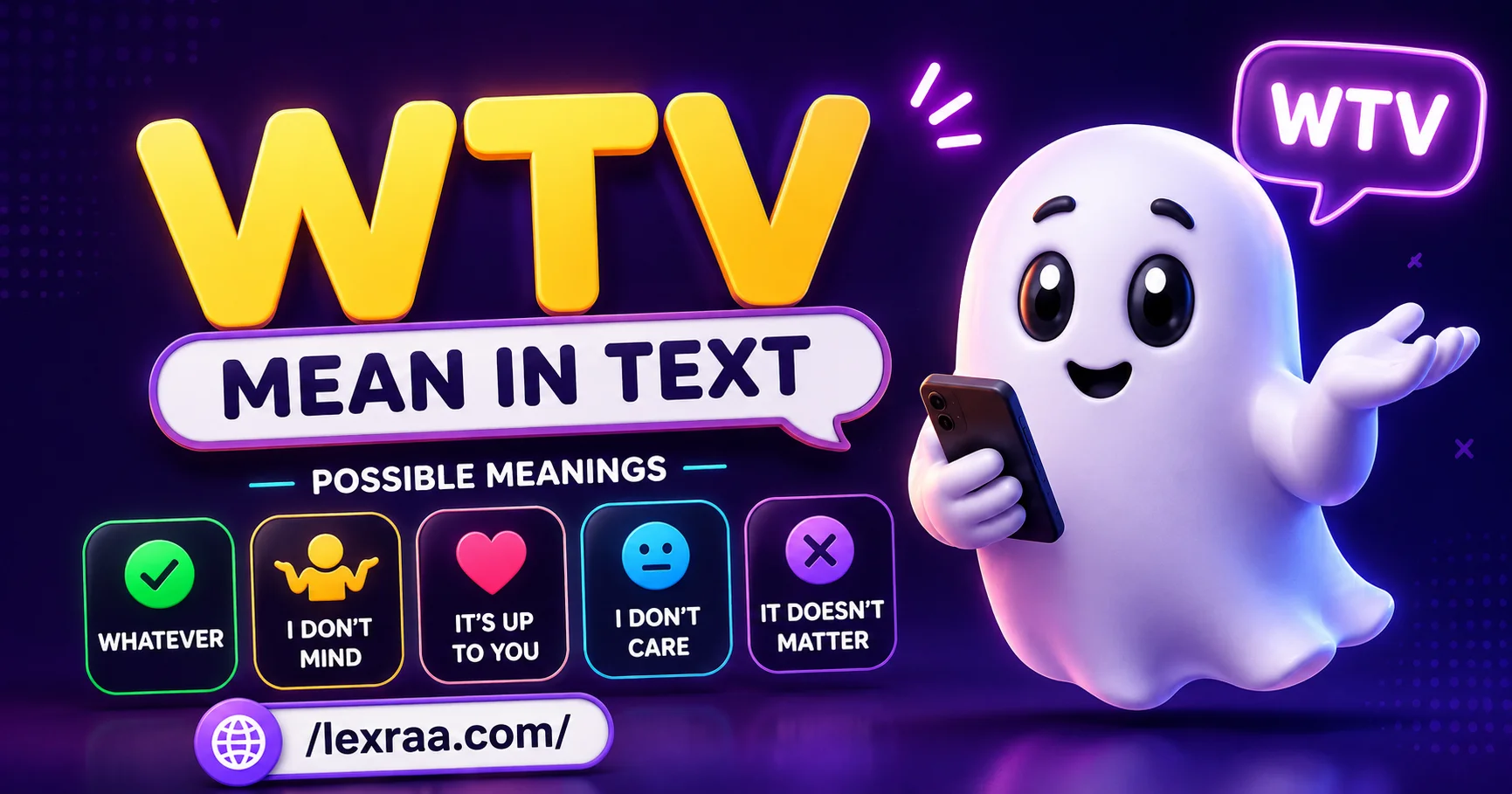
WTV usually means “whatever” in texting and online chat. Depending on the context, it can mean “I don’t mind,” “I don’t care,” “it’s up to you,” or a more dismissive “whatever.”
The tricky part is that WTV itself does not tell you the sender’s attitude. A friend saying “wtv, you pick” may genuinely be flexible, while “wtv.” during an argument can sound like they are done discussing the issue.
What Does WTV Mean in Texting?
WTV is an informal abbreviation of “whatever.” It is generally used in casual digital communication rather than formal writing. Wiktionary lists wtv as internet and text-messaging slang and also records it as an interjection and pronoun.
The most common meanings are closely related:
- “Whatever.”
- “I don’t mind.”
- “It’s up to you.”
- “I don’t care.”
- “It doesn’t matter.”
- “I’m done arguing about this.”
Those meanings can sound very different emotionally, even though the abbreviation stays exactly the same.
For example:
“Pizza or burgers?”
“wtv, you choose.”
Here, WTV means something like “I’m fine with either.”
Compare that with:
“You never listen to me.”
“wtv.”
In this situation, the same three letters can sound much closer to “whatever, I’m not discussing this anymore.”
That difference is why understanding WTV requires more than simply expanding the abbreviation.
Is WTV an Acronym, Abbreviation, or Slang?
The most accurate description is an abbreviation used as internet and texting slang.
It is not normally pronounced as a new spoken word. If someone reads “wtv” aloud, they would generally say “whatever” rather than pronounce the letters as a word. YourDictionary describes WTV as a shortened form of “whatever” and notes its use in texting and social media.
You may see it written as:
- wtv
- WTV
- Wtv
Capitalization usually does not change the meaning. Lowercase wtv tends to fit naturally into casual texting, while uppercase WTV can add emphasis depending on the conversation.
The Most Important Difference: “I Don’t Mind” vs. “I Don’t Care”
One of the easiest ways to misunderstand WTV is assuming that it always means “I don’t care.”
It does not necessarily carry that strong a meaning.
If someone asks:
“Should we meet Friday or Saturday?”
and you answer:
“wtv works for me”
you are probably communicating flexibility, not hostility.
But if someone writes:
“I already explained it to you. WTV.”
the abbreviation may communicate dismissal or frustration.
The surrounding words matter enormously. “WTV, you decide 😂” is considerably softer than “WTV. Do what you want.”
Why WTV Can Feel Ruder Than “Whatever”
There is an interesting feature of digital communication here: shortening a word can remove some of its emotional cushioning.
Spoken “whatever” can be delivered with a laugh, a shrug, or a playful voice. Text has none of those built-in signals.
So when someone sends only:
wtv
the recipient has to infer the tone from the conversation, punctuation, relationship, and sometimes emojis.
That is why a standalone WTV can occasionally feel colder than the sender intended.
A message such as “wtv 😂” gives the reader an obvious playful clue. By contrast, “wtv.” can look final or irritated, particularly after disagreement.
This is not a strict rule—punctuation and emojis do not have one universal meaning—but they can provide useful contextual clues.
Is WTV Ever a Different Meaning?
In the context of texting slang, “whatever” is the established meaning supported by slang and dictionary-style references.
WTV can also appear as an abbreviation for unrelated terms in technical, medical, business, and other specialized contexts. Acronym databases list several non-slang expansions.
So if you encounter WTV in a medical document, technical report, or professional setting, do not automatically translate it as “whatever.”
For a casual message such as “wtv, I’m good”, however, “whatever” is overwhelmingly the relevant interpretation.
Where Is WTV Used?
WTV is primarily associated with informal digital communication.
Documented examples and reference sources place it in:
- Text messages
- Online chats
- Social media
- Snapchat
- Instagram and TikTok-style conversations
- Group chats
- Online comments and DMs
YourDictionary specifically notes its popularity on social media, especially Snapchat, while Slang.net lists messaging, social media, email, and online chat as usage contexts.
Current slang references also describe WTV appearing in TikTok, Instagram, Snapchat, and casual messaging. Because platform-specific slang changes quickly, it is more accurate to describe WTV as general internet/texting shorthand rather than claiming that it belongs exclusively to one particular app.
You are much less likely to see it in a formal business email, academic paper, official letter, or professional report.
Where Did WTV Come From?
There is no well-documented single person, community, or event that can be credited with inventing WTV.
The abbreviation developed as part of the broader habit of shortening words in digital communication. “Whatever” itself is much older English, while WTV is a comparatively modern written abbreviation associated with texting and online communication. YourDictionary describes it as a relatively new abbreviation, and an Abbreviations.com entry for the “whatever” meaning dates to 2006.
An Urban Dictionary entry for wtv = whatever dates to December 2004, providing early user-submitted evidence that the shorthand was already circulating online by then.
It is therefore safer to describe WTV as an internet-era abbreviation that emerged through informal digital writing, rather than claiming a precise invention date.
There is also no strong evidence that WTV itself originated specifically in AAVE or another particular cultural variety of English. The available evidence points more broadly to internet and text-messaging abbreviation practices.
WTV in Different Tones: 4 Short Conversations
1. Funny
Friend: What do you want for dinner?
You: Wtv 😂
Friend: That is not an answer.
You: Fine. Surprise me. I trust the chef.
Here, WTV is playful and means “I’m not picky.”
2. Sarcastic
Friend: I told you the movie was going to be terrible.
You: And yet you watched the whole thing.
Friend: Wtv 🙄
You: Exactly. You loved every terrible minute.
The abbreviation works as a sarcastic dismissal rather than a literal statement of indifference.
3. Playful
Date: Beach or coffee tonight?
You: Wtv, I’m free 😌
Date: “Whatever” is not helping me plan.
You: Coffee first, then beach. Problem solved.
Here, WTV communicates flexibility without serious annoyance.
4. Serious
Friend: Are you actually okay with what happened?
You: Honestly, wtv.
Friend: That doesn’t sound like you’re okay.
You: I’m just tired of arguing about it.
In this context, WTV signals emotional exhaustion or disengagement.
More Natural Examples of WTV
Friends Choosing Plans
Friend: Movie or bowling?
You: Wtv works.
Friend: You seriously have no preference?
You: Nope, you pick.
Family Chat
Sibling: Mom said we’re leaving at six.
You: Wtv, just tell me when you’re ready.
Sibling: That’s not how schedules work.
You: Apparently it is today.
Group Chat
Friend 1: Thai food?
Friend 2: Pizza?
Friend 3: Wtv, I’m hungry.
Friend 1: Pizza wins by unanimous hunger.
Here WTV simply communicates “I’m fine with either option.”
Coworker Chat
Coworker: Do you want the morning shift or afternoon?
You: Wtv is fine.
Coworker: I’ll put you down for afternoon, then.
You: Sounds good.
This is understandable in an informal workplace chat, although a full phrase is safer in formal professional communication.
Dating Conversation
Person A: Where should we go tonight?
Person B: Wtv you want 😉
Person A: Dangerous answer.
Person B: I trust your choice.
The surrounding message makes the abbreviation feel relaxed rather than dismissive.
After a Minor Argument
Friend: We’re never going to agree on this.
You: Wtv.
Friend: Are you annoyed?
You: A little. Let’s just drop it.
Here WTV is a clear conversation-closing signal.
Instagram DM
Friend: That outfit is either amazing or completely ridiculous.
You: Wtv, I’m wearing it 😂
Friend: Honestly, respect.
You: Exactly.
Snapchat
Friend: We’re going to the mall later if you want to come.
You: Wtv, lmk when you’re leaving.
Friend: Around 5.
You: Bet.
The phrase means “sure, I’m flexible.”
Group Debate
Friend 1: The old version was better.
Friend 2: No way, the new one wins.
You: Wtv, both are good.
Friend 1: Finally, someone refuses to pick a side.
Ending a Repetitive Conversation
Friend: But I still think you’re wrong.
You: I know.
Friend: So you’re changing your mind?
You: Wtv, we’re going in circles.
Here WTV communicates “I’m no longer interested in debating this.”
How Should You Reply to WTV?
The best response depends on what the sender appears to mean.
If They Mean “I Don’t Mind”
Them: Pizza or burgers? Wtv.
You: Pizza it is.
There is no need to overthink the message.
If It Sounds Dismissive
Them: Wtv.
You: Are you actually okay, or do you want to talk about it?
This works better than immediately assuming they are angry.
Funny Reply
Them: Wtv 😂
You: Incredible contribution to the discussion.
A joking response works best with someone who already uses playful banter with you.
Neutral Reply
Them: Wtv, you choose.
You: Okay, I’ll decide.
Flirty Reply
Flirty replies can work when the conversation already has that tone:
Them: Wtv, you choose 😉
You: Careful, I might choose somewhere romantic.
Don’t treat WTV itself as inherently flirty. The flirtation comes from the surrounding conversation.
WTV vs. Similar Texting Abbreviations
| Term | Meaning | Tone | Popularity | Confusion Risk |
|---|---|---|---|---|
| WTV | Whatever; I don’t mind / I don’t care | Casual to dismissive | Common | Low |
| IDC | I don’t care | More direct, often stronger | Common | Medium |
| IDK | I don’t know | Uncertain or neutral | Very common | Low |
| NVM | Never mind | Withdrawal or correction | Common | Medium |
| TBH | To be honest | Direct / candid | Very common | Low |
| W/E | Whatever | Casual, indifferent | Less common in some circles | Medium |
| Sure | Yes / okay | Neutral or agreeable | Very common | Low |
The closest comparison is IDC. Both can communicate indifference, but “I don’t care” is generally more explicit. WTV can be softer when it means “either option is fine.”
NVM is different because it normally means the speaker is withdrawing a question, request, or thought rather than expressing indifference.
Who Uses WTV?
WTV is most strongly associated with informal internet and texting culture, and references commonly describe it as popular among teenagers and young adults.
That does not mean older users cannot understand or use it. Internet abbreviations often spread beyond the age group that popularized them, especially when they are short and easy to interpret.
There is also no reliable basis for saying that WTV belongs exclusively to Gen Z, Gen Alpha, Millennials, men, women, or a particular region. Usage can vary by individual, online community, and age.
Is WTV Rude or Safe to Use?
WTV is not profanity and is not inherently offensive.
The risk is its tone.
Among close friends, “wtv 😂” can be completely harmless. In a serious conversation, however, “wtv.” may sound dismissive, irritated, or emotionally detached.
It is generally fine for casual texting, group chats, social media comments, and conversations with friends. For school assignments, formal emails, job applications, customer-service messages, or professional correspondence, writing “whatever,” “either is fine,” or another clear phrase is a better choice.
A particularly important rule is this: don’t use WTV to dismiss someone who is trying to discuss a serious personal issue. Even if you mean “I’m tired of arguing,” the recipient may interpret it as “I don’t care about your feelings.”
Why Does WTV Work So Well in Conversation?
WTV survives because it compresses a surprisingly complicated attitude into three letters. It can communicate flexibility, indifference, resignation, or dismissal without requiring a full explanation. That makes it useful in fast-moving conversations where people expect context to fill in the emotional details. The abbreviation also fits a broader pattern in digital language: people routinely shorten familiar expressions while relying on the surrounding conversation to preserve meaning.
Common Mistakes When Reading WTV
Assuming WTV Always Means “I Don’t Care”
It can mean that, but it can also simply mean “I have no preference.”
“Wtv, you pick” is very different from “Wtv, I’m done talking.”
Assuming WTV Always Means Someone Is Angry
A standalone WTV can sound cold, but context matters. An emoji, additional words, or a familiar relationship can completely change how it reads.
Treating It Like a Formal Abbreviation
WTV belongs primarily to informal communication. It is not something you should automatically carry into professional writing.
Overanalyzing Capitalization
wtv, WTV, and Wtv generally refer to the same slang expression. Look at the surrounding words rather than treating capitalization as a secret code.
Frequently Asked Questions
What does WTV mean in a text from a girl?
WTV does not have a special meaning based on the sender’s gender. It normally means “whatever,” and the intended tone depends on context.
A message such as “wtv, you choose” can show flexibility, while “wtv.” during an argument may sound dismissive. It is better to interpret the entire conversation than to assign a gender-specific meaning.
What does WTV mean from a guy?
The basic meaning is also “whatever.” It might mean that he has no preference, doesn’t want to continue discussing something, or is simply using casual shorthand.
The relationship and surrounding messages matter more than the sender being a guy.
Does WTV mean “whatever” or “what”?
In texting slang, WTV normally means “whatever,” not “what.” Multiple dictionary and slang references identify “whatever” as its established chat meaning.
If the context does not make sense, check the surrounding conversation before assuming the abbreviation has a different meaning.
Is WTV the same as IDC?
Not exactly. IDC means “I don’t care” and is more direct, whereas WTV can also mean “I don’t mind” or “you decide.”
For example, “Pizza or tacos?” → “WTV” can mean either is fine. “I don’t care what happens” → “IDC” is a more direct match.
What does “wtv you want” mean?
“Wtv you want” usually means “whatever you want.” Depending on context, it can be genuinely accommodating or slightly dismissive.
For example, “Pick the restaurant, wtv you want” sounds flexible, while “Do wtv you want” during an argument can sound irritated.
Is WTV still used in texting?
Yes. Current slang references continue to document WTV as an abbreviation for “whatever” in text messaging and online communication.
Its exact popularity varies across communities, so it is better described as an established piece of informal internet shorthand than as a brand-new trend.
Can WTV be used in a professional message?
It is better to avoid it in formal professional communication. Although most readers who know texting slang will understand it, the abbreviation can appear overly casual or dismissive.
Use “either is fine,” “whatever works,” or “I don’t have a preference” when clarity and professionalism matter.
What does “WTV 😂” mean?
“WTV 😂” generally softens the abbreviation with humor. It may mean something like “whatever, lol” or “I don’t really care about this.”
The laughing emoji does not guarantee a specific emotional meaning, but it can make the message feel less serious than a bare “wtv.”
Conclusion
WTV means “whatever” in texting and online slang. It can express genuine flexibility, indifference, resignation, or dismissal depending on what surrounds it.
The safest way to read WTV is to look beyond the three letters. “Wtv, you choose” usually means the sender has no preference, while “wtv.” after an argument may signal that they are frustrated or finished with the discussion.
Use WTV freely in relaxed conversations when the tone is already casual. If you’re talking to someone you don’t know well, discussing something serious, or writing professionally, a clearer phrase such as “either is fine” or “I don’t mind” avoids unnecessary misunderstanding.