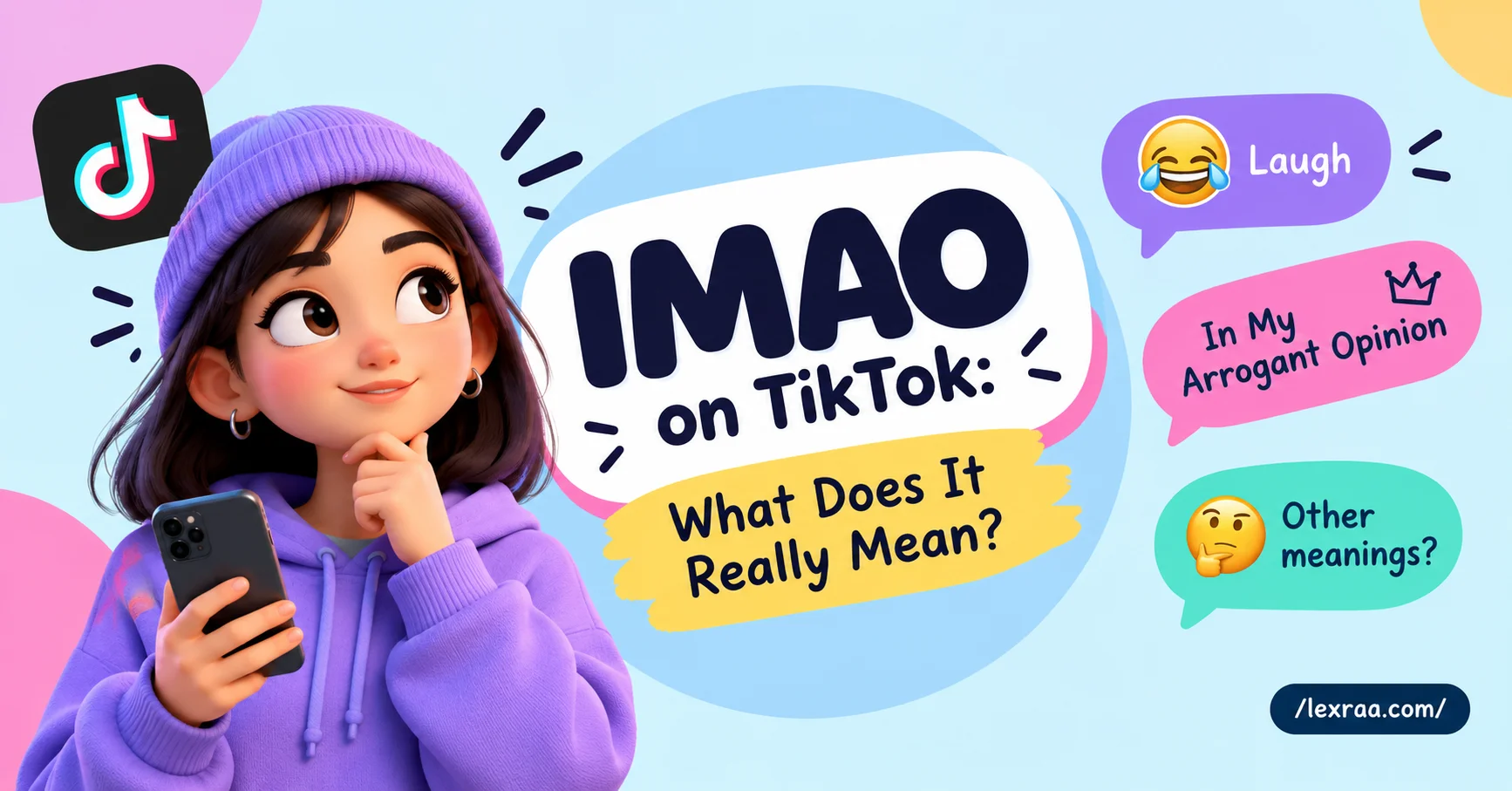
On TikTok, IMAO usually means “in my arrogant opinion.” It is an internet initialism used to introduce a confident, exaggerated, sarcastic, or deliberately self-aware opinion. It is not a TikTok-specific term.
If you saw “IMAO” in a TikTok comment such as “IMAO, this is their best song,” the person is essentially saying, “In my very confident opinion, this is their best song.” The word “arrogant” is often part of the joke rather than a serious admission of arrogance.
What Does IMAO Stand For?
IMAO = “In My Arrogant Opinion.”
It is best described as an internet initialism because each letter represents part of the phrase. It works similarly to IMO (“in my opinion”) and IMHO (“in my humble opinion”), but IMAO intentionally swaps the modest-sounding humble for arrogant. Collins lists IMAO as an abbreviation used in messaging and social media.
The important difference is tone. IMO simply marks something as a personal opinion, while IMHO can make the statement sound more modest. IMAO deliberately exaggerates the speaker’s confidence, which is why it often feels humorous or sarcastic.
For example:
IMO, the second outfit looks better.
IMHO, the second outfit looks better.
IMAO, the second outfit is obviously the winner.
The basic opinion has not changed. What changes is how confidently the writer presents it.
Is IMAO a Joke or a Serious Opinion?
Usually, IMAO is playful rather than genuinely arrogant. Dictionary.com specifically describes it as commonly carrying irony or self-deprecation.
Someone might write:
“IMAO, nobody makes fries better than me.”
They probably are not announcing that they consider themselves superior to everyone else. The exaggerated wording makes the statement sound intentionally cocky, which can make an ordinary opinion more entertaining.
However, context matters. If someone writes:
“IMAO, you clearly don’t understand music.”
the phrase can sound genuinely condescending because the rest of the sentence attacks another person’s knowledge.
So IMAO does not automatically make a message funny. The surrounding words, relationship between the people, and subject of the conversation determine whether the arrogance is clearly a joke.
IMAO vs. LMAO: Why People Get Confused
One of the biggest sources of confusion is LMAO.
LMAO means “laughing my ass off,” while IMAO means “in my arrogant opinion.” They are completely different expressions. Collins identifies LMAO as a slang abbreviation for “laughing my arse/ass off.”
The confusion becomes especially understandable when everything is typed in lowercase:
- lmao → laughing my ass off
- imao → in my arrogant opinion
The first letter can be easy to misread, particularly in some fonts or on a fast-moving comment section.
There is also a practical wrinkle: someone can accidentally type IMAO when they intended LMAO. That does not create a second official meaning for IMAO; it is simply a possible typo or mistaken substitution. If the sentence is clearly reacting to something hilarious and contains no opinion at all, checking whether the writer meant LMAO makes sense.
By contrast, a sentence such as “IMAO, the original version is better” clearly supports the standard “in my arrogant opinion” interpretation.
Is IMAO Actually TikTok Slang?
Not specifically.
There is no reliable evidence that TikTok created a separate definition for IMAO. The expression is an older internet initialism that predates TikTok by decades. Its meaning comes from broader internet communication rather than from a TikTok feature, trend, or platform-specific dictionary.
That distinction matters because some search results describe IMAO as though it were a newer TikTok expression. The historical evidence does not support that interpretation. Dictionary.com traces an early documented use to Usenet in May 1989, while the Jargon File later listed IMAO as a variant of IMHO.
Where Can You See IMAO?
Because IMAO is a general internet abbreviation, it can make sense in informal places where people exchange opinions, including TikTok comments and other social-media or messaging conversations. Collins categorizes it under messaging and social media rather than assigning it to one particular platform.
You may encounter the same meaning in an Instagram comment, Snapchat conversation, WhatsApp group, or an X post when someone is expressing a personal view. However, reliable platform-by-platform usage statistics are not available, so it would be misleading to claim that IMAO is especially common on one of these apps.
In other words, the app generally does not determine the meaning; the sentence does.
Where Did IMAO Come From?
The history of IMAO is unusually well documented for an internet abbreviation.
Dictionary.com identifies an early example from a May 1989 Usenet discussion about The Grateful Dead. A participant used IMAO while giving an assessment of different periods of the band and later explicitly explained that the abbreviation meant “in my arrogant opinion.” Dictionary.com says the expression and its expanded form appeared several times in Usenet discussions during 1989.
IMAO was also connected to the older IMHO pattern. The Jargon File, a major historical record of internet and hacker terminology, lists IMHO as “In My Humble Opinion” and specifically records IMAO — In My Arrogant Opinion as a variant. A 1992 edition already included IMAO, showing that the expression was established in early internet culture long before modern social media.
That makes the basic joke behind IMAO easy to understand: IMHO sounds humble, while IMAO intentionally turns the idea upside down.
I found no reliable evidence connecting IMAO’s origin to AAVE or another specific cultural movement. The documented trail points instead to early internet and Usenet acronym culture.
10 Natural Examples of IMAO
1. Funny TikTok comment
Mia: “This dog is trying to cook dinner 😭”
Jay: “IMAO, give him five minutes.”
Mia: “He’d probably make better pasta than me.”
Jay: “Honestly, I trust the dog.”
Here, IMAO exaggerates the speaker’s confidence for comedic effect.
2. Sarcastic friend chat
Alex: “Why did you buy another notebook?”
Sam: “Because I needed it.”
Alex: “You have twelve already.”
Sam: “IMAO, twelve is basically one.”
The acronym makes the deliberately ridiculous justification sound even more self-aware.
3. Playful dating conversation
Nora: “Which movie should we watch?”
Evan: “The second one.”
Nora: “Why?”
Evan: “IMAO, I have excellent movie taste.”
The phrase adds playful confidence without necessarily sounding serious.
4. Serious discussion
Chris: “Do you think the creator should credit the original artist?”
Taylor: “Yes. IMAO, giving credit should be standard.”
Chris: “That’s fair.”
Taylor: “Especially when the original work is easy to identify.”
Here, IMAO can soften an otherwise firm opinion by acknowledging the speaker’s own strong stance.
5. Family group chat
Mom: “Who finished the last slice of cake?”
Leo: “Not me.”
Sophie: “IMAO, Leo is the only person who was home.”
Leo: “I plead the fifth.”
The humor comes from treating an obvious family accusation like a formal debate.
6. Instagram comment
Rina: “Which outfit should she wear?”
Kay: “The black one.”
Rina: “Really?”
Kay: “IMAO, it isn’t even close.”
The abbreviation makes the preference sound intentionally confident.
7. Snapchat conversation
Noah: “Should I keep this haircut?”
Max: “Definitely.”
Noah: “You’re sure?”
Max: “IMAO, the old one wasn’t even competing.”
The statement is an exaggerated opinion, not a literal claim of authority.
8. WhatsApp group chat
Ava: “Pineapple belongs on pizza.”
Ben: “Absolutely not.”
Ava: “IMAO, you’re all just afraid of greatness.”
Ben: “We’re leaving this group.”
IMAO works especially well when the opinion is intentionally overdramatic.
9. X reply
Jordan: “Their first album is still their best.”
Chris: “You really think so?”
Jordan: “IMAO, easily.”
Chris: “Okay, that’s a respectable hot take.”
Here, the acronym signals that the writer knows the statement is subjective.
10. Coworker chat
Daniel: “Which logo do you prefer?”
Priya: “The first one.”
Daniel: “Any particular reason?”
Priya: “IMAO, it’s much easier to read.”
This is understandable in an informal workplace chat, but the abbreviation would be less appropriate in a formal report or client presentation.
How Do You Reply to IMAO?
Your response should match the tone rather than treating “arrogant” as a personal insult.
Funny:
“That is an aggressively confident opinion.”
Serious:
“Fair enough. What makes you prefer that one?”
Flirty:
“Bold opinion. You might have to convince me 😉”
Neutral:
“Got it. That’s your take.”
If you are unsure whether the person meant IMAO or accidentally typed LMAO, simply respond to the actual context. If necessary, you can ask, “Did you mean IMAO or LMAO?”
IMAO Compared With Similar Internet Abbreviations
| Term | Meaning | Tone | Popularity | Confusion Risk |
|---|---|---|---|---|
| IMAO | In My Arrogant Opinion | Playfully confident, sarcastic | Less common | High with LMAO |
| IMO | In My Opinion | Neutral, direct | Very common | Low |
| IMHO | In My Humble Opinion | Modest, opinion-focused | Common | Medium with IMAO |
| LMAO | Laughing My Ass Off | Strong laughter | Very common | High with IMAO |
| TBH | To Be Honest | Direct, candid | Very common | Low |
| ROFL | Rolling On the Floor Laughing | Exaggerated laughter | Recognizable, less common than LMAO | Low |
| IMNSHO | In My Not-So-Humble Opinion | Humorous, self-aware | Uncommon | Medium |
There is no standard literal opposite of IMAO. IMHO is the closest contrast because “humble” and “arrogant” deliberately pull the tone in opposite directions, but they are not strict dictionary antonyms.
Who Uses IMAO?
There is not enough reliable demographic research to say that Gen Z, Millennials, men, women, or another particular group uses IMAO more than everyone else.
Its documented history also makes a simple “Gen Z slang” label inaccurate. IMAO was already recorded on Usenet in 1989, decades before TikTok and before the current generation of social-media slang.
There is likewise no strong evidence of a separate US and UK meaning. Collins lists IMAO in its British English dictionary as a messaging/social-media abbreviation for “in my arrogant opinion,” while the historical documentation places its early use in English-language Usenet culture.
So the safest conclusion is simple: people familiar with internet abbreviations may recognize it, but its use should not be assigned to a particular generation or region without stronger evidence.
Is IMAO Rude or Safe to Use?
IMAO is not profanity. The word “arrogant” describes the attitude being jokingly adopted; it is not itself a swear word.
Still, IMAO can sound rude if the statement is directed at someone’s intelligence, appearance, abilities, or choices. Compare “IMAO, pineapple pizza is the best” with “IMAO, you’re too stupid to understand this.” The first is playful; the second can sound openly insulting.
For school assignments, formal emails, professional reports, or communication with someone you do not know well, IMO or plain “in my opinion” is safer. IMAO depends on the reader recognizing the humor.
The same principle applies to sensitive arguments. If someone is discussing politics, personal conflict, grief, work performance, or another serious subject, deliberately calling your own opinion “arrogant” may make your message sound dismissive rather than funny.
Why Does IMAO Work So Well as an Expression?
The clever part of IMAO is that the joke is built into the wording. Saying “in my humble opinion” traditionally presents a personal view with a little modesty; saying “in my arrogant opinion” openly exaggerates the speaker’s confidence. That contradiction creates a self-aware tone without requiring a separate joke. Its connection to the older IMHO pattern also makes it immediately understandable to people familiar with internet shorthand.
Frequently Asked Questions
What does IMAO mean on TikTok?
On TikTok, IMAO normally means “in my arrogant opinion.” It is used when someone wants to introduce a personal judgment with exaggerated confidence or humor. TikTok does not appear to give the abbreviation a separate platform-specific definition.
Does IMAO mean laughing?
No. IMAO traditionally means “in my arrogant opinion,” not laughter. LMAO means “laughing my ass off.” If someone writes “imao” after something hilarious and never expresses an opinion, they may have accidentally typed IMAO instead of LMAO.
Is IMAO the same as IMO?
No, although they perform a similar function. IMO means “in my opinion” and is neutral, while IMAO means “in my arrogant opinion” and deliberately adds exaggerated confidence. IMAO is therefore more playful or sarcastic than ordinary IMO.
Is IMAO the same as IMHO?
They are closely related but have different wording. IMHO means “in my humble opinion,” while IMAO means “in my arrogant opinion.” IMAO essentially plays with the same opinion-marking structure by replacing humble with arrogant.
What does IMAO mean in text messages?
In text messages, IMAO still means “in my arrogant opinion.” It can appear before or after an opinion and usually works as a humorous way to acknowledge that the writer is being unusually confident. The meaning does not fundamentally change just because the conversation is private rather than public.
When was IMAO first used?
One early documented use dates to May 1989 on Usenet, in a discussion concerning The Grateful Dead. The writer explicitly explained that IMAO meant “in my arrogant opinion.” Later editions of the Jargon File also recorded IMAO as a variant of IMHO.
Is IMAO a TikTok-only abbreviation?
No. IMAO predates TikTok by decades. It belongs to a broader tradition of internet abbreviations that developed through early online discussion communities and later appeared in messaging and social media. TikTok is simply one place where a user may encounter it today.
Is IMAO appropriate at work?
It depends on the setting, but it is generally better suited to informal communication. In a casual coworker chat, people may understand it as a joke; in a formal email, report, presentation, or client communication, “in my opinion” is clearer and more professional. The deliberately arrogant wording can also be misread when there is no shared sense of humor.
Final Takeaway
If you see IMAO on TikTok, the established meaning is “in my arrogant opinion.” It is an older internet initialism, not a slang term invented by TikTok, and it usually adds deliberate confidence, irony, or self-aware humor to an opinion.
The biggest mistake is confusing it with LMAO. Look at the sentence: if the person is giving a judgment or preference, IMAO probably means in my arrogant opinion; if they are simply reacting with laughter, a typo for LMAO is possible.
Use IMAO when the conversation is casual and the exaggerated confidence fits. Avoid it in formal or sensitive situations where the joke could be mistaken for genuine arrogance.