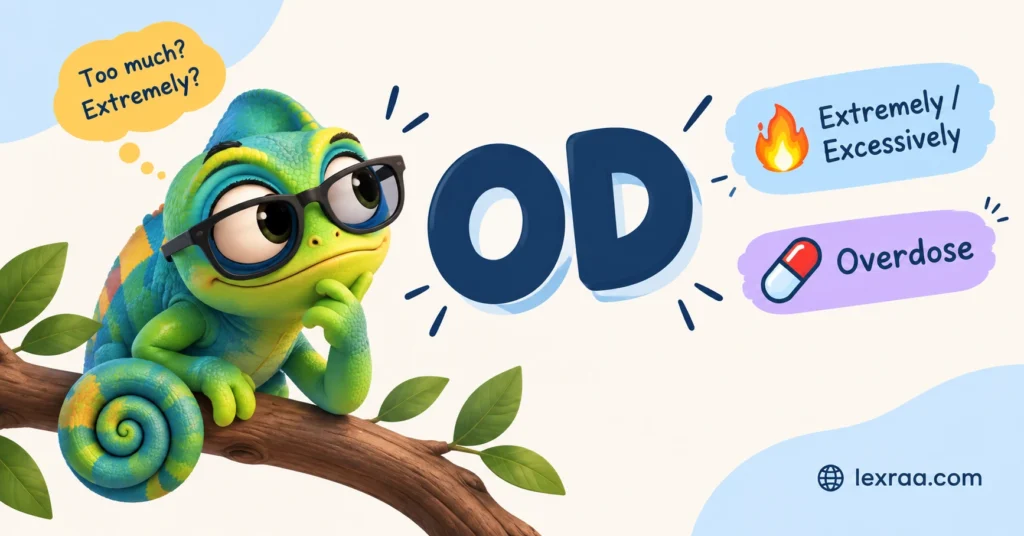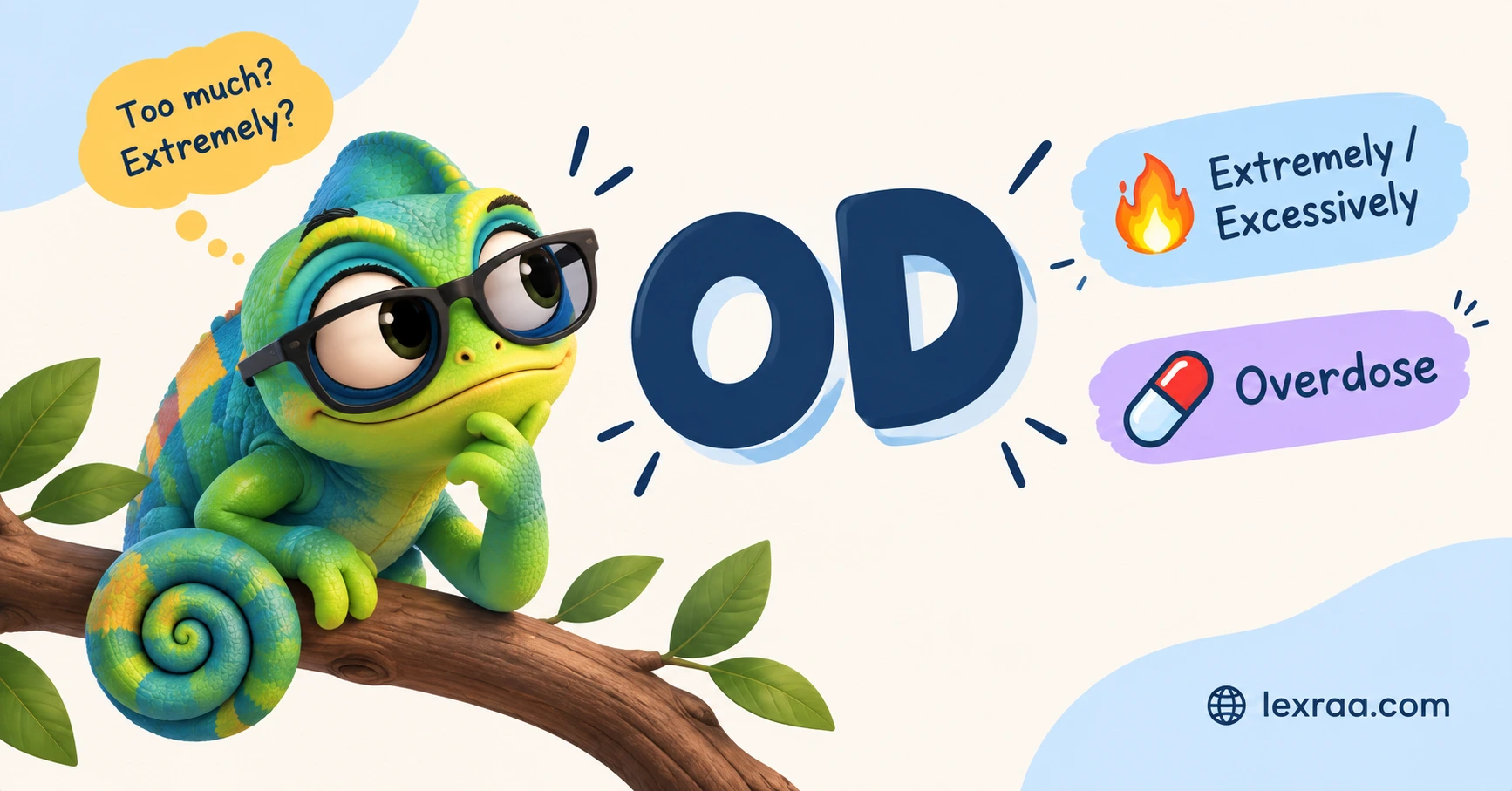
OD in slang usually means “extremely,” “excessively,” or “too much.” Someone might say “that’s OD” when something is over the top, or “OD funny” when something is extremely funny. In a different context, OD means overdose, so the surrounding conversation matters.
What Does OD Mean in Slang?
In casual slang, OD describes something as excessive, extreme, or unusually intense.
It can work like an intensifier before an adjective:
“That movie was OD good.”
Here, OD good means “extremely good” or “really good.”
It can also describe behavior:
“You’re OD right now.”
That could mean “you’re doing too much,” “you’re being excessive,” or “you’re taking this too far.”
OD is therefore not always negative. Saying “OD funny” can be praise, while saying “you’re OD” may be a criticism. Tone and sentence structure determine which interpretation makes sense.
The slang is an abbreviation, written most often as OD and pronounced “oh-dee.” It is not normally treated as a conventional acronym with a separate spoken word.
What Does OD Stand For?
The literal abbreviation OD stands for overdose. Dictionaries document OD as slang for taking an overdose and also as a verb meaning to have or consume too much of something. The American Heritage Dictionary traces the abbreviation to “overdose,” while Collins gives the same basic origin.
That literal meaning helps explain why OD developed a broader association with excess.
In casual slang, however, someone saying:
“That outfit is OD.”
is usually not talking about drugs or a medical emergency. They are saying the outfit is extremely flashy, excessive, or over the top.
OD Meaning in Text Messages
In texting, OD often appears as a quick way to emphasize how extreme something is.
For example:
- “That test was OD hard.” = That test was extremely hard.
- “Bro is OD funny.” = Bro is extremely funny.
- “You’re OD dramatic.” = You are being way too dramatic.
- “That price is OD.” = That price is excessive or ridiculously high.
The grammar can vary. OD may appear before an adjective, stand alone as a reaction, or appear in forms such as OD’ing or OD’d.
That last form is where context becomes especially important. “He’s OD’ing on jokes” can mean he is overdoing the jokes, while “he OD’d” in a conversation about drugs can refer to an actual overdose.
What Does “That’s OD” Mean?
“That’s OD” generally means “that’s too much,” “that’s excessive,” or “that’s extremely intense.”
The exact emotional meaning depends on what happened.
If someone says:
“They gave him 20 birthday cakes.”
and you reply:
“That’s OD.”
you probably mean that is excessive.
But if someone shows you an incredible gaming performance and says:
“I finally beat the boss.”
you might respond:
“That was OD!”
In that context, OD can communicate that the performance was extreme, impressive, or unusually intense.
This is one reason simply translating OD as “too much” can be incomplete. The word can criticize excess or celebrate an extreme level of something.
OD as “Extremely” or “Very”
One of the most distinctive slang uses is placing OD directly before another word.
For example:
“She’s OD talented.”
means she is extremely talented.
“That food was OD spicy.”
means that food was extremely spicy.
“He was OD tired after the trip.”
means he was extremely tired.
In these constructions, OD behaves more like an intensifier than a standalone noun. It strengthens the word that follows it.
This use is documented in modern slang references and is also reflected in the related spelling “odee,” which Wiktionary identifies as New York City slang meaning “very” or “extremely.”
OD vs. Overdoing It: Are They the Same?
They overlap, but they are not identical in every sentence.
When someone says:
“You’re OD.”
the intended meaning may be “you’re doing too much.”
When someone says:
“This is OD expensive.”
OD is acting more like “extremely” or “way too.”
So “OD” can describe excessive behavior and can also intensify a description.
That distinction matters because replacing every occurrence of OD with “overdoing it” can make some sentences sound unnatural.
For example:
“That restaurant is OD expensive.”
does not necessarily mean the restaurant is literally “overdoing it.” It means the price is extremely high.
Where Did OD Slang Come From?
The well-documented abbreviation OD comes from overdose, with dictionary evidence dating the noun slang sense to the 20th century. The Routledge Dictionary of Modern American Slang and Unconventional English records OD meaning a drug overdose in U.S. slang by 1959, with examples from the 1960s.
The later slang meaning associated with extreme, excessive, or over-the-top behavior is strongly associated with New York slang and African American Vernacular English (AAVE) in modern references. Know Your Meme describes OD/Odee as AAVE slang and connects the modern usage with New York slang, while Wiktionary specifically labels “odee” as New York City slang.
The exact path from the literal overdose abbreviation to every modern slang construction is less certain than the basic overdose origin, so it is better not to assign a precise inventor or exact year without stronger evidence.
Is OD Used on TikTok and Social Media?
Yes, current slang references document OD in TikTok and other social-media contexts, where it can describe something as excessive, extremely funny, dramatic, impressive, or otherwise intense. Examples of the usage include phrases such as “OD funny” and “that’s OD.”
It is also found in casual texting and online conversations. However, OD is not a TikTok-only term; the social-media usage reflects slang that existed outside TikTok before appearing widely in internet conversations.
That distinction is useful if you are searching for “OD meaning on TikTok.” The platform may be where you encountered it, but the slang meaning is broader than the platform.
OD, Odee, and Ode: Are They the Same?
OD and “odee” can refer to the same slang idea, particularly when “odee” is being used as the phonetic spelling of OD.
For example:
“That was OD funny.”
and:
“That was odee funny.”
can both communicate “that was extremely funny.”
“Ode,” however, can be confusing because it is also an ordinary English word referring to a type of poem. If the surrounding sentence is something like “an ode to friendship,” it has nothing to do with slang OD.
So context matters not only for meaning but also for spelling.
Is OD Positive or Negative?
It can be either.
Positive OD
“That song is OD good.”
Here, OD strengthens a compliment.
Negative OD
“You’re OD annoying today.”
Here, it emphasizes criticism.
Neutral or descriptive OD
“That bag is OD expensive.”
This does not necessarily praise or insult anyone. It simply says the price is unusually high.
The safest translation is therefore “very,” “extremely,” “excessively,” or “too much,” depending on the sentence.
5 Conversations Showing How OD Changes Meaning
1. Friends — Compliment
Jay: Did you see Maya’s new dance video?
Chris: Yeah, she’s OD talented.
Jay: Seriously. That ending was crazy.
Chris: I had to replay it twice.
2. Group Chat — Calling Someone Out
Nia: I sent him three paragraphs because he left me on read.
Tasha: Girl, you’re OD. 😭
Nia: Three paragraphs is not that bad.
Tasha: You wrote an entire closing argument.
3. Gaming — Positive Reaction
Alex: I finally got the rare drop.
Marcus: OD luck!
Alex: After six hours, I deserved it.
Marcus: Fair. That grind was brutal.
4. Dating — Playful
Lena: He brought flowers, chocolates, and a handwritten letter for the first date.
Mia: OD romantic.
Lena: I know. I wasn’t prepared.
Mia: At least he understood the assignment.
5. Serious Context — Literal Meaning
Sam: The article said he was hospitalized after an overdose.
Daniel: That’s serious.
Sam: Yeah, they said he received emergency treatment.
Daniel: I hope he gets the help he needs.
This final example shows why context should come before assumptions. In a health-related conversation, OD can have its literal overdose meaning rather than the casual “extremely” meaning.
OD vs. Similar Slang
| Term | Meaning | Tone | Popularity | Confusion Risk |
|---|---|---|---|---|
| OD | Extremely, excessively, or too much; also overdose in a different context | Casual | High | High |
| Odee | Very, extremely, excessively | Casual/NYC slang | Medium | Medium |
| Extra | Excessive, dramatic, or unnecessarily elaborate | Casual | High | Low |
| Doing too much | Acting excessively or going beyond what is needed | Casual | High | Low |
| Hella | Very, extremely, or a lot | Casual | High | Medium |
| Understated | Deliberately restrained or not exaggerated | Neutral/formal | Medium | Low |
The biggest confusion comes from OD’s double life. “OD funny” is slang for “extremely funny,” while “an OD” can mean an overdose. Those meanings should never be treated as interchangeable.
Is OD Rude or Appropriate for School and Work?
OD is informal slang, so it is better suited to friends, casual messages, social media, and relaxed conversations.
A message such as:
“That presentation was OD good!”
may be perfectly understandable among friends, but a professional email would usually sound clearer with:
“That presentation was extremely effective.”
The overdose meaning also deserves care. Using OD casually around a serious situation involving drug use can sound insensitive, particularly if someone is discussing an actual medical emergency.
The word itself is not automatically offensive, but its appropriateness depends heavily on context and audience.
How Do You Reply When Someone Says “OD”?
If someone says:
“That movie was OD good.”
a natural response could be:
“For real, it was amazing.”
If someone says:
“You’re OD.”
and they mean you are doing too much, you could reply playfully:
“Okay, okay, I’ll chill.”
If the meaning is unclear, simply ask:
“OD as in too much?”
That is often better than assuming they mean overdose.
A Useful Trick for Understanding OD in a Message
Look at what comes immediately around the abbreviation.
If you see:
OD + adjective
such as “OD funny,” “OD expensive,” or “OD tired,” it is probably functioning as an intensifier meaning very/extremely.
If you see:
OD + on + something
such as “OD on candy,” it can mean having too much of something.
If you see:
an OD or OD’d
inside a serious discussion involving drugs or medication, the overdose meaning becomes much more likely.
This small grammatical clue can solve many of the “what does OD mean in text?” searches without relying on the platform where you saw it.
Real Insight: Why OD Works So Well as Slang
OD is effective because its short form carries a built-in sense of excess. The literal word “overdose” already suggests an amount beyond a safe or normal limit, so the abbreviation can be repurposed as a punchy way to mark something as extreme. Its flexibility also makes it useful in both criticism and praise: “OD dramatic” can call out someone for doing too much, while “OD good” turns the same intensifier into a compliment. That ability to move between negative, positive, and neutral descriptions gives the slang more staying power than a word tied to only one emotion.
FAQs About OD Slang
What does OD mean on TikTok?
On TikTok, OD is commonly used to describe something as extremely intense, excessive, over-the-top, or “too much.” It can be positive or negative depending on what is being described.
What does “OD funny” mean?
“OD funny” means “extremely funny” or “really funny.” In this construction, OD works as an intensifier rather than referring to an overdose.
What does “you’re OD” mean?
It usually means “you’re doing too much,” “you’re being excessive,” or “you’re going overboard.” The tone can be teasing or critical depending on the conversation.
Does OD mean overdose?
Yes. OD is an established slang abbreviation for “overdose.” That meaning is particularly important in medical, drug-related, or serious conversations.
What does Odee mean in slang?
Odee is a phonetic spelling associated with OD and can mean “very” or “extremely.” Wiktionary specifically identifies it as New York City slang.
Is OD the same as “extra”?
They can overlap, but they are not identical. Extra usually describes behavior, appearance, or actions that seem unnecessarily dramatic or excessive, while OD can also work as an intensifier meaning “extremely.”
Is OD a bad word?
Not automatically. OD is informal slang, and its common “extremely/excessively” meaning is not inherently profane. However, because OD also means overdose, using it carelessly around a serious drug-related situation can create an inappropriate or confusing impression.
Conclusion
The OD meaning in slang is usually “extremely,” “excessively,” “too much,” or “over the top.” It can describe behavior, reactions, appearance, prices, feelings, skills, or almost anything else that reaches an unusually high degree.
The key is context. “OD funny” is generally a compliment, “you’re OD” can mean someone is doing too much, and “an OD” in a drug-related conversation means an overdose.
OD is informal, so save it for conversations where casual slang fits. In school, work, or sensitive situations, words such as extremely, excessive, or over-the-top are usually clearer. And when the context involves drugs or health, never assume OD is merely internet slang.