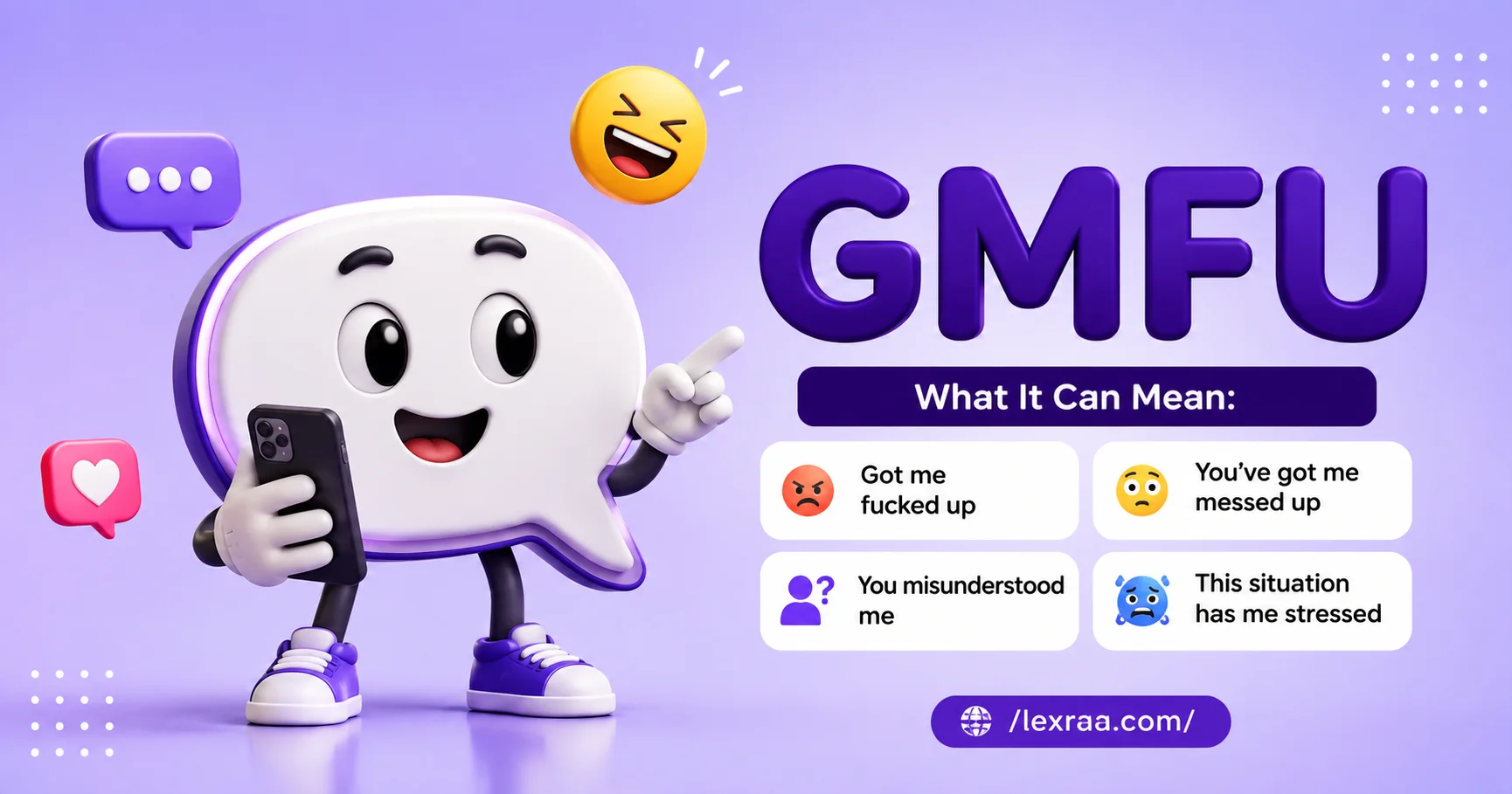
GMFU usually means “got me fucked up” in text and online slang. It expresses strong disbelief, frustration, offense, or the feeling that someone has seriously misunderstood or disrespected you.
What Does GMFU Mean in Text?
GMFU is an internet slang acronym/initialism for “got me fucked up.” Depending on the context, it can communicate several closely related reactions:
- “You’ve got me messed up.”
- “You seriously think I’m going to accept that?”
- “I can’t believe this.”
- “That is completely out of line.”
- “You misunderstood me.”
- “This situation has me stressed or upset.”
The important point is that GMFU is usually a reaction, rather than a literal description of someone’s physical or mental state. Dictionary.com describes it as something used when a person feels “all out of sorts,” while also noting that it can signal aggression, surprise, confusion, hilarity, sadness, or anxiety.
For example, if someone texts:
“You really expect me to pay for your whole vacation? GMFU.”
they are not saying they have literally been “fucked up.” They mean something closer to “You have seriously got me mistaken if you think I’m doing that.”
That distinction matters because GMFU can change slightly depending on what happened immediately before it.
GMFU can describe two main reactions
The first is disbelief or frustration about a situation:
“They charged me $20 for delivery. GMFU 😭”
Here, the sender thinks the situation is ridiculous.
The second is pushback against another person’s assumption or behavior:
“You think I’m apologizing first? GMFU.”
Here, the phrase is more confrontational. The speaker is essentially saying, “You’ve got the wrong idea about me.”
Both uses come from the same underlying expression.
Is GMFU an Acronym or Just Slang?
GMFU is best described as an internet slang acronym or initialism formed from the phrase “got me fucked up.”
It belongs to the same broad family of abbreviated online expressions as STFU, GTFO, and other profanity-based initialisms. Dictionary.com specifically describes GMFU as an internet slang acronym and notes that its abbreviated form likely developed in the mid-to-late 2000s.
You may see it written as:
- GMFU
- gmfu
- you GMFU
- u GMFU
Capitalization does not normally change the meaning.
A Common Misunderstanding About GMFU
One common mistake is assuming GMFU always means “I’m angry.”
That’s too narrow.
Someone can write “GMFU” because they’re angry, but the same abbreviation can also communicate shock, disbelief, amusement, confusion, or feeling misunderstood. Dictionary.com explicitly notes this range of emotional uses.
Compare these:
“My landlord raised the rent again. GMFU.”
This sounds genuinely irritated.
“Bro wore a winter coat to the beach. GMFU 😭”
This is much more likely to be humorous disbelief.
So if you’re trying to interpret a message, don’t read the four letters in isolation. Look at what happened immediately before them and the emojis or punctuation around them.
Read More: YW Meaning in Text: The Tiny Reply With a Big Clue
Where Is GMFU Used?
The strongest evidence supports GMFU as general internet and texting slang, rather than slang belonging exclusively to one app.
Text messages and private chats
GMFU works naturally in SMS, iMessage, WhatsApp, and other informal messaging because it compresses a longer emotional reaction into four characters.
A person might send only:
“GMFU.”
Or attach it to a sentence:
“You really forgot my birthday? GMFU.”
The private setting can make the phrase especially direct because there is usually an established relationship between the people chatting.
TikTok
GMFU also appears in TikTok culture, particularly around reaction posts, jokes, relationship situations, and exaggerated stories. Search evidence shows the abbreviation appearing in TikTok-related content and hashtags.
However, it is safer to say that GMFU is used on TikTok, not that TikTok invented or uniquely popularized it. The abbreviation predates TikTok by many years.
GMFU is also used in informal Instagram captions, comments, and DMs. Contemporary slang references consistently describe it in social-media contexts, while the older documented history shows that its internet use existed before Instagram became central to online slang.
X/Twitter
There is particularly strong historical evidence for GMFU on Twitter/X. Know Your Meme records an early viral use of the acronym on Twitter in 2017, while Dictionary.com includes examples of the abbreviation in tweets from the 2010s.
Snapchat
GMFU is also reported in Snapchat-oriented slang explanations and casual social-media communication. However, there isn’t good evidence that Snapchat has a unique meaning for the term. If you see GMFU there, the ordinary “got me fucked up” interpretation is the one to consider first.
GMFU can occur in informal WhatsApp conversations, but the evidence does not suggest that WhatsApp created or substantially changed the slang. Treat it as general internet/texting slang rather than a WhatsApp-specific expression.
Read More: FTF Mean in Slang Text? Snapchat & TikTok Meaning
Where Did GMFU Come From?
The exact origin of the phrase is unclear, so it would be misleading to claim that one particular person or website invented it.
What can be documented is its history.
Dictionary.com traces “got me fucked up” to urban slang and notes that the phrase was used extensively in rap. It says the abbreviated form GMFU appeared on Urban Dictionary by 2009 and likely emerged in the mid-to-late 2000s.
Know Your Meme provides additional historical documentation, noting that the full phrase had already appeared in rap culture in the 1990s and that “Got Me Fucked Up” was added to Urban Dictionary in 2003, followed by the abbreviation GMFU in 2009.
That means the phrase is older than the abbreviation.
It’s also important not to flatten this history into the claim that “TikTok created GMFU.” TikTok-era usage helped expose many older expressions to wider audiences, but GMFU was documented online long before TikTok existed.
There is evidence connecting the phrase to Black American/urban slang and hip-hop culture, but the available sources do not establish a single moment when it originated in AAVE. It’s more accurate to describe the phrase as having roots in U.S. urban slang and rap culture than to assign it a precise invention date.
The abbreviation subsequently became part of broader internet slang. Songs titled “GMFU” by artists including Keke Palmer, Adrian Marcel, and DC the Don also helped keep the phrase visible in popular culture.
8 Realistic GMFU Conversation Examples
The following examples show how the meaning changes with context.
1. Funny — friends
Alex: Bro, did you really order 14 tacos?
Jay: They were on sale.
Alex: There are two of us.
Jay: GMFU, I’m planning for tomorrow too 😂
Here, GMFU is playful rather than genuinely hostile.
2. Sarcastic — group chat
Mia: Your presentation starts in ten minutes.
Noah: WHAT?
Mia: You said you’d already checked the schedule.
Noah: GMFU 😭 I thought it was tomorrow.
The phrase communicates exaggerated disbelief at the situation.
3. Serious — disagreement
Chris: You told everyone I quit.
Jordan: I thought that’s what you meant.
Chris: I never said that.
Jordan: Okay, I misunderstood.
Chris: Yeah, you GMFU if you think I’d do that without telling you.
Here, GMFU is much more confrontational and means something close to “you’ve seriously got me wrong.”
4. Dating
Sam: So you’re saying you didn’t miss me?
Taylor: I didn’t say that.
Sam: Then why were you ignoring my messages?
Taylor: I was busy.
Sam: GMFU 😂 you definitely missed me.
The context makes it teasing rather than aggressive.
5. Family
Mom: Your brother said you broke the TV.
Eli: I wasn’t even home.
Mom: So who was here?
Eli: Him.
Mom: Oh.
Eli: GMFU if you believed him that fast 😭
Here, it means “you’ve got the wrong person.”
6. Coworkers
Nina: They moved the deadline to Friday.
Omar: Again?
Nina: Yep.
Omar: GMFU. I already booked my weekend around this.
This usage communicates frustration. It would still be informal workplace language, though—not something you’d normally put in a formal email.
7. Snapchat-style reaction
Ava: He posted that he was “single” last night.
Leah: Didn’t you two just get back together?
Ava: Literally three days ago.
Leah: GMFU 😭
Here, GMFU is a reaction to relationship drama.
8. X/Twitter-style reaction
User 1: The restaurant just canceled my reservation after I arrived.
User 2: After you got there??
User 1: They said the system “made a mistake.”
User 2: Nah, GMFU.
The speaker is expressing disbelief and annoyance at someone else’s behavior.
9. Playful
Dylan: I ate your fries.
Marcus: All of them?
Dylan: There were like four left.
Marcus: GMFU 😂 those were the best four.
The phrase is exaggerated for comic effect.
10. A genuine boundary
Riley: You said you’d keep that private.
Casey: I only told one person.
Riley: That was still not yours to share.
Casey: You’re right.
Riley: You GMFU if you think I’m okay with that.
This is one of the strongest uses because the phrase expresses real offense rather than casual joking.
How to Reply to GMFU
Your response should match the emotional temperature.
Funny reply:
“LMAO what did I do this time? 😭”
Serious reply:
“If you’re upset, tell me what I got wrong and we’ll talk about it.”
Flirty reply:
“Maybe I got you a little fucked up over me 😉”
This only fits when the conversation is already clearly flirtatious. Otherwise, it can sound forced.
Neutral reply:
“Wait, what happened?”
That is often the safest response because GMFU doesn’t tell you exactly why the person is upset.
GMFU vs. Similar Slang
| Term | Meaning | Tone | Popularity | Confusion Risk |
|---|---|---|---|---|
| GMFU | Got me fucked up; strong disbelief, frustration, or feeling misunderstood | Strong / blunt | Common online slang | — |
| SMH | Shaking my head; disappointment or disbelief | Mild–moderate | Very common | Medium |
| WTF | What the fuck; shock, confusion, or disbelief | Strong / profane | Very common | Medium |
| STFU | Shut the fuck up | Aggressive / commanding | Very common | Low |
| GTFO | Get the fuck out / strong disbelief depending on context | Strong / confrontational | Common | Medium |
| FR | For real; emphasis or agreement | Neutral–casual | Very common | Low |
| LMFAO | Laughing extremely hard | Humorous | Common | Low |
One particularly useful distinction is between GMFU and SMH. If someone writes “SMH,” they may simply be expressing disappointment or an eye roll. GMFU usually carries more emotional force, especially when directed at another person.
Who Uses GMFU?
GMFU is associated with informal U.S. internet and texting culture, and its documented history reaches back well before today’s youngest social-media users. Dictionary.com describes its internet use as dating to the 2000s, while its underlying phrase has older roots in urban slang and rap culture.
It is therefore misleading to label GMFU exclusively as a Gen Z word. Younger users may encounter it frequently through social media, but the abbreviation itself has been documented online since at least 2009.
There also isn’t reliable evidence that GMFU has a special British, Canadian, Australian, or Pakistani meaning. Its documented slang sense is primarily tied to U.S. internet culture, although people elsewhere can encounter and use it online.
Is GMFU Rude or Safe?
GMFU contains profanity, so it is not considered formal or professional language.
It’s generally appropriate only when you’re comfortable using explicit slang with the person you’re talking to. Friends may use it casually, and people sometimes use it jokingly, but the same four letters can sound genuinely hostile during an argument.
For school assignments, formal emails, job applications, customer-service messages, interviews, and professional communication, avoid it.
A softer alternative could be:
- “You’ve got me confused.”
- “Are you serious?”
- “You’ve got the wrong idea.”
- “I can’t believe this.”
- “That’s not okay.”
There is also a cultural consideration: the phrase has roots in U.S. urban slang and hip-hop culture, so treating it as a random collection of internet letters overlooks its linguistic history.
Why Does GMFU Work So Well as Slang?
GMFU works because it compresses a complicated emotional reaction into four letters. The sender doesn’t have to explain whether they’re annoyed, shocked, offended, or laughing at an absurd situation; the surrounding conversation supplies that information.
The phrase also carries more emotional weight than a neutral abbreviation such as FR or SMH. That intensity makes it useful when someone wants their reaction to sound immediate and emphatic. At the same time, friends can deliberately exaggerate it for humor, which gives GMFU flexibility across serious arguments, memes, group chats, and everyday reactions.
Frequently Asked Questions
What does GMFU mean in text?
GMFU most commonly means “got me fucked up.” It is used to express strong disbelief, frustration, offense, or the feeling that someone has misunderstood you. The exact emotion depends on the surrounding conversation.
Does GMFU mean “got me fucked up” or “got me messed up”?
The documented standard slang expansion is “got me fucked up.” “Got me messed up” is sometimes used as a cleaner paraphrase because it preserves the idea without repeating the profanity. It is better understood as a softened interpretation rather than a separate established expansion.
Is GMFU a bad word?
The abbreviation itself isn’t a swear word when spoken as individual letters, but it represents a phrase containing profanity. Because of that, GMFU should be treated as explicit informal slang, not professional language.
Can GMFU be used as a joke?
Yes. GMFU can be humorous when friends use it to exaggerate disbelief over something relatively minor. Emojis such as 😂 or 😭 can help signal that the reaction is playful, although context remains more important than the emoji.
Does GMFU mean “you misunderstood me”?
Sometimes. One documented use is to tell someone that they have misread, misunderstood, or made an incorrect assumption about you. In that context, “you GMFU” is closer to “you’ve got me completely wrong.”
Is GMFU the same as SMH?
No. SMH generally expresses disappointment, disbelief, or disapproval in a milder way. GMFU is more forceful and contains implied profanity, so it can sound more confrontational.
Is GMFU appropriate for school or work?
Usually not. Because the underlying phrase contains profanity, it is better reserved for casual conversations and informal social media. A formal setting calls for clearer, non-profane wording.
Is GMFU a Gen Z abbreviation?
Not exclusively. Although younger social-media users may use or encounter GMFU, the abbreviation has documented internet use going back to at least 2009, while the underlying phrase is older.
Final Takeaway
If you see GMFU in a text, the safest first interpretation is “got me fucked up.” It usually signals that something is shocking, frustrating, ridiculous, offensive, or based on a completely wrong assumption.
The biggest mistake is treating every GMFU as an angry message. A friend might write it over a serious disagreement, while another might use it jokingly because someone ate their fries. Context determines the emotional strength.
Use GMFU only in informal settings where profanity is acceptable. If you’re unsure whether the sender is joking or genuinely upset, ask what happened rather than automatically responding with another slang reaction.